
A founder usually reaches the same point at the same time. The activity is clear, the partners are aligned, the logo draft is sitting in someone's inbox, and the website domain is already being discussed. Then the first official obstacle appears. The name that sounded perfect in a meeting suddenly has to survive an authority review.
That's where trade name registration stops being a branding exercise and becomes a legal one.
In the UAE, a trade name isn't just what appears on your signboard or Instagram page. It affects your licence application, your banking file, your contracts, and how smoothly the rest of your company setup moves. I've seen entrepreneurs lose time over names that were too generic, too close to an existing business, mismatched with the approved activity, or filled with modern terms they assumed would help but triggered scrutiny.
From Business Idea to Official Brand Name
A common scenario looks like this. A new entrepreneur decides to launch a consultancy, e-commerce venture, restaurant concept, or tech service in Dubai. The commercial idea is sound. The market is there. The budget is planned. But the first application stalls because the chosen name doesn't fit the authority's rules.
The problem is rarely effort. It's usually assumption.
Many founders assume that if a domain is available, the company name will be available too. Others assume that a creative English name will pass because it sounds modern and professional. Some choose a name before deciding whether they should be on the mainland, in a free zone, or offshore, then discover that the jurisdiction choice changes the naming path and the business consequences that follow.
Practical rule: Treat the trade name as part of company formation strategy, not as a last-minute branding task.
A trade name is your operating identity. It has to be unique enough, compliant enough, and commercially usable enough to support the next steps. If it fails at the start, the delay isn't limited to the name itself. It can affect licence issuance, document preparation, office leasing, and the rest of the formation file.
Two founders can have the same business activity and still need different naming strategies. One may need a mainland structure because they want direct access to the UAE market. Another may be better suited to a free zone because ownership flexibility matters more than local market access. A third may be setting up offshore for international holding or cross-border transactions, where the naming concern is tied to a very different operating model.
That's why the right question isn't “What should I call the business?” It's “What name will get approved in the right jurisdiction and still work commercially after approval?”
Decoding UAE Trade Name Rules and Eligibility
A founder picks a sharp English name, prints it on a draft pitch deck, and assumes the hard part is done. Then the authority flags the wording, the Arabic rendering creates a different meaning, or the name suggests an activity the licence does not cover. That is where time gets lost.
Trade name review in the UAE is a compliance check first and a branding exercise second. The authority wants a name that can sit cleanly on legal documents, match the licensed activity, and avoid restricted wording. If the name looks clever but creates doubt, approval slows down.
What a compliant name needs to do
A workable trade name usually meets four tests.
- It is distinguishable. It should not be too close to an existing registered name or a protected trademark.
- It matches the activity. A consultancy should not sound like a contracting company, and a trading business should not read like a regulated financial service.
- It avoids restricted expressions. Religious references, government-related wording, offensive terms, and misleading claims are common rejection points.
- It fits the legal form. The entity type and naming format have to align.
One mistake I see often is founders trying to add authority, scale, or technical sophistication through the name itself. Words like "international," "global," "royal," "bank," "fund," "exchange," or highly specialised medical and engineering terms attract closer review. In the past, some of these slipped through if the rest of the file looked tidy. That has become harder. Authorities have taken a stricter view on foreign and technical terms that are not clearly justified by the activity, supporting documents, or accepted usage.
That shift matters because a name can be rejected even when it sounds professional to the founder.
Where names usually run into trouble
The weak point is rarely uniqueness alone. It is usually a mismatch between the name, the activity, and how the wording reads in Arabic and English together.
These patterns cause problems most often:
- Generic names with minor variations. Changing one word or adding "group" or "services" does not make a weak name distinctive.
- Activity inflation. A business licensed for basic consulting uses a name that implies regulated advisory, engineering, healthcare, or investment activity.
- Unverified foreign wording. French, German, or invented technical expressions may be questioned if they look unclear, exaggerated, or difficult to transliterate.
- Official-sounding language. Names that suggest state affiliation, public authority status, or institutional endorsement are high risk.
- Bad Arabic rendering. A clean English name can become confusing, misleading, or too similar to another record once transliterated.
This is one of the practical differences founders miss. The approval test is not just "Is the English name available?" It is also "Can this name be accepted in the authority's naming system without creating legal or linguistic issues?"
A better way to screen your options
Before submission, check the National Economic Register for obvious conflicts and existing licensed names. The register helps filter out names that are already in use, but it does not tell you whether the wording is commercially sensible or whether an officer may question part of it during review.
Use a short screening process before you file:
- Prepare at least three distinctly different options. Small edits to the same base name waste time.
- Test each name against the licensed activity. Read it as if you were the reviewing officer, not the founder.
- Strip out sensitive or inflated wording. If a word sounds regulated, official, or hard to justify, remove it.
- Check the Arabic version early. Do not leave transliteration to the end.
- Confirm the legal form fits the name format. The structure and the wording should line up cleanly on the application.
The best trade name is not the one that sounds the most impressive. It is the one that gets approved without argument, fits the licence you need, and still works once the business starts trading.
Choosing Your Jurisdiction Mainland vs Free Zone vs Offshore
A founder reserves a name, pays the fee, starts logo work, then discovers the chosen jurisdiction will not let the business operate the way the plan requires. That mistake is common in the UAE. Trade name approval is not just a branding step. It sits inside the licensing rules of the jurisdiction you choose.

Mainland when local market access matters
Mainland usually fits businesses that need to sell, contract, hire, and operate across the UAE without being tied to one zone's commercial perimeter.
From a trade name perspective, mainland review is usually less forgiving because the name is assessed in the context of the wider local market. Officers are not only checking availability. They are also looking at whether the wording fits the activity, legal form, and public-facing nature of the business. If the name sounds too broad, too technical, or too close to a regulated service, questions tend to come earlier.
This is also where founders get caught by wording that looked harmless on paper. Foreign expressions, industry jargon, and imported buzzwords can attract scrutiny, especially if the term cannot be clearly justified against the licensed activity or translated cleanly into Arabic. Recent reviews have become less tolerant of unverified technical language. A name that sounds modern to the founder can look vague or unsupported to the reviewing officer.
Mainland is often the right commercial choice. It is not always the easiest naming environment.
Free zone when setup speed and business model fit matter
Free zones work well for many consultancies, digital businesses, trading firms, and specialist activities that do not need unrestricted onshore trading from day one.
The practical difference is that each free zone applies its own internal naming standards. Some authorities are pragmatic if the activity and documents are clear. Others apply strict formatting rules and reject names for small issues such as wording sequence, prohibited descriptors, or mismatch with the selected licence package. Founders often assume free zone means easier approval. In practice, it means the rules are more localised.
That can help or hurt.
A sector-focused free zone may understand a specialised business model faster than a mainland reviewer would. The same free zone may also reject a name that uses trendy technical terms without a clear business case. I have seen applicants lose time because they picked a zone for price, then discovered the authority was stricter on naming style than expected.
Free zone trade-offs are usually practical:
- Stronger fit for: international service businesses, founders who want a structured setup process, and activities aligned with the zone's sector focus
- Potential limitation: serving the wider UAE market can require extra structuring, depending on the activity
- Naming implication: a good name must satisfy that specific free zone's standards, not just general UAE naming logic
Offshore when the company is a structure, not an operating business in the UAE
Offshore companies are generally used for holding assets, international transactions, and cross-border structures that do not trade directly in the UAE market.
That changes how the trade name should be chosen. If the company will not market locally, meet retail customers, or build a UAE-facing brand, the name can be more functional. Legal clarity matters more than storefront appeal. The mistake is choosing offshore because it sounds cheaper or lighter, then trying to use it like a mainland or free zone operating company.
If the business will invoice UAE clients as an active local operator, offshore is usually the wrong starting point, even if the name approval looks simpler.
Side-by-side decision view
| Attribute | Mainland (DED) | Free Zone | Offshore |
|---|---|---|---|
| Core use case | Trading and operating within the UAE market | Zone-based setup with sector or ownership advantages | International holding or cross-border activity |
| Trade name authority | DED or equivalent emirate authority | Relevant free zone authority | Offshore registrar or authority |
| Local market access | Broadest practical access | Depends on structure and activity | Not for local UAE trading |
| Best for | Businesses needing local commercial presence | Founders prioritising ownership and streamlined setup | Asset holding and international structures |
| Naming mindset | Legal compliance plus market practicality | Authority-specific compliance within the zone | Structural suitability over local branding |
Choose jurisdiction based on how the company will trade, not which setup package looks cheapest in the first quotation.
A good rule is simple. If the business needs broad UAE market access, start with mainland. If the model fits a specific zone and the client base is regional or international, test free zone options carefully. If the company is purely a holding or cross-border vehicle, offshore may fit. The trade name should follow that commercial reality, because the same name can be acceptable in one jurisdiction and problematic in another.
The Application and Approval Process Step by Step
A founder picks a name on Monday, pays to reserve it on Tuesday, and by Thursday learns the licence activity, Arabic rendering, or jurisdiction review does not support it. That is how a simple filing turns into rework.
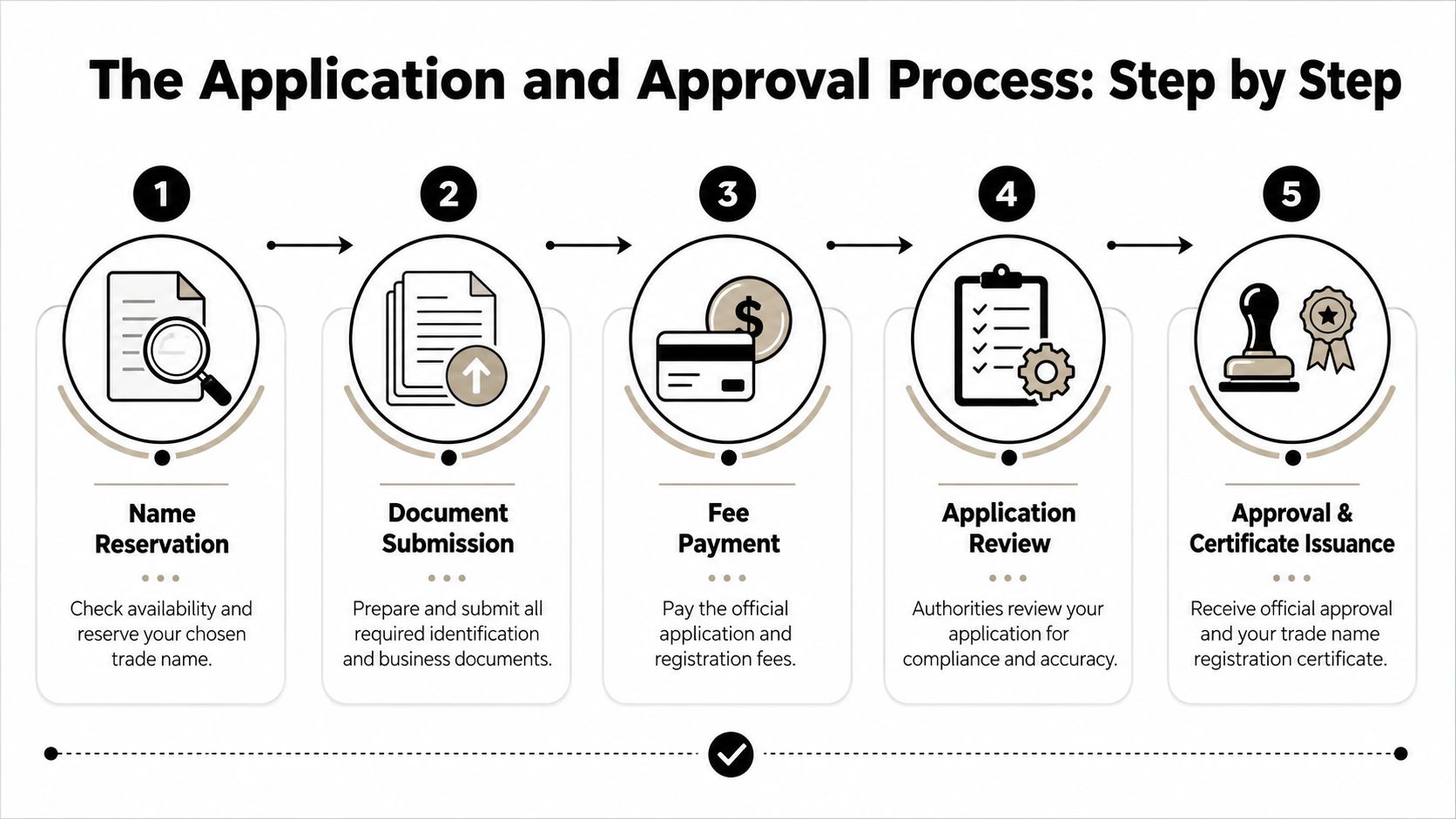
Step one, align the name with the actual setup
Start with three fixed points: jurisdiction, business activity, and legal form. Only then should the final name go in for reservation.
This matters more in the UAE than founders expect. A mainland application is reviewed through the emirate authority, usually with closer attention to activity fit and public-facing wording. Free zones often have their own naming rules and portal process, which can feel simpler, but the same name may still be questioned if it suggests a regulated service or uses foreign wording carelessly. Offshore registrars are different again. The process may look lighter, but that does not make the name suitable for a business that plans to trade inside the UAE.
The practical mistake is filing the name too early because the portal allows it.
Step two, prepare the file before you submit
Name approval delays usually come from inconsistencies, not from missing effort. The founder has the documents, but the details do not line up across the application.
Check these points before payment:
- Passport names match exactly
- Shareholder and partner spellings are consistent
- The selected activity supports the proposed name
- The legal structure matches the filing
- English and Arabic versions do not create a different meaning
- Any technical or foreign terms can be explained if queried
That last point is getting more attention now. Terms that sound modern or specialised in English can attract extra review, especially if the wording is vague, highly technical, or not easy to verify in Arabic.
Step three, file with cost and scrutiny in mind
Trade name fees are not always flat. In many cases, certain wording can trigger a higher charge or a closer review. Foreign words, abbreviations, numbers, geographic references, and industry-specific expressions are common examples.
Founders often treat this as a branding decision. The authority treats it as a compliance question.
Simple names tend to move faster. They are also easier to reuse consistently across the licence, immigration file, bank forms, tenancy documents, and contracts. A clever name that creates confusion at approval stage usually creates more confusion later.
Clear and defensible beats clever and borderline.
Step four, expect a real review
Authorities do not just process data. They review whether the proposed name fits the activity, avoids restricted or misleading wording, respects public standards, and is distinct enough from existing registrations.
This is also where jurisdiction differences show up in practice. A free zone reviewer may accept wording that a mainland authority questions, or ask for a revised activity description before approval. Mainland filings can face stricter practical scrutiny if the name sounds too broad, too official, or disconnected from the commercial purpose. Offshore applications may appear easier at this stage, but that does not solve the bigger issue if the business later needs local presence, a physical operation, or a bank that wants the structure and name to make obvious commercial sense.
Recent reviews have also become less forgiving with unverified foreign and technical expressions. If the name sounds imported, scientific, digital-first, or artificially complex, expect questions.
Step five, use the approval immediately and correctly
Approval is only useful if the same approved name carries through the rest of the setup without changes. I regularly see founders reserve a name, then adjust spacing, abbreviations, or wording in later documents because the revised version looks better on a logo. That creates avoidable corrections.
Once approved, follow this sequence:
- Use the approved spelling exactly as issued
- Apply the same version across licence and incorporation documents
- Match the Arabic and English versions consistently
- Carry the name into banking and immigration paperwork without edits
- Check proposed branding materials against the approved legal name
A consultant can manage that coordination. Smart Classic Business Hub handles trade name support within broader company formation and compliance work. The useful part is not just submitting the application. It is keeping the name, activity, and setup documents aligned so the file does not break later.
Common Rejections and How to Fix Them
Most rejections are preventable. The issue is that founders often prepare for the obvious problems and miss the newer ones.
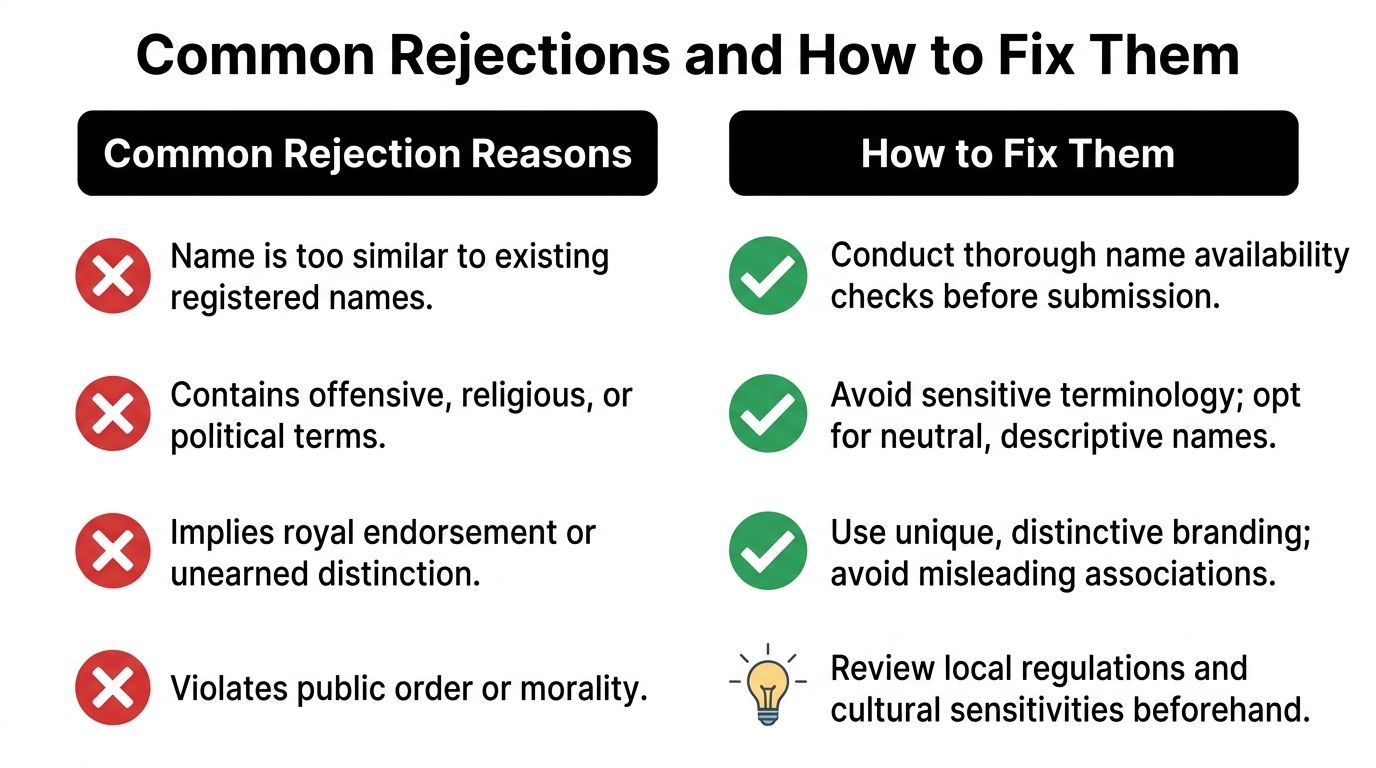
Similarity and mismatch are still the classic problems
The most common frustration is a name that feels unique to the founder but looks too close to an existing registration when reviewed formally. That can happen even if the wording isn't identical.
Another frequent problem is activity mismatch. A name can be attractive and still fail because it suggests services, products, or status outside the approved business activity. The founder sees a broad brand. The authority sees inconsistency.
A practical fix is to test the name against these questions before filing:
- Would this name still make sense if I removed the logo and branding?
- Does it clearly fit the selected activity?
- Is it distinctive enough without sounding official or exaggerated?
- Could an Arabic review create ambiguity that I'm ignoring in English?
The newer issue with technical and foreign wording
One naming trend is catching founders off guard. Technical English terms that once seemed commercially useful are now drawing more scrutiny.
A 2025 DET internal audit cited by RAKEZ reported a 34% year-on-year rise in rejections for trade names using unverified English terms such as AI, Crypto, and Blockchain where applicants did not provide Arabic transliteration clarity or proof of activity alignment. The same material notes that founders may now need to prepare evidence letters before applying.
That matters because many branding exercises begin with those exact terms.
How to reduce rejection risk before submission
The fix isn't to avoid every modern word automatically. It's to use them carefully and only where they can be justified.
| Problem | What usually helps |
|---|---|
| Name too close to an existing business | Replace the root wording, not just one small part |
| Activity mismatch | Rewrite the name so it reflects the licensed commercial purpose |
| Foreign or technical term triggers scrutiny | Prepare Arabic transliteration and supporting explanation in advance |
| Sensitive wording | Remove it entirely rather than trying to defend it |
If your chosen name includes a technical term, assume you may need to justify it.
Another point founders miss is timing. If a name is approved but the rest of the setup stalls, changing the plan later can be harder than choosing more carefully at the start. Renaming after approval is possible in principle, but it creates extra coordination across licensing, banking, contracts, and branding. It's better to solve naming risk before the first submission.
Secure Your Brand with Smart Classic Business Hub
A trade name looks simple from the outside. In practice, it sits at the intersection of legal compliance, cultural screening, licensing logic, and commercial positioning. That's why entrepreneurs who try to handle it quickly often end up spending more time fixing the result than they would have spent planning it properly.

The practical challenge isn't just choosing a name that sounds good. It's choosing one that fits the jurisdiction, matches the activity, avoids restricted wording, survives review, and still makes sense for the business once the licence is issued. Mainland, free zone, and offshore structures each bring different operational consequences. Recent scrutiny around technical and foreign terms adds another layer that many first-time founders won't spot until an application is already delayed.
That's where a setup partner earns their place. A firm that handles UAE formation work every day can pressure-test the name before submission, identify risk in the wording, align the name with the activity and legal form, and keep the registration process connected to the rest of the formation file instead of treating it as an isolated task.
For founders, the benefit is simple. Fewer avoidable rejections, fewer naming mistakes that spill into banking or licensing, and a clearer start.
If you want practical help with trade name registration, company formation, PRO services, accounting, or wider UAE compliance, contact Smart Classic Business Hub. Their team supports mainland, free zone, and offshore setups so you can move from name approval to a fully operational business with fewer delays.