
A free zone company in the UAE is a business entity set up inside a designated economic zone, typically allowing 100% foreign ownership and, in many cases, a licence issued within 14 working days after review and approval. That's why so many foreign founders start there first. It gives them control, speed, and a practical base for regional trade, but it also comes with rules about how and where the company can operate.
If you're looking at the UAE from abroad, you're probably facing the same first question most founders do. Should you open on the mainland, choose a free zone, or use an offshore structure? That choice isn't paperwork. It shapes who can own the company, how you invoice clients, whether you can trade directly inside the UAE market, and how much friction you'll face during setup and compliance.
A lot of entrepreneurs ask what is a free zone company as if it's a simple definition. In practice, it's a decision about business model fit. The right structure for a consultant serving overseas clients isn't the right structure for a retailer targeting walk-in customers in Dubai. Likewise, a holding structure for assets or international invoicing is a different conversation again.
The UAE built free zones for exactly this reason. They were designed to make international business easier, especially for founders who want operational control without giving up equity. Used properly, a free zone company can be an efficient launch platform. Used badly, it can box you into the wrong market access model and force a restructure later.
Your Gateway to Business in the UAE
A foreign founder often starts with a simple plan. Open a UAE company, get bank access, invoice clients, and begin trading. The complication appears one step later, when the legal structure starts dictating what the business can and cannot do.
The UAE gives entrepreneurs more than one route to market. That is a strength, but it also means the wrong setup can create avoidable restrictions on ownership, tax treatment, and local trading. A free zone company suits many international businesses, but not all of them. The right choice depends on how the business will earn revenue, where customers sit, and whether direct access to the UAE mainland matters from the start.
Free zones became integral to UAE company formation because they solved a practical problem for foreign investors. They offered a clearer entry point for businesses that wanted full ownership and a more straightforward licensing path, especially where the operating model was regional or cross-border rather than retail inside the local UAE market.
Why this choice matters early
Founders usually focus first on setup speed and first-year cost. Both matter. Neither should decide the structure on its own.
A better starting point is the revenue model.
Ask yourself:
- Who will pay your invoices: overseas clients, UAE private companies, government entities, or consumers inside the UAE?
- Where will you trade: outside the UAE, into the UAE mainland, or through a logistics and re-export model?
- What matters most at launch: full foreign ownership, local market access, residency eligibility, warehousing, or a holding structure for assets and IP?
These answers shape the legal fit.
Practical rule: Choose the company structure around your revenue path, not the cheapest first-year package.
I have seen founders save money on the initial setup, then spend far more fixing the structure later. A consultancy firm serving clients abroad may work well in a free zone from day one. A business that expects to sell directly across the UAE often needs a different route, or at least a setup designed with that expansion in mind.
Why free zones are often the starting point
Free zones are established parts of the UAE business system, not a side option for a narrow group of companies. They are widely used by service firms, trading businesses, logistics operators, and regional subsidiaries because they can offer control and efficiency at the entry stage.
That does not make them the default answer in every case. It makes them a strong starting point for founders whose business is internationally oriented, who want to retain ownership, and who do not need unrestricted mainland trading on day one.
That is the decision framework. The question is not whether a free zone sounds attractive. The question is whether it matches the way the business will operate.
Defining a UAE Free Zone Company
A free zone company isn't just a company with an address inside a special area. It's a legal entity that operates under the rules of a specific zone authority.
The easiest way to understand it is to think of a free zone as a business district with its own operating framework. You still form a real company. You still need a licence. But the licensing, approvals, and permitted activities are administered by the free zone authority rather than the general mainland system.
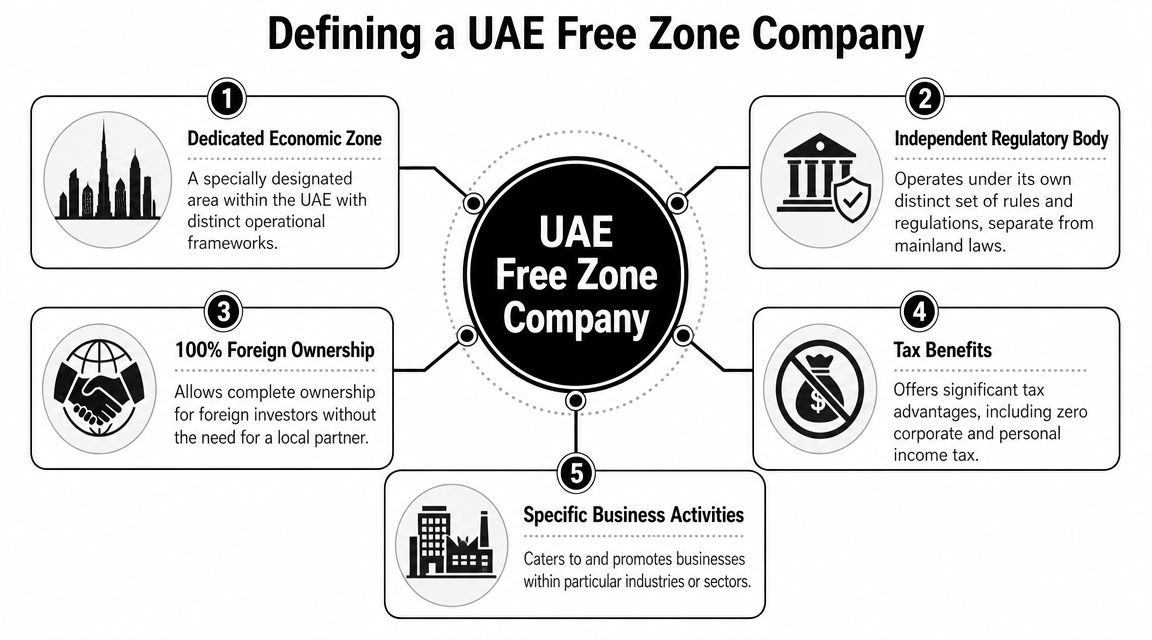
The three parts founders need to separate
Most confusion comes from mixing up the zone, the authority, and the company itself.
- The free zone: This is the designated economic area.
- The free zone authority: This is the regulator and licensing body for that zone.
- The free zone company: This is your legal entity, formed under that authority's rules.
That distinction matters because your permitted activities, licence type, office rules, and internal procedures depend on the authority you choose.
The UAE Ministry of Economy states on its free zones overview that the country has more than 40 multidisciplinary free zones and that these zones are designed to provide foreign investors and expatriates full ownership together with efficient infrastructure and services.
What that means in real life
When a founder asks what is a free zone company, the practical answer is this: it's a separately regulated vehicle built for businesses that want foreign ownership and an easier entry process, especially when the business is focused on international activity.
This structure often works best when the company does one or more of the following:
- Sells across borders: Export, import, regional distribution, or international services.
- Needs sector alignment: Media, logistics, technology, consulting, light industrial activity, or specialised trade.
- Values setup efficiency: The authority handles licensing and operational approvals inside the zone.
A free zone company isn't just where you sit. It's the legal rulebook your company will live under.
That last point is where many founders get it wrong. They pick a zone because the package looks simple, then discover later that the licence activity, client access, or banking profile doesn't match how the business operates in practice. A free zone company works well when the chosen authority fits your business model. It works badly when the founder treats all zones as interchangeable.
Key Benefits and Strategic Restrictions
The strongest reason entrepreneurs choose a free zone company is simple. They want to keep ownership.
In many cases, free zones offer full foreign ownership, which removes the need for a local equity partner and gives founders cleaner control over shares, profits, and decision-making. For solo founders, small partnerships, and overseas parent companies, that's often the deciding factor.
But practical advice matters. Ownership is only one side of the setup decision. Market access is the other.
What works well in a free zone
A free zone company tends to work well for businesses that serve clients outside the UAE, trade internationally, or operate in a specialised ecosystem where proximity to logistics or industry support matters.
It is often a good fit for:
- Export-focused traders: Goods move through the UAE as part of a wider regional or global chain.
- Service businesses with foreign clients: Consulting, digital services, back-office support, and similar models.
- Founders who want administrative efficiency: The setup process is usually more direct than more layered structures.
Where founders get caught out
The biggest mistake is assuming a free zone company automatically gives unrestricted access to the UAE mainland market. It doesn't.
If your plan is to sell directly to mainland customers, open a customer-facing shop, or build a business around day-to-day UAE domestic trade, you need to assess that carefully before incorporating. For many founders, this is a key trade-off. The free zone gives control and convenience, but mainland access may require additional structuring, distribution arrangements, or a different setup route.
The wrong setup usually doesn't fail on day one. It fails when the company starts winning the kind of business its licence wasn't designed for.
Free zone doesn't mean tax-free in every sense
Another common misunderstanding is tax. Some founders hear "free zone" and assume there are no tax obligations at all. That's not how compliance works.
According to the Rise Accounting explanation of UAE free zone VAT obligations, a free zone company with taxable supplies exceeding AED 375,000 annually must register for VAT and file returns, even if it is incorporated in a free zone. The same guidance notes that the company must obtain a Tax Registration Number through the Federal Tax Authority portal.
That means your bookkeeping still matters. Your invoices still matter. Your transaction classification still matters.
Here are the operational consequences many founders underestimate:
- VAT registration can become mandatory: Free zone status doesn't remove that threshold test.
- Transaction treatment still matters: The tax result depends on the transaction and the counterparty, not only on where the company is registered.
- Internal controls are necessary: You may need proper invoicing procedures, records, and VAT-compliant accounting from the start.
A free zone company can be efficient. It is not a shortcut around federal compliance.
Free Zone vs Mainland vs Offshore
This is the decision point that matters most. A free zone company is not automatically better than a mainland company, and offshore is not a cheaper version of either. Each structure serves a different purpose.
If your clients are outside the UAE or your work is internationally mobile, a free zone often makes sense. If your revenue depends on direct access to the UAE local market, mainland is usually the more natural fit. If the company is mainly for holding assets or international structuring rather than active local operations, offshore may be the right conversation.
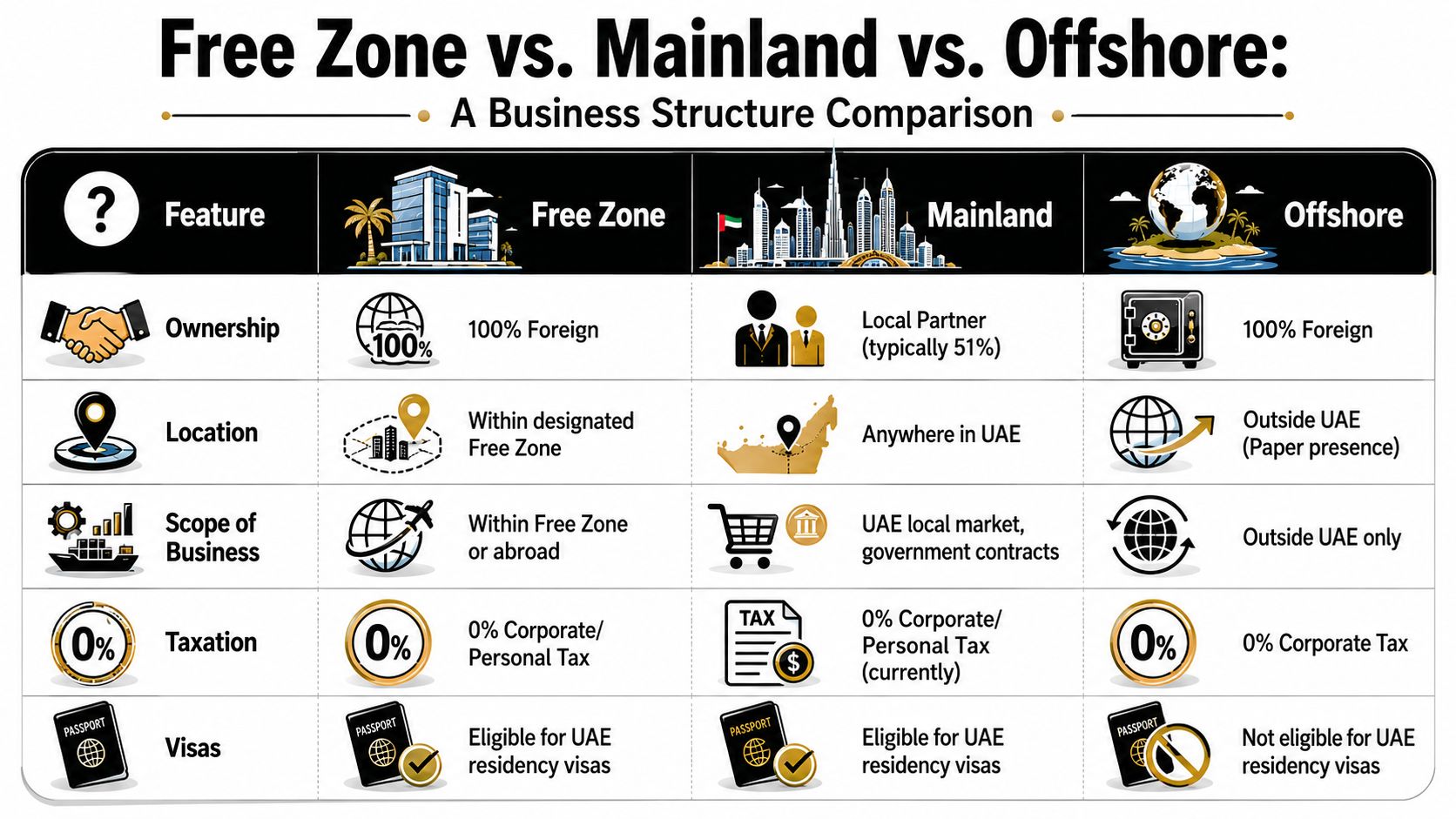
UAE Company Structures Compared
| Feature | Free Zone Company | Mainland Company | Offshore Company |
|---|---|---|---|
| Ownership | Typically structured for full foreign ownership | Depends on legal route and activity | Commonly used for foreign ownership structures |
| Core market fit | International trade, cross-border services, specialised sectors | Direct UAE market activity | Holding or international structuring |
| Regulation | Specific free zone authority | General mainland framework | Offshore registry framework |
| Office presence | Usually tied to zone rules and licence package | Based on mainland licensing requirements | Typically not used for operational local presence |
| UAE residency pathway | Often used by founders seeking residency-linked setup | Common route for local operations and residency | Not generally chosen for local operating presence |
| Best use case | Regional launchpad with controlled ownership | Local trading and direct domestic business | Asset holding, international ownership, non-operational use |
For a more detailed discussion of the trade-offs, this guide on mainland vs freezone in Dubai is useful if you're comparing operational goals rather than just formation paperwork.
When free zone is the right answer
Choose a free zone when your company will mostly do business internationally, when you want a regulated and relatively efficient setup route, and when control of ownership is essential.
This usually suits founders in consulting, e-commerce support, logistics, software, agencies, and cross-border trade. It can also suit regional headquarters or subsidiary structures that don't need unrestricted mainland selling from day one.
When mainland is the better call
Choose mainland if your commercial plan depends on direct sales inside the UAE market.
That includes many businesses such as retail, restaurants, contracting, local services, and businesses targeting domestic customers as their core revenue base. In those cases, founders often lose more money restructuring later than they would have spent choosing the right form at the start.
When offshore belongs in the conversation
Offshore isn't for every entrepreneur. It usually makes sense when the company is being used for ownership, asset holding, or international structuring rather than active UAE operations.
If you need local visas, active trading on the ground, or a customer-facing UAE presence, offshore is usually the wrong instrument. Founders sometimes choose it because it sounds simple. Then they discover it doesn't match what they need the company to do.
The Company Formation Process Step-by-Step
A free zone setup usually goes well when the founder treats it as a commercial decision first and an admin exercise second. The order matters. If the business model is clear, the formation steps become easier to choose and harder to get wrong.
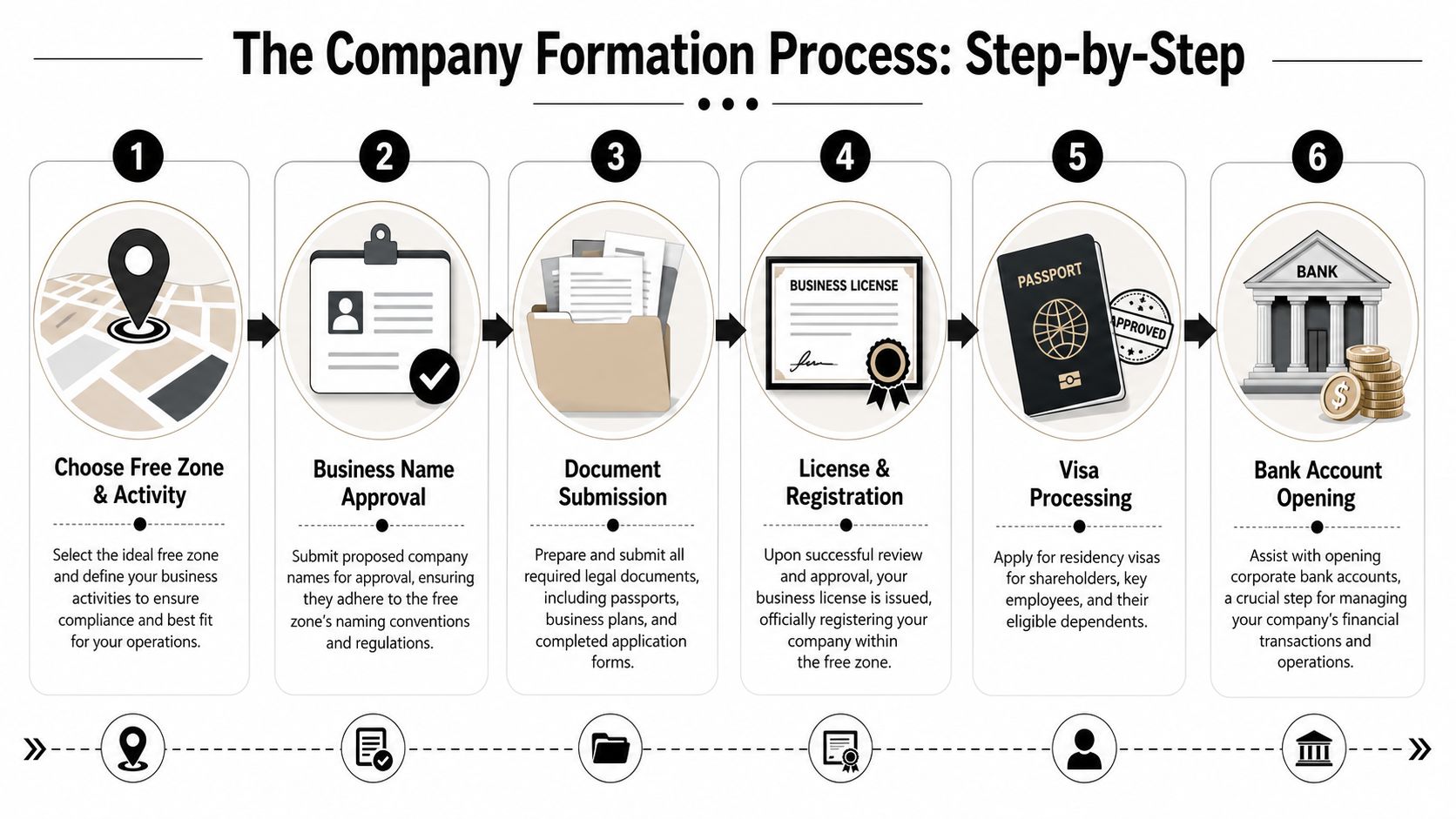
Step 1 and Step 2
Start by defining three things together: the free zone, the licensed activity, and the legal form.
The UAE government's free zone business setup guidance makes that sequence clear. Before licensing, the applicant chooses the free zone authority and the legal entity. Common structures include Free Zone Company (FZ Co.), Free Zone Establishment (FZE), and branch setups.
In practice, this is the stage where the right structure is chosen for the way the company will earn money.
A consultant serving overseas clients may need a straightforward service licence and a single-shareholder vehicle. A trading business importing and re-exporting goods may need a different zone, different approvals, and more attention to warehousing or customs processes. A founder planning to sell heavily inside the UAE should pause here and test whether free zone is still the right route, or whether mainland would avoid restrictions later.
Three checks matter early:
- Activity fit: The licence must reflect what the company will do, not just what sounds broad enough.
- Zone fit: Some zones are better for digital services, some for trading, some for logistics or regulated sectors.
- Entity fit: One shareholder, multiple shareholders, or a branch structure each create different filing and ownership requirements.
Step 3 and Step 4
Once those choices are set, move to trade name reservation, document collection, and application filing.
The documents are usually straightforward. Passport copies, shareholder details, application forms, and supporting papers based on the activity and ownership structure. The main issue is consistency. If the application says "consultancy" but the supporting profile reads like a trading business, the authority may ask questions or request amendments. That costs time.
I see this problem often with founders who choose activities based on price instead of operational fit. A cheaper licence is not cheaper if it needs correction after issuance.
After review, the authority issues the licence and incorporation documents if the file is approved. Timing varies by zone, activity, and whether extra approvals are required. Founders should treat any published timeline as a working estimate, not a promise.
Step 5 and Step 6
The final phase usually covers establishment card processing where applicable, visa steps, and bank account opening.
These are not minor follow-up tasks. They test whether the company was set up in a way that matches the actual business. Banks look closely at ownership, source of funds, transaction pattern, client geography, and the logic of the activity on the licence. If those points do not align, the file can stall even when the company is already incorporated.
Budgeting helps here because formation cost is only one part of the setup decision. Visa allocation, immigration fees, office requirements, compliance work, and banking preparation all affect the first-year spend. If you want a practical cost reference before filing, this guide to Dubai free zone company setup cost breaks down the main components.
How a Consultancy Streamlines Your Setup
A lot of DIY applications don't fail because the founder lacks commitment. They fail because small technical choices are made in the wrong order.
A founder may choose the cheapest zone without checking whether the permitted activity fits the actual service line. Another may form the company correctly but reach banking stage with an unclear business description, weak supporting documents, or a structure that doesn't match the expected transaction flow. These aren't dramatic mistakes. They're common ones.
Where advisers add real value
The first job of a good adviser is not filling forms. It is pressure-testing the setup logic.
That usually includes:
- Matching the structure to the business model: Overseas B2B services, local trading, holding activity, and investor-led expansion all need different treatment.
- Filtering the zone options: With many free zones in the UAE, the issue isn't lack of choice. It's too much choice.
- Reducing avoidable rework: Wrong activity selection, poor document sequencing, and inconsistent applications often create delays that could have been avoided.
A practical use case for outside help
If you're comparing providers, one option is UAE business setup services from Smart Classic Business Hub, which covers mainland, free zone, and offshore formation together with VAT-compliant accounting, PRO support, and related compliance services. That kind of combined support matters when the formation decision affects tax registration, visas, and ongoing administration rather than only the licence issue date.
The main value of a consultancy is judgment. Founders usually don't need someone to explain that forms must be submitted. They need someone to spot where the selected structure will create friction six months later.
Frequently Asked Questions about Free Zone Companies
Can I keep my job and own a free zone company
Often, this depends on your existing visa, employment terms, and the rules attached to your current status. The practical point is to check both employment restrictions and immigration implications before forming the company. Ownership is one issue. The right to manage and work through that entity is another.
What annual renewals should I plan for
Plan for licence renewal, establishment-related renewals, visa-related costs where relevant, and ongoing compliance such as accounting and tax administration if applicable. The exact cost depends on the zone, activity, office package, and headcount, so this should be budgeted case by case rather than guessed from headline package prices.
Can a free zone company own property in Dubai
This depends on the property type, the location, the authority requirements, and how the company is structured. It needs a transaction-specific review. Founders shouldn't assume that any free zone entity can automatically hold any property asset.
Is it easy to get family visas through a free zone company
Many founders use company ownership as part of their residency planning, but the ease of family sponsorship depends on the visa route, supporting documents, and current immigration rules. It is workable in many cases, but it should be handled as part of a full residency plan rather than treated as an automatic add-on.
Is bank account opening guaranteed after licence issuance
No. Incorporation and banking are connected, but they are not the same approval process. Banks conduct their own review, and they will look closely at business activity, ownership, expected transactions, and supporting documents.
A licence proves the company exists. It doesn't remove the need to explain the business clearly to a bank.
What is the simplest way to decide
Use a short filter. If you want direct local UAE trading, check mainland first. If you want foreign ownership with an international operating model, free zone is often the better place to start. If the company is mainly for holding or structuring, discuss offshore before you commit to an operating licence.
If you're deciding between free zone, mainland, or offshore and want the structure matched to your actual business model, Smart Classic Business Hub can help you assess the setup route, licensing fit, compliance implications, and next practical steps before you file anything.