
The number that should reset how you think about business opportunities in Dubai is this: the UAE's non-oil foreign trade exceeded US$1 trillion in 2025 for the first time (TMGHQ). That isn't a tourism story. It's a commercial infrastructure story.
Dubai works because it sits in the middle of trade flows, capital flows, and service flows. Founders who treat it like a glamour market usually chase crowded sectors and expensive positioning. Founders who treat it like an operating base tend to make better decisions. They build companies tied to movement, compliance, fulfilment, finance, administration, and cross-border execution.
That's the key angle. Yes, property, crypto, AI, and consumer brands get attention. If you're specifically considering property exposure, this guide on how to invest in Dubai real estate is a useful companion. But most new entrants don't need a flashy sector. They need a business model that fits Dubai's commercial logic and a setup plan that won't slow them down.
Dubai also rewards founders who understand structure early. Jurisdiction, licence scope, visa planning, VAT treatment, and banking readiness aren't admin details. They shape whether your business can sell, hire, invoice, and scale. If you want a quick overview of the practical upside, these benefits of setting up a business in Dubai give useful context.
Why Dubai Is Your Next Business Destination
Dubai isn't attractive because it looks global. It's attractive because it operates globally.
The emirate gives entrepreneurs a base that connects suppliers, distributors, clients, and service providers across the Gulf, Africa, and South Asia. That matters more than hype. If your business depends on movement of goods, money, documentation, or talent, Dubai gives you a serious platform.
Dubai is built for throughput
Most markets are driven mainly by local consumer demand. Dubai is different. Companies use it to import, warehouse, distribute, re-export, invoice, structure ownership, and manage regional operations. That's why so many business opportunities in Dubai sit behind the scenes rather than on the billboard.
A lot of founders arrive asking the wrong question. They ask, “What's trending?” The better question is, “What does this market repeatedly need?”
Dubai rewards useful businesses. If your company removes friction from trade, compliance, payments, hiring, or operations, you're aligned with how the market actually functions.
The obvious sectors are not the whole opportunity
There's money in headline sectors. There's also competition, licensing complexity, and inflated expectations. Many entrepreneurs would be better off entering through the service layer around those sectors. Every new company needs corporate administration, documentation support, tax handling, recruitment coordination, and practical local guidance.
That's why I don't advise clients to copy whatever gets the most search traffic. I advise them to find the recurring need created by business formation and cross-border activity. In Dubai, recurring need usually outperforms fashion.
Understanding Dubai's High-Growth Sectors
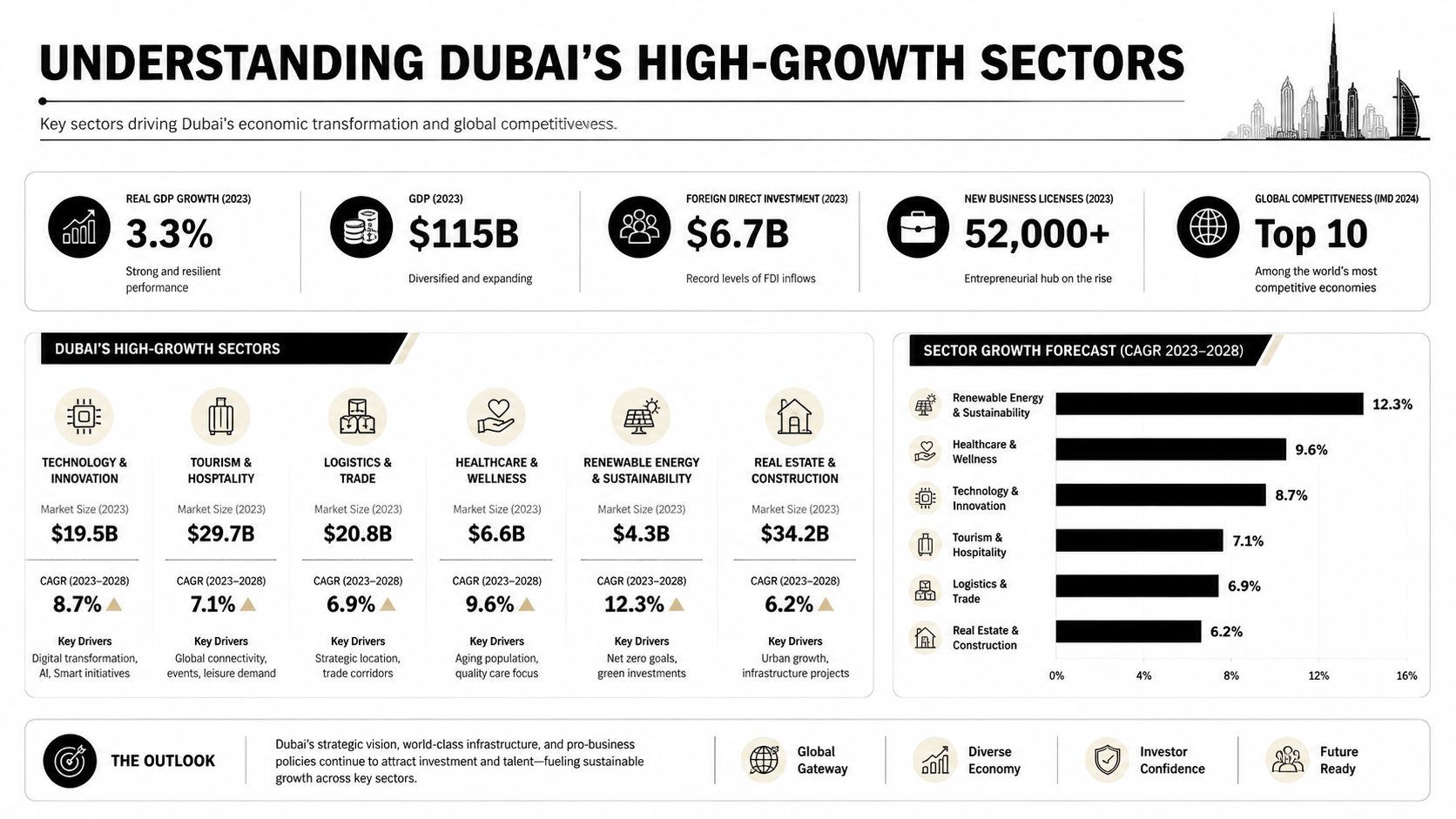
Dubai's fastest-growing sectors follow a clear pattern. They sit where trade volume, business formation, regulation, and recurring operational demand meet. That is the filter I use with clients, because it points you toward markets with repeat revenue instead of short-term hype.
Trade and logistics still drive real volume
Dubai remains a trade-first economy. Dubai's GDP in 2023 was about AED 429 billion, roughly US$116.8 billion, while historical sector data show wholesale and retail trade accounted for 26% of GDP in 2018 and transport and logistics contributed 12% (Economy of Dubai data). If you want demand that is tied to movement of goods rather than passing attention, start here.
That creates room for more than classic import-export companies. It supports freight coordination, customs documentation, warehousing support, packaging, fulfilment, procurement support, and supplier management. These are less glamorous than consumer brands, but they are easier to justify commercially because they solve daily operational problems.
Jebel Ali Free Zone reinforces the same point. Large logistics clusters there host over 9,500 companies in the same economic context cited above. Dense business activity creates constant demand for support services around shipping, paperwork, inventory, payments, and coordination.
E-commerce growth creates service businesses, not just stores
A lot of founders see e-commerce and immediately think, "launch a product brand." That is only one option, and often not the best one.
The UAE e-commerce market reached approximately AED 32.3 billion in 2024 and is projected to exceed AED 50.6 billion by 2029 (UAE Expert Hub market outlook). The stronger play for many new entrants is the operating layer around online selling. Marketplace account management, catalogue setup, cross-border fulfilment, returns handling, customer service outsourcing, and seller onboarding all benefit as online transaction volume rises.
That matters because service businesses usually need less capital than inventory-heavy retail. They also fit Dubai's role as a regional base for companies selling across the Gulf, Africa, and South Asia.
Finance, compliance, and business support are the durable opportunity
Many articles miss a key opening. Dubai does offer growth in fintech, payments, and digital finance. But the more durable opportunity often sits one layer below the headline. New companies need bookkeeping, VAT handling, payroll coordination, document clearing, corporate administration, licence amendments, and regulatory support from day one.
Those are high-growth sectors too. They grow because company formation grows.
If I were entering Dubai without a large budget, I would take business infrastructure seriously before I chased a fashionable vertical. Compliance services, PRO support, accounting, outsourced finance operations, and incorporation support are easier to sell than many founders expect because they address immediate, required tasks.
Practical rule: Choose sectors that create recurring admin, financial, or operational work. Repeated demand beats attention.
Where I'd focus first
If your goal is a practical market entry with realistic execution risk, these are the strongest starting points:
- Trade support services such as sourcing coordination, shipping documentation, fulfilment support, and procurement assistance.
- E-commerce operations including marketplace management, returns handling, seller services, and customer support.
- Finance and compliance services such as bookkeeping, VAT support, reporting, payroll coordination, and regtech tools for SMEs.
- Corporate support businesses including PRO services, document clearing, licence support, visa processing coordination, and business setup assistance.
The right choice depends on one question. Do you want to compete for attention, or do you want to solve a problem that every new company already has?
In Dubai, I would choose the second option.
Finding Your Niche Beyond the Obvious Headlines
Most articles about business opportunities in Dubai recycle the same shortlist. Real estate. Crypto. AI. Tourism. Import-export. That's not wrong. It's incomplete.
The better opportunities often sit underneath those sectors. Most content on Dubai business opportunities recycles the same headline sectors, while the more durable openings may sit in the “infrastructure” around them, such as accounting, VAT support, liquidation, and PRO services, because Dubai's expanding business population creates recurring demand for compliance and corporate administration (Payoneer analysis of Dubai opportunity themes).
Sell picks and shovels, not only gold
When a market attracts new founders, investors, and trading companies, support demand rises with it. That creates businesses that are less glamorous and often more durable.
Here are the niches I'd take seriously:
- VAT and bookkeeping support for SMEs that need clean records, compliant filing, and management reporting.
- PRO and document-clearing services for licence amendments, immigration processing, renewals, attestations, and government coordination.
- Feasibility studies and business planning for investors who need market-entry clarity before they commit.
- Liquidation and restructuring support for owners who need to close or reorganise correctly.
- Recruitment support for SMEs that need practical hiring help without building a large internal HR function.
- Corporate administration retainers for companies that need recurring operational support rather than one-off setup.
Why these models are stronger than they look
A service business tied to compliance and administration can start lean. It can win through speed, reliability, and clarity. It also benefits from repeat demand because licences renew, visas expire, books need updating, and shareholders keep changing plans.
That doesn't mean every support business is easy. It means the demand is more stable than trend-driven sectors where everyone copies the same idea and spends too much on branding.
A crowded sector can still work. A necessary service usually works sooner.
My blunt recommendation
If you're entering Dubai for the first time, don't default to a headline industry unless you already have sector expertise, regulatory readiness, and a clear route to clients. If you don't, start with a support model that solves a recurring business problem for companies already operating here.
That's the practical path. Less noise. Better margins on execution. Fewer vanity decisions.
Choosing Your Legal Structure Mainland vs Free Zone
Most setup mistakes happen before the company exists. Founders choose a jurisdiction because it sounds familiar, not because it matches the business model.
Use a simple analogy. A mainland company is like opening on the high street. A free zone company is like operating inside a specialised business park. Neither is automatically better. One fits your route to market better than the other.
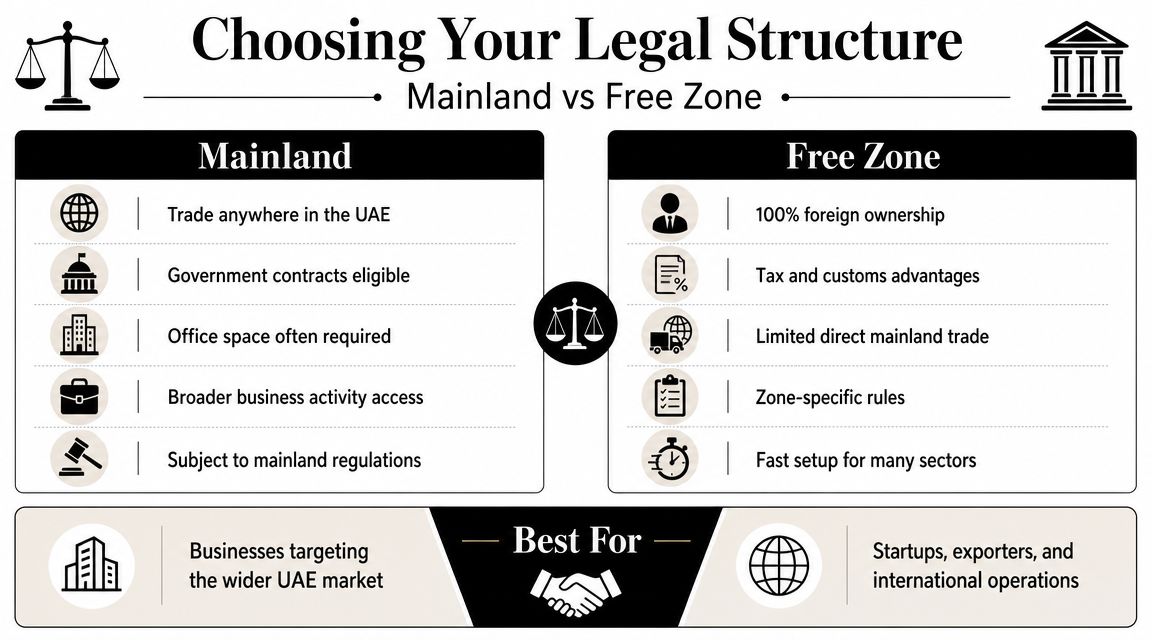
For a more detailed breakdown, review this guide to mainland vs free zone in Dubai.
Start with your sales model
If you plan to sell directly into the UAE local market, bid for broad local commercial work, or operate a physical consumer-facing business, mainland is usually the first structure to assess.
If your company is focused on regional trade, international services, holding stock for export, online operations, or a specialised ecosystem inside a free zone, then free zone often makes more sense.
Mainland vs Free Zone Company Setup in Dubai
| Factor | Mainland Company | Free Zone Company |
|---|---|---|
| Primary market access | Better suited for businesses targeting the wider UAE local market | Better suited for businesses operating within a specific free-zone ecosystem or serving international markets |
| Typical use case | Retail, local trading, general services, onshore client work | Export-import structuring, consulting, digital business, niche sector ecosystems |
| Regulatory environment | Broader commercial scope tied to mainland rules and approvals | Zone-specific rules, activity lists, and administrative processes |
| Office expectations | Often better for firms needing a visible local operating presence | Often efficient for firms that want a lighter initial footprint |
| Operational style | Flexible for companies that expect extensive onshore activity | Efficient for companies prioritising setup speed and ecosystem alignment |
| Cost logic | Can make sense when local market access is the priority | Can make sense when founders want focused activity licensing and simpler entry |
| Best fit | Businesses selling where customers physically are in the UAE | Businesses serving trade flows, international clients, or specialised sectors |
Don't ignore offshore, but don't misuse it
Offshore structures have specific uses, usually around holding assets or ownership structuring. They are not the default answer for someone who wants to trade actively in Dubai, hire locally, and run day-to-day operations from the UAE.
I see founders get this wrong when they chase a cheaper-looking setup without asking whether it supports banking, contracts, visas, and actual commercial activity. If the structure can't support the actual business, it isn't cheaper. It's a delay.
The decision filter I use with clients
Ask these questions in order:
- Where will revenue come from. UAE local clients, regional clients, or both?
- What activity are you performing. Trading, consulting, fulfilment, support services, software, or something regulated?
- Will you need visas immediately for owners or staff?
- Do you need a warehouse, shop, desk, or only a legal entity?
- Will banks understand the model easily from your licence and documents?
Choose the jurisdiction that fits the business you'll run in the first year, not the empire you imagine in year five.
That one decision saves a lot of rework.
Navigating Licenses Visas and Initial Compliance
Most founders overcomplicate this part. The process is straightforward if you follow the right sequence.
Your business activity drives your licence type. Your licence affects your approvals, and those approvals influence your visa pathway, office needs, and supporting documents. When people struggle, it's usually because they chose an activity carelessly at the start.

Pick the activity first, not the name
If you describe your business too broadly, you create trouble later. If you describe it too narrowly, you box yourself in. The activity list needs to match how you'll invoice clients and what regulators expect you to do.
Most founders fall into one of these licence categories:
- Commercial licence for trading and goods-related activities.
- Professional licence for consulting, advisory, technical, and service work.
- Industrial licence for manufacturing or production-related activity.
That classification isn't cosmetic. It affects approvals, documentation, and how clearly your company profile reads to banks and counterparties.
Visas follow the company, not the other way around
Once the company is formed and the licence is issued, the immigration process can begin for eligible owners and staff. That usually includes investor or employee visa pathways, depending on the structure and roles involved.
A practical setup order looks like this:
- Define the activity correctly
- Choose jurisdiction and licence route
- Reserve the trade name
- Prepare incorporation documents
- Obtain initial approvals where required
- Issue the licence
- Start immigration and residency processing
- Move to post-licensing tasks such as banking and compliance
Mainland-specific detail that confuses people
Some mainland professional activities may involve a Local Service Agent arrangement depending on the activity and legal form. Founders often misunderstand this point and assume it means surrendering ownership or control. It doesn't automatically mean that. What matters is the exact activity, the legal framework around it, and the documents used.
That's why copying someone else's setup is a bad idea. Their licence activity, jurisdiction, and immigration goals may be completely different from yours.
If the activity is wrong, every step after it gets slower. Licensing delays usually start with bad scoping, not bad paperwork.
Initial compliance is where disciplined founders pull ahead
Treat compliance as part of launch, not as cleanup. Keep your incorporation documents organised. Make sure the shareholder information is consistent across applications. Match your business description across the licence, invoices, website, and bank profile. That consistency matters.
I also advise founders to decide early who will handle renewals, immigration tracking, accounting handover, and document storage. If nobody owns those tasks, they drift. Then a simple setup becomes an expensive maintenance problem.
Understanding Your Tax and Financial Obligations
A lot of entrepreneurs come to Dubai expecting a simple tax story. Though still favourable, it isn't casual. You need clean books, correct registration decisions, and disciplined financial handling from day one.
The first rule is simple. Don't wait for problems before building your accounting process.
What matters in practice
Founders usually need to think about three areas:
- Personal tax position in the UAE context.
- Corporate tax treatment based on the company's structure and taxable position.
- VAT obligations if the business triggers registration requirements or operates in a way that requires careful tax treatment.
You also need proper bookkeeping, invoice control, expense tracking, and document retention. These are not back-office luxuries. They determine whether your filings, audits, and banking interactions stay smooth.
VAT is operational, not theoretical
Many businesses leave VAT too late because they treat it as an accounting issue. It's an operations issue. Your contracts, pricing, invoicing, supplier setup, and record-keeping all interact with VAT treatment.
If you're reviewing the registration side, this guide on how to register for VAT in the UAE is a practical starting point.
A lot of business opportunities in Dubai also involve cross-border elements. That makes transaction mapping more important, not less. Goods movement, service location, and documentation quality all affect how safely you can manage tax treatment.
My advice on financial setup
Do these things early:
- Separate business and personal spending from the beginning.
- Use proper bookkeeping software rather than spreadsheets as the company grows.
- Review contracts before invoicing starts so the commercial terms and tax treatment don't conflict.
- Prepare for bank scrutiny by keeping transaction logic and supporting records clean.
- Plan for tax residency documentation if your wider international structure may benefit from it.
If you want a practical operator in this area, Smart Classic Business Hub provides VAT-compliant accounting, tax residency certificate support, audit coordination, and related business support services in Dubai. That's one route. The important point is to appoint someone competent before compliance starts stacking up.
Clean records protect more than tax compliance. They protect banking, shareholder trust, due diligence readiness, and your ability to scale.
Your Step-by-Step Market Entry Checklist
Most market-entry failures aren't dramatic. They happen because founders skip sequencing. They choose a licence before deciding the sales model. They apply for visas before preparing the file properly. They chase a bank account without presenting a coherent business profile.
Use this checklist as your working order.
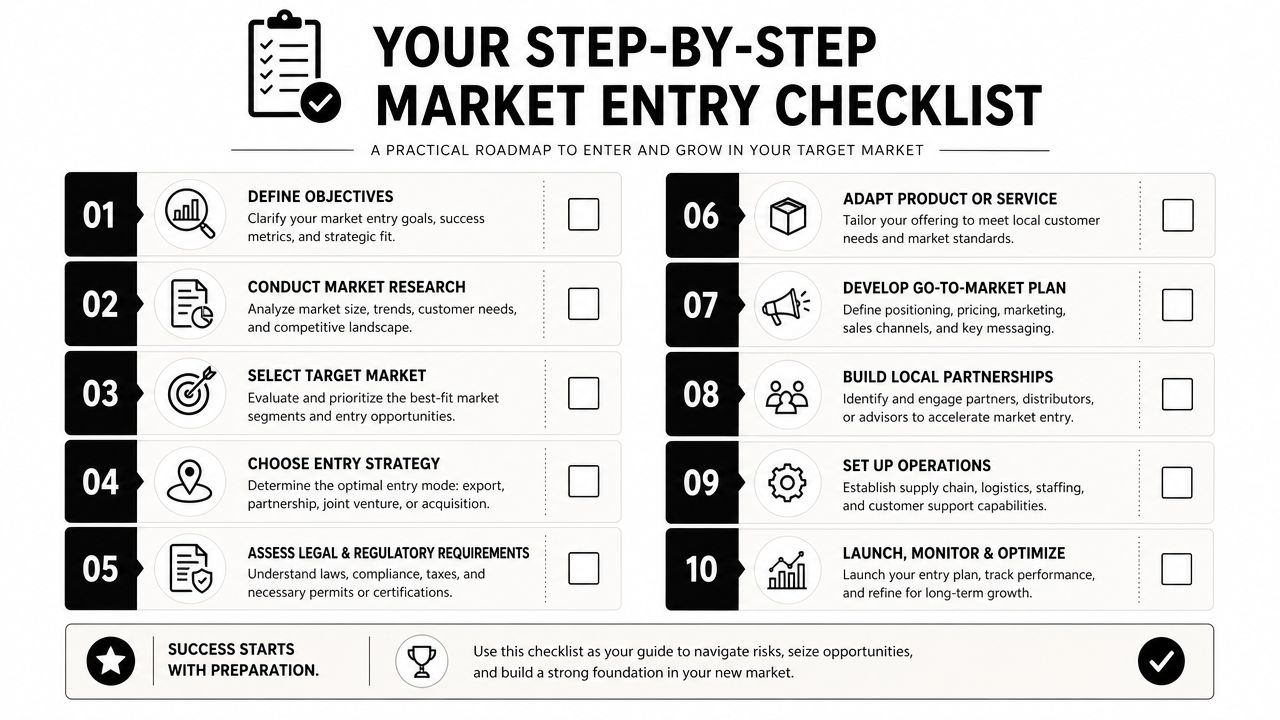
The correct launch sequence
Define the commercial model
Decide exactly what you'll sell, to whom, and where revenue will come from. If the target client is unclear, the wrong jurisdiction usually follows.Choose the activity and licence scope
Match the legal activity to the service or product. Don't use vague wording just to get approved faster.Select mainland or free zone
Base this on your route to market, not on what a friend used or what sounds cheaper.Reserve the trade name and prepare incorporation documents
Keep shareholder names, passport details, and business descriptions consistent across all documents.Secure approvals and issue the licence
Some activities move quickly. Others need extra review. Build your business plan around that possibility.Arrange immigration processing if required
Once the entity is live, process investor or employee residency steps in the proper order.Open the corporate bank account
Present a credible profile. Banks want to understand what you do, where funds come from, and how the company will operate.Set up accounting, invoicing, and document control
Don't wait until the first filing deadline. Build the operating system now.Prepare post-launch administration
Assign responsibility for renewals, licence amendments, visa expiries, bookkeeping, and government correspondence.
The mistakes to avoid
A founder can lose weeks on avoidable errors. These are the common ones:
- Copying another company's setup when the business model is different.
- Under-scoping the activity and discovering later that the licence doesn't cover actual work.
- Ignoring compliance during setup and trying to clean everything up after invoices have started.
- Presenting weak documents to banks with no clear explanation of operations.
- Treating visas as separate from the company file when they depend on it.
What a realistic founder does
A realistic founder doesn't obsess over perfection. They get the structure right, the paperwork aligned, the financial controls in place, and the launch sequence organised.
That's enough to start well.
Good market entry is boring on paper. That's why it works. Clear activity, correct jurisdiction, clean documents, and disciplined follow-through beat excitement every time.
Launch and Grow Your Business in Dubai
Dubai gives you genuine room to build. But access isn't the same as execution. The founders who do well here aren't the ones with the loudest concept. They're the ones who match their business model to the market, choose the right structure, and stay compliant while they grow.
If you're evaluating business opportunities in Dubai, be honest about your entry point. You don't need to launch in the most visible sector. You need a business that solves a real problem, can be licensed properly, can open a bank account cleanly, and can operate without administrative chaos.
My opinion is straightforward. Start with commercial logic. If your business supports trade, digital commerce, finance operations, or the infrastructure every company needs, you're in a stronger position than founders chasing attention-heavy sectors without a clear operating plan.
Then move fast, but not carelessly. Decide the activity. Pick the jurisdiction that fits the first phase of the business. Build accounting discipline early. Treat visas and compliance as operating essentials, not paperwork.
That approach saves time, prevents restructuring, and gives you a company that can function in the UAE.
If you're serious about launching in the UAE, speak with Smart Classic Business Hub to map your setup properly before you file anything. A focused consultation can help you choose the right jurisdiction, align your licence with your actual business model, and avoid the common mistakes that delay banking, visas, and compliance.