
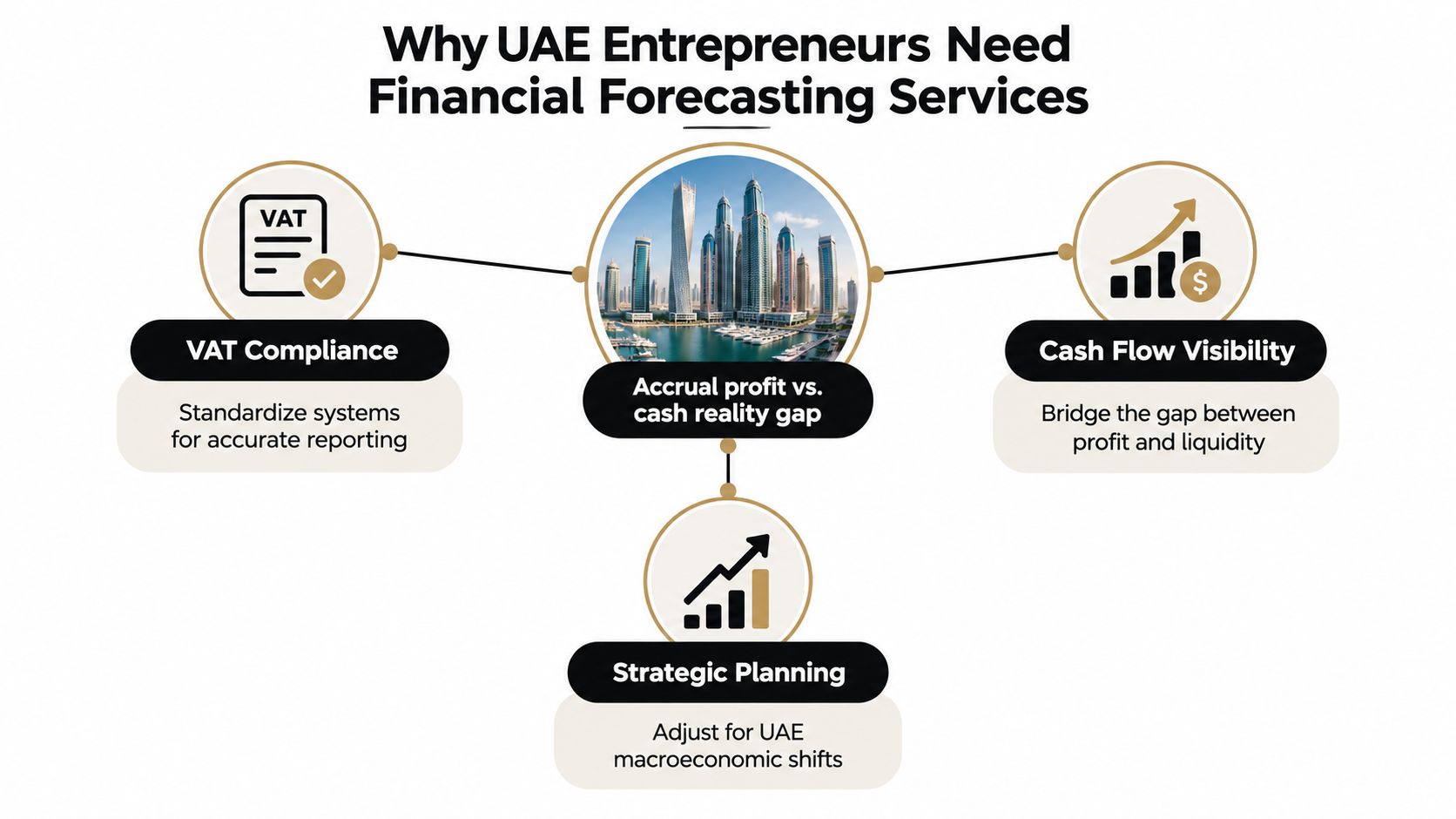
A Dubai consultancy can have strong sales, signed projects, and a respectable profit on its accounts, yet still feel short of cash. Client invoices may be outstanding, VAT collections may be sitting in the wrong account, payroll may be due before a major receivable arrives, and a planned hire may add a fixed cost before revenue becomes predictable. That gap between accrual profit and cash reality is where many otherwise healthy businesses become exposed.
Financial forecasting services turn those uncertainties into visible decisions. A well-built forecast shows when cash will arrive, which costs are committed, how much working capital the business needs, and what changes under different growth or cost assumptions. For UAE entrepreneurs, the work must also reflect local operating structures, VAT-compliant records, staffing and visa-related costs, free-zone or mainland arrangements, and changing economic conditions.
Why UAE Entrepreneurs Need Financial Forecasting Services
A founder running a consultancy in Dubai Marina may look at a profitable monthly income statement and assume the business can afford another consultant, a larger office, or a new marketing campaign. The bank balance may tell a different story. A large client could be paying slowly, annual software renewals may have landed together, and the business may have used operating cash to cover a tax or supplier obligation.
Bookkeeping records what has happened. Forecasting helps the owner decide what can happen next without putting liquidity under unnecessary pressure. That distinction matters for businesses that are growing quickly, preparing a funding application, hiring staff, managing inventory, or moving between project-based and recurring revenue.
The UAE's SME market makes this a broad business need, not a service reserved for large groups. The official UAE Government platform reported approximately 557,000 small and medium-sized enterprises as of mid-2022, and these businesses contributed as much as 63.5% of the UAE's non-oil GDP according to the UAE Government's SME platform. A forecasting model for this market must work across mainland companies, free-zone businesses, retailers, manufacturers, professional practices, and technology ventures.
Profit does not pay suppliers
A forecast separates earned revenue from collected cash. It also separates operating costs from VAT-related cash movements, owner withdrawals, loan repayments, capital expenditure, and other items that can materially affect the bank account without appearing as ordinary operating expenses.
For a service business, that means mapping invoices by expected collection date rather than treating every signed contract as immediate cash. For a retailer, it means connecting purchasing plans and stock levels to sales timing. For a growing employer, it means modelling payroll, recruitment, benefits, office costs, and other recurring commitments before approving expansion.
Practical rule: Never approve a new fixed cost solely because the profit and loss statement looks healthy. Check the effect on monthly cash, receivables timing, and the downside case first.
A good forecast also supports a stronger business plan. Entrepreneurs comparing planning formats can use this business plan outline to organise the commercial assumptions that feed the financial model. For a more structured approach to assumptions, cash planning, and decision-led modelling, the Financial Forecasting Toolkit overview is another useful reference.
The value isn't a static spreadsheet delivered once and forgotten. It's a management system that helps an owner decide whether to delay a purchase, renegotiate supplier terms, change pricing, accelerate collections, or proceed with investment. That makes forecasting a practical growth control, not merely an accounting exercise.
Core Methods in Financial Forecasting Services
Professional financial forecasting services usually combine several methods because no single report answers every business question. A cash flow forecast answers, “Can we meet upcoming obligations?” A budget answers, “How should we allocate resources?” A sales forecast asks, “What revenue is likely under current commercial conditions?” Scenario analysis then tests how the plan behaves if the assumptions change.
Cash flow forecasting
Cash flow forecasting tracks expected inflows and outflows over a defined period. The model should include customer collection dates, supplier payments, payroll, rent, financing movements, VAT-related payments and receipts, capital expenditure, and owner distributions where relevant.
The most useful version is operational rather than theoretical. A Dubai agency may have contracts worth substantial future revenue, but the forecast should record when each invoice is expected to be raised and when the client is likely to pay. If collections slip, the owner can see the effect on hiring, supplier payments, and available working capital before the pressure reaches the bank account.
Businesses that need a short-term liquidity view can also use a cash flow statement template as a starting point, provided they adapt it to their own chart of accounts and collection behaviour.
Budgeting and budget-to-actual review
A budget sets an agreed financial direction. It translates a growth plan into expected sales, gross margin, staffing, rent, technology, marketing, professional fees, and other costs. It also gives management a reference point for reviewing actual results.
A budget becomes weak when the team treats it as a promise that cannot be changed. UAE businesses operate in conditions where supplier costs, financing arrangements, customer demand, and project timing can move. The better practice is to compare actual results with the budget, identify the reason for the variance, and decide whether the original assumption still applies.
Sales and revenue forecasting
Revenue forecasting should reflect the way the company sells. A subscription business may model recurring customer revenue and churn assumptions. A contractor may model a pipeline by probability, project start date, billing milestone, and delivery capacity. A retail operator may connect expected sales volumes to product categories, purchasing requirements, and stock availability.
Historical performance helps, but it shouldn't be used mechanically. A past month with an unusual contract, delayed invoice, or one-off event may distort the baseline. Management should label assumptions clearly and distinguish committed revenue from opportunities that still require a proposal, approval, deposit, or signed agreement.
Scenario analysis
Scenario analysis replaces a single fragile answer with a set of decision paths. A UAE SME might create:
- Base case: Current sales pipeline, expected collections, planned staffing, and known operating costs.
- Lower-growth case: Slower conversions, later customer payments, weaker utilisation, or reduced order volumes.
- Upside case: Stronger sales conversion, faster collections, and investment that expands capacity.
The output should go beyond projected profit. It should show cash runway, working-capital requirements, debt-service coverage, and covenant headroom where relevant. A modest revenue slowdown can create a much larger liquidity issue when rent, staffing, visa-related expenses, software subscriptions, and compliance costs remain fixed.
A forecast earns trust when every important number has an owner, a source, and a review date.
Deliverables and Workflow of Professional Services
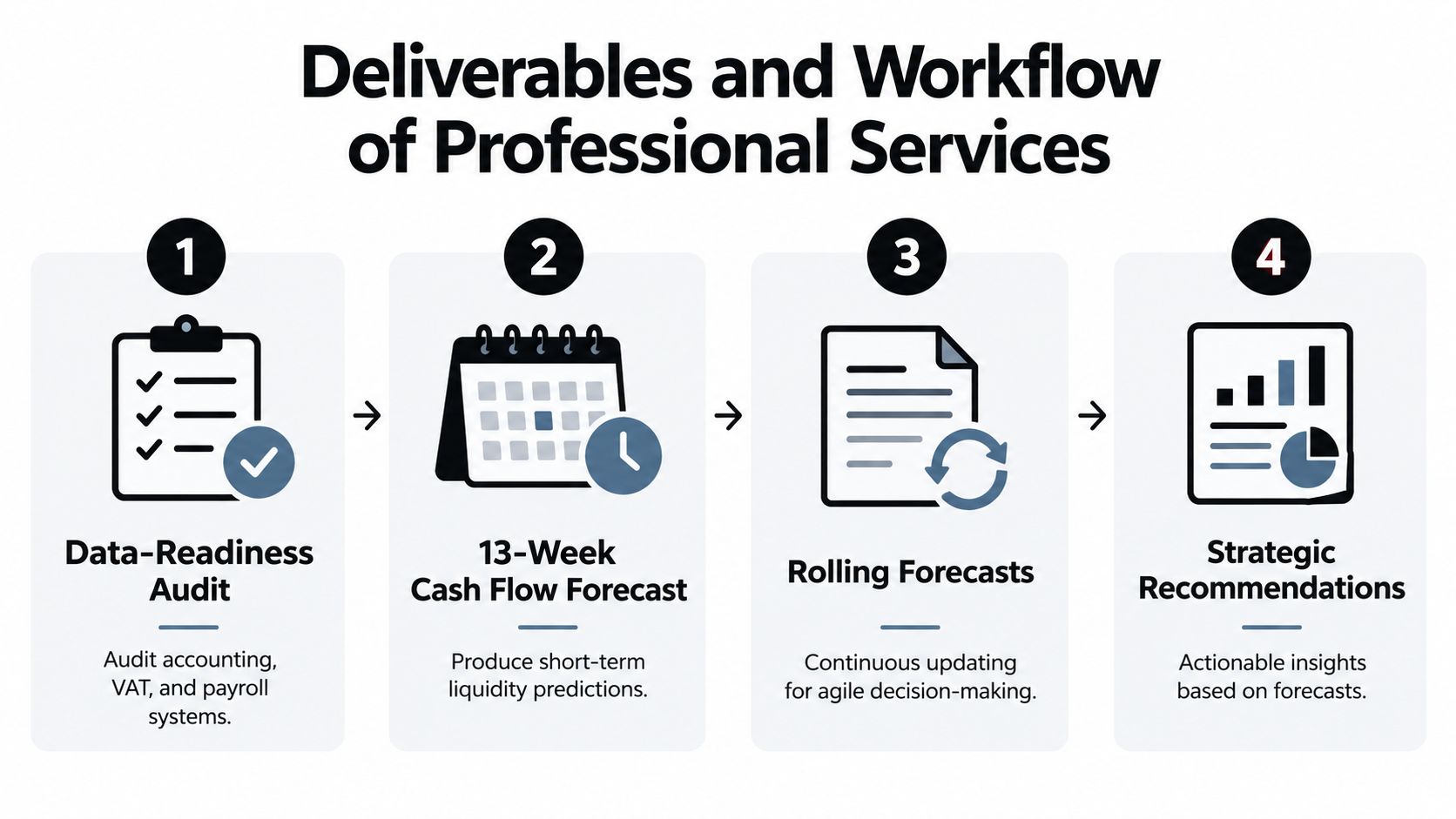
A reliable engagement starts with the data, not with a polished dashboard. The provider first needs to understand how the business records sales, purchases, payroll, VAT, bank transactions, inventory, loans, and owner transactions. If the source records are inconsistent, automation will only produce unreliable outputs faster.
Start with a data-readiness audit
The first deliverable should identify missing, duplicated, delayed, or inconsistently categorised information. The review may cover the accounting ledger, bank reconciliations, receivables ageing, supplier balances, payroll records, VAT-related entries, and operational data such as bookings, units sold, project milestones, or utilisation.
This stage matters because founders often mix personal and business spending, record VAT together with operating revenue, or classify similar costs differently from month to month. The forecast should document how those items are treated before the model starts producing recommendations.
Build the operating model
The next step converts cleaned records into linked assumptions. Revenue, direct costs, staffing, overheads, working capital, financing, and capital expenditure should connect to the profit and loss statement, balance sheet, and cash flow view.
A professional model should make assumptions visible. If a forecast assumes customers pay later, the collection timing must be documented. If inventory purchases rise with sales, the relationship should be explicit. If a planned hire starts only after a revenue threshold, that trigger should appear in the model rather than remain in a private note.
Produce rolling outputs
A 13-week cash flow forecast provides a short-term view of liquidity, while an annual budget and rolling forecast support larger decisions. The rolling forecast should be updated with actual VAT-compliant accounting data and revised when the business receives new information about sales, costs, collections, financing, or investment.
Sensitivity analysis then shows the impact of changes such as slower collections, higher supplier prices, reduced gross margin, or delayed project starts. The final management pack should identify the decision required, not present rows of figures.
Useful deliverable: Ask for a forecast pack that explains what changed, why it changed, and what management should do next.
Navigating UAE Macroeconomic Variables
Historical company results are necessary, but they aren't sufficient for a UAE forecast. A business can repeat last year's sales pattern and still produce an unreliable plan if financing conditions, construction costs, customer demand, shipping expenses, or sector activity have changed.
The Central Bank of the UAE's September 2025 Quarterly Economic Review stated that real GDP grew 3.9% year over year in the first quarter of 2025, while non-hydrocarbon GDP grew 5.3%. The Central Bank projected real GDP growth of 4.9% in 2025 and 5.3% in 2026, as reported in this summary of the Central Bank outlook.

Turn national indicators into business assumptions
Those figures shouldn't be copied directly into an SME revenue line. A construction supplier, hospitality operator, logistics company, financial services firm, and software venture experience economic expansion differently. The model should identify which part of revenue depends on domestic non-hydrocarbon demand, which part is linked to international customers, and which costs are sensitive to trade or energy conditions.
The Central Bank's projections also included non-hydrocarbon growth of 4.5% in 2025 and 4.8% in 2026, alongside hydrocarbon growth of 5.8% in 2025 and 6.5% in 2026 in the September 2025 Quarterly Economic Review. A company with energy-linked customers should therefore test production and price sensitivities separately from a company driven mainly by tourism, construction, domestic consumption, or professional services.
A practical model can organise macroeconomic exposure like this:
| Business exposure | Forecast questions |
|---|---|
| Domestic demand | What happens to conversion, order volume, and customer budgets if private-sector sentiment weakens? |
| Construction and manufacturing | Which materials, subcontractor costs, and project delays affect gross margin and cash timing? |
| Logistics and imported inventory | How would freight, insurance, supplier lead times, and foreign-currency purchases change working capital? |
| Energy-linked activity | Which revenue lines depend on production volumes, energy prices, or the spending plans of major customers? |
Model inflation and supply-chain risk separately
A headline inflation assumption shouldn't be applied uniformly to every expense. The Central Bank's June 2026 review projected 1.7% real GDP growth and 2.3% inflation for 2026, while noting that geopolitical conditions could affect energy markets, shipping costs, and food prices in its June 2026 economic review.
For an importer, the forecast should separate unit volume, selling price, supplier price, freight, insurance, lead time, and inventory holding cost. A business may maintain revenue growth while losing gross margin if it can't pass higher input costs to customers. Monthly sensitivity tables can show the cash impact of slower collections, higher freight, weaker margin, or a delayed procurement cycle.
Financial forecasting services create practical value. They connect an external assumption to a specific decision, such as revising prices, reducing stock commitments, changing payment terms, delaying recruitment, or arranging additional working capital. The forecast isn't predicting the economy perfectly. It's helping management stay prepared when the economy doesn't follow the base case.
Selecting the Right Provider and Pricing Model
The right provider depends on the decision you need to make, the quality of your records, and how often the forecast must change. A one-off feasibility study and an ongoing management forecasting arrangement shouldn't be evaluated in the same way.
| Provider model | Suitable use | Main trade-off |
|---|---|---|
| Project-based engagement | Feasibility study, funding model, expansion plan, or transaction decision | Clear scope and defined output, but updates may require a new engagement |
| Fixed-fee retainer | Recurring forecasts, management reporting, cash monitoring, and budget reviews | Predictable ongoing cost, but the scope should define meeting frequency and revisions |
| Internal finance team | Businesses with established systems and dedicated financial expertise | Direct access to company information, but requires internal capacity and appropriate controls |
| Hybrid support | Internal bookkeeping combined with external modelling or advisory | Flexible division of responsibilities, but ownership of data and assumptions must be explicit |
Compare the work, not just the fee
A low price can become expensive if the provider copies ledger balances into a spreadsheet without testing collection timing, VAT treatment, payroll assumptions, or operational drivers. Ask what the engagement includes:
- Data review: Will the provider check reconciliations, classifications, receivables, VAT entries, and payroll data?
- Model structure: Does the forecast link profit and loss, balance sheet, and cash flow outputs?
- Scenario design: Will the provider test lower growth, delayed collections, higher costs, and planned investment?
- Management use: Will someone explain the changes and translate them into decisions?
- Update process: How will actual results replace assumptions, and who approves revisions?
A provider serving UAE companies should understand the difference between mainland, free-zone, and other operating structures, while recognising that the forecast itself must be adapted to the company's transactions rather than built from a generic template. The work should support VAT-compliant accounting and reflect corporate tax obligations without presenting a forecast as a substitute for specialist tax or legal advice.
For founders comparing ongoing financial guidance with a defined advisory assignment, corporate finance advisory in Dubai is one example of the type of service category to assess. The important test is whether the provider can connect the model to funding, expansion, pricing, hiring, and liquidity decisions.
A strong engagement letter should state the data the client must supply, the forecast period, the scenarios included, the update schedule, the deliverables, and the limits of responsibility. It should also explain whether the fee changes when the business adds entities, revenue streams, currencies, employees, or reporting requirements. Clear scope protects both sides and keeps the conversation focused on useful management information.
Compliance, AI Readiness, and Next Steps
AI can accelerate forecasting, but it can't correct disorganised records by itself. Before using automation, check whether accounting, VAT, payroll, bank, sales, and operational data use consistent categories and dates. Separate VAT collections and payments from operating cash, document founder withdrawals, and identify assumptions that require human approval.
A 2025 SAP-commissioned YouGov survey found that 94% of UAE enterprises believe AI will drive expansion, 97% of UAE IT decision-makers are confident using AI insights for critical decisions, and 58% plan to invest in data consolidation and quality improvement within 12 months according to SAP's published survey summary. Confidence in AI isn't the same as forecast readiness. A precise output built from incomplete receivables or inconsistent VAT treatment can still mislead management.
Use this sequence before selecting an automated tool:
- Reconcile the source records and correct obvious classification or timing problems.
- Define the cash rules for VAT, payroll, owner transactions, financing, and capital expenditure.
- Document assumptions for sales, collections, staffing, prices, and supplier costs.
- Create base, lower-growth, and upside cases with clear approval responsibilities.
- Review actuals regularly and change the model when business conditions change.
The provider should help align the forecast with UAE compliance requirements, including VAT and corporate tax obligations, while keeping financial modelling separate from formal tax advice where specialist input is required. That combination gives entrepreneurs a more dependable basis for pricing, funding, expansion, and day-to-day cash decisions.
Smart Classic Business Hub offers UAE-focused support across VAT-compliant accounting, financial management advice, feasibility studies, business planning, and corporate finance advisory. Visit Smart Classic Business Hub to discuss a forecasting framework built around your records, compliance needs, cash position, and next business decision.