
You're in a Dubai co-working space with a company formation quote open on one screen and a bank application on the other. Your visa isn't issued yet, your business partner is abroad, and every online guide seems to give a different answer about whether you need an Emirates ID, a branch visit, or a local introduction.
The paperwork matters, but it isn't the first decision. Your identity status determines which banking route is realistic. A UAE resident, a non-resident founder, and a tourist aren't just applicants at different stages of the same process. They belong to different onboarding categories, with different eligibility rules, document expectations, and digital options.
That's the practical answer to how to open a bank account in the UAE: classify yourself correctly before you compare banks. The right sequence is identity status, account purpose, document readiness, bank fit, then application.
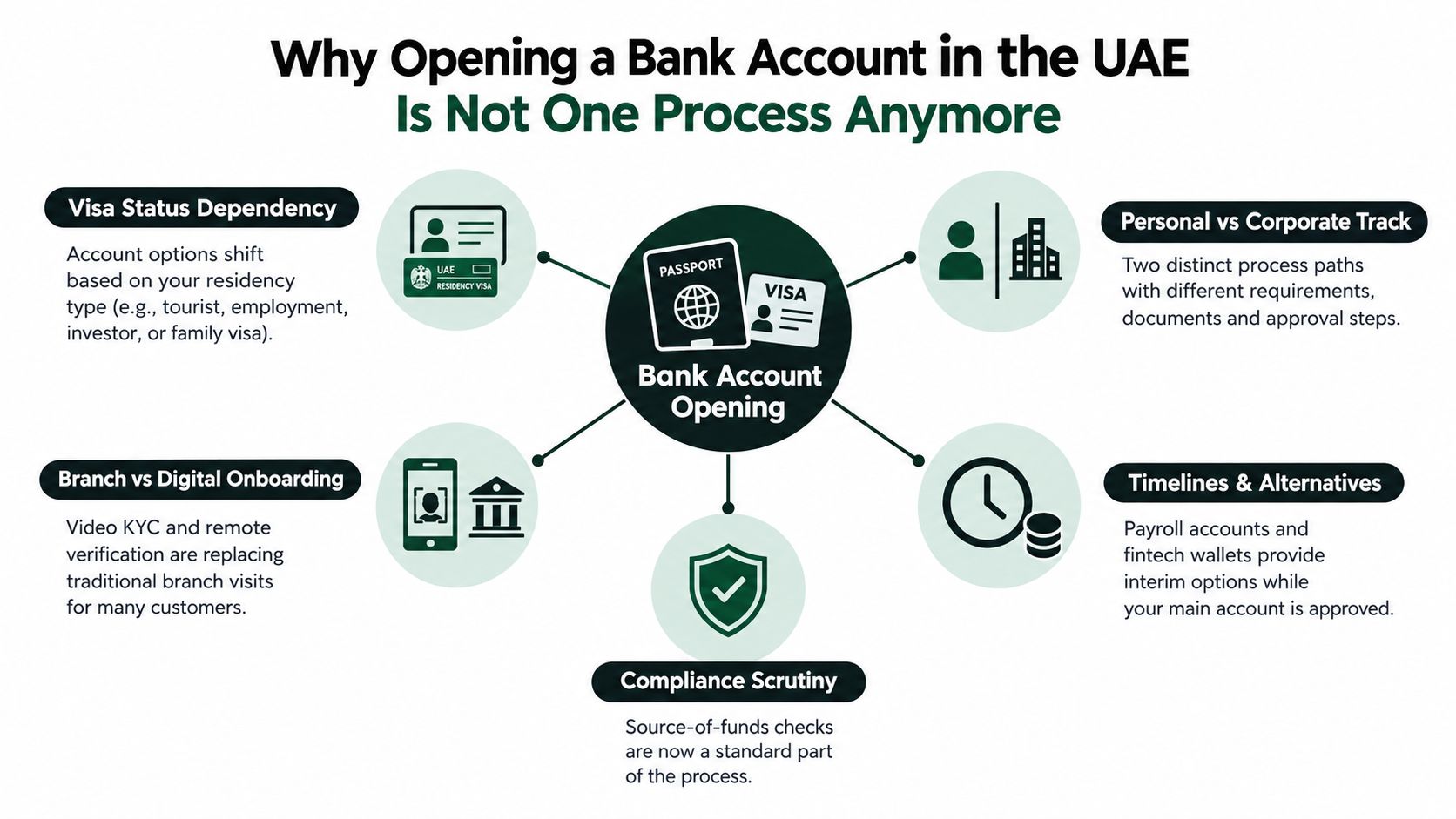
Why Opening a Bank Account in the UAE Is Not One Process Anymore
A resident founder with a valid residence visa and Emirates ID can usually start with a mainstream personal or business banking application. A visitor without residency may need a separate non-resident route, enhanced source-of-funds evidence, or a bank's wealth or international desk. A tourist may now qualify for a narrower digital route linked to tourist identity verification, rather than the conventional resident process.
The distinction is becoming more important as the UAE moves towards identity-linked onboarding. In April 2026, the Central Bank of the UAE, the Federal Authority for Identity, Citizenship, Customs and Port Security, and ADCB announced a digital account-opening service through the Tourist Identity initiative. The service allows eligible non-resident visitors to open accounts within minutes and receive immediate digital debit access, as described in the official Tourist Identity announcement.
Start with the category, not the bank
The UAE government's banking guidance separates the ordinary resident application from other possibilities. Residents typically need an Emirates ID, valid residence visa, passport or family book, and often a salary certificate or employment letter. Self-employed applicants may also need a trade licence and company documents. Applications can be made at a branch, on a bank website, or through a mobile app, and some banks support in-app identity verification through digital onboarding. Review the UAE government guidance on opening a bank account before you start collecting documents.
That classification changes the practical route:
- Resident: Use the standard personal or corporate onboarding path, provided your documents and activity make sense.
- Non-resident: Expect a more selective review, particularly around source of wealth, business purpose, ownership, and the reason for maintaining a UAE account.
- Tourist or visitor: Check whether you qualify for a tourist-identity or visitor product. Don't assume it provides the same facilities as a resident current account.
The resident route also has a defined service benchmark. The Central Bank's account-opening rulebook says licensed financial institutions should be able to open an account within three business days when the applicant is low risk and standard due diligence is satisfied, as reflected in the government guidance linked above. That's a benchmark for a clean, low-risk file, not a promise that every application will finish within that period.
Practical rule: Don't ask a bank to assess the wrong identity category. Your first question should be, “Which onboarding path applies to me?”
Opening a Personal Bank Account Step by Step
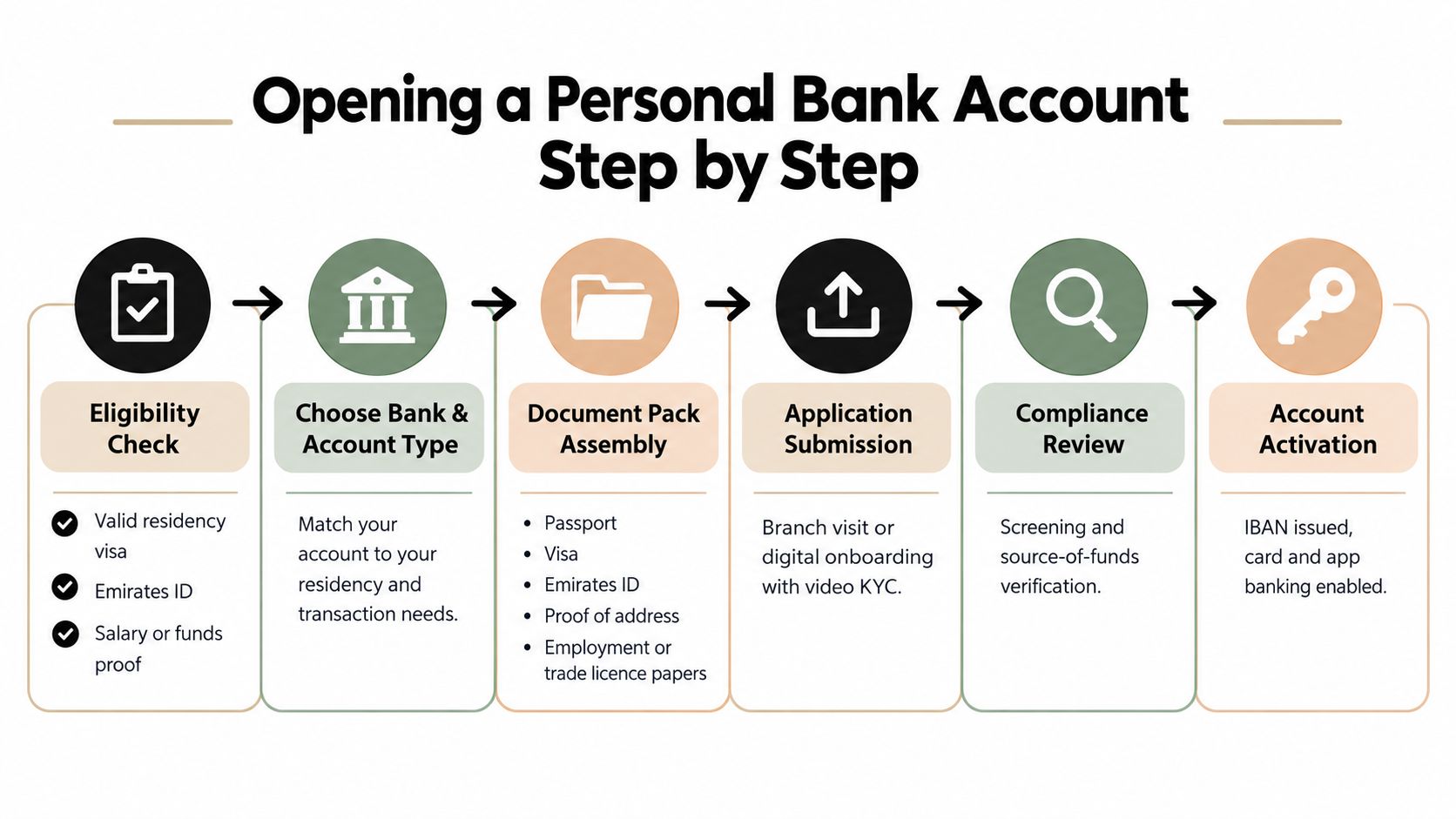
For a resident, the cleanest application begins with eligibility. You'll normally need a valid UAE residence visa and Emirates ID, followed by evidence explaining how you earn and how you expect to use the account. An employed applicant may provide a salary certificate or employment letter. An investor or self-employed applicant may need a trade licence, company documents, an NOC where relevant, or other proof of income.
The document pack should tell one consistent story. Prepare a passport copy, visa page, Emirates ID, income evidence, and proof of address. A recent utility bill or comparable address document may be requested during updated KYC checks. If you're applying as an investor, include the documents that explain your role in the company and the origin of funds you expect to deposit.
Choose the channel that suits the file
Digital onboarding is convenient for a standard resident profile. Services such as Liv, Mashreq Neo, or Wio can let eligible applicants submit information and complete identity checks through an app. This route works best when your name, address, visa details, employment information, and expected account activity are straightforward.
A branch application can be more effective for a complicated profile. ENBD, FAB, ADCB, and CBD branches can give you access to a relationship manager who may clarify missing documents, explain account conditions, and understand an investor or self-employed file before it reaches a compliance queue. Don't choose a branch merely because digital feels unfamiliar. Choose it when your application needs context.
Let the bank understand the money
The compliance review isn't an administrative nuisance. The bank is checking whether your expected activity matches your job, company, income, residence status, and declared purpose. If you expect large transfers, international payments, or funds from a company sale or investment, prepare the supporting records before submission.
The UAE government notes that account opening can take place digitally or at a branch, while the Central Bank benchmark applies when the customer is low risk and standard due diligence is complete. A clean digital application may move quickly, but a file that triggers source-of-funds questions will take longer. Don't promise yourself an approval date until the bank confirms that its review is complete.
Choosing the Right Business Account by Company Structure
A business account isn't approved because a company has a trade licence. The bank evaluates the entity, jurisdiction, owners, activity, transaction profile, and physical presence as one file. Your company structure affects how much explanation the relationship manager will need and which banking channels are sensible.
| Company Structure | Bank Access | Typical Approval Time | Key Requirement |
|---|---|---|---|
| Mainland LLC | Broadest access to UAE commercial banks when the activity and operating footprint are clear | Depends on due diligence and file complexity | Trade licence, constitutional documents, ownership records, operating address, and a credible activity profile |
| Reputable free zone company | Often suitable for digital and traditional banks, subject to jurisdiction and activity | Depends on jurisdiction, ownership, and compliance review | Free zone licence, certificate of incorporation, shareholder documents, business plan, and address evidence |
| Higher-risk or less familiar free zone company | More selective access and greater need for explanation | May require additional review | Clear business rationale, source-of-funds evidence, ownership transparency, and supporting contracts |
| Offshore entity | Not a straightforward route to an onshore UAE operating account | Depends on the institution and international structure | Offshore corporate records, beneficial-owner evidence, banking rationale, and suitable offshore or international channel |
A mainland LLC usually gives a bank the clearest picture when the business genuinely operates in Dubai or Abu Dhabi. The trade licence should match the activity, and the company should be able to explain where it works, who its customers are, and how money will move. A mismatch between a consultancy licence and projected trading activity is a problem before the first transfer arrives.
Free zone companies need a more careful jurisdiction assessment. DIFC, ADGM, DMCC, RAKEZ, and Sharjah Publishing City can present different levels of familiarity to different banks. The bank won't assess the free zone name in isolation. It will examine the company's activity, shareholders, expected transactions, and evidence of real operations.
Offshore structures require a separate reality check. A JAFZA, RAK ICC, or Ajman offshore entity shouldn't be treated as a normal mainland operating company. The appropriate route may involve offshore or international banking rather than a standard onshore UAE account.
For early-stage teams, it's also sensible to compare banking with the wider finance workflow. A business expense platform for startups can help founders assess how account access, expense controls, and operating needs fit together before they commit to a structure.
Non-Resident and Tourist Account Paths Worth Knowing
Non-resident banking is a separate lane, not a delayed version of resident banking. If you don't hold a UAE residence visa or Emirates ID, don't build your plan around the assumption that a bank will automatically accept a passport and open a full local current account.
The new Tourist Identity service changes that assumption for some visitors. The April 2026 announcement from the Central Bank, ICP, and ADCB describes a digital route that lets eligible non-resident visitors complete identity-linked onboarding and receive digital debit access. It doesn't mean every tourist qualifies for every product, and it doesn't erase the bank's obligation to complete due diligence.
Three routes deserve attention
Visitor-linked digital products are relevant when you're physically entering the UAE and meet the programme's eligibility conditions. These products may be suitable for immediate spending or limited banking needs, but confirm the account's permitted use, transfer limits, card functionality, and duration before relying on it for a business.
Non-resident accounts through specialist or international desks may suit founders, investors, and people with a clear commercial reason to bank in the UAE. Expect the bank to ask about your country of residence, tax status, source of wealth, business purpose, beneficial ownership, and expected transactions. Documents may need certification, notarisation, or legalisation depending on the institution and jurisdiction.
Premium banking channels can provide a more structured assessment for applicants with substantial financial relationships, but eligibility depends on the bank's own criteria. Don't confuse an introduction with approval. The relationship manager still has to show that the customer and activity fit the institution's risk framework.
| Account Path | Best For | Minimum Balance | Approval Timeline |
|---|---|---|---|
| Tourist Identity-linked digital account | Eligible visitors needing a limited, immediate digital banking route | Product-specific, confirm directly with the provider | Designed for rapid digital onboarding when eligible |
| Non-resident specialist account | Founders, investors, and international clients with a clear UAE banking purpose | Institution-specific | Usually more involved than resident onboarding |
| Premium or private banking route | Applicants with a suitable wealth profile and complex international needs | Institution-specific | Dependent on due diligence and relationship review |
| Resident account after immigration | Applicants who can provide UAE residence documents and Emirates ID | Product-specific | Follows the ordinary resident process once eligibility is established |
If you're deciding whether to pursue this route, review practical guidance on a non-resident bank account in Dubai and then verify the exact product with the bank. The key decision isn't the logo on the debit card. It's whether you need spending access, a personal account, a corporate account, or an account that can support international business flows.
How to Pick the Right Bank for Your Situation
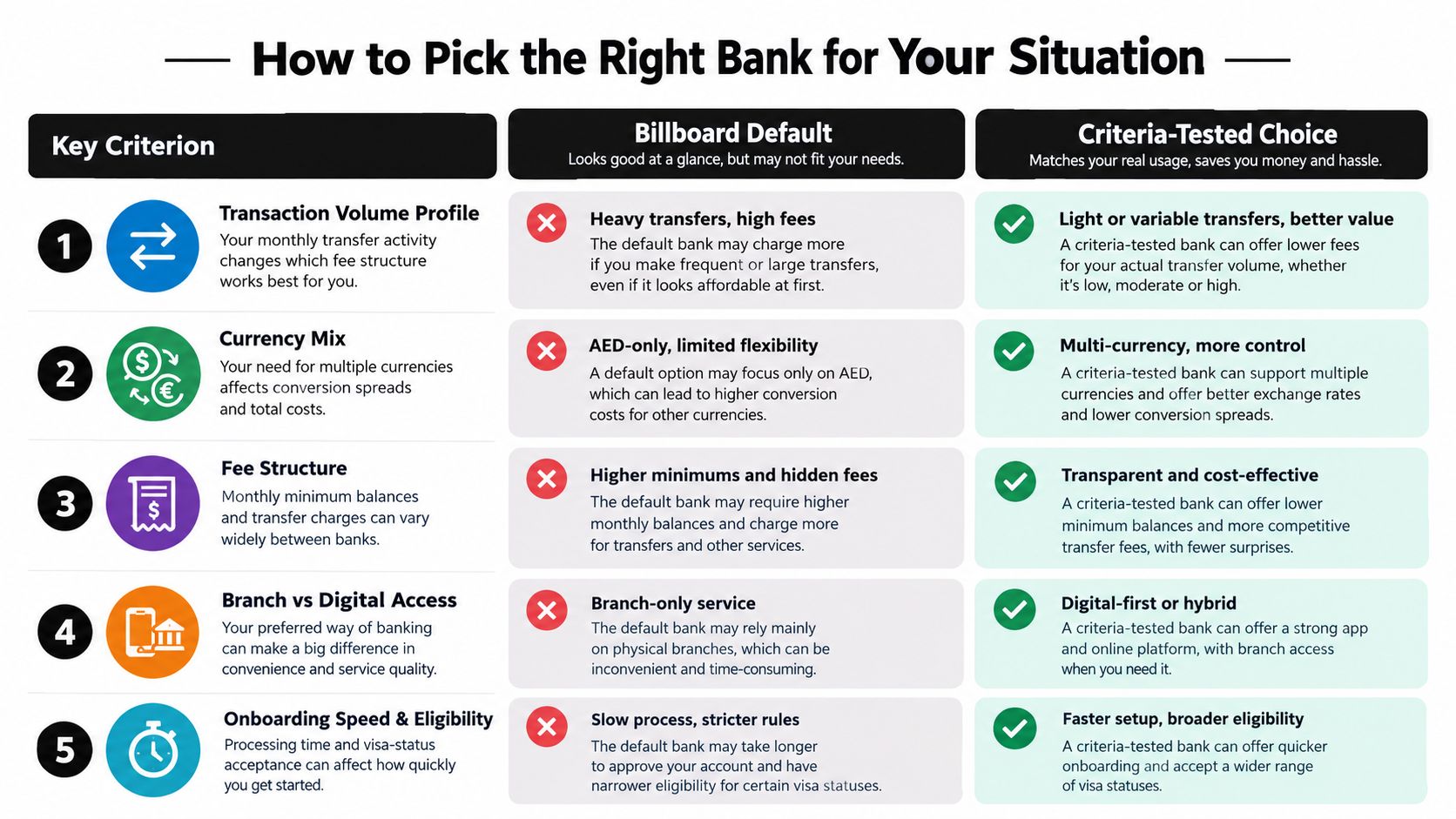
Don't choose a bank because its logo is on every road in Dubai. Choose it because its products match the way your money will move.
Start with five questions. How many incoming and outgoing transfers will you make? Which currency corridors matter? Do you need branches or will an app work? Can you reach a relationship manager when a payment is held? Do the fees and balance conditions make sense for your expected use?
Match the bank to the operating model
A high-volume importer needs a bank with a capable trade finance and documentary collections team. A consultancy receiving international client payments needs dependable foreign-currency handling and clear compliance support. A freelancer may prioritise a low-balance product, simple transfers, and a responsive app over a large lending catalogue.
Digital-first banks often make standard onboarding easier and offer a clean mobile experience. Traditional banks can provide broader lending, trade finance, cash management, and relationship coverage, but their files may require more explanation and documentation. Neither category is automatically right.
Crypto-adjacent businesses need particular care. Don't hide the digital-asset connection behind a generic consultancy description. Approach institutions that can assess the activity transparently and explain the compliance documents they require.
Build a shortlist before you apply
Benchmark at least three suitable institutions, but don't submit careless applications to all of them at once. Compare their eligibility rules, account purpose, expected activity, branch access, digital onboarding, minimum balance conditions, and support for your currencies.
You can use a focused guide to compare good banks for business accounts while building your shortlist. Treat it as a starting point, then confirm current requirements directly with each bank because product rules and acceptance criteria can change.
Banking advice: The cheapest account is not the cheapest banking relationship if every international transfer requires manual intervention.
Your application should go to the bank most likely to understand your profile, not just the bank you already use in another country. A well-matched file gives the relationship manager a clear reason to recommend approval.
Common Pitfalls and Why Applications Really Get Rejected
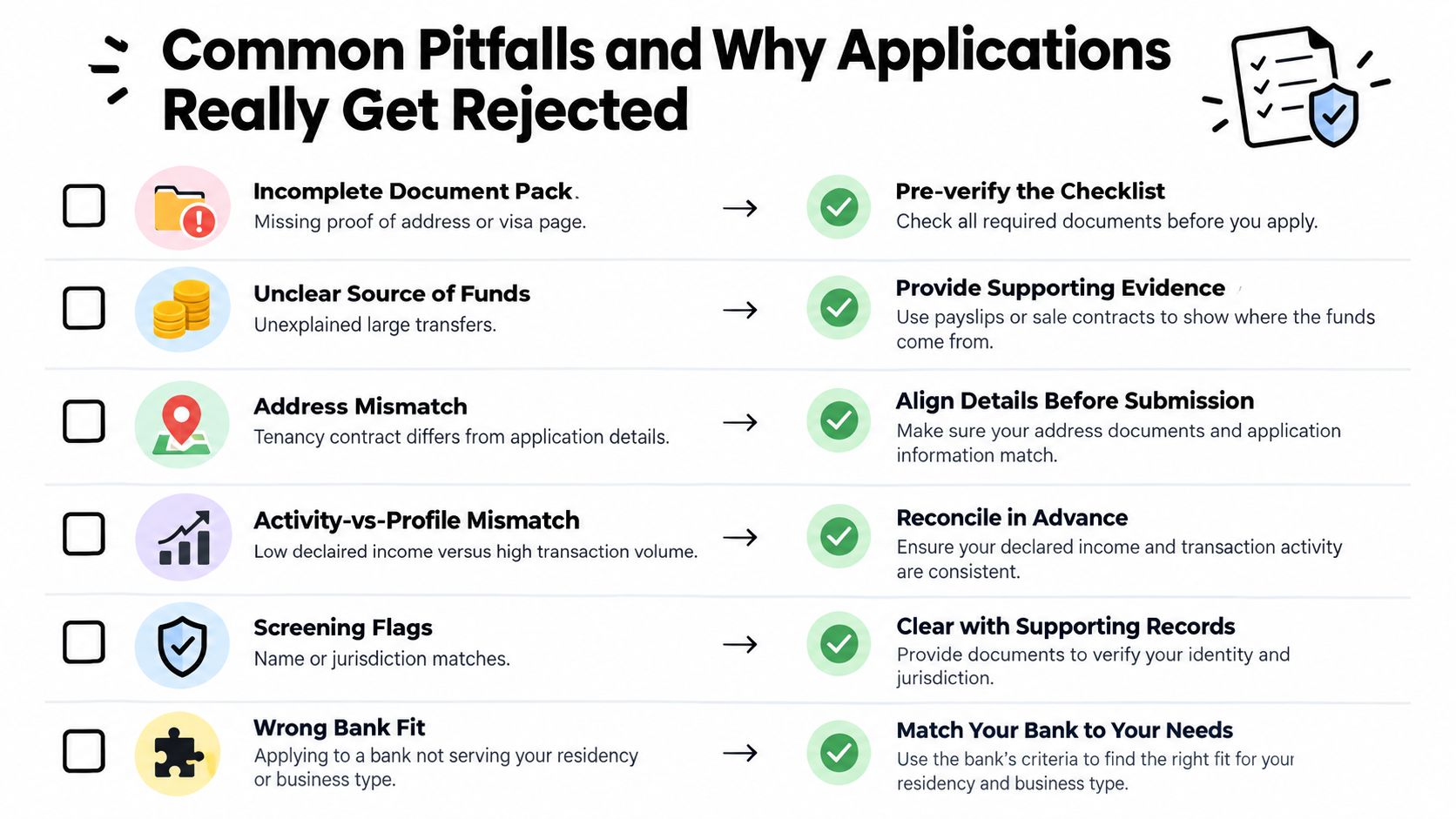
Most failed applications aren't random. They usually contain a contradiction, a missing explanation, or a risk signal the applicant could have addressed before submission.
A missing visa page or incomplete translation tells the bank that the file isn't controlled. An activity mismatch tells compliance that the declared business may not describe the actual flow of funds. A beneficial-owner gap makes it difficult to establish who controls the company. Each issue connects to the bank's AML, sanctions, or reputational-risk obligations.
Six avoidable failure modes
- Incomplete KYC pack: Missing notarised translations, address evidence, visa pages, or company records creates avoidable follow-up. Build a document index and check every name, date, and attachment before submission.
- Economic-activity mismatch: A licence, website, business plan, and expected transaction volume must describe the same business. If they don't, explain the commercial model before the bank asks.
- Beneficial-ownership gaps: Multi-shareholder structures require a clear ownership chart and identification of every relevant controller. Don't rely on a single shareholder's passport to explain a complex company.
- Weak source-of-wealth evidence: Non-residents and investor applicants should prepare sale agreements, audited accounts, payslips, investment statements, or other records that explain the money. The bank needs a traceable story, not a verbal assurance.
- Multiple simultaneous applications: Applying everywhere after one delay can create inconsistent answers and additional compliance questions. Select a suitable bank, submit a controlled file, and manage the review.
- Inactive follow-up: A file can stall when the applicant doesn't answer requests promptly. Assign one person to monitor email, calls, and document deadlines.
Address information deserves particular care. A PO box may be a normal mailing arrangement, but it doesn't always replace evidence of a physical residential or operating address. Cloud Residents provides a useful explanation of PO box bank KYC rules, including why banks may request further address verification.
A rejection is information. Ask what issue prevented approval, correct that issue, and change the application strategy. Reapplying with the same file won't produce a different result.
Don't assume a rejection ends your banking options. It means the current institution, product, identity category, or evidence pack didn't satisfy its review. Fix the underlying weakness instead of sending the same documents to another bank without explanation.
Final Checklist and How Smart Classic Business Hub Helps
Before you approach a relationship manager, score your file against the applicant type that actually describes you.
Personal resident
Have your passport, residence visa, Emirates ID, income evidence, and address proof ready. Decide whether you need a salary account, savings account, current account, or another product, and make sure your expected transfers match your employment or business profile.
Personal non-resident
Prepare your passport, residence-country address, tax and immigration information, source-of-wealth records, and a written reason for using a UAE account. Confirm whether you qualify for a visitor-linked digital product or need a specialist non-resident route.
Mainland company
Organise the trade licence, incorporation documents, MOA, ownership chart, signatory information, operating-address evidence, business plan, contracts, and expected transaction profile. The bank should understand what the company sells, where it sells, and why it needs the account.
Free zone company
Add the free zone certificate, shareholder and director records, licence details, office or workspace evidence, and a clear explanation of the jurisdiction's connection to the business. Review the bank's appetite before submitting.
Offshore entity
Confirm that the chosen institution serves your structure and that an onshore UAE account is genuinely available. Prepare constitutional records, beneficial-owner evidence, banking rationale, and any international or offshore documentation the institution requires.
Smart Classic Business Hub can act as the operational layer between company formation and the bank application. Its services include trade licence coordination, MOA drafting, board resolution preparation, Economic Substance return support, and bank-introduction letter preparation. That work helps founders assemble a coherent file, reduce avoidable back-and-forth, and assess whether the entity and activity fit the bank's appetite before submission.
Your next step should be practical. Put your identity category, account purpose, company structure, ownership chart, expected transactions, and available documents on one page, then use that summary to test your application with a suitable UAE banking contact.
Smart Classic Business Hub helps founders and foreign investors prepare UAE bank-account applications by coordinating corporate documents, compliance paperwork, and bank-introduction materials around the actual business profile. Visit Smart Classic Business Hub to discuss your structure, document readiness, and the most suitable banking route before you submit.