
The UAE collected AED 46 billion in combined VAT and Excise Tax revenue in 2025, compared with AED 41 billion in 2024, while tax registration transactions reached 1.7 million, up 20%, according to the Federal Tax Authority's 2025 update. For a first-time founder, that's a useful reminder: VAT tax accounting is no longer a minor administrative task. It's a daily control system covering sales invoices, supplier documents, ledgers, tax returns, payments, and evidence.
The practical challenge is straightforward to describe. You need to know when registration becomes necessary, charge the correct VAT, recover only supported input VAT, file accurate returns, and preserve records that explain every figure. The 2026 reforms add two further controls, supplier-document retention under reverse charge and ageing of unused recoverable VAT credits.
What VAT Tax Accounting Means in the UAE
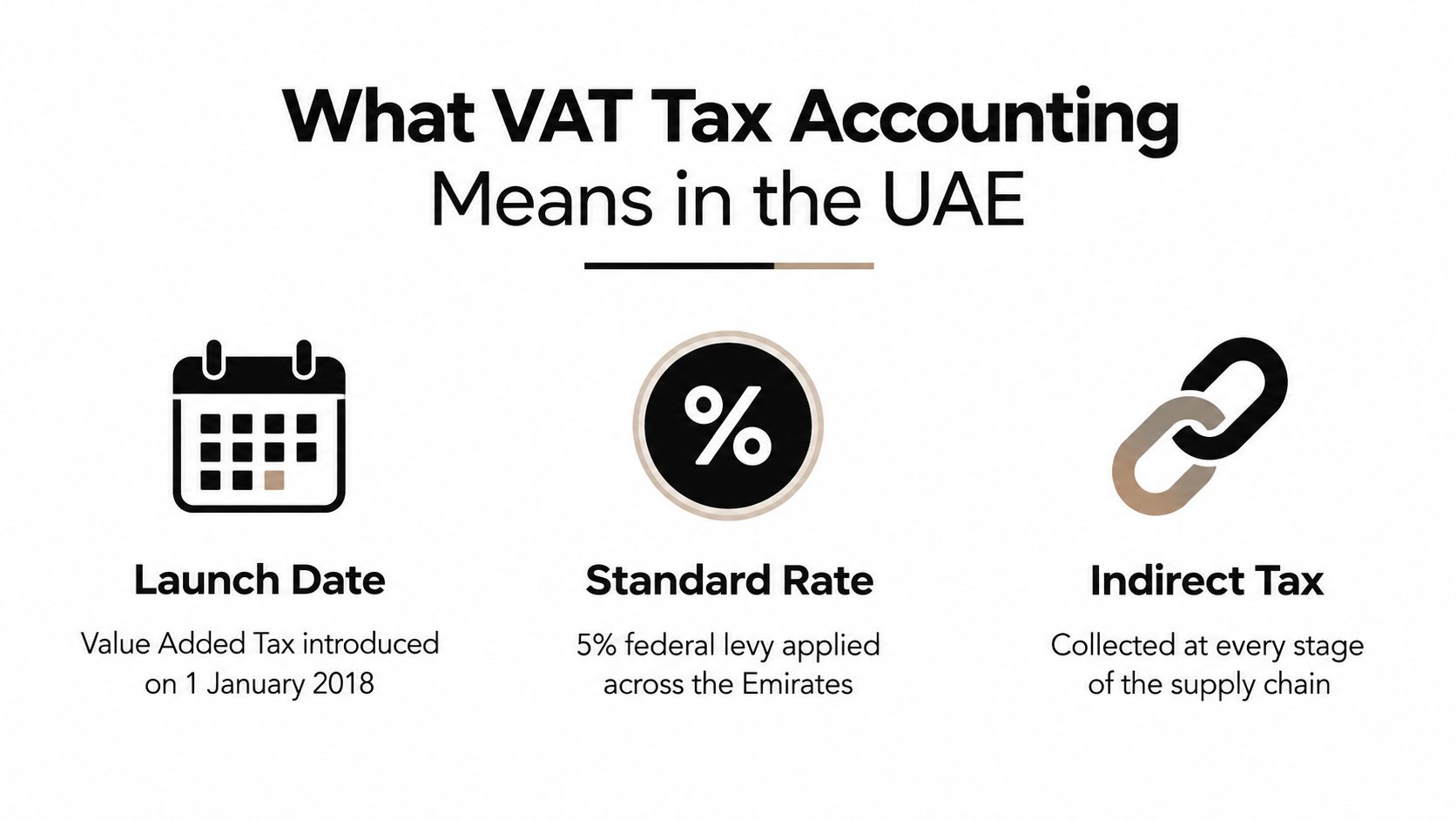
Value Added Tax is an indirect federal tax charged on qualifying goods and services as they pass through the supply chain. The UAE introduced its VAT regime under Federal Decree-Law No. 8 of 2017, and it took effect on 1 January 2018. The standard rate is 5% for most goods and services. The UAE VAT infographic summarises these fundamentals.
VAT is separate from corporation profit. A registered business collects output VAT from customers, pays VAT on eligible business purchases as input VAT, and reports the net position in its periodic return. The business works like a checkpoint in the supply chain: it collects tax, records it, claims supported credits, and settles the difference with the FTA. The final consumer generally carries the economic cost.
VAT tax accounting therefore connects four records: the sales ledger, purchase ledger, VAT control accounts, and supporting documents. If one record does not agree with the others, the return may be wrong even when the underlying sale or purchase is genuine.
The rules can apply to mainland companies, free-zone businesses making taxable supplies, and non-resident businesses with UAE VAT obligations. A free-zone licence does not place every transaction outside VAT. The supply, customer, place of supply, and applicable treatment determine how the transaction is handled.
The three ledger questions
For each transaction, ask three questions:
- Did we make a taxable supply? If so, record output VAT using the correct tax treatment in the sales ledger.
- Did we buy something for the business? If so, identify potentially recoverable input VAT and keep the required evidence in the purchase file.
- What must be reported or paid? Reconcile the VAT control accounts to the return before submission.
Zero-rated and exempt supplies require separate attention. A zero-rated supply has a VAT rate of zero and may still allow input VAT recovery in the relevant circumstances. An exempt supply is treated differently, and associated input VAT recovery can also differ. Use configured tax codes rather than memory, then record why the selected code applies.
A further control matters under the 2026 workflow: recoverable VAT credits should not sit forgotten in the ledger. Track them by period and transaction, alongside the normal register, invoice, file, and retain cycle, so the business can use eligible credits before they expire.
Practical rule: Treat VAT as money held for settlement, not ordinary sales income. Configure the accounting system to separate customer VAT from revenue as soon as each invoice is posted.
Registration Thresholds and the TRN Process
The registration decision turns on taxable turnover, not whether the business has made a profit. Mandatory VAT registration applies at AED 375,000, while voluntary registration is available at AED 187,500. These figures are confirmed in the FTA's VAT framework documentation, but founders should still check the current FTA requirements before applying.
Track taxable supplies on a rolling basis. Your working file should include signed contracts, recurring invoices, and expected sales, much like a fuel gauge showing how close the business is to a required action. Waiting for year-end accounts can leave the application late. Once the business becomes liable, the authorised person should apply through the FTA's EmaraTax platform and gather the supporting records.
What the TRN does
The Tax Registration Number, or TRN, identifies the registered taxable person in the FTA system. Add it to the legal entity profile in your accounting software, then connect that profile to invoices, contracts, customer records, and return preparation. This prevents staff from retyping the number and introducing errors. Test the invoice template before sending customer documents.
The application may require the trade licence, identity documents, authorised signatory details, banking information, business activities, and constitutional documents where relevant. The FTA needs a clear picture of who controls the entity, what it sells, and where its transactions occur.
| Threshold Type | Turnover | Action Required | Deadline |
|---|---|---|---|
| Mandatory registration | AED 375,000 | Apply for VAT registration when the business becomes liable | Follow the FTA application requirement after the threshold is reached |
| Voluntary registration | AED 187,500 | Apply if eligible and if voluntary registration suits the business | Apply through EmaraTax with supporting evidence |
For a practical walkthrough, follow this guide on how to register for VAT in the UAE. Use it to organise the application file, then confirm the latest administrative requirements with the FTA because procedures can change.
De-registration requires its own review. If taxable turnover stays below the relevant voluntary threshold for the required period, assess whether the business qualifies to cancel its registration. Complete the FTA process, submit the final return, and retain the supporting schedules and records for the required period after cancellation.
VAT Invoicing Rules Every Business Must Follow
A VAT invoice is the transaction's paper trail. It lets the customer, accountant, and FTA verify who supplied the goods or services, when the supply occurred, how the amount was calculated, and how much VAT was charged.
A full tax invoice normally shows the words “Tax Invoice”, a unique sequential number, the invoice date, and the supply date if different. It also identifies the supplier and, where required, the recipient, including the supplier's TRN. The document should describe the goods or services, state the quantity and unit price, show the taxable amount and VAT rate, record VAT in AED, and display the gross total. The FTA VAT Returns User Guide explains how supporting documentation and invoice details affect accounting and VAT recovery.
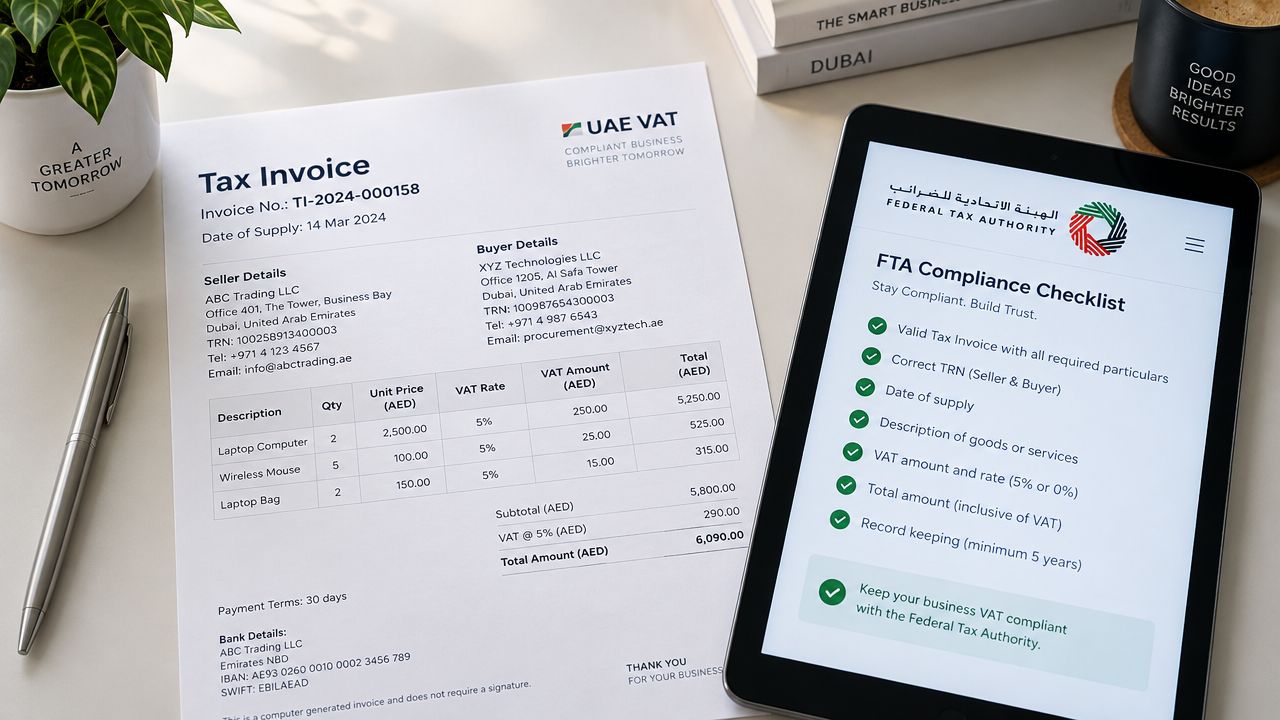
Check the invoice before it leaves the system
Use a short pre-issue review:
- Identity: Confirm the legal name, address, and TRN.
- Sequence: Check that the number is unique and follows the invoice series.
- Calculation: Separate the amount before VAT, VAT amount, and total.
- Description: Describe the supply clearly enough for an independent reviewer.
- Treatment: Confirm whether each line is standard-rated, zero-rated, exempt, or subject to another rule.
- Evidence: Link contracts, delivery records, and credit notes to the transaction file.
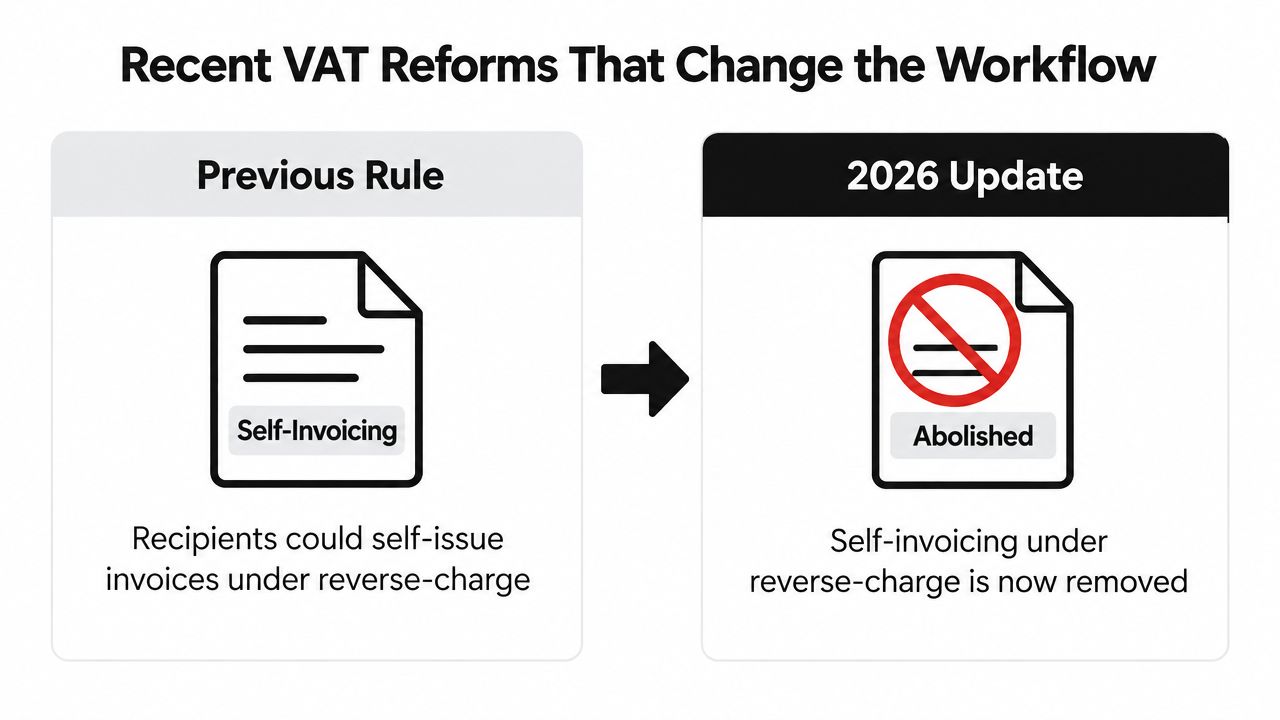
A simplified document may suit a low-value consumer transaction, but a transaction requiring a full tax invoice should not use that format. B2B supplies need careful review because a missing TRN or incorrect VAT treatment can create inconsistent records for both parties. Reverse-charge transactions also require particular care. Under the 2026 reform, businesses should not create self-invoices for reverse-charge supplies, so the accounting workflow must record the transaction using the correct supporting evidence instead.
Accounts payable carries the same control in reverse. A genuine expense does not automatically create recoverable input VAT. The business needs a valid tax invoice or equivalent evidence and must retain it with the transaction records. The AP workflow should capture the document, validate VAT details, code the expense, and connect the invoice to the ledger before filing.
Teams reducing manual checks can review how to automate AP processes. A controlled payment voucher form can connect approval, payment evidence, and the accounting entry. Keep these records organised because recoverable VAT credits now expire after five years, making timely document review part of invoice control.
Filing Periodic Returns and Paying the FTA
The core calculation is simple:
Net VAT position = output VAT on taxable sales minus recoverable input VAT on eligible purchases.
If output VAT exceeds recoverable input VAT, the business generally has a payment obligation. If recoverable input VAT is higher, the business may have a credit or refund position, subject to the supporting conditions and filing process. The arithmetic is easy. The difficult part is proving that every number belongs in the return.
Start with the sales ledger. Reconcile issued invoices, credit notes, debit notes, cancellations, and payments to the output VAT control account. Then review the purchase ledger for duplicate invoices, missing supplier TRNs, blocked claims, reverse-charge entries, and costs that don't relate to taxable business activity.
A controlled filing sequence
- Close the period: Stop late postings from entering the return without review.
- Run the VAT report: Extract output and input VAT by tax code.
- Test exceptions: Investigate unusual rates, manual journals, credit balances, and large movements.
- Match documents: Confirm invoices and equivalent evidence are retained.
- Reconcile: Tie the VAT report to the general ledger and bank or payment evidence.
- Submit and pay: Complete the return through EmaraTax and settle the amount due.
- Archive: Save the submitted return, calculation, payment confirmation, and working papers together.
The standard filing deadline and payment timing should be checked against the FTA notice for the assigned tax period. A business should maintain a filing calendar rather than rely on memory. This UAE VAT filing guide can support the preparation process, while the FTA portal remains the place for submission.
| Step | Standard Taxable Person | Excess Turnover |
|---|---|---|
| Transaction review | Reconcile sales and purchases before the return | Use tighter cut-off and exception controls |
| Return preparation | Calculate output VAT less recoverable input VAT | Review the larger transaction population and more frequent postings |
| Approval | Obtain management sign-off on the reconciliation | Escalate unusual items to a senior reviewer |
| Payment | Pay the amount shown as due through an approved method | Protect cash flow with earlier forecasting |
If you discover an error after submission, don't overwrite the accounting history. Identify the affected invoices, quantify the difference, assess whether a correction or voluntary disclosure is appropriate, and preserve the original return alongside the corrective working papers. A clean audit trail explains not only the corrected number but also why the original number was wrong.
Recent VAT Reforms That Change the Workflow
From 1 January 2026, affected reverse-charge imports follow a different document trail. The self-invoicing approach was abolished, so taxpayers no longer issue a tax invoice to themselves for those imports. The change is explained in DLA Piper's UAE VAT update. Finance teams should retain supplier invoices, contracts, payment evidence, delivery notes, and proof of the import date.
The practical shift is simple: the file should be built around external evidence. The reverse-charge calculation must connect to the supplier record and the relevant import date, rather than relying on an internally generated invoice.
Update the system, not only the checklist
Review these ERP settings:
- Document capture: Require supplier invoices and import records before posting the transaction.
- Reverse-charge coding: Keep separate purchase and output VAT codes where both sides of the entry are required.
- Date controls: Record whether the goods or services were imported on or after 1 January 2026.
- Approval workflow: Send missing contracts, delivery notes, or payment evidence to AP exceptions.
- Reporting: Produce a reverse-charge schedule that traces each return figure back to its source documents.
The second reform concerns recoverable VAT credits. An unused credit can expire after five years from the end of the tax period in which it arose. Certain 2020 and 2021 claims have a transitional deadline of 31 December 2026, according to the DLA Piper analysis. Treat that date as the stated transitional deadline, and confirm the applicable position before taking action.
Maintain an aged credit register with the originating period, balance, refund status, utilisation, and final action date. This works like an expiry tracker for tax balances: older entries receive review before newer ones.
Avoid estimating the AED impact until the ledger balance is confirmed. If an unused credit expires, the business loses the ability to use or recover it. The control objective is to identify each balance early, then choose and document a valid refund or utilisation action.
Building a Compliant Monthly Accounting Workflow
A VAT-ready business doesn't wait until filing week to discover that supplier invoices lack TRNs. It creates a recurring close process in which every team member knows what to capture, approve, reconcile, and archive.
Days one to five
Accounts payable should capture supplier invoices at source and reject documents that don't contain the required information. The buyer who approved the purchase should confirm the business purpose, while the accountant checks the supplier identity, VAT treatment, and supporting contract or delivery evidence.
Flag imported services and goods separately. They need a reverse-charge review under the 2026 workflow, with supplier documents and import timing attached to the transaction rather than generated through a self-invoice.
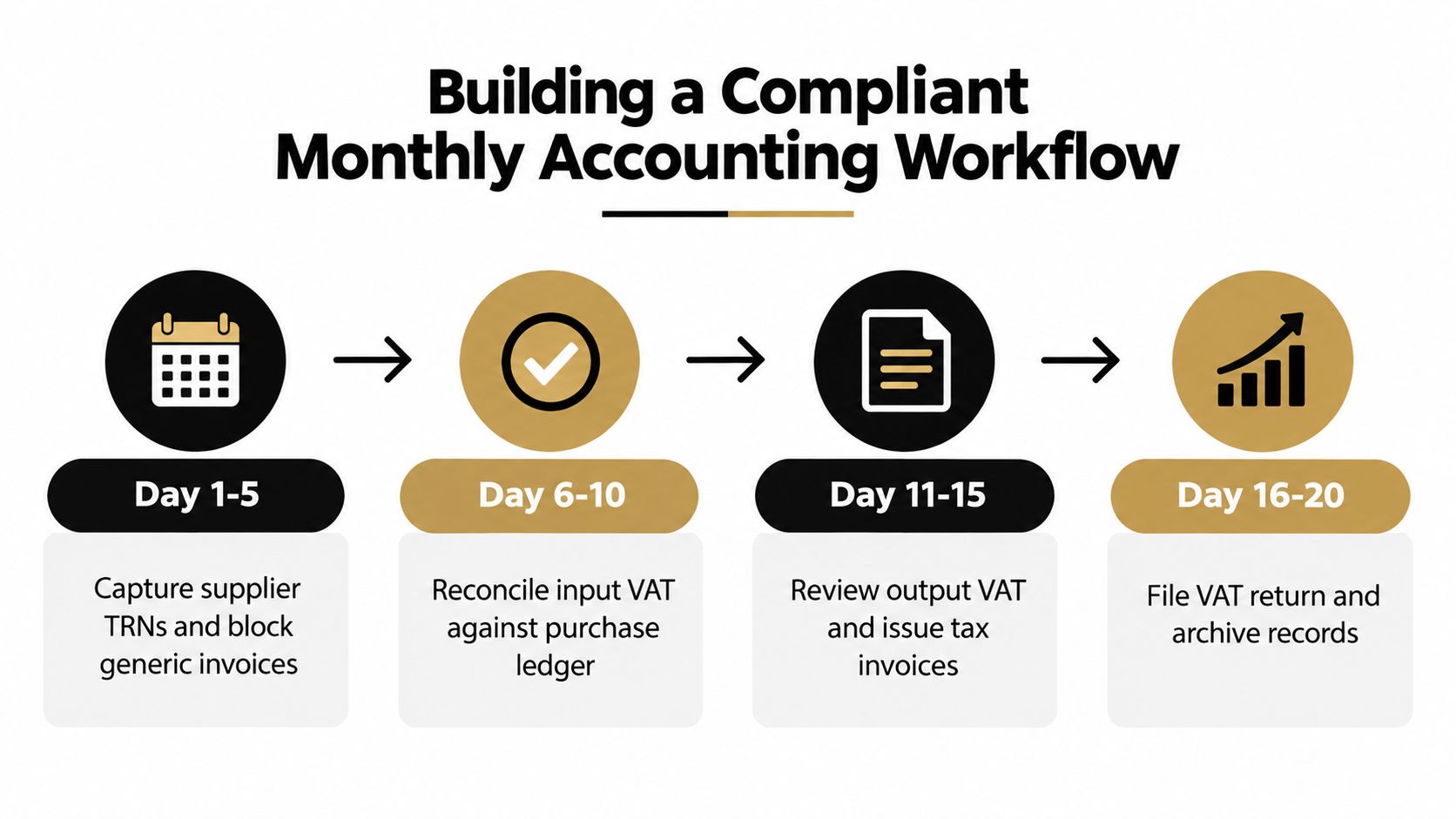
Days six to fifteen
The purchase ledger review should match recoverable input VAT to retained invoices and payment evidence. Sample petty cash, employee expenses, mileage, and card transactions. A receipt may prove that money was spent, but it doesn't automatically prove that input VAT is recoverable.
The sales team should issue compliant tax invoices when the supply is made and send credit notes through the same approval path. Review customer master data, TRNs, tax codes, and outstanding receivables. A credit note that never reaches the VAT ledger can leave output VAT overstated.
Days sixteen to twenty
Run the VAT report, reconcile it to the general ledger, and investigate differences before management approval. Your software should produce transaction-level reports for output VAT, input VAT, reverse charge, credit notes, exempt supplies, and the VAT control account.
Zoho Books, Xero with a UAE VAT configuration, QuickBooks Online, Odoo, and Microsoft Dynamics can support different levels of this process. The right platform is the one that produces an auditable tax report, preserves source documents, controls user permissions, and exports the schedules your accountant needs. Review the exact UAE functionality before selecting or configuring a system.
At year-end, review exempt and zero-rated supplies, assess input VAT recovery treatment, inspect the aged credit register, and confirm that electronic records remain readable and retrievable. Retention isn't merely a storage task. It's part of proving the return.
VAT Audits, Penalties, and How to Prepare
An FTA audit is easier to handle when records follow the path of a reported figure. A review can begin with a VAT return, a refund claim, a mismatch between third-party information and the ledger, or a wider compliance check. The auditor may review submitted documents remotely or inspect records and processes at the business premises.
For each material figure, the founder should be able to trace the VAT return to the general ledger, invoice, contract, delivery evidence, and payment record. A reverse-charge entry needs a second trail: supplier documentation, import timing, the tax calculation, and the accounting treatment.
Build the audit file continuously
Keep these working papers organised:
- Returns: Submitted VAT returns and confirmation records.
- Ledgers: General ledger, trial balance, sales ledger, purchase ledger, and VAT control accounts.
- Invoices: Tax invoices, supplier evidence, credit notes, and debit notes.
- Calculations: Input VAT eligibility reviews, reverse-charge workings, and refund schedules.
- Commercial proof: Contracts, delivery notes, export evidence where relevant, and payment records.
- Governance: Approval logs, correction notes, voluntary disclosures, and management sign-off.
A late audit file often contains unexplained gaps, inconsistent dates, and unsupported manual adjustments. Reconcile monthly instead. The accountant can then investigate a difference while the transaction, supplier, and approval history are still familiar.
An auditor does not only test the final VAT figure. They test whether your records explain how you reached it.
Penalty consequences depend on the violation and the applicable FTA rules. Penalty schedules and administrative treatments may change, so use the current FTA position for a live case instead of relying on an old internal spreadsheet.
| Violation | Penalty | Additional Consequence |
|---|---|---|
| Late registration | Apply the current FTA administrative penalty | Registration delay and increased compliance exposure |
| Late return | Apply the current FTA late-filing penalty | The return remains outstanding until submitted |
| Late payment | Apply applicable payment consequences | Cash cost and unresolved tax liability |
| Unsupported recovery | Input VAT may be denied | Rework, amended filing, and possible assessment |
Digital businesses selling to customers across jurisdictions can also review how Creem manages digital VAT penalties for process ideas. The practical lesson is to assign an owner, attach evidence to each transaction, and monitor exceptions before they become a formal dispute. A clear audit file turns an inspection from a document hunt into a controlled review.
Choosing the Right VAT Accounting Partner
The right adviser depends on the complexity of your transactions, not just the size of your office. A founder with a simple local trading model needs a different service from a group handling imports, exempt income, related-party charges, and refund claims.
Match the service to the business
Early-stage businesses often need help deciding whether registration is appropriate, preparing the TRN application, configuring the chart of accounts, and setting up invoice controls. They may prefer a pay-per-return arrangement while transaction volume remains modest, provided the service includes reconciliation rather than only form submission.
Growing SMEs need repeatable monthly bookkeeping, supplier-document controls, reverse-charge review, credit ageing, and management reporting. A monthly retainer can make sense because the work happens throughout the period, not only on the filing deadline.
Groups and family offices usually need stronger governance. Look for consolidated reporting, intercompany reconciliations, audit support, documented tax positions, and representation during FTA correspondence. The provider should understand how VAT schedules connect to wider financial statements and internal controls.
Ask before signing
Use the first meeting to test the operating model:
- Tax credentials: Ask whether the provider is an FTA-registered tax agent where representation is required.
- Software: Confirm which accounting platform they use and whether it produces transaction-level VAT reports.
- Review process: Ask who reviews invoices, reconciliations, reverse-charge entries, and credit balances.
- Filing support: Confirm the response time during filing windows and the procedure for late documents.
- Audit scope: Establish whether FTA correspondence, fieldwork, voluntary disclosures, and refund support are included or billed separately.
- Commercial model: Compare pay-per-return, monthly retainer, and fully outsourced finance based on the work your business requires.
Automation can reduce repetitive tasks, but it doesn't replace judgement over place of supply, exemption, evidence, or recoverability. If you're assessing financial operations with AI employees, ask how human review, approvals, audit logs, and exception handling remain in the process.
Smart Classic Business Hub offers UAE VAT registration guidance, VAT-compliant accounting, bookkeeping, and tax filing support alongside broader business services. The practical test is whether the engagement gives your team accurate ledgers, complete evidence, timely returns, and a clear owner for every unresolved item.
If you need help turning VAT obligations into a working monthly process, speak with Smart Classic Business Hub about VAT registration support, compliant bookkeeping, return preparation, and audit-ready record management. Share your business activity, registration status, and current accounting setup so the team can recommend a practical service structure for your UAE operation.