
A new hire arrives in Dubai ready to work, but the visa file is still moving through the process, the Emirates ID application has no clear owner, payroll hasn't been configured, the laptop is waiting for a password, and the manager hasn't agreed the first priorities. That situation creates more than a poor welcome. It can expose gaps in legal status, payroll accuracy, client-data protection and early performance.
An effective employee onboarding checklist works as a UAE operating-control system. It connects pre-arrival documents, PRO and immigration tracking, contract compliance, payroll and tax settings, IT permissions, training, team integration and first-90-day reviews. A UAE checklist is often structured as 57 tasks across five phases, pre-boarding, Day 1, Week 1, Month 1 and Month 3+, including the MOHRE and ICP chain, work permits, contracts, payroll, attestation and insurance steps (UAE onboarding checklist).
The eight stages below give founders and SME managers a practical workflow. Confirm current requirements with the relevant UAE authorities, your free-zone or mainland authority, and qualified legal, immigration or payroll advisers, because procedures can change. If you also employ people outside the office, connect this process with your effective onboarding for remote teams.
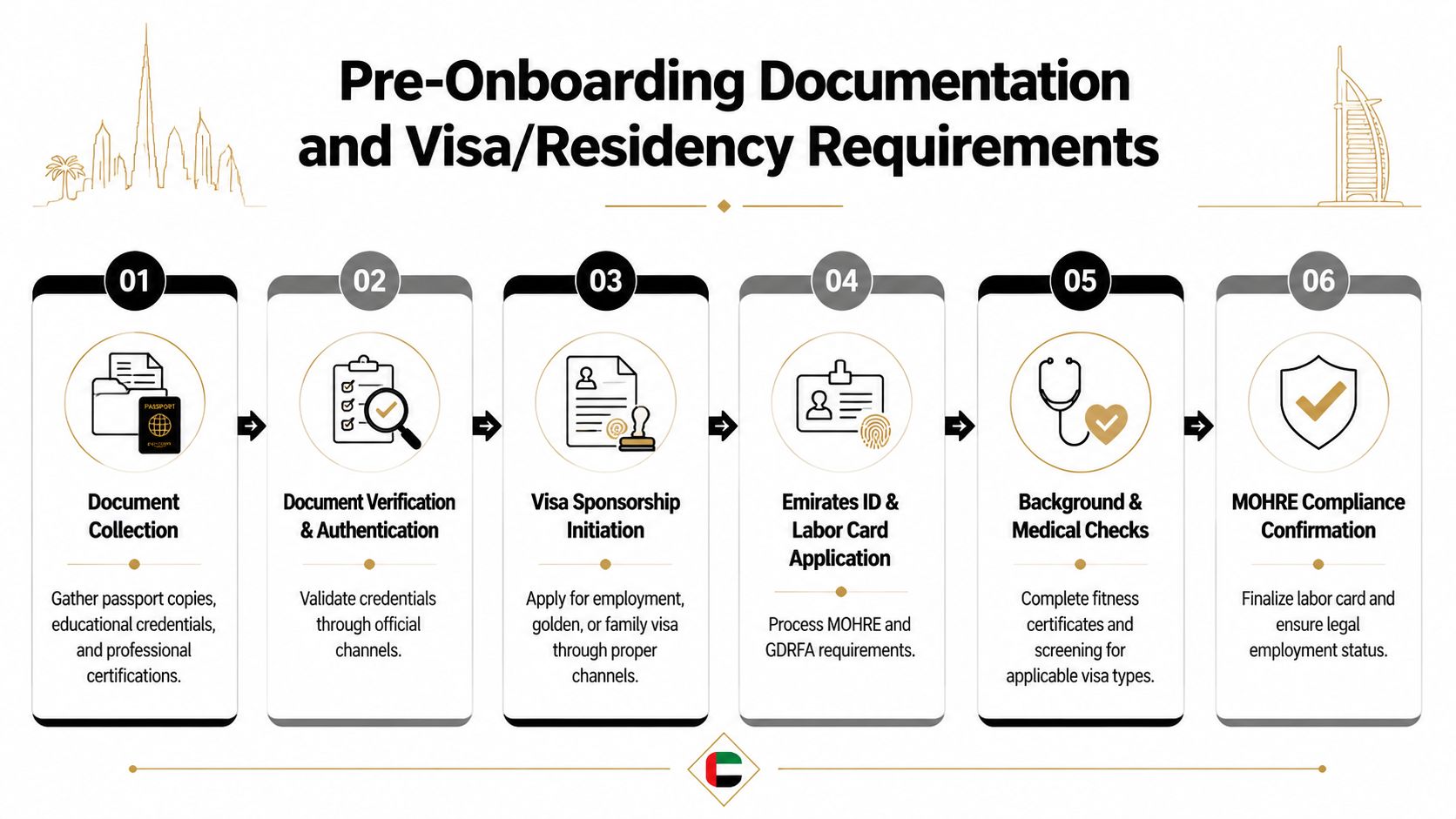
1. Pre-Onboarding Documentation and Visa and Residency Requirements
Open the employee file once the offer is accepted. Request the documents for the intended employment or residency route, then compare names, dates and other details across the offer letter, passport, application forms and HR record. The file may include a passport copy, photograph, educational credentials, professional certifications, current visa details, Emirates ID information where applicable, emergency contacts and documents that require attestation.
Assign one owner before the employee arrives. A founder can delegate submissions to a PRO, HR manager or immigration adviser, but the owner must track the application status, missing documents, authority responses and next action. Record each step in the same workflow as the planned start date, payroll setup and system-access request.
Use separate paths for employment, family, investor, freelance and golden visa cases. A technical employee joining a newly formed UAE company may follow a different sequence from a senior executive relocating under an established sponsorship arrangement. Confirm the route before promising a start date.
UAE onboarding connects to Federal Decree-Law No. 33 of 2021. The probation period is capped at six months. Practical guidance reports that expatriate onboarding commonly takes two to four weeks, while UAE nationals are often onboarded in one to two weeks, because the administrative steps differ (UAE hiring and onboarding laws). Use these as planning ranges, not guarantees, and confirm current requirements with the relevant authority.
Assign the file owner before arrival
Your control sheet should show:
- Document status: Mark every item as requested, received, checked, submitted or rejected.
- Government responsibility: Name the next actor, whether HR, the PRO, the employee or an authority.
- Start-date risk: Flag anything that could delay lawful commencement, payroll registration or company-system access.
- Secure storage: Keep copies in a restricted HR or compliance repository, accessible only to people who need them.
- Employee briefing: State what the employee must provide, attend or sign, and what the company will handle.
Follow dedicated UAE residence visa guidance instead of relying on informal messages. Include medical testing, Emirates ID processing, work permit progress, contract registration and insurance requirements. Keep the checklist connected to the contract, payroll and VAT settings so an incomplete visa file cannot disappear between departments.
2. Role Clarity, Job Description, and Expectations Setting
A new consultant arrives expecting client work, while the founder expects help with VAT compliance and internal administration. That mismatch can consume the first weeks and create avoidable performance disputes. Convert the hiring discussion into a role document before Day 1.
Set out the position title, reporting line, core responsibilities, decision rights, priorities, collaboration points and expected standards. For a UAE consultancy, separate client delivery, VAT-compliance work, company-formation support, corporate-finance analysis and internal administration. In a startup, one early employee may cover several functions, but the document should identify decisions requiring founder approval.
Keep the priority list realistic. If every possible task is labelled urgent, the employee cannot judge what to do first.
Build a role pack the manager can use
Use these fields:
- Purpose of the role: Describe the business outcome the position supports.
- First priorities: Identify the work the employee should understand during the opening weeks.
- Success measures: Define the indicators the manager will review, without presenting untested targets as commitments.
- Decision boundaries: Record approval levels, escalation routes and restricted client, financial or hiring decisions.
- Development path: Note required training, mentoring and possible capability growth.
- Review points: Schedule discussions during the first 90 days and update the document when the original assumptions prove wrong.
Write objectives so completed work is recognisable. Specify deliverables, quality requirements, deadlines and the evidence used in review. A client-facing consultant may need response standards, document-review procedures and escalation rules. A finance employee may own reconciliations and records while requiring approval for payment or reporting decisions.
Practical rule: If the manager cannot explain how performance will be assessed in a short conversation, the job description is not ready.
Discuss the role pack with the employee, invite questions and confirm the first assignment. Request acknowledgement for the record, but do not treat a signature as proof of understanding. Store the agreed version with the onboarding control sheet so the founder, manager and HR team work from the same expectations.
Review the role at the first-month and 90-day meetings. Update it when the business, client portfolio or reporting structure changes. This keeps role clarity connected to the UAE onboarding workflow, rather than leaving performance expectations in informal messages.

3. System Access, IT Infrastructure, and Technology Setup
A new hire who cannot access email, shared files or core software cannot contribute on the first day. A new hire with excessive permissions creates a different problem, exposing client, payroll or financial records. Treat technology setup as an operating control connected to the wider UAE onboarding workflow, not as a last-minute IT task.
Start with a role access map. A consultant may need a client-management system, secure document storage, video-conferencing tools and accounting software for VAT-related work. An administrator may need scheduling and finance access without permission to download sensitive client files. The founder should approve exceptions, while IT or an external provider applies the agreed profile.
Prepare hardware and accounts before the start date. Test sign-in, multifactor authentication, approved cloud storage, VPN access where required and account recovery. Do not send credentials through an insecure channel. Record the asset number, assigned user, software licence and return process in the onboarding control sheet.
Set up the working environment
Office, hybrid and remote arrangements require different controls. Decide who ships equipment, how the recipient is verified, how the device is configured and how support will be provided if the employee is outside the UAE on Day 1. UAE onboarding guidance covers digital portals, permit and payroll workflows, remote hardware shipping and related controls, while the employer remains responsible for device custody and cybersecurity (UAE onboarding and offboarding checklist).
Before the employee starts, confirm:
- Role-based access: Grant only the systems and folders required for the job.
- Security controls: Activate MFA, endpoint protection, encryption and password-manager access.
- Day-one test: Check email, calendar, collaboration tools, VPN and essential business systems.
- Asset register: Record equipment, owner, condition, warranty and return status.
- Access review: Remove temporary, unused or excessive permissions after the employee settles into the role.
For finance and consultancy work, connect software selection to permission design, VAT workflows, document retention and payroll handoffs. A business assessing accounting software for UAE operations should test those workflows before assigning live records. This prevents a platform purchase from creating access or reporting problems later.
Review permissions after the first working period and again when responsibilities change. Keep the access map, asset register and approval record together so the founder, manager and service provider can verify who has access to what.

4. Compliance Training, Legal Agreements, and Contract Finalization
Contract finalization is a control point, not an administrative formality. Reconcile the approved offer with the employment contract, checking the role, salary components, allowances, start date, work location and other material terms. UAE onboarding guidance connects work permit approval, contract registration, residency processing, payroll setup and insurance enrollment. It also notes that the contract may need to match the offer exactly and may require Arabic submission for MOHRE, as outlined in this UAE HR onboarding checklist.
Before requesting a signature, have the manager review the document and confirm who submits or registers it. Store the executed version in a controlled repository and give the employee a copy. Obtain legal advice for confidentiality, intellectual property, restrictive provisions, data handling and clauses tied to the role. Templates can speed drafting, but UAE-specific review still determines whether the agreement and process are suitable.
Training should reflect the employee's actual exposure to business risk. A consultant handling client accounts needs guidance on confidentiality, secure document sharing, professional conduct and the firm's VAT or tax procedures. A finance employee needs clear approval controls, recordkeeping requirements and fraud-risk guidance. International teams also need practical instructions on workplace conduct, communication norms and escalation.
Use a completion register that connects each requirement to evidence:
- Agreement status: Employment contract, confidentiality terms, intellectual-property provisions and policy acknowledgements.
- Training assignment: Course, owner, deadline and risk addressed.
- Evidence: Signed document, attendance record, assessment or manager confirmation.
- Storage location: Controlled repository for retrieval during audits or reviews.
- Refresh trigger: Policy change, role change, audit finding or renewed training requirement.
For government-process questions, use Ministry of Labour inquiry services and check compliant hiring templates before adapting an agreement. Digital signatures improve tracking, but the company remains responsible for selecting the correct document, approvals and submission process. Tie the register to the visa, PRO, payroll and 90-day review tracker so unresolved compliance items remain visible to the founder and manager.
5. Company Culture, Values, and Team Integration
Culture becomes visible through daily decisions. Show the new employee how the company treats clients, responds to mistakes, communicates urgency, protects confidential information and resolves disagreements. Link each value to a real workplace example, rather than presenting values as statements detached from the work.
Start with a personal, practical welcome. The direct manager should explain the schedule, clarify the first priorities and introduce the people the employee will depend on. Assign a buddy for informal questions about communication channels, meeting habits, office routines and information sources. This support helps expatriate hires adjust to a new workplace and gives remote employees access to norms they cannot observe in the office.
Use the company's actual work to explain team expectations. In a professional-services SME, culture may appear in how consultants prepare a client meeting, review a VAT file, escalate uncertainty or communicate a delay. Invite the new hire to a suitable project briefing early. Limit confidential information until the employee completes relevant training and receives the required system permissions.
6. Training Programs, Skill Development, and Role-Specific Competencies
Training is an operating control, not a folder of presentations. For each role, define the work the employee must perform, the errors that could create client, compliance or financial risk, and the evidence required before access or responsibility increases.
For a UAE business-services firm, the pathway may cover company-formation routes, client-document requirements, VAT-compliance workflows, accounting software, financial analysis and client communication. A startup generalist may need training on the CRM, sales process, supplier approvals, internal reporting and data-security requirements. Match the sequence to the employee's experience and the consequences of mistakes.
Build the learning path around proof
Use a staged plan:
- Foundations: Explain company services, policies, terminology, systems and escalation routes.
- Observation: Have the employee shadow meetings, reviews or internal workflows.
- Practice: Assign sample or low-risk tasks before live work.
- Supervision: Review important outputs while the employee handles real assignments.
- Evidence: Store completed exercises, knowledge checks, manager feedback and training records.
- Continuation: Add advanced skills, certifications or cross-functional work after core competence is demonstrated.
Pair each learning block with a manageable assignment. This lets the manager identify unclear instructions early and connect training records to the employee's 90-day review. Standard operating procedures, short videos and annotated examples are useful when employees can find them quickly and the team updates them after a process change.
Record who approved each stage, which systems the employee may use, and which tasks still require review. That trail helps founders coordinate managers, PRO responsibilities, payroll settings and IT permissions without treating onboarding as separate administrative tasks.
A mentor needs defined boundaries. Schedule regular question-and-answer sessions, list decisions requiring manager approval and state that mentoring does not replace formal supervision. For client-facing work, require supervised participation until the employee consistently meets quality and confidentiality standards. Keep training open after onboarding, especially when a UAE process, software workflow or client requirement changes.
7. Performance Metrics, Goals, and 30-60-90 Day Expectations
A new hire can appear busy while still misunderstanding approvals, quality standards or the purpose of the role. Build the first 90 days around visible decisions, evidence and scheduled conversations. Set a limited number of outcomes for each stage, define how the manager will assess them and give the employee a clear way to report obstacles before a review.
Use the first checkpoint to confirm role readiness, working relationships, required training and the quality of early outputs. The next checkpoint should test whether the employee can manage agreed responsibilities with less supervision and work effectively with other teams. At the final review, assess sustained performance, development needs, probation decisions where relevant and whether the job description still matches the work being performed.
Track only measures that support a management decision. Useful indicators include 90-day retention, probation confirmation ratio, new-hire satisfaction, onboarding-step completion and time to productivity, as noted earlier. A founder-led company may need only one tracker showing each item as complete, late, blocked or misunderstood. Connect that tracker to the same workflow used for visa and PRO follow-ups, contract status, payroll setup, IT permissions and training records, so a delay has a named owner.
Make manager check-ins operational
Every check-in should produce an action record:
- Completed work: Review documents, tasks, approvals or other evidence rather than relying on general impressions.
- Blocked work: Identify missing access, unclear approval rights, training gaps or client restrictions.
- Required adjustment: Change the task, support level or priority when the original plan does not fit the role.
- Next control point: Record the action, owner and review date.
Keep feedback concrete. “Improve communication” becomes useful only when the manager identifies the missed update, required format and next opportunity to practise it. Client-facing roles may need quality, relationship and volume measures together. Internal roles should include accuracy, dependability, collaboration and process control alongside completed work.
Document the probation review carefully. Compare results with the agreed expectations, record the support provided, invite the employee's response and confirm the next employment or development decision through the appropriate UAE process. This record also shows whether the onboarding system prepared the employee properly or whether a control, owner or expectation needs correction.
8. Benefits Administration, Compensation Finalization, and Workspace and Facilities Setup
A new hire can be legally cleared and still be unable to work or receive accurate pay. Close the final operating controls before the first pay cycle: written compensation terms, benefits status, payroll fields, workspace access and support ownership.
Give the employee a clear breakdown of basic salary, allowances, bonuses, deductions, pay dates, leave arrangements, insurance coverage and applicable end-of-service provisions. State which enrolments the employee must complete, which items the company activates and who answers questions. Match these details to the employment contract, payroll record and legal setup.
Confirm the current position on mandatory health insurance as a prerequisite for residency from 1 January 2025 for the employee's emirate, authority and visa route before acting. The insurer, payroll provider and adviser should confirm coverage and terms before HR makes any promise. Record the policy status, member details and process for raising questions.
Make the workplace usable on day one
Facilities readiness depends on the working model. An office employee may need a desk, device, badge, building access, Wi-Fi instructions, meeting-room guidance, parking information and emergency procedures. A hybrid employee needs office-booking rules and clear equipment custody. A remote hire needs secure delivery, device setup support, a home-working risk check and an IT escalation route.
Use one handoff record across finance, HR, IT and facilities. Mark each item with an owner and evidence, such as a payroll verification, activated policy, tested device or issued access credential.
- Payroll verification: Compare salary fields, bank details, start date and payment instructions before the first pay cycle.
- Insurance confirmation: Record active status, member information and the employee's support route.
- Handbook delivery: Provide leave procedures, working arrangements, conduct rules and contact points in accessible language.
- Workspace readiness: Test the desk, device, badge, connectivity and required software.
- Employee acknowledgement: Capture receipt and explain the information. A signature alone does not show understanding.
- Change control: Assign ownership for updates to the handbook, payroll record and benefits guide when requirements or company policies change.
A green status is valid only when the underlying evidence exists. The handoff is complete when the employee can lawfully work, receive the agreed pay, access the right tools and identify where to get help. That gives the founder one operating view instead of separate HR, finance, IT and facilities promises.
8-Point Employee Onboarding Comparison
| Item | 🔄 Implementation complexity | ⚡ Resource requirements | 📊 Expected outcomes | 💡 Ideal use cases | ⭐ Key advantages |
|---|---|---|---|---|---|
| Pre-Onboarding Documentation and Visa/Residency Requirements | High 🔄, multi-agency legal steps | Medium–High ⚡, PRO services, translations, fees | Legal work authorization; reduced compliance risk 📊 | Hiring expatriates; visa sponsorship; company formation 💡 | Ensures legal status; audit trail; faster processing when started early ⭐ |
| Role Clarity, Job Description, and Expectations Setting | Medium 🔄, drafting, stakeholder alignment | Low–Medium ⚡, HR time, manager input | Clear expectations; measurable performance 📊 | Knowledge roles; scaling teams; performance reviews 💡 | Reduces ambiguity; aids fair reviews and retention ⭐ |
| System Access, IT Infrastructure, and Technology Setup | Medium 🔄, coordination with IT and security | Medium–High ⚡, hardware, licenses, security tools | Day‑one productivity; secure access and audit trails 📊 | Remote/hybrid work; client-data handling; consultancies 💡 | Lowers support tickets; protects sensitive data ⭐ |
| Compliance Training, Legal Agreements, and Contract Finalization | High 🔄, legal drafting and regulatory training | Medium ⚡, legal counsel, training resources | Legal protection; regulatory compliance; documented consent 📊 | Regulated industries; client‑confidential roles; UAE operations 💡 | Mitigates litigation risk; protects IP and client confidentiality ⭐ |
| Company Culture, Values, and Team Integration | Low–Medium 🔄, events, mentorship coordination | Low ⚡, leadership time, informal activities | Faster team bonding; improved engagement and retention 📊 | Consulting firms; client‑centric teams; distributed teams 💡 | Accelerates belonging and morale; improves collaboration ⭐ |
| Training Programs, Skill Development, and Role-Specific Competencies | Medium–High 🔄, curriculum design & delivery | High ⚡, trainers, materials, time, assessment tools | Competency, consistent service quality, faster ramp-up 📊 | Technical, regulated, or client-facing roles; consultancies 💡 | Ensures capability; reduces errors; supports career growth ⭐ |
| Performance Metrics, Goals, and 30-60-90 Day Expectations | Medium 🔄, goal setting and review cadence | Low–Medium ⚡, manager time, tracking tools | Structured ramp-up; early issue detection; objective reviews 📊 | Sales, client delivery, startups with rapid onboarding 💡 | Clear accountability; measurable progress and course correction ⭐ |
| Benefits Administration, Compensation Finalization, and Workspace & Facilities Setup | Medium–High 🔄, legal, payroll and logistics coordination | High ⚡, payroll systems, insurance, facilities setup | Transparent compensation; legal compliance; functional workspace 📊 | Onsite teams; UAE operations (DHAMAN, gratuity); hybrid workforce 💡 | Reduces disputes; improves satisfaction; ensures statutory compliance ⭐ |
Turn the Checklist Into a Repeatable UAE Process
An employee onboarding checklist becomes valuable when it can run consistently for the next hire, not only when a founder remembers every step. Convert this article into an onboarding pack with a master task list, role-specific access profile, document folder structure, manager guide, first-week agenda, training plan, payroll handoff and 90-day review form. Give every task an owner, due date, status and evidence field.
Use one central tracker, but don't collapse every responsibility into one person. Immigration and PRO work, employment documentation, payroll, tax and VAT settings, IT security, benefits and data protection involve different risks and may require different advisers. The founder should have a single view of progress while each responsible person remains accountable for the accuracy of their own work.
Review the process at practical control points:
- End of the first week: Confirm legal and administrative blockers, system access, training gaps and manager support.
- Day 30: Check early deliverables, role clarity, employee experience and missing documentation.
- Day 60: Review responsibility growth, technical competence, collaboration and revised development needs.
- Day 90: Complete the performance and probation discussion, assess the onboarding process and record improvements for the next hire.
UAE procedures can differ by mainland or free-zone setup, emirate, nationality, visa route and role. Verify current requirements with the relevant authority or a qualified adviser before collecting documents, submitting applications, activating insurance, registering contracts or changing payroll. A checklist is a control tool, not a substitute for professional advice.
The UAE-linked onboarding evidence also shows why managers shouldn't stop at paperwork. A quarter of surveyed junior employees said poor onboarding made them more likely to leave, while two-thirds said they didn't feel supported (UAE onboarding support findings). That makes first-week support, manager briefings and pre-arrival provisioning practical retention controls, especially when relocation and visa timing add uncertainty.
For founders who need help joining these workstreams, Smart Classic Business Hub can be relevant for PRO services, legal support, VAT-compliant accounting, recruitment assistance and workspace arrangements. Its business-support offering is designed around UAE establishment and ongoing compliance, so an SME can keep the onboarding owner focused on decisions while specialists handle defined administrative and advisory tasks. You can also use this structured onboarding guide as a reference when turning the workflow into a reusable pack.
Smart Classic Business Hub can help UAE founders coordinate PRO and visa support, legal documentation, VAT-compliant accounting, recruitment assistance and workspace solutions connected to employee onboarding. Visit Smart Classic Business Hub to discuss the controls your next hire needs and organise the relevant support before Day 1.