
The standard resident Emirates ID fee is AED 100 for each year of validity. That's only the ICP base charge, so your final bill can also include online service, typing-centre, delivery, urgent-processing, or late-renewal fees.
You're probably checking the amount because a renewal notice has arrived, a visa application is moving forward, or your PRO has sent an invoice that's higher than the figure you saw online. The difference usually isn't a mystery. The published Emirates ID fees describe the government charge, while the amount you pay out of pocket depends on who files the application, which service channel you use, and whether the card is being renewed, replaced, or corrected.
A practical budget separates four cost groups:
- ICP base fee: Calculated mainly from the card's validity period and category.
- Service or typing fee: Added when a centre, PRO office, or intermediary submits the application.
- Urgent or optional charges: Applied when you request faster processing or additional handling.
- Late penalties: Charged when renewal is completed more than one month after expiry.
Before approving an invoice, ask for each line item separately. You should be able to see the base fee, the filing charge, any delivery or urgent-service amount, and any penalty rather than receiving one unexplained total. If your business manages several employees, that discipline also makes it easier to reconcile identity records with other official documents, including information extracted through tools such as ID card extraction with Matil. For broader UAE identity guidance, you can also review UAE national identity information.
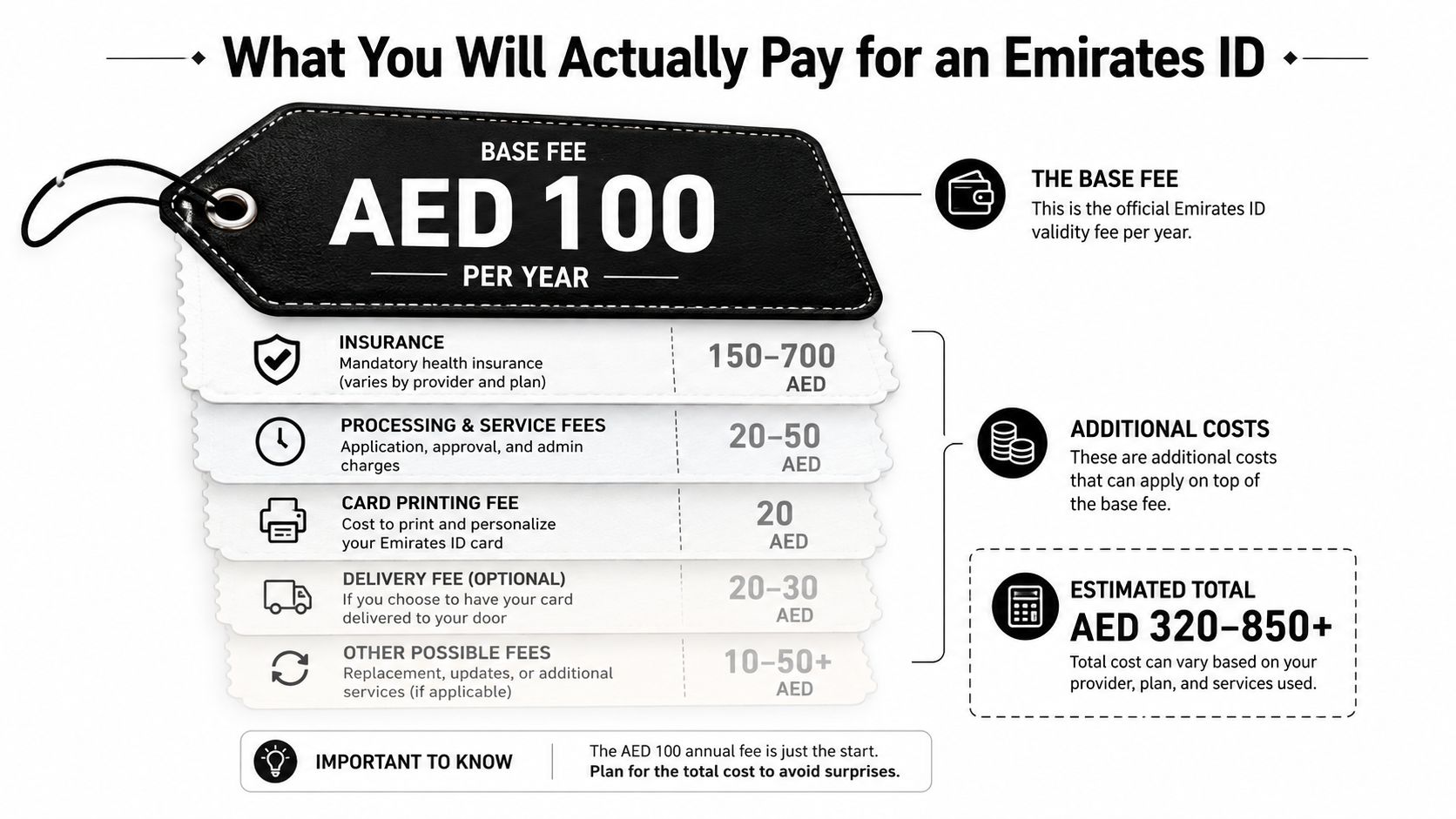
What You Will Pay for an Emirates ID
A resident reviewing an Emirates ID invoice may see the official fee first, then separate amounts for filing, delivery, or faster processing. The official ICP service page sets the base calculation at AED 100 for each year of residence validity. A two-year card therefore carries a different base fee from a card issued for a longer residence period.
Your filing channel determines how much is added. Applying through the ICP website or smart app usually keeps the transaction close to the government charge. A typing centre or Amer centre may add data entry, document scanning, submission, and follow-up fees. Delivery can appear separately, and urgent processing is outside the ordinary base calculation.
The four charges to check
- Base issuance or renewal fee. ICP calculates this according to the cardholder's category and validity period.
- Electronic or typing service fee. The provider may charge for preparing the form, scanning documents, submitting the application, and monitoring its progress.
- Urgent service fee. ICP lists urgent service at AED 150, separate from the ordinary fee.
- Late-renewal penalty. A card left unrenewed beyond the applicable grace period can attract a separate penalty.
Ask the provider to show the government charge and its own service fee on separate lines. This also helps businesses reconcile employee records with other identity documents, including files prepared through ID card extraction with Matil. For related guidance, review UAE national identity information.
A portal renewal may look inexpensive until typing, delivery, or optional processing is added. Those charges can be legitimate, provided the invoice identifies who receives each amount and what service it covers.
Standard Emirates ID Fees by Residency Category
The fee structure splits sharply between residents and nationals, and the per-year figure can mislead. A resident's charge follows the length of residence validity, while UAE and GCC nationals use fixed card terms. Investors and long-term visa holders may fall under a separate calculation.
| Residency Category | Validity Period | Total ICP Fee | Per-Year Cost |
|---|---|---|---|
| Resident | 2 years | AED 200 | AED 100 |
| Resident | 5 years | AED 500 | AED 100 |
| UAE or GCC national | 5 years | AED 100 | AED 20 |
| UAE or GCC national | 10 years | AED 200 | AED 20 |
| Investor or 10-year golden visa holder | 10 years | AED 1,000 | AED 100 |
| Child under 15 | 5 years | AED 100 | AED 20 |
For residents, calculate the government charge from the residence period shown in the application record. The ICP fee schedule sets the charge at AED 100 for each year of residence validity. Confirm the visa or residence record before quoting the total, especially when the requested ID term follows the underlying residency.
National and GCC categories require a different check. Their charges correspond to the available card validity, so applying the resident rate to a five-year or ten-year national ID would produce the wrong estimate. The table's annual equivalent is useful for comparison, not necessarily the amount used to calculate the application.
The child category also shows why the annual figure needs context. A five-year card can carry a lower apparent yearly cost than a resident card, even though the payable amount is tied to that category and term.
These figures are ICP fees only. They exclude typing-centre handling, delivery, and optional urgent processing. On a PRO invoice, keep the government amount separate from each filing or delivery charge so the client can see the actual out-of-pocket total.
Renewal, Replacement, and Correction Charges
The service type must match the problem recorded on the Emirates ID. Renewal, replacement, and correction trigger different charges, and selecting the wrong option can delay approval or require a new submission.
| Service Type | When It Applies | Fee (AED) | Validity Fee Added? |
|---|---|---|---|
| Renewal | Existing card is reaching expiry | Same validity-based fee as issuance | Yes |
| Replacement | Card is lost or damaged | AED 300 | Check the applicable service calculation |
| Correction | Printed or recorded information needs correction | AED 150 for corrected printed data | Check the applicable service calculation |
For a routine renewal, use the same validity-based calculation that applies to issuance. This is generally the correct route when the card is still available, the identity record is accurate, and only the validity period is changing.
Replacement applies when the physical card is lost or damaged. ICP's published information identifies AED 300 as the replacement charge for a lost card. Its earlier clarification also records the replacement treatment and confirms that renewal fees follow issuance fees. Check the current application screen before payment, because the displayed total can still include filing-channel or delivery charges.
Correction is for inaccurate information on the card or record, such as a spelling error or another data issue. It should not be used for a missing card. The earlier ICP clarification identifies AED 150 for corrected printed data. The authority's explanation of service fees helps reconcile an older fee table with a newer quotation.
Before submitting: If the card is missing, choose replacement. If the card is present but the information is wrong, ask about correction.
Keep the original card, passport details, and supporting evidence available. A typing centre or Amer centre that files a correction as a replacement, or the reverse, may have to cancel and resubmit the transaction. Record the government charge separately from service, delivery, and any urgent-processing amount on the client invoice, so the payable total is clear.
Late Renewal Penalties and the AED 1,000 Cap
The late fee doesn't replace the ordinary renewal fee. It sits on top of it. The UAE government platform states that a late fee of AED 20 per day applies when renewal is completed more than one month after expiry, with the accumulated penalty capped at AED 1,000. See the UAE government Emirates ID guidance for the official rule.
For a simple calculation, treat the one-month period as the grace window and count chargeable days after that point:
| Days After Expiry | Penalty (AED) | Total With Renewal Fee (AED) |
|---|---|---|
| 10 days | AED 0 | Renewal fee plus AED 0 |
| 30 days | AED 0 | Renewal fee plus AED 0 |
| 60 days | AED 600 | Renewal fee plus AED 600 |
The table assumes the stated days fall within the one-month period and then the chargeable period is calculated under the official rule. Your actual ICP account remains the controlling record, particularly if the expiry and renewal dates involve different calendar calculations.
For a business, the exposure grows across employee records even though the cap applies to the individual card's accumulated penalty. A delayed batch can therefore create several separate fines, each added to the relevant renewal costs.
The practical rule is simple: start the renewal before expiry whenever possible, and don't allow the card to move beyond the grace window.
True Total Cost by Filing Channel
Your filing channel directly controls both your out-of-pocket cost and the amount of work you handle. The ICP smart app or website can avoid intermediary charges, provided you upload accurate documents, complete the required identity steps, and monitor the application yourself.
A typing centre suits applications that need document scanning, form checking, or face-to-face assistance. Its service charge is separate from the ICP fee. Amer and other service centres can provide guided support, especially where the applicant is less comfortable filing alone. Ask for an invoice that separates government fees, centre charges, and delivery.
| Filing Channel | ICP Fee (AED) | Service/Typing Fee (AED) | Estimated Total (3-yr) |
|---|---|---|---|
| ICP website or smart app | AED 300 | Channel fee, if shown | Base fee plus displayed service charges |
| Authorised typing centre | AED 300 | Centre charge | Base fee plus typing and service charges |
| Amer or in-person service centre | AED 300 | Centre handling charge | Base fee plus centre and delivery charges |
| Urgent ICP service | AED 300 | AED 150 urgent service | Base fee plus urgent and other displayed charges |
The three-year comparison applies the resident calculation of AED 100 per year. It shows the official fee component, while the final amount depends on the channel and any selected service. Urgent processing adds AED 150, and a lost or damaged replacement is listed at AED 300 in the applicable service information.
Published typing-centre and online totals may vary by provider, emirate, delivery choice, and transaction type. Treat a quoted total as provisional until each line is confirmed, including typing, handling, delivery, and urgent-service charges.
The cheapest channel on paper saves money only when the application is submitted correctly the first time.
For a straightforward renewal with complete documents, self-service usually limits the bill to displayed government and channel charges. A family application, employee batch, correction, or replacement may justify a typing centre or Amer handling fee if controlled document preparation helps avoid a failed submission or repeat visit.
Payment Methods and Where to Pay
You can settle Emirates ID charges through digital channels or in person, depending on where the application is filed. The ICP website and smart app are designed for online payment, while authorised centres generally accept card payments and may accept cash at the counter.
Digital payment routes
- ICP smart app: Use the official application to submit the transaction and pay the displayed amount.
- ICP website: The web portal supports online filing and card payment where the service is available.
- Digital wallets and cards: The available checkout options may include Apple Pay, Samsung Pay, Visa, and Mastercard, subject to the channel's live payment screen.
In-person locations
- ICP service centres: Suitable when the applicant needs face-to-face assistance or a centre-based transaction.
- Authorised typing centres: Useful for document scanning, data entry, and application submission.
- Amer centres: Relevant for services handled through Dubai's government service network.
- Other authorised intermediaries: Some PRO offices and affiliated service providers submit applications on a client's behalf and may add a handling charge.
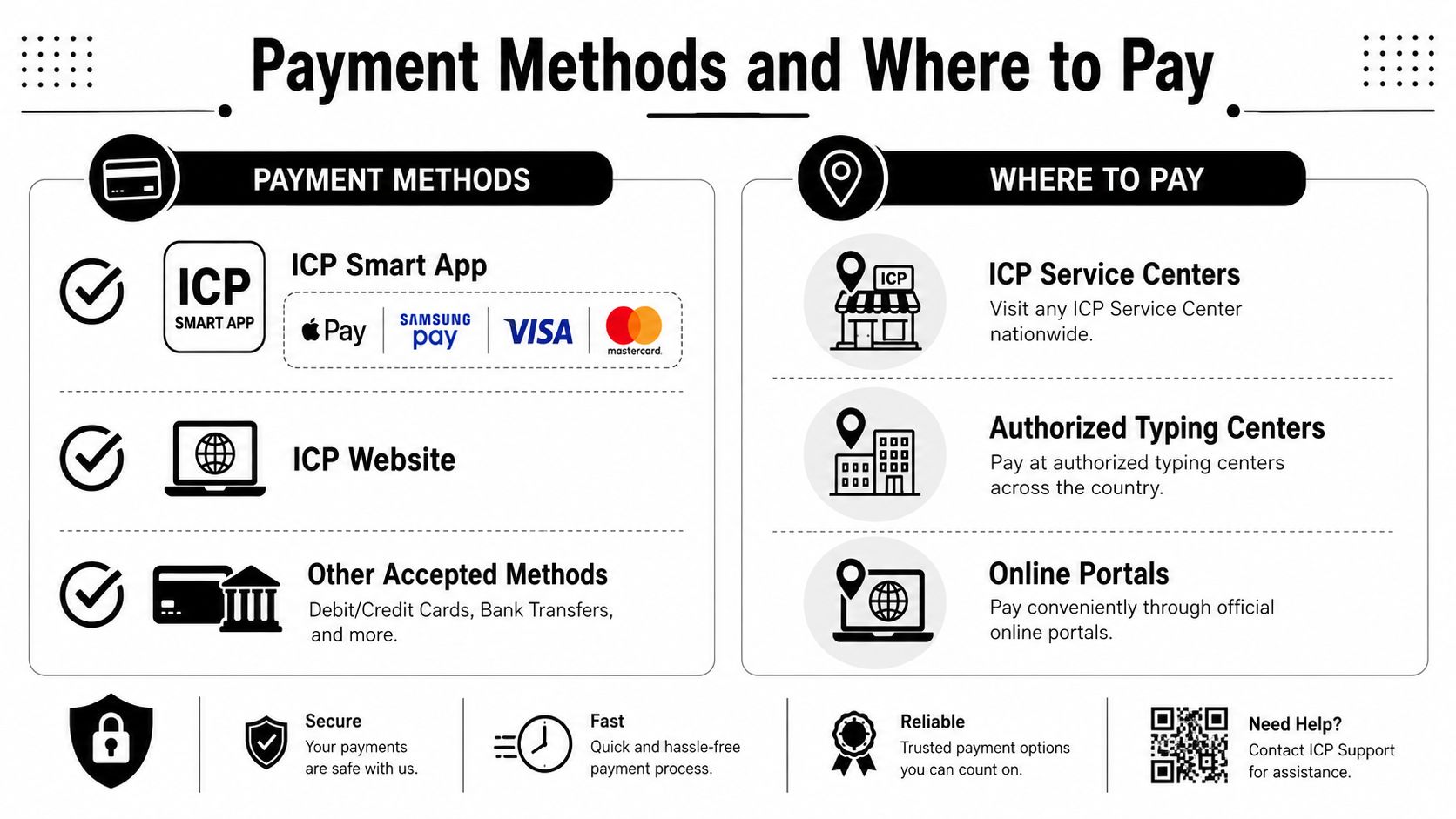
If you pay in person, ask whether the quoted amount includes typing, service handling, delivery, and any urgent option. If you pay online, save the electronic receipt and transaction reference.
Keep that receipt until the new card is delivered or collected. It gives you a record of the amount paid, the transaction date, and the application reference if a status query becomes necessary.
Documents Required for Issuance, Renewal, and Replacement
Prepare the documents before paying. A missing passport copy or an unavailable police report can turn a single visit into another service charge and another appointment.
| Document | New Issuance | Renewal | Replacement (Loss/Damage) | Correction |
|---|---|---|---|---|
| Original passport | Required | Usually required or verified | Required | Required |
| Valid visa, residence record, or entry permit | Required | Required or confirmed electronically | Relevant supporting record | Relevant supporting record |
| Existing Emirates ID | Not applicable | Required where available | Not available if lost | Required |
| Passport-size photograph | If requested | If requested | If requested | If requested |
| Police report | Not normally required | Not required | Required for loss | Not normally required |
| Proof supporting the change | Not required | Not required | Damage evidence if requested | Required |
| Birth certificate and parent attendance | For children where applicable | For children where applicable | For children where applicable | For children where applicable |
| GCC ID or passport | For GCC nationals | For GCC nationals | For GCC nationals | For GCC nationals |
New issuance commonly requires the original passport, valid residence or entry documentation, and an image that meets ICP requirements. The sponsor, employer, or tenancy documentation may also depend on the applicant's category and the way the residence file was created.
Renewal requires the existing card where it's available, passport information, and confirmation that the residence status remains valid. The applicant may still need to complete biometric capture at an authorised location, so an online application doesn't always eliminate an in-person step. Read the practical guidance on biometrics for Emirates ID before booking.
Replacement after loss normally requires a police report from the relevant emirate and a written declaration. Correction requires the original ID and evidence supporting the amended detail, such as a marriage certificate or other official proof. Children may need a parent or guardian present, while GCC nationals should carry the original GCC ID or passport.
Worked Cost Examples for Common Scenarios
A client invoice should show the components, not just the final number. The following examples use the figures supplied for these scenarios and demonstrate how a channel charge changes the amount paid.
| Cost Component | Adult Resident (2-yr visa, smart app) | Child Resident (2-yr visa, Amer centre) | GCC National (6-mo visa, smart app) |
|---|---|---|---|
| ICP base fee | AED 200 | AED 200 | AED 100 |
| Service charge | AED 30 | AED 30 | AED 30 |
| Typing fee | AED 0 | AED 50 | AED 0 |
| Urgent processing | AED 0 | AED 20 | AED 0 |
| Electronic payment fee | AED 15 | AED 0 | AED 0 |
| Total | AED 245 | AED 300 | AED 130 |
The adult resident's total is driven by a two-year validity period and the smart-app service components. The child's bill rises because the application is filed through an Amer typing centre and includes the stated typing and urgent-processing amounts.
The GCC example shows why you shouldn't apply the resident annual formula to every applicant. The scenario uses the stated base amount for that cardholder category and adds the smart-app service charge without a typing fee.
These are worked illustrations, not universal tariffs for every application. The live payment screen or centre invoice remains decisive because charges can vary by transaction route and optional service selection. Older fee tables may also show separate eDirham or knowledge charges, so compare them carefully with the current unified checkout before relying on an old quotation.
Step-by-Step Application and Renewal Process
Start with the identity record, not the payment screen. Confirm the passport spelling, visa validity, sponsor information, mobile number, and delivery details before entering the application.
Online filing
- Open the ICP channel. Log into the ICP smart app or website and select the relevant new ID or renewal service.
- Enter the application data. Add the sponsor, residence, and personal details exactly as they appear in the official records.
- Upload documents. Use clear scans and check that every required page is readable.
- Review the bill. Separate the ICP base charge from service, payment, delivery, or urgent amounts before authorising payment.
- Complete identity requirements. Book or attend biometric capture if the application requires it.
- Track and receive the card. Choose courier delivery or centre collection where offered, then retain the reference number. A dedicated Emirates ID tracking guide can help you monitor the application status.
In-person filing
Take the original documents to an authorised typing centre or Amer service centre. The agent can enter the form, scan documents, submit the transaction, and provide a receipt, but ask for a written breakdown before paying.
For a lost card, obtain the relevant police report before filing the replacement request. For a renewal, early preparation reduces the risk of passing the one-month grace period described earlier.
Courier delivery is separate from the ICP base charge and can vary by emirate and provider. Keep the tracking receipt until the card is physically received, especially when a company is coordinating several employee renewals.
Quick Reference Summary of Emirates ID Costs
The cost calculation starts with the cardholder category and validity, then expands according to the filing route. Residents use the AED 100 per year of validity rule, while national and GCC categories follow their applicable fixed card charges. Lost or damaged cards carry the published replacement charge, and late renewal can add AED 20 per day, subject to the AED 1,000 cap, under the official government guidance.
The most common avoidable overspends come from selecting a typing centre without comparing its handling fee, requesting urgent service without needing it, or allowing the card to move beyond the grace period. Don't approve a bundled invoice until you've checked the base ICP fee, service charge, delivery, urgent option, and any penalty separately.
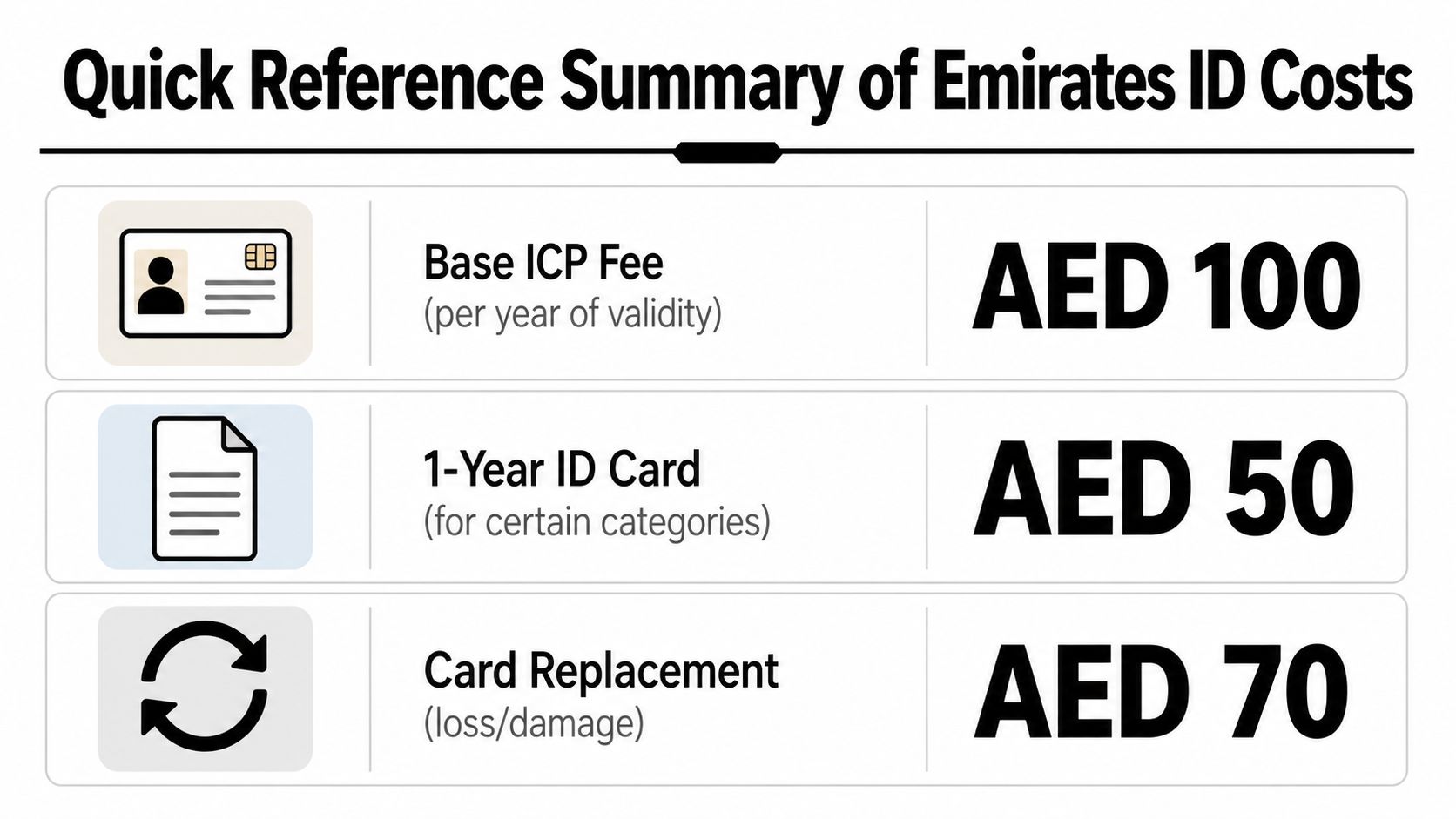
Save the payment receipt and compare the final invoice with the current ICP schedule. If you're handling employee or family applications, record each card's expiry date and transaction reference rather than relying on memory.
Smart Classic Business Hub can help with UAE PRO coordination, visa-related administration, and Emirates ID application tracking, while keeping the government charge and service handling visible in the quotation. Visit Smart Classic Business Hub to discuss the documentation, filing route, and compliance support your case requires.