
A Dubai trading company founder opens her laptop and sees three accounting platforms on the shortlist. Her VAT filing deadline is close, the auditor wants an FTA Audit File, the corporate tax registration message has arrived, and the payroll team is preparing the next WPS submission. None of those tasks is difficult in isolation. The problem starts when they all depend on the same ledger, customer records, tax codes, and transaction history.
That's why choosing accounting software for UAE businesses isn't a simple VAT feature comparison. The right platform must reduce total compliance exposure across VAT, corporate tax, payroll, e-invoicing, foreign-currency transactions, and audit evidence. A cheap ledger that creates manual work at every regulatory deadline is an expensive system.
The Real Question Behind Choosing Accounting Software for UAE
The founder with three shortlists doesn't need another feature table. She needs to know which platform can produce the right records when several stakeholders ask for them at once.
The Federal Tax Authority expects tax accounting software to generate an FTA Audit File, a VAT return file in the prescribed format, and compliant tax invoices plus credit and debit notes. The FTA requirement document for tax accounting software makes the technical implication clear. The platform must preserve transaction-level data, map entries into the relevant reporting structure, and export usable compliance files without forcing the finance team to rebuild the ledger in spreadsheets.
The decision has become more urgent because the UAE's e-invoicing framework applies broadly. The Ministry of Finance's 2026 Electronic Invoicing Guidelines state that electronic invoicing is mandatory for persons conducting business in the UAE, regardless of VAT registration status, unless specifically excluded. The phased rollout requires businesses with revenue at or above AED 50 million to appoint an Accredited Service Provider by 30 October 2026 and go live on 1 January 2027.
Practical rule: Choose the ledger for the next compliance requirement, not the last one you solved.
A serious shortlist therefore tests five things before it compares dashboards: UAE VAT logic, structured e-invoicing, Arabic and multi-currency handling, a chart of accounts that supports corporate tax reporting, and audit-ready integrations. Cloud versus on-premises architecture matters too, but only after the software can produce the required outputs.
The question I use with UAE founders is direct: If the FTA, auditor, payroll provider, and management team all request information this week, can the system answer without manual reconstruction? If the answer is no, the shortlist is wrong.
What Makes Accounting Software UAE-Ready
A UAE-ready platform is more than a bookkeeping application with a VAT toggle. It needs local tax logic, structured records, usable exports, and controls that survive an audit review.
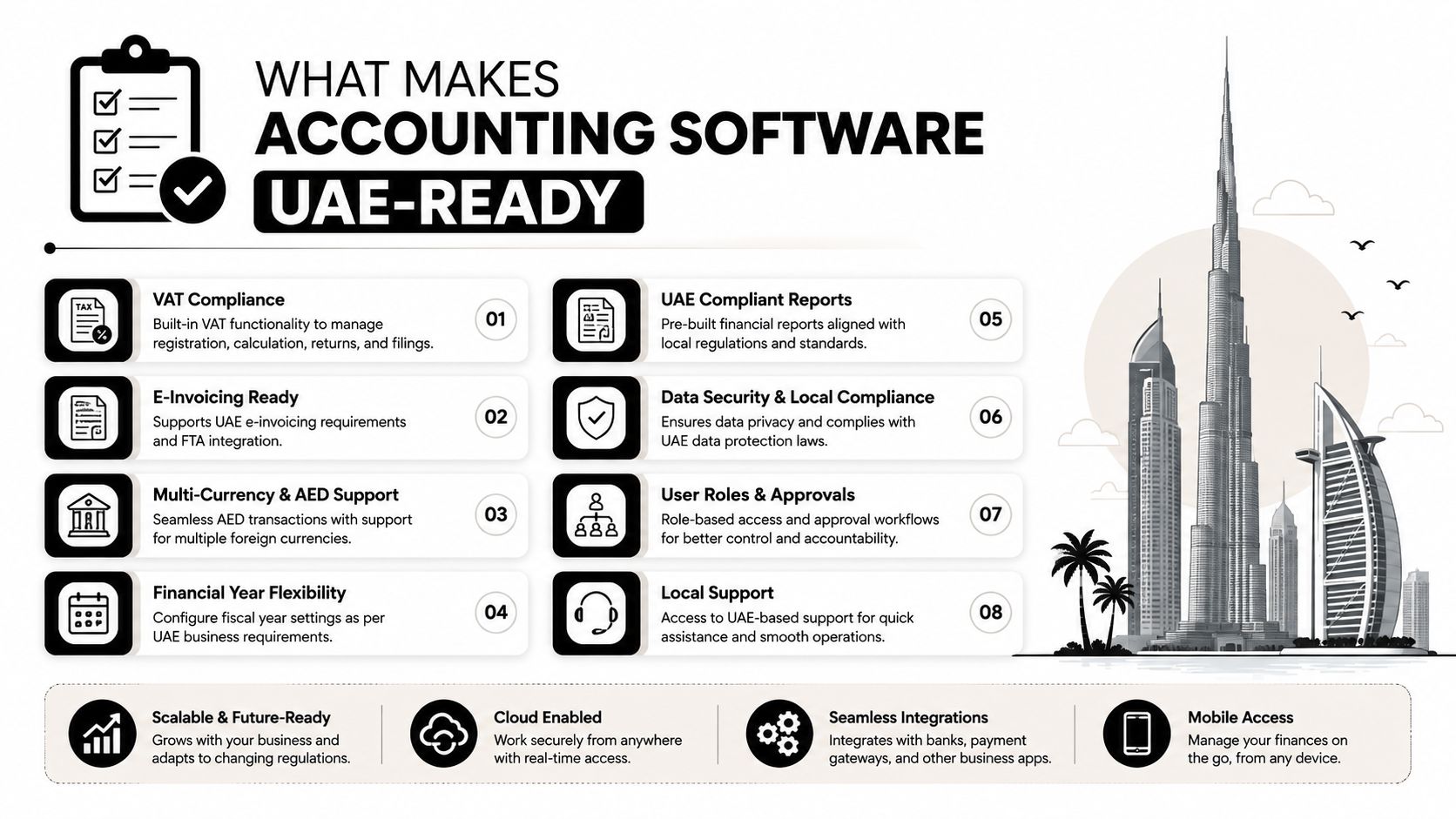
Start with the five capabilities that matter
1. Native VAT compliance. The system should handle standard-rated, zero-rated, exempt, and reverse-charge transactions, then map source entries into the required VAT return structure. It should also support compliant tax invoices and credit or debit notes. A platform that merely calculates VAT on an invoice still leaves the finance team exposed if the return and audit export require manual editing.
2. Structured e-invoicing readiness. A printable PDF isn't the same as an electronic invoice. Ask the vendor to demonstrate structured XML or UBL output, validation of mandatory fields, and a roadmap for the UAE's Peppol-based exchange model. If the demo ends with “you can email the PDF”, you haven't seen e-invoicing readiness.
3. Arabic and multi-currency functionality. Bilingual invoices, right-to-left presentation, and AED reporting are practical requirements for many UAE operations. The Ministry of Finance guidelines require key invoice data, including VAT line amounts and total payable amounts, to appear in AED even when the document is issued in another currency. Test the actual invoice and report output rather than accepting a localisation claim.
4. A UAE-sensible chart of accounts. The account structure should distinguish tax treatments, corporate-tax categories, payroll liabilities, intercompany balances, and owner transactions. A clean structure makes tax review faster because the finance team can trace a balance from the report to the underlying documents. For background on the reporting framework, review this guide to accounting standards for SMEs.
5. Audit trails and integrations. Look for immutable activity logs, bank feeds, approval controls, payroll connections, and reliable exports. If employees use corporate prepaid cards, finance teams may also benefit from specialist prepaid card accounting tools that bring spend data into the accounting workflow with clearer ownership and categorisation.
Each missing capability creates a predictable failure. Without VAT mapping, the return needs manual reconstruction. Without structured e-invoicing, invoices remain documents rather than exchangeable data. Without bilingual output, official reporting becomes a parallel process. Without a suitable chart of accounts, corporate-tax analysis becomes a spreadsheet exercise. Without audit logs and integrations, the auditor starts with exceptions instead of evidence.
Cloud vs On-Premises Accounting in the UAE
For most UAE freelancers and SMEs, cloud accounting is the practical default. It removes the need to maintain local servers, gives authorised users access from different locations, and lets the vendor distribute tax and e-invoicing updates centrally.
The main trade-off is control. An on-premises deployment keeps the database inside the company's own environment, which can suit organisations handling classified government or defence information or operating under strict internal data policies. A UAE-region cloud environment usually offers stronger disaster-recovery options, but the buyer must verify hosting, backup, access, and data-export terms in writing.
Compare the decision across three axes
| Decision axis | Cloud | On-premises |
|---|---|---|
| Cost structure | Predictable subscription and user fees, with less server investment | Upfront licence, hardware, maintenance, and internal IT responsibility |
| Control | Vendor manages infrastructure, access depends on contract and configuration | Company controls the local environment and release timing |
| Compliance updates | Vendor can distribute VAT and e-invoicing changes centrally | Internal teams or partners must plan upgrades and testing |
Cloud works particularly well for freelancers, distributed teams, and SMEs under 50 staff. It also suits businesses that need accountants, auditors, and management users to work from different locations. The subscription model is easier to budget, and the implementation team can focus on configuration rather than infrastructure.
On-premises can make sense for larger groups, regulated industries, or free-zone entities with restricted data-residency requirements. A hybrid model is also defensible. For example, a company may keep payroll data locally while placing the general ledger, invoicing, and management reporting in a cloud environment.
The compliance question deserves more weight than the infrastructure question. If a vendor releases a required tax or e-invoicing update, cloud customers can often deploy it through the vendor's release process. On-premises users may wait for testing, procurement, and an internal release window. That delay can create avoidable filing pressure.
Vendor Evaluation Checklist for UAE Buyers
A polished demo can hide weak controls. Give each vendor the same questionnaire, then require a live demonstration using your invoices, tax treatments, bank files, payroll workflow, and reporting scenarios. Evaluate the platform against total compliance exposure, not just whether it supports VAT. Corporate tax, payroll, e-invoicing, and FTA audit-file exports must work together on the same system.
Assign the largest share of the score to FTA-facing compliance. A platform that cannot produce required FTA files from source transactions should not reach your shortlist, whatever its interface or subscription price. Let your operating model determine the remaining scores, but do not let attractive extras offset a compliance gap.
Use five blocks in the demo
1. FTA-facing compliance
- Can the platform produce the FTA Audit File directly from source transactions?
- Can it generate the VAT return file in the prescribed FTA format?
- Can it issue compliant tax invoices, credit notes, and debit notes?
- Does its corporate-tax data model preserve the classifications your adviser needs?
- Does its e-invoicing roadmap support structured exchange rather than PDF output?
Scoring guide: Disqualify a vendor that fails two or more questions, or cannot demonstrate the relevant export live. For the VAT-return question, use this VAT filing guidance for UAE businesses to clarify the filing mechanics you expect the software to support.
2. Localisation
- Can users produce bilingual invoices and reports?
- Does the interface handle Arabic and right-to-left layouts properly?
- Can the company use AED as its base currency while recording foreign-currency transactions?
- Can the system retain relevant local dates and reference fields, including Islamic calendar fields where needed?
Scoring guide: Reject a candidate if Arabic is limited to translated labels and reports still require manual formatting.
3. Integration
- Does the system connect reliably with your UAE bank accounts?
- Can it generate or exchange WPS payroll files through an approved payroll workflow?
- Can it connect with free-zone authority invoicing, POS, inventory, and e-commerce systems?
- Does it retain the source reference for imported settlements and payments?
For teams replacing spreadsheet bank imports, this guide to importing bank statements provides useful background for testing file formats and reconciliation controls. Ask every vendor to import your own statement sample and explain how exceptions are handled.
Scoring guide: Disqualify a platform that requires repeated manual rekeying between banking, payroll, sales, and the ledger.
4. Security and continuity
- Is two-factor authentication available?
- Is a UAE-hosted data option available where your policy requires it?
- Does the audit trail record the user, time, change, and approval details?
- Are backups performed daily, with documented restoration procedures?
Scoring guide: Reject any candidate that cannot explain recovery, access removal, and audit-log retention in operational terms.
5. Total cost
- What does the licence include?
- How do per-user fees change as the team expands?
- What will implementation, migration, training, and integrations cost?
- What does annual support cover?
- Are tax, e-invoicing, payroll, or audit-file functions charged as add-ons?
Scoring guide: Remove vendors whose written proposal omits implementation and support costs. The subscription is only one part of the decision.
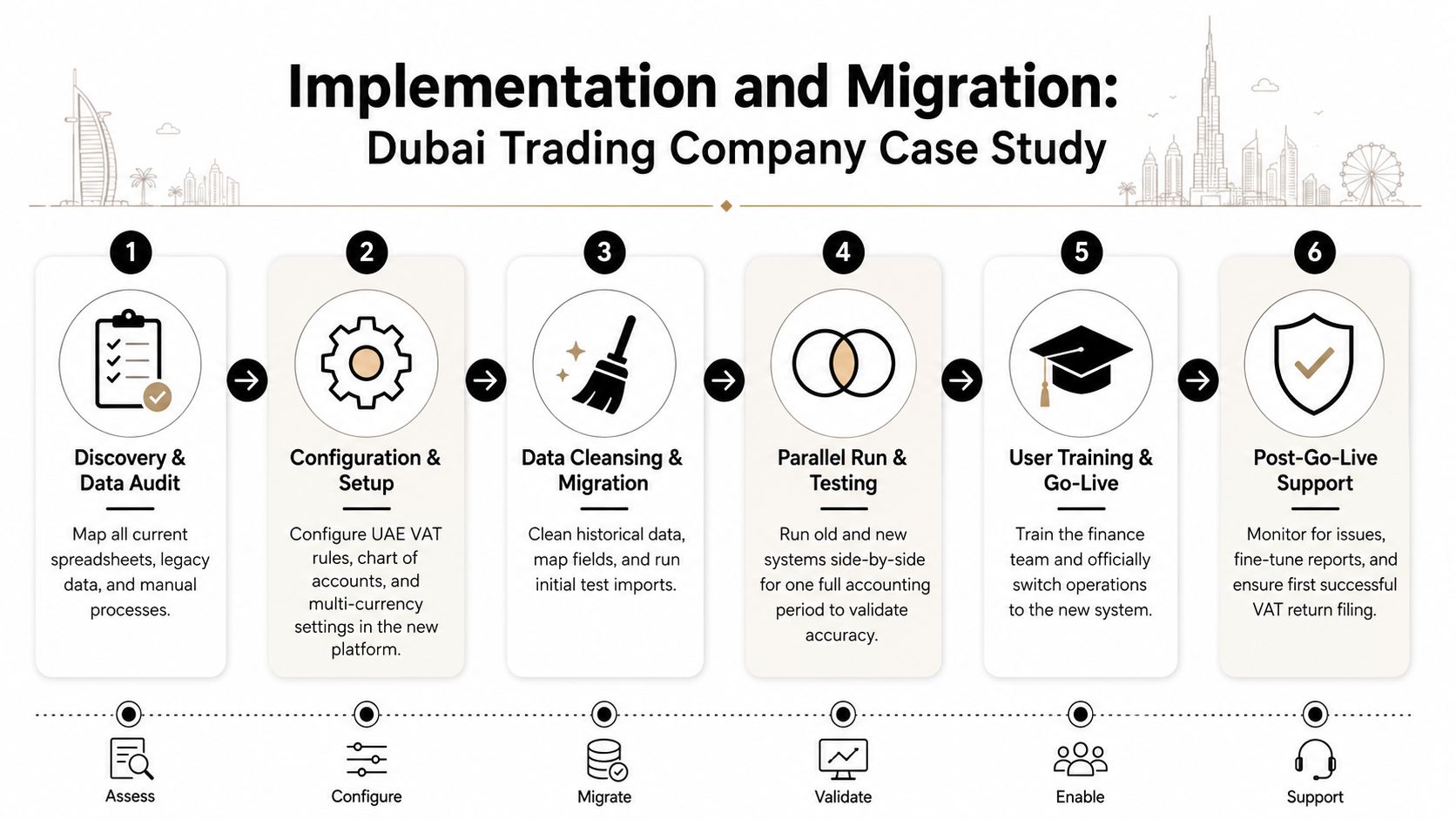
Implementation and Migration From Your Current Stack
A Dubai trading company can select an excellent platform and still fail at go-live. The danger usually sits in opening balances, customer records, VAT treatment, and untested integrations, not in the software demo.
I'd start by mapping the legacy chart of accounts into a UAE-appropriate structure. Old spreadsheets often contain duplicate customer accounts, vague expense categories, and tax codes that were applied inconsistently. Clean those records before importing them. Otherwise, the new platform automates old errors.
A controlled migration sequence
First, reconcile opening balances against bank statements as of the cutover date. Then clean customer and supplier masters, checking tax registration details and required identification fields. For a trading business, also validate inventory quantities, cost layers, foreign-currency balances, credit limits, and outstanding documents before migration.
Run the old and new systems in parallel for at least one full quarter. Post the same transactions in both environments, compare the trial balance, test bank reconciliation, and check whether the VAT return lines match the underlying entries. Your UAT scripts should follow the FTA return line by line, not just test whether an invoice prints correctly.
The cutover checklist should be signed by the finance controller and external auditor. Include opening balances, user access, tax codes, bank feeds, payroll files, invoice templates, approval workflows, report permissions, and the archive plan.
Migration discipline: The cheapest implementation is the one that doesn't force you to run the parallel process twice.
Two decisions deserve special attention. Determine how partially recovered input VAT from the old period will be treated, and archive the legacy database in a read-only form that preserves the original transaction trail. The record-keeping requirements for UAE businesses should inform that archive policy.
Teams planning a broader technology change can also use this legacy system migration guide for SaaS founders to think through ownership, dependencies, testing, and cutover risk. The accounting project still needs a UAE-specific tax review, but the migration principles apply.
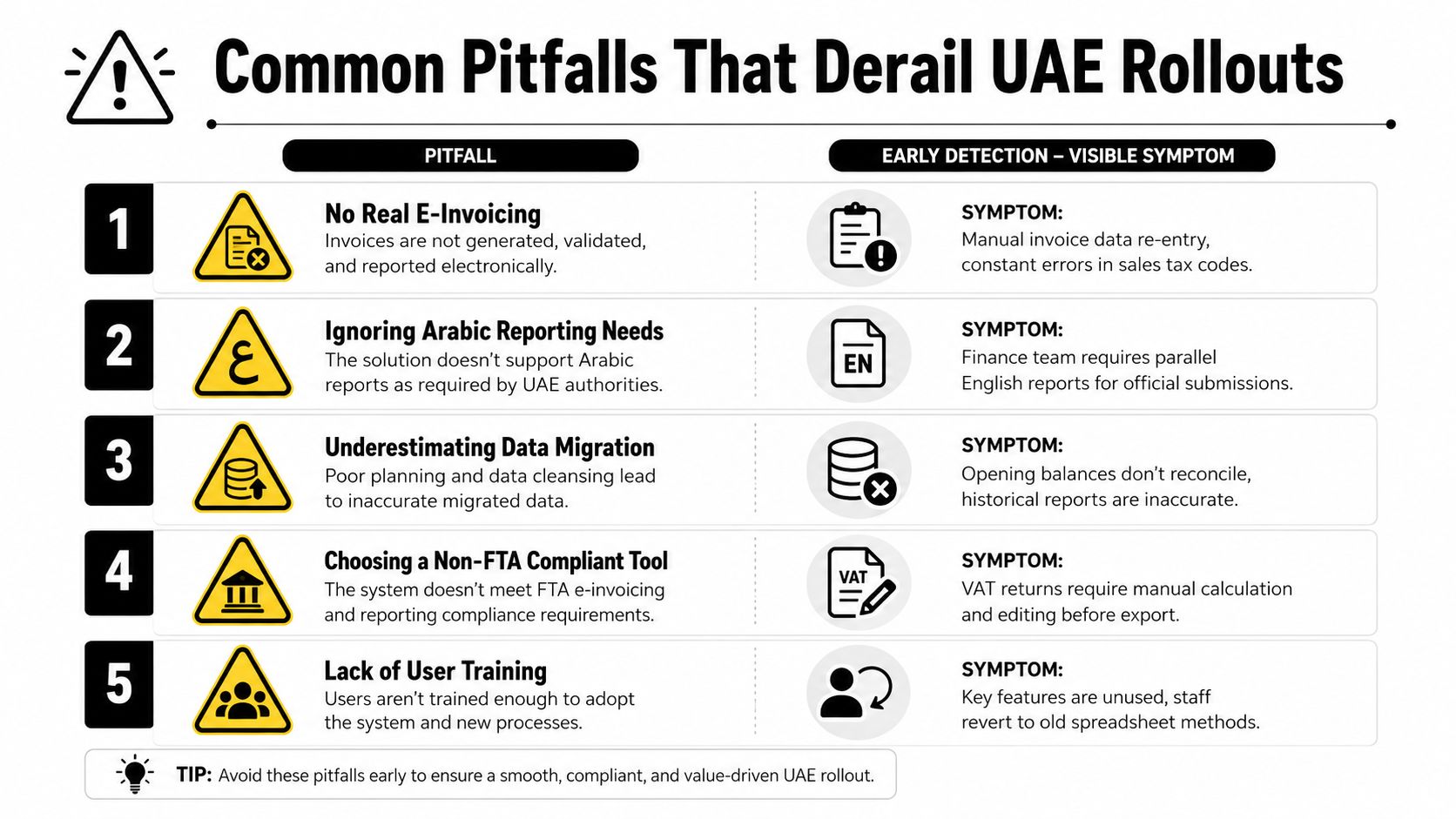
Common Pitfalls That Derail UAE Rollouts
Most failed rollouts don't collapse dramatically on day one. They develop visible symptoms that finance teams ignore until a filing, payroll run, or audit request exposes the underlying weakness.
Five warning signs to catch early
1. The product has no real e-invoicing roadmap. The sales team says the platform is “VAT-ready”, but no one can explain structured invoice output, service-provider connectivity, validation, or the planned UAE rollout path. The symptom is simple. The team has no upgrade plan when the mandate reaches its phase.
Preventive action: Ask for the roadmap in writing and require a live structured-invoice demonstration before signing.
2. Arabic is treated as a cosmetic option. A translated invoice heading doesn't prove that the system handles right-to-left reports, bilingual fields, or official document layouts. The symptom appears when staff create a second English report because the Arabic version is misaligned or incomplete.
Preventive action: Test a bilingual invoice, credit note, customer statement, and tax report using your own fields.
3. Mainland and free-zone treatment is left to spreadsheets. Different business activities, registrations, and transaction flows may need distinct tax treatment. The visible symptom is a quarter-end VAT return that doesn't reconcile to the general ledger.
Preventive action: Document the tax logic by entity, branch, customer type, supply type, and registration status before configuring the chart of accounts.
4. WPS integration is treated as an afterthought. Payroll may calculate correctly while the salary file fails during bank submission. The symptom is a rejected WPS file near the salary deadline, followed by manual corrections and avoidable employee frustration.
Preventive action: Test the complete payroll-to-bank workflow with the actual payroll provider and bank process.
5. AR users aren't trained on receipts and allocations. The ledger can't reconcile itself if clerks post deposits to suspense or leave customer receipts unmatched. The auditor then finds unreconciled items in the first sample.
Preventive action: Train the people who enter transactions, not only the finance manager. Give them written rules for receipts, refunds, credit notes, and customer allocations.
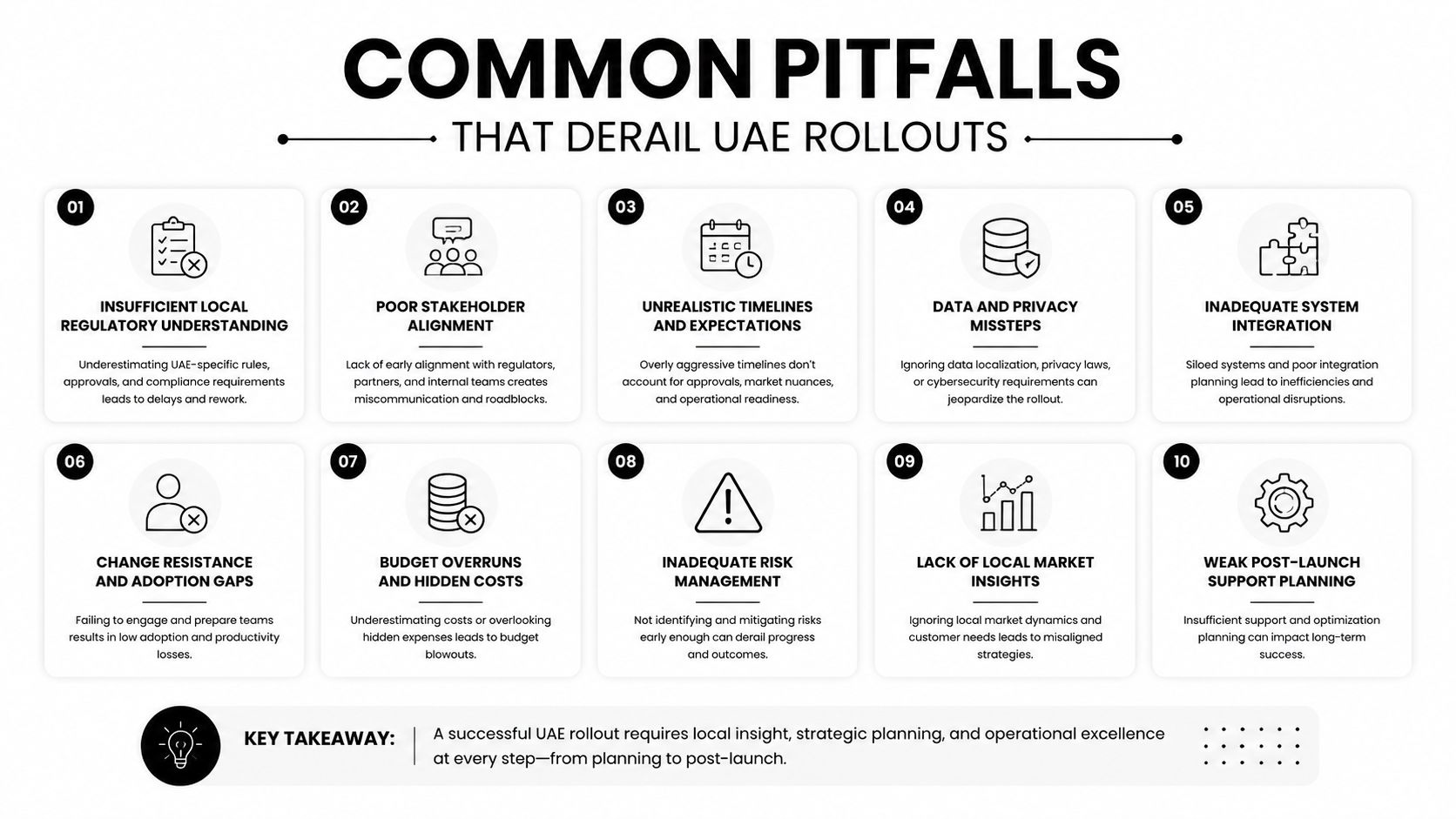
The common thread is ownership. A vendor can provide functionality, but your finance team must define the tax treatment, approve the chart of accounts, test the outputs, and enforce the process after go-live.
When to Bring In a Local Consultancy Like Smart Classic
UAE-ready software still leaves important work undone. The vendor can configure modules and train users, but it generally won't redesign your trial balance, decide how opening balances should support corporate-tax reporting, or pre-populate the FTA Audit File mapping tables for your specific business.
That gap matters most when the company operates across mainland and free-zone structures, prepares for its first corporate tax filing, or has complex payroll across multiple emirates. These businesses need configuration decisions that connect legal structure, accounting treatment, tax reporting, payroll, and audit evidence. A generic implementation package rarely covers all of that.
What an implementation partner won't solve
A software vendor may show you how to create a tax code. It may not determine whether your historical transactions were coded consistently or whether the chart of accounts gives your tax adviser the classifications needed for review. It may demonstrate a payroll export. It may not validate the entire WPS process against your bank and employee master data.
A local consultancy can work through those questions before the contract is signed. That's particularly valuable for groups exceeding AED 10 million in revenue, companies with multiple operating structures, and founders moving from spreadsheets without a documented accounting policy.
The right adviser should review the proposed account structure, migration scope, tax mappings, bilingual reporting requirements, payroll integration, approval matrix, archive approach, and auditor expectations. Smart Classic Business Hub is one local option that provides UAE company support, VAT-compliant accounting, bookkeeping, audit, and business advisory services.
Don't bring in an adviser after the first failed filing. Engage one while the scope is still negotiable. It's easier to build a clean audit trail before go-live than to reconstruct missing evidence after a regulator or auditor asks for it.
Your 30-Day Plan to Pick and Deploy the Right System
Start on a Monday and keep the process evidence-based. The aim isn't to collect the most impressive demos. It's to prove that one platform can support your actual transactions and compliance outputs.
Week one, document and shortlist
Write down every current pain point, including spreadsheet reconciliations, duplicated customer records, manual VAT calculations, delayed management reports, payroll handoffs, and missing audit evidence. Map each requirement to the FTA Audit File, VAT return, tax invoice, e-invoicing, payroll, and corporate-tax data needs.
Shortlist three platforms using the yes-or-no checklist. Don't shortlist a product because another UAE company uses it. Shortlist it because it passes your compliance and integration tests.
Week two, test the real workflows
Run paid trials where possible, using realistic transactions rather than sample data. Ask each vendor to demonstrate Arabic-language invoices, foreign-currency sales, credit notes, reverse-charge treatment, bank reconciliation, tax reporting, and structured e-invoice output.
Validate the VAT return output against the FTA portal's required schema and compare the report to your existing reconciled records. A sales dashboard isn't evidence of compliance.
Week three, lock the migration scope
Agree how historical data will be cleansed, which period will be migrated, how opening balances will be treated, and how partially recovered input VAT will be handled. Confirm the scope for bank feeds, payment gateways, inventory, POS, e-commerce, payroll, WPS files, user roles, and auditor access.
Ask for a written implementation plan with owners and acceptance criteria. If the proposal only says “data migration included”, it isn't detailed enough.
Week four, contract and schedule
Sign only after the compliance, migration, integration, support, and data-hosting terms are clear. If the business has complex structures, appoint a local consultancy such as Smart Classic Business Hub for FTA configuration and accounting setup before fixing the go-live date.
Schedule the parallel run, user training, UAT, cutover, first close, and first VAT return review. Keep three guardrails in place:
- Manual reconciliation window: Maintain a 30-day post-go-live reconciliation period.
- Read-only legacy archive: Preserve the old database and supporting documents without allowing uncontrolled edits.
- Auditor briefing: Explain the new system, mappings, and controls to the auditor before the first closing cycle.
A good accounting platform should make compliance evidence easier to produce, not make invoices look more professional. Test the outputs, protect the history, and choose the system that reduces the number of manual decisions your team must make under deadline pressure.
Smart Classic Business Hub helps UAE companies configure VAT-compliant accounting, organise bookkeeping and audit records, connect financial processes with business operations, and prepare for structured compliance requirements. Visit Smart Classic Business Hub to discuss your accounting software migration, FTA configuration, and implementation plan with a Dubai-based consultancy.