
A founder in Dubai signs a large contract, celebrates the strongest quarter the business has had, and then discovers that the company's accounting basis, tax workpapers, audit file, and chart of accounts no longer fit together. The problem isn't that the business suddenly became “too large” on paper. It's that revenue, tax status, licensing requirements, transaction volume, and financial reporting standards can pull the company into different compliance lanes.
For UAE business owners, choosing accounting standards for SMEs isn't an academic exercise. It affects how your team closes the books, prepares corporate tax accounts, supports VAT filings, handles related-party transactions, and responds to an auditor or Federal Tax Authority review. The practical question is simple: which framework applies to your business now, and what needs to change before your next filing?
Why SME Owners Hit a Compliance Wall Faster Than They Expect
A founder can cross the AED 50 million revenue threshold after signing one major customer contract or recording an unusually strong trading period. The company may keep the same legal name, licence, staff, and office, yet its corporate tax accounting framework can change. The IFRS Foundation's UAE jurisdiction profile states that taxable persons with revenue not exceeding AED 50 million may use IFRS for SMEs for corporate tax purposes. Businesses above that limit must use full IFRS.
Owners should therefore treat “SME” as a current compliance assessment, not a permanent identity. The decision depends on revenue, assets, public accountability, free zone status, transaction complexity, and why the accounts are being prepared.
The warning signs usually appear in the bookkeeping
A company may keep VAT records in reasonable order while lacking accounts suitable for corporate tax or audit. Missing accruals, unsupported provisions, unrecorded inter-company balances, and shareholder expenses often surface only during the year-end close. The accountant then reconstructs the numbers instead of reviewing a controlled ledger.
Everyday founder decisions can expose the gap. A new contract may push revenue above the corporate tax accounting threshold. A VAT invoice still needs the correct treatment, while a related-party payment needs supporting records and an appropriate accounting policy. Bookkeeping, VAT filings, and corporate tax accounts must connect, but they do not use identical triggers.
A company can remain below the corporate tax accounting threshold and still face VAT obligations, licence-related reporting requirements, or lender demands for reviewed or audited statements. Test each obligation separately rather than choosing one rule and applying it everywhere.
Practical rule: Treat every major contract, acquisition, new free zone activity, and related-party arrangement as an accounting-policy event, not just a sales or operations event.
Use a decision tree, not a company-size label
Start with the corporate tax revenue test. Then check public accountability, any free zone requirement for full IFRS, and whether the licence or financing documents require audited statements. Finally, confirm that the bookkeeping system can produce complete accrual-based accounts with a clear audit trail.
Owners who need plain-language background on the wider standards ecosystem can consult the BookkeepDIY FASB dictionary entry. The UAE decision remains practical: do not assume IFRS for SMEs applies automatically, and test the threshold before year-end, while aligning the ledger, VAT evidence, and corporate tax workpapers.
IFRS for SMEs and Full IFRS in Plain English
Your founder decisions often expose the difference between IFRS for SMEs and Full IFRS. You approve a new customer contract, buy equipment, bring in an investor, or restructure a group company. Each decision changes the records your accountant must maintain. The AED 50 million revenue test then determines whether IFRS for SMEs remains available for corporate tax accounting, while VAT and bookkeeping obligations continue under their own rules.
IFRS for SMEs is a self-contained reporting standard for qualifying entities without public accountability. It requires substantially fewer disclosures than full IFRS and gives smaller businesses a practical framework without every complex rule used by listed or highly accountable entities. The IFRS Foundation reports that 85 of 168 jurisdictions required or permitted its use as of August 2024, a context that matters when UAE businesses deal with international lenders, investors, suppliers, or group companies. Read The IFRS Foundation's standard overview for the framework's scope and international role.
Full IFRS applies a broader set of reporting requirements. It usually demands more detailed disclosures, closer analysis of measurement and presentation, and stronger evidence for complex instruments, group structures, leases, acquisitions, and fair-value-sensitive assets. Changing frameworks is not a software setting. It can affect opening balances, revenue analysis, provisions, deferred tax, consolidation, and the supporting documents behind each balance.
The UAE jurisdiction profile permits entities meeting the SME definition to use IFRS for SMEs. Entities that do not use it must apply full IFRS Standards. The Federal Tax Authority guide adds the corporate tax gateway: revenue must not exceed AED 50 million in the relevant tax period for a taxable person to use IFRS for SMEs for corporate tax accounting. Private ownership alone does not make IFRS for SMEs the default.
IFRS for SMEs vs Full IFRS at a glance
| Criteria | IFRS for SMEs | Full IFRS |
|---|---|---|
| Intended users | Qualifying entities without public accountability | Larger, publicly accountable, or otherwise required entities |
| Disclosures | Substantially fewer disclosures | Broader and more detailed disclosures |
| UAE corporate tax gateway | Available where the taxable person meets the applicable SME conditions and revenue does not exceed AED 50 million | Required where the applicable conditions for IFRS for SMEs aren't met |
| Operational impact | Simpler reporting structure, but still requires disciplined accrual accounting | More extensive accounting analysis, controls, and supporting documentation |
| Transition concern | Must be monitored as revenue and business complexity change | Should be planned before the business becomes subject to the framework |
The IFRS Foundation issued the third edition of IFRS for SMEs in February 2025. Its projected effective date is for periods beginning on or after 1 January 2027, giving owners a defined planning window. Review the current framework, confirm the corporate tax position, and document whether the business will adopt the updated edition when it becomes effective.
How UAE VAT and Corporate Tax Connect to Your Accounting Standard
Your accounting standard sets the structure of the financial accounts, but it doesn't replace VAT rules. VAT registration, tax invoices, output tax, input tax, and reverse-charge treatment must still be handled under UAE VAT legislation. A business can produce an income statement under IFRS for SMEs and still submit a defective VAT return if invoice dates, tax codes, credit notes, imports, or reverse-charge entries aren't mapped correctly.
The first control is a reconciliation between the sales ledger and VAT return. Your team should be able to trace reported output tax back to invoices, identify exempt or zero-rated transactions, and explain timing differences. Imported services need specific attention because reverse charge can create both output and input tax entries, subject to the applicable recovery rules. These entries shouldn't be left for an annual accountant adjustment.
VAT compliance and corporate tax compliance are separate tests
VAT registration thresholds are independent of the accounting standard. The mandatory registration threshold is AED 375,000, while voluntary registration is available at AED 187,500, as set out in UAE VAT rules and the relevant Cabinet decisions. A business may therefore become VAT registered long before the corporate tax accounting question becomes decisive.
Corporate tax works differently. The financial accounts used for the tax computation need to be prepared using an acceptable accounting basis, and the choice between IFRS for SMEs and full IFRS can affect recognition, measurement, disclosures, and supporting schedules. A bookkeeping file that produces VAT-ready invoices may still lack the accruals, provisions, fixed-asset records, related-party analysis, and reconciliations needed for a defensible corporate tax file.
VAT asks whether the transaction was taxed correctly. Corporate tax asks whether the financial result was measured and supported correctly. Your ledger has to answer both questions.
Build one tax-aware ledger
Use separate tax codes and accounting accounts for VAT, corporate tax adjustments, related parties, exempt income, non-deductible expenses, and uncertain balances. Don't create manual year-end entries without retaining the calculation and approval trail. A practical VAT compliance checklist can help your team test the recurring controls before submission.
The result should be a single source ledger that supports VAT returns, corporate tax workpapers, management accounts, and audit evidence. If those outputs require four different spreadsheets, your accounting design is already too fragile.
Matching Your Revenue Band to the Right Reporting Regime
Revenue bands are useful only when you treat them as screening points rather than complete answers. The UAE accounting decision also depends on entity type, tax status, public accountability, licensing conditions, and whether a regulator, lender, or shareholder requires audited accounts.
The most important confirmed accounting boundary for this article is the AED 50 million corporate tax revenue test. Below that level, an eligible taxable person may use IFRS for SMEs for corporate tax purposes. Above it, the business must use full IFRS. Other thresholds may govern VAT registration, audit, or special tax treatment, but they don't automatically change the accounting standard by themselves.
A practical screening table
| Revenue Band (AED) | Accounting Basis | VAT Obligation | Corporate Tax Filing | Audit Required? |
|---|---|---|---|---|
| Below VAT registration point | Maintain complete books suited to the business and its licence; confirm whether cash or accrual treatment is permitted for the specific purpose | VAT registration may not be required unless voluntary registration or another rule applies | Prepare records supporting the corporate tax position and select the permitted accounting framework | Check the licence, law, lender, and shareholder requirements |
| At or above the VAT registration point and below AED 50 million | Use disciplined accrual records where required, with VAT controls built into the ledger; don't confuse VAT registration with IFRS for SMEs eligibility | VAT registration obligations apply when the relevant threshold is met | An eligible taxable person may use IFRS for SMEs, but it isn't an automatic default | Confirm the entity-specific audit requirement |
| Above AED 50 million | Full IFRS is required for the corporate tax accounting position under the UAE guide | Continue VAT reporting and reconciliations | Prepare full-IFRS financial accounts and supporting corporate tax workpapers | Confirm statutory, licensing, financing, and free zone requirements |
| Any band with public accountability or a specific full-IFRS condition | Full IFRS may apply regardless of the owner's preferred simplified process | Apply the relevant VAT rules | Use the framework required by the entity's status and tax conditions | Obtain the audit or assurance report where required |
The Federal Tax Authority's Accounting Standards Guide should be read alongside the entity's legal and tax facts. Don't use a cash-basis shortcut merely because the business is small, and don't rely on a general internet table to decide whether your licence requires audited statements.
For planning, use the practical guidance on UAE corporate tax planning as a starting point, then obtain an entity-specific review. Your finance team should monitor monthly revenue, not just the year-end total, because the accounting policy decision becomes harder to manage after a threshold has already been crossed.
Building a Chart of Accounts That Survives a Standard Switch
A strong chart of accounts gives you options. A weak one forces a reconstruction whenever the company grows, changes framework, adds a related entity, or faces an audit. Build the ledger around the transactions you need to explain, not around the minimum number of accounts your bookkeeper can post.
Start with clear account groups for trade receivables, inventory, fixed assets, payables, tax accounts, related parties, equity, revenue, and operating costs. Trade receivables should support ageing analysis. Inventory records should allow management to assess cost against net realisable value. Fixed assets need a register with purchase dates, useful lives, disposals, and component information where relevant.
Five controls for a clean monthly close
Reconcile bank accounts by day five. Investigate unmatched receipts, supplier payments, card transactions, and transfers before they distort the month.
Post accruals and prepayments. Record expenses in the period they relate to, retain the calculation, and reverse temporary journals systematically.
Review inter-company and shareholder current accounts. These accounts often expose personal spending, undocumented loans, missing invoices, and transactions that require related-party analysis.
Reconcile VAT control accounts. Tie the ledger to filed returns, review tax codes, and document adjustments rather than carrying unexplained balances.
Issue a management accounts pack by day ten. Include the profit and loss statement, balance sheet, cash position, receivables ageing, payables ageing, inventory movement, and key reconciliations.
This routine supports both simplified and full reporting. It also gives an incoming auditor reliable opening information instead of a pile of unexplained balances. For UAE-specific guidance on documentation and retention, review these accounting record-keeping requirements.
Keep contracts, invoices, customs entries, bank evidence, payroll support, board approvals, related-party agreements, and transfer pricing documentation in an organised repository. The retention period must match the applicable UAE tax and legal requirements. Do not delete records just because the VAT return has been filed or because the transaction seems too small to matter.
Common Misconceptions That Lead to Real Penalties
The most expensive accounting mistakes usually begin as reasonable-sounding assumptions. Owners hear “SME” and conclude that the simplified standard automatically applies. They hear “free zone” and assume the company is outside ordinary tax and audit discipline. Both shortcuts can produce a costly correction.
Misconception one, IFRS for SMEs is the default
It isn't. The UAE tax guide links permission to use IFRS for SMEs to the applicable revenue test and states that the standard isn't the default. If the business doesn't meet the conditions, full IFRS applies. Owners should document the basis for the choice instead of allowing software settings or a bookkeeper's habit to make the decision.
Misconception two, VAT-ready books are automatically tax-ready
VAT records focus heavily on tax invoices, tax codes, filing periods, and transaction treatment. Corporate tax accounts require a reliable financial result, support for adjustments, and evidence for balances such as provisions, depreciation, related-party transactions, and accrued expenses. A company can satisfy one process while failing the other.
Misconception three, free zone status removes reporting obligations
Free zone treatment depends on the entity's conditions and tax status. Where the applicable Qualifying Free Zone Person rules require full IFRS or audited financial statements, an owner can't substitute a simplified set of accounts merely because the company operates in a free zone. Confirm the exact regime before preparing the annual statements.
Misconception four, personal and company costs can share one ledger
This creates more than a presentation problem. Mixed spending makes it difficult to establish whether an amount is a business expense, a shareholder distribution, a loan, or a related-party transaction. It can also weaken transfer pricing documentation and make the company's tax position harder to defend.
The correction is straightforward: separate business and personal banking, approve related-party entries, reconcile current accounts monthly, and obtain a written accounting-policy decision before the year-end close.
Getting Ahead of the 2027 IFRS for SMEs Update
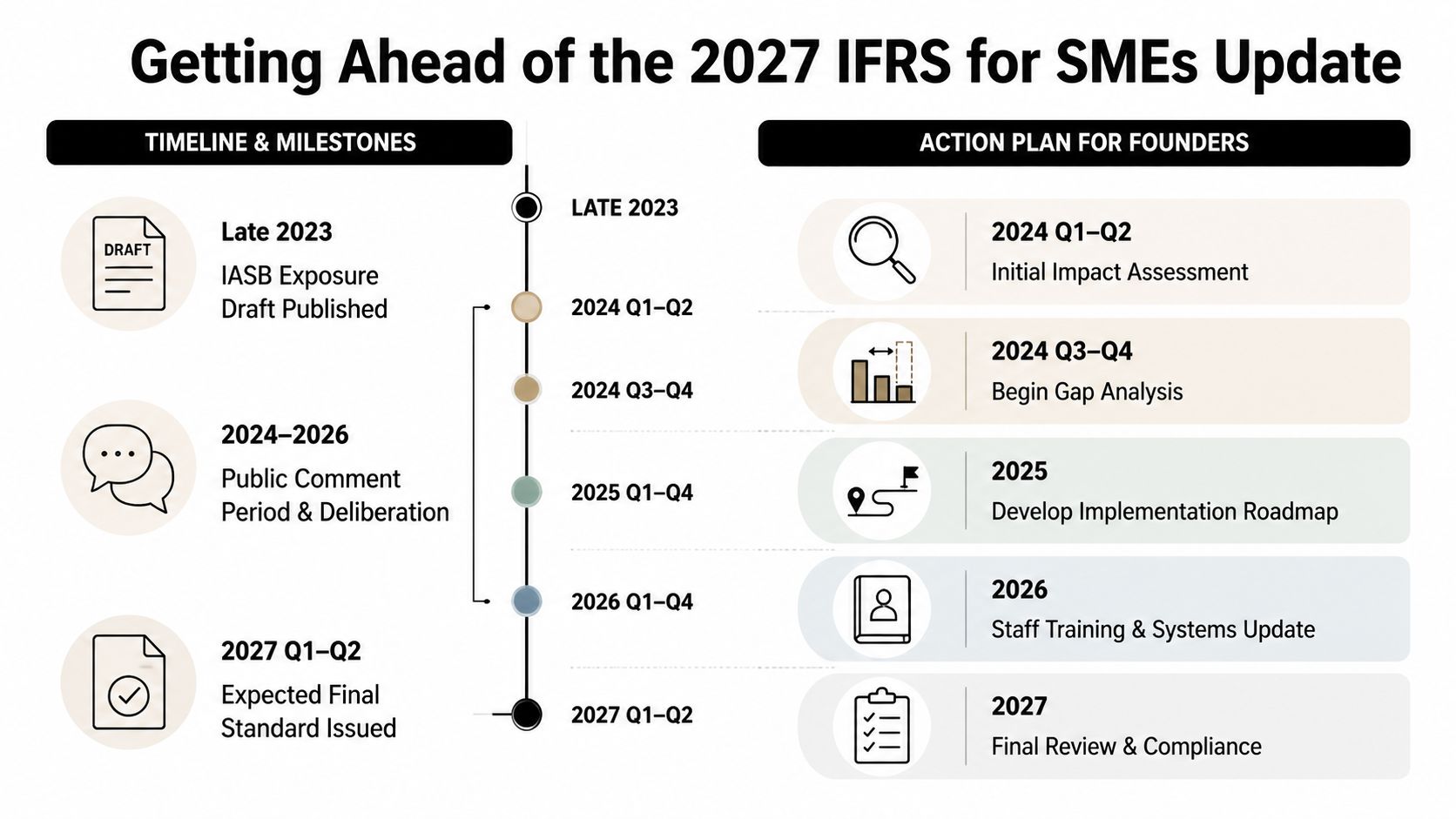
The third edition of IFRS for SMEs was issued in February 2025. According to the IFRS Foundation, the projected effective date is for periods beginning on or after 1 January 2027. UAE owners have time to prepare, but that window should be treated as a work plan, not a reason to wait. Check your software, contracts, account balances, and disclosure records before the first affected financial statements.
Use the next 12 months as a controlled runway
First quarter, establish the facts. Confirm your accounting framework, corporate tax position, free zone status, revenue trend, asset profile, related-party arrangements, and auditor expectations. Check whether revenue is comfortably below the AED 50 million gateway or moving towards it.
Second quarter, perform the gap analysis. Compare your chart of accounts and financial statement formats with the updated requirements. Examine revenue contracts, financial instruments, leases, provisions, deferred tax schedules, and disclosure records. Record missing information and ownership of each fix, rather than only listing standard sections.
Third quarter, design the implementation plan. Decide whether to adopt the updated standard when effective, whether early adoption is permitted and suitable, and how the change fits your tax and audit cycle. Prepare opening-balance schedules and a method for restating comparatives where required.
Fourth quarter, test the systems. Ask your accounting software provider whether reporting templates, account mappings, journal controls, and audit exports support the revised framework. Brief the external auditor, train finance staff, and run a parallel close if the changes are significant.
Keep the AED 50 million test in every review. Revenue affects whether your bookkeeping structure, VAT records, and corporate tax filings continue to support the same reporting basis. A business approaching the gateway may need full IFRS instead of the revised SME framework. Confirm the applicable framework in writing, complete the gap analysis, and prepare the chart of accounts for either outcome.
Frequent Questions UAE Founders Ask Their Accountant
Does a mainland company below the revenue gateway have to use full IFRS?
Not automatically. An eligible entity may use IFRS for SMEs for corporate tax purposes when it meets the applicable conditions, including the UAE revenue test. The choice still needs to be documented, and the company should check whether its licence, lender, shareholders, public accountability, or another rule requires full IFRS.
How should a free zone company report?
Don't decide from the free zone label alone. Review whether the entity qualifies for the relevant tax treatment and whether that regime requires full IFRS or audited financial statements. If it does, prepare the accounts on that basis from the start of the reporting period.
Can a sole establishment use cash accounting?
That depends on the specific legal form, tax position, applicable guidance, and purpose of the accounts. Cash records may be useful for internal cash management, but they shouldn't be used as a shortcut where corporate tax accounts require an acceptable accrual-based reporting framework. Ask your accountant to confirm the basis in writing.
What happens to opening balances after a standards switch?
You'll need a controlled transition schedule. Reclassify balances, reassess recognition and measurement, document adjustments, and preserve a clear bridge from the previous accounts to the new opening figures. Don't overwrite the old ledger without retaining the reconciliation.
How quickly should a VAT-registered business upgrade its records?
Immediately after management identifies that the accounting framework or tax position may change. Waiting until the filing deadline creates avoidable pressure, especially where contracts, inventory, related parties, leases, and provisions need deeper review.
This month, confirm your revenue position, accounting framework, free zone or mainland status, and the evidence supporting your VAT and corporate tax ledgers.
Smart Classic Business Hub provides VAT-compliant accounting, bookkeeping, audit support, and UAE record-keeping guidance for businesses reviewing their reporting obligations. Visit Smart Classic Business Hub to discuss your current framework, threshold exposure, and next compliance steps with a Dubai-based consultancy.