
A longer business plan isn't automatically a stronger one. In the UAE, a generic template can fail before anyone reaches the financial section because it doesn't answer the decisions that determine whether the business can operate, raise funding, or pass due diligence.
A useful business plan outline must explain the setup route, prove local demand, map the operating model, and connect every assumption to cash flow. The UAE Ministry of Economy and Tourism defines a business plan around the product or service, goals, target market, customer profile, business model, marketing, competitors, management, finance, and implementation steps. That framework matters in a market where the UAE recorded 558 thousand companies in 2022 and has set a target of 1 million companies by 2030. (UAE Ministry of Economy and Tourism entrepreneurship guidance)
The outline below is decision-first. It moves through setup, demand, operations, and money, then adds the evidence a bank, regulator, or investor will test.
Why a UAE Business Plan Outline Is Built Around Decisions, Not Sections
The popular advice says to copy a ten-section template, fill in the blanks, and make the document look professional. That approach confuses document length with business readiness. A bank manager or investor doesn't need another polished description of your ambition. They need to know whether your licence, customers, staff model, and cash position fit together.
The UAE ecosystem makes that discipline essential. By the end of 2025, the country had attracted about 760,000 companies since the Commercial Companies Law was issued, with roughly 250,000 new companies established in 2025, taking active companies above 1.4 million. The same reporting records 118.7% growth compared with the first half of 2021. (UAE companies and business-base expansion) A founder entering that environment needs a sharper market position, not a longer introduction.
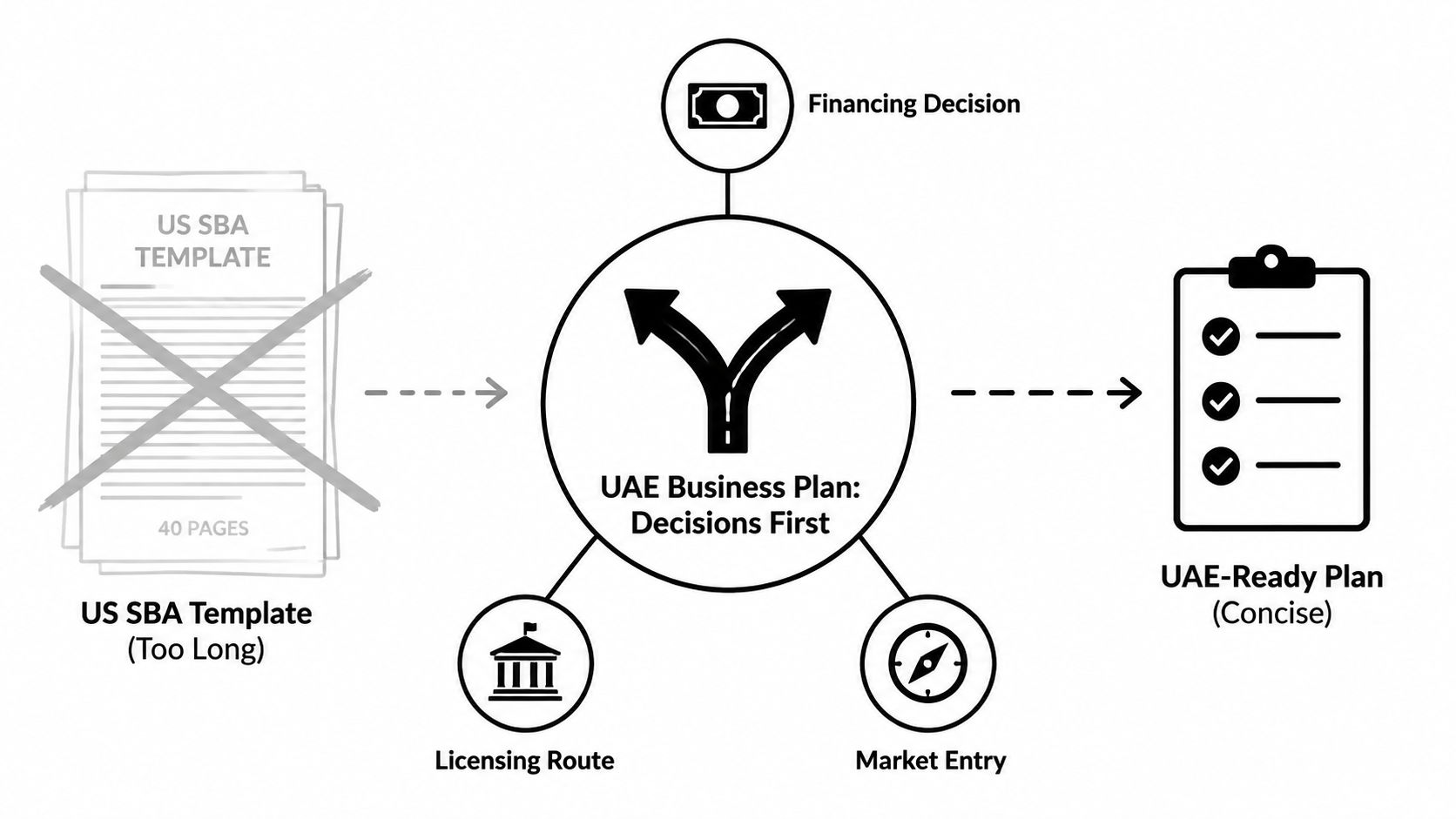
Start with four decisions
Write the plan around these calls:
- Setup: Which jurisdiction, legal structure, licence activity, office arrangement, and visa capacity support the business?
- Demand: Which UAE customer segment will buy, through which channel, at what price, and with what evidence?
- Operations: Who delivers the product, which regulated approvals apply, and how does the company function day to day?
- Money: What does the business need to launch, when does cash leave the account, and how will the company fund the gap?
The government's guidance also highlights the importance of defining the problem and target market, sizing capital needs, selecting financing options, and translating assumptions into revenue and implementation plans. That matters because the Central Bank's UAE MSME survey found that almost three-quarters of firms were financially constrained. Among firms that applied for bank credit, 53% were rejected, and weak business performance was cited as the top rejection reason by 70%. (UAE Ministry guidance on effective business plans)
Practical rule: If a section doesn't support a setup, demand, operating, or funding decision, shorten it or move its evidence to the appendix.
The Credibility Layer Cover Page, Executive Summary, and Company Description
A polished cover page does not make a UAE business plan credible. The first pages must show that the company has a coherent legal route, a defined commercial purpose, and an executable setup.
Make the cover page operational
State these decisions clearly:
- Legal identity: Proposed legal name and trade name status.
- Jurisdiction: Mainland Dubai, DMCC, DAFZ, ADGM, DIFC, RAKEZ, or another selected route.
- Activity: The specific activity intended for the trade licence.
- Value proposition: One sentence explaining the customer problem and commercial solution.
- Document control: Version date, confidentiality wording, and contact details.
Name one intended route where possible. If the founder is comparing mainland with a free zone, label the choice as pending and state the test that will decide it, such as customer access, office requirements, visa capacity, or licensing compatibility. A list of disconnected jurisdictions signals that the setup has not been worked through.
Write the executive summary for a busy reviewer
Put the customer, problem, solution, revenue model, management team, regulatory status, and funding requirement on the first page. Add the next material milestone, whether that means completing licensing, securing a pilot, reaching a defined sales target, or launching a regulated product.
Separate evidence from assumptions. State what has already been validated, what still requires testing, and how the requested funds will produce specific milestones. Banks look for repayment capacity, controlled cash use, and evidence that management understands the business. Investors look for a scalable opportunity, a disciplined use of funds, and a credible route to the next financing event.
Keep the summary decision-ready. It should allow a reviewer to understand why this jurisdiction, activity, customer, and funding amount belong together without searching through later sections.
Make the company description match the licence
Describe the legal structure, ownership, ultimate beneficial owners, proposed office, and Emirates covered by the licence. Match each senior manager's responsibilities to the licensed activity and operating model. A fintech holding company in DIFC has a different regulatory position from a trading entity in a Ras Al Khaimah free zone, even if both use the label technology business.
The Ministry's framework expects coverage of the business model, competitors, management team, financial plan, and implementation steps. (UAE business-plan components) Use those components as a consistency check. If the company description says “consultancy” while the product, staff, or revenue model requires another activity, the mismatch can surface during licensing, banking, or investment review. Ensure the stated office, visa plan, regulatory approvals, and ownership structure support the same operating story.
Market Analysis That Proves Real Demand in the UAE
A market analysis becomes persuasive when it shows who can buy, why they'll buy, and how the company can reach them. Broad regional market figures don't answer those questions. A global software category may be large, but that doesn't prove that AED-denominated customers in Dubai, Abu Dhabi, Sharjah, or another target market can be acquired profitably.
Build the opportunity from the customer backwards
Use a layered market model:
- TAM: The broad category of customers who could theoretically use the product.
- SAM: The segment your licence, location, language, pricing, and delivery model can serve.
- SOM: The portion you can realistically reach through your sales capacity, partnerships, and launch geography.
Support the model with credible UAE sources such as the Dubai Statistics Centre, Federal Competitiveness and Statistics Centre, sector reports, and relevant Dubai Chamber material. Each source should answer a different question. Population data can establish the addressable audience, while sector research and customer interviews can test spending behaviour and purchase priorities.

Triangulate, then name the competition
Don't rely on one report. Cross-check consumer sentiment with sector-specific findings, then compare the results with conversations from UAE buyers. Your competitor section should identify direct and indirect alternatives, their pricing logic, service gaps, sales channels, and licence positioning.
Name three local competitors per segment where possible. Explain why customers choose them and what would make a buyer switch. “Our service is better” isn't a differentiator. A defensible advantage might involve a regulated capability, faster implementation, a distribution partnership, a specialised customer segment, or a cost structure competitors can't easily replicate.
For a practical process for turning interviews and desk research into a commercial decision, use this founder's market research framework. Founders planning their UAE entry can also review this guide to conquering the UAE market before finalising their customer assumptions.
Demand evidence belongs in the main plan
Put the strongest proof near the market conclusion:
- Letters of intent: Include the buyer, proposed scope, timing, and conditions.
- Pilot agreements: Explain the test criteria and conversion path.
- Early contracts: Separate signed revenue from verbal interest.
- Waitlist deposits: Show whether interest has financial commitment.
- Customer interviews: Record repeated pain points and buying objections.
Investors don't need optimism disguised as market size. They need a traceable path from customer problem to signed or measurable demand.
Choosing Your Setup Mainland, Free Zone, or Offshore
Jurisdiction is a commercial decision, not a filing detail. It determines which customers you can serve, what premises you need, how many visas your office package supports, how banks assess the account, and how customs and compliance work. Set the route before building the financial model. Otherwise, rent, payroll, visa capacity, and revenue assumptions will be wrong from the start.
Use this decision rule: mainland suits UAE-wide trading and government contracts; a free zone suits export-heavy or sector-specific activity; and offshore suits holding intellectual property or property. Confirm the rule against the licensed activity, customer location, invoicing route, and physical delivery requirements.
| Dimension | Mainland, DED | Free Zone, DMCC or ADGM | Offshore, JAFZA or RAK |
|---|---|---|---|
| Primary use | UAE-facing operations, local trading, and contracts requiring mainland presence | Sector-focused, international, export, or financial-centre structures | Holding assets, intellectual property, or investments |
| Ownership | Foreign ownership depends on the activity and applicable rules | Often supports foreign ownership, subject to zone and activity requirements | Designed for holding rather than active local operations |
| Office requirement | Physical premises and tenancy requirements depend on the activity | Zone-specific office or flexi-desk conditions apply | Usually not suitable as an operating office |
| Visa capacity | Linked to premises, activity, and authority approval | Linked to the zone package, premises, and approval | Generally not the route for an operating workforce |
| Customs treatment | Suitable for local distribution, subject to customs rules | Relevant to import, export, and zone logistics | Not designed for active goods trading |
| Audit exposure | Depends on activity, authority, lenders, and tax obligations | May increase with regulated or investor-facing structures | Holding structures still require proper accounting and records |
Your plan should name the chosen jurisdiction and record the rejected alternatives. State the specific reason for each decision: customer access, permitted activity, premises, visa capacity, banking requirements, customs route, or future expansion. A founder comparing routes can review this mainland versus free zone Dubai guide before confirming the licensed activity and commercial route.
Treat offshore as a holding structure unless the authority and activity clearly support operations. It is a poor fit for an operating workforce, local premises, or regular UAE-facing delivery.
The UAE Ministry groups micro, small, and medium enterprises by employee count and annual revenue. Your plan should show how the selected structure remains workable as the company crosses those classifications, adds staff, changes premises, or expands into another Emirate. Confirm the relevant authority's licensing and premises rules before committing capital, and use the UAE business ecosystem guidance for broader context.
Operations, Management, and Product in an UAE Context
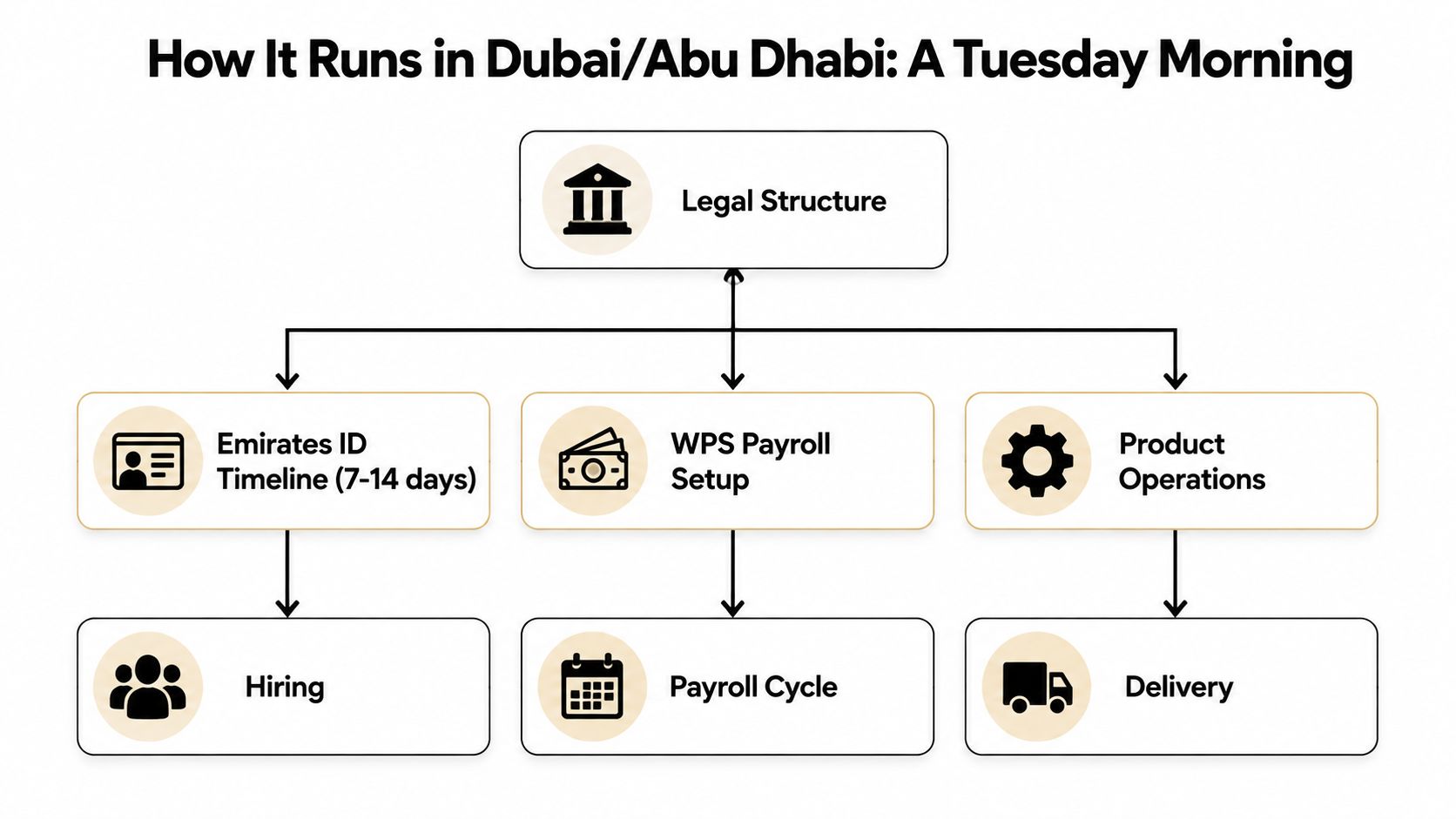
A plan that says “we'll hire a team and deliver through technology” isn't an operating model. Write the operations section as if the company must function next Tuesday morning in Dubai or Abu Dhabi.
Show the people and compliance workflow
Map every core role to a responsibility and a hiring trigger. Include the founder, general manager, finance lead, sales owner, operations manager, technical staff, and any regulated function. Then show when each role joins, what the position costs, and which activity or approval makes it necessary.
The operating plan should address:
- Immigration: Emirates ID and employment-visa workflow, dependent sponsorship where relevant, and the difference between a standard hire and a Golden Visa-eligible specialist.
- Payroll: WPS registration and payroll controls for employees covered by the system.
- Employment cost: Gratuity accrual, insurance, recruitment, onboarding, and leave obligations.
- Premises: Ejari or registered-office compliance, storage, customer access, and inspection readiness.
- PRO work: Licence renewals, immigration filings, labour administration, and document tracking.
Don't use a visa quota as a decorative assumption. Tie headcount to the office package, activity, revenue stage, and operational workload. A reviewer should be able to challenge the staffing plan and see how the model changes.
Treat product approvals as launch dependencies
For regulated or infrastructure-sensitive products, identify the authority before describing the roadmap. A fintech proposition may require attention to the DFSA or another applicable framework. Capital-market activity may involve the SCA, while mobility products may involve the RTA. Don't promise a launch date until the plan shows the approval route, testing environment, responsible manager, and contingency if approval takes longer.
The management section should include a simple organisation chart and decision rights. Investors will inspect whether the team has the skills required by the licence, the product, and the sales model. If there's a gap, name the adviser, hire, or outsourced provider that will close it.
A credible operations plan makes compliance visible without allowing compliance language to hide weak execution.
Financial Projections With Tax and Threshold Scenarios
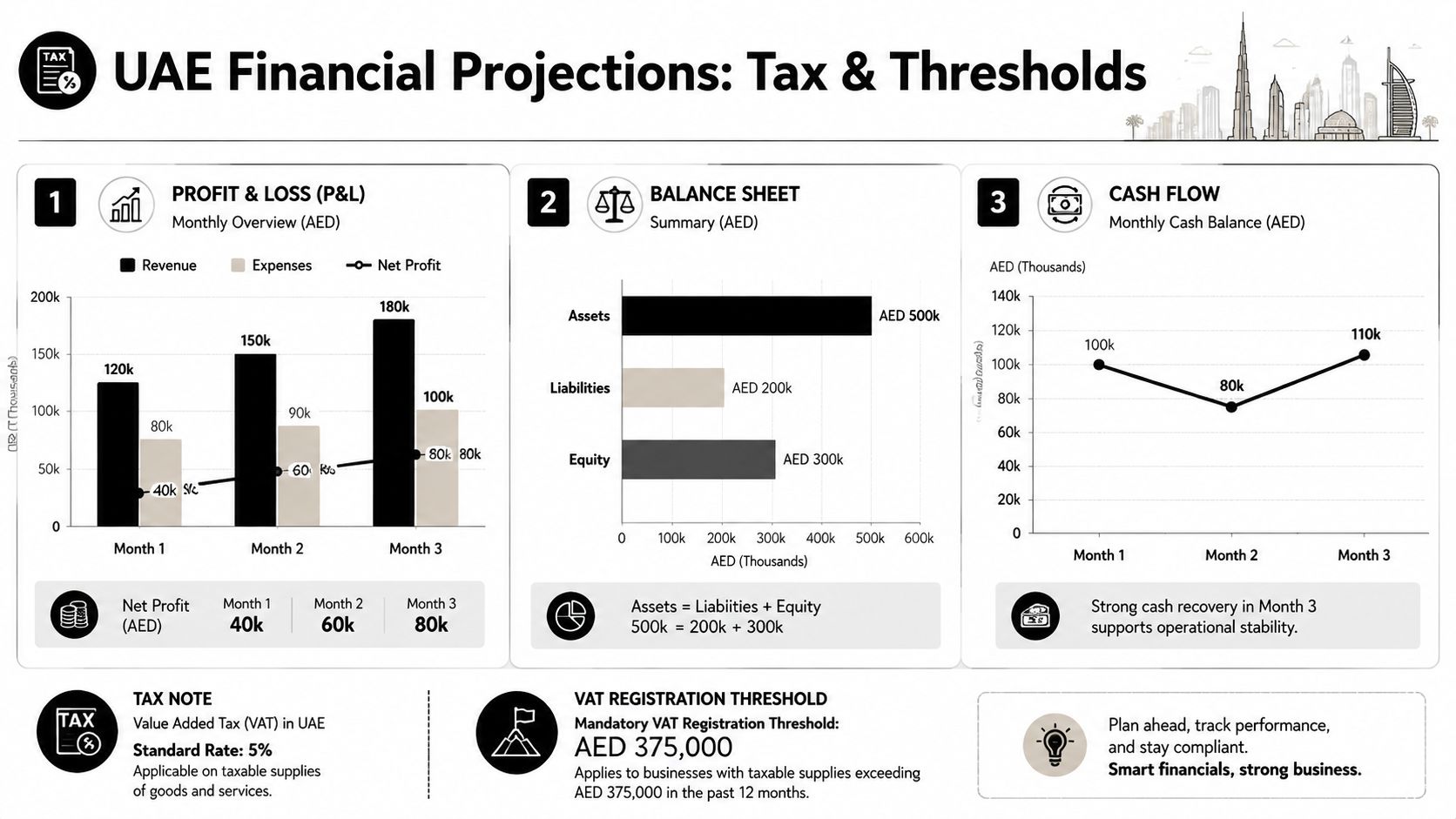
A UAE financial model must show how the company reaches stable collections, not merely report attractive sales. Build it from the decisions already made: jurisdiction, activity, staffing, product requirements, office package, pricing, and collection cycle. Banks will test whether those assumptions connect. Investors will test whether the founder can operate the plan when sales arrive later than expected.
Build three linked statements
Use one connected model containing:
- Profit and loss: Revenue, direct costs, overheads, payroll, depreciation, finance costs, and profit.
- Balance sheet: Cash, receivables, inventory, fixed assets, liabilities, and equity.
- Cash flow: Opening cash, operating inflows and outflows, investment, financing, and closing cash.
Model the first year monthly. Present later periods at a frequency suited to the business. Change a key assumption and make the effect flow through every statement. Higher sales should also change receivables, VAT, inventory, working capital, and closing cash. If those balances remain static, the forecast is not bankable.
Add UAE tax and compliance sensitivities
Separate revenue from taxable income, then model the triggers that change how the business operates. UAE SME classifications consider employee count and annual revenue, so growth affects more than the sales line. It can change staffing, office requirements, licensing decisions, reporting workload, and funding needs. Use the official UAE SME classification context as a reference, then verify current requirements before submission.
Build scenarios for:
- VAT registration and filing obligations as taxable supplies approach the applicable threshold.
- Corporate tax exposure as taxable income approaches the applicable threshold.
- Related-party transactions and transfer-pricing documentation.
- Economic Substance considerations for holding or relevant activities.
- Visa and office costs as staffing expands.
- Receivable delays and their effect on runway.
- Liquidation or restructuring costs if milestones are missed.
Verify current thresholds and rates against Federal Tax Authority guidance. A threshold is a planning trigger, not a sales target to avoid. Crossing it can change pricing, invoicing, accounting, reporting, and cash-reserve requirements. Include a corporate tax planning resource for UAE businesses when reviewing the tax assumptions with your adviser.
Present base, downside, and stretch cases
The base case should use the most defensible assumptions for conversion, pricing, hiring, approvals, and collections. The downside case should reduce conversion, delay receipts, increase hiring friction, or extend approval timing. The stretch case may show stronger distribution or faster adoption, but identify the additional people, capital, capacity, or approvals required.
For every case, show the breakeven month, cash runway, funding gap, tax headroom, and milestone dependencies. Tie the funding request to the cash-flow gap, not the founder's preferred headline. A bank should be able to reconcile the model. A founder should be able to run the business from it.
Funding Request, Risks, and the Investor-Ready Appendix
The funding request is where the plan stops describing the business and starts asking another party to accept risk. Banks and investors will challenge the amount, instrument, use of funds, repayment or exit logic, and evidence behind the forecast.
Make the ask executable
State the amount in AED, the proposed instrument, the closing condition, and the use of funds. Possible structures include equity, a convertible instrument, a Sharia-compliant facility, or an SME Murabaha facility from a bank such as Emirates NBD or ADCB, subject to eligibility and approval.
Tie each use of funds to a milestone:
- Licensing and premises: Establish the approved operating base.
- Hiring: Add the roles required to deliver sales or regulated operations.
- Product development: Reach a defined release or approval gate.
- Customer acquisition: Fund a channel with measurable conversion evidence.
- Working capital: Cover the timing difference between invoices and collections.
Include repayment capacity for debt or a credible 36-month exit view for equity. Don't hide working-capital pressure. If customers pay slowly, show the receivables assumption and the cash reserve needed to survive it.
Use a risk register that a lender can test
| Risk | Probability | AED Impact | Mitigation |
|---|---|---|---|
| Regulatory change | Assess against the activity and authority | Model the direct compliance and restructuring cost | Monitor official guidance, maintain tax records, and reserve funds for compliance changes |
| Slow receivables | Base on contract terms and buyer profile | Link to the cash-flow gap | Use deposits, staged billing, credit controls, and collection ownership |
| Talent and visa dependency | Assess role scarcity and approval needs | Model replacement, delay, and onboarding cost | Cross-train staff, document processes, and maintain an approved hiring pipeline |
| Demand cyclicality | Test against sector exposure | Link weaker sales to runway | Diversify customer segments, stage hiring, and protect cash reserves |
The appendix should support the story without burying it. Include licences, ownership records, founder CVs, customer evidence, supplier terms, product documentation, tax registrations, financial-model assumptions, contracts, and a clean investor data room index.
Founders approaching investors should also organise their targeting rather than sending the same plan to every fund. A resource such as the Gritt.io analytics investor database can help structure investor research, but the plan still needs a UAE-specific thesis and a precise funding rationale.
Finish with a launch control list
Before circulation, verify:
- Licence status: Activity, jurisdiction, premises, and renewal dates align.
- Ownership records: UBO information is complete and consistent.
- Tax readiness: VAT and corporate-tax responsibilities are mapped to the model.
- ESR position: Notification and reporting obligations are assessed where relevant.
- Banking file: Source of funds, ownership, contracts, and financial projections are organised.
- Data room: Every forecast assumption has supporting evidence or a clear owner.
- Exit or closure route: The plan explains what happens if the company pauses, restructures, or liquidates.
The UAE startup path is selective. Dubai Chamber material reports that only about 20% of Dubai seed-stage startups have historically advanced to Series A, meaning roughly one in five reached that scale-up stage. (Dubai Chamber startup transition benchmark) Your outline should therefore demonstrate traction, unit economics, compliance control, and funding milestones instead of relying on generic growth language.
Smart Classic Business Hub helps founders turn a UAE business idea into a decision-ready plan, covering feasibility studies, company formation, VAT-compliant accounting, audit, tax planning, PRO support, and liquidation planning. Visit Smart Classic Business Hub to discuss your jurisdiction, financial model, compliance requirements, and launch roadmap with a Dubai-based advisory team.