
You're staring at two quotations for the same UAE business activity. The mainland consultant promises broad market access, while the free zone package appears cheaper and includes a flexi-desk. Both proposals sound attractive, but the licence you choose now can shape your ownership position, customer access, tax treatment, visa capacity, office obligations, and compliance workload for the next three to five years.
The right way to choose a business structure in the UAE isn't to compare headline licence prices. Start with the legal footprint, test how and where you'll earn revenue, then confirm whether the structure can support your people, premises, banking, invoicing, and tax obligations as the company grows. An offshore vehicle belongs in a different category altogether, because it's designed for holding and international structuring rather than operating inside the UAE.
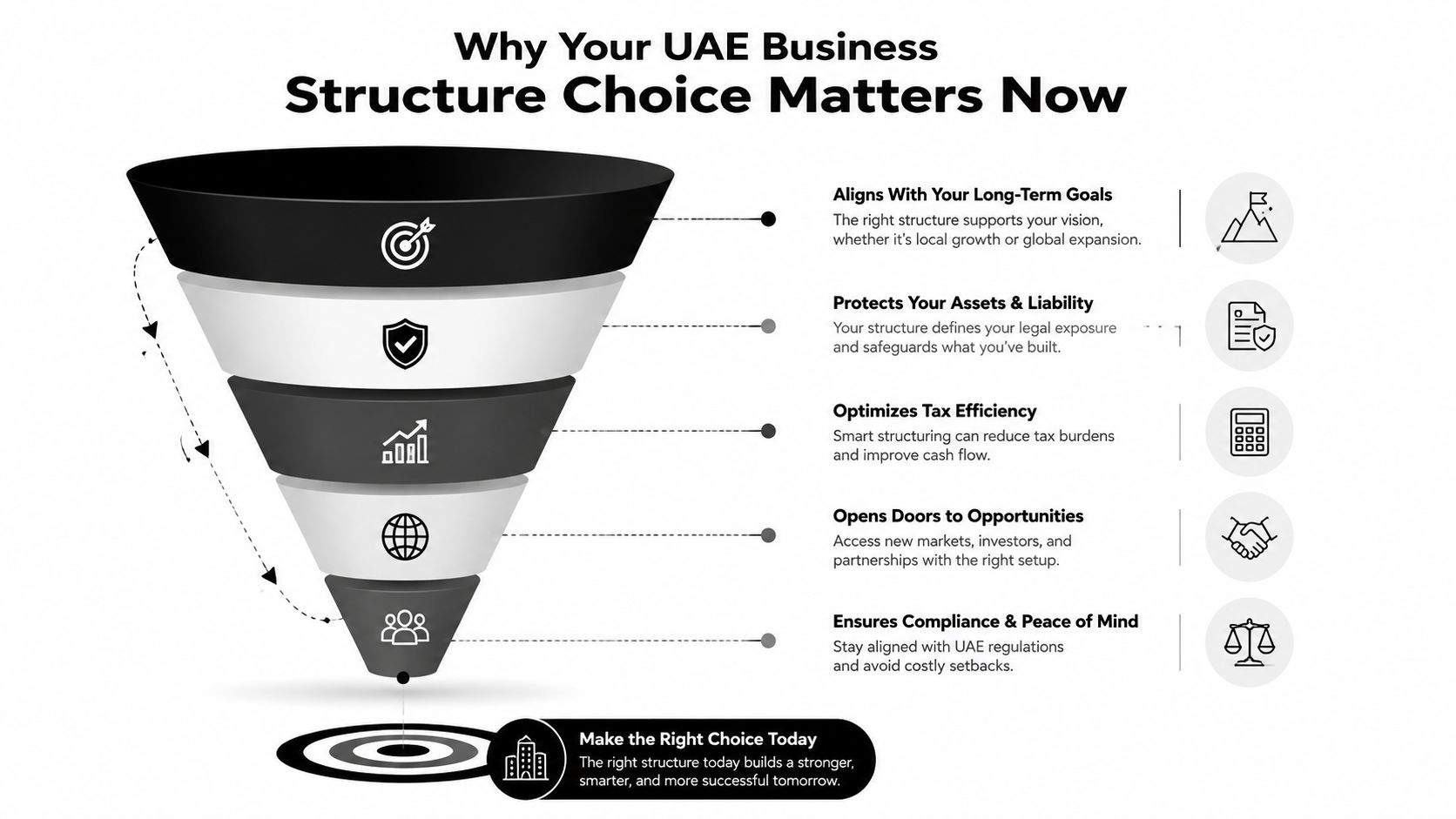
Why Your UAE Business Structure Choice Matters Now
A founder who chooses the cheapest licence often creates a more expensive problem later. The company may win an early saving, then discover that it can't contract directly with the intended customers, needs a different regulatory approval, has insufficient visa capacity, or can't maintain the operating substance required for its intended tax position.
Use three decisions in sequence.
Start with the legal footprint
First, decide whether the business needs a mainland entity, free zone entity, or offshore vehicle. Mainland entities licensed by an emirate economic department can sell throughout the UAE and abroad. Free zone companies are generally structured for international or intra-zone trade, with mainland access depending on the activity and applicable arrangements. Offshore entities are non-resident holding or asset vehicles and can't conduct operating business inside the UAE, as described in this UAE entity-selection guide.
This legal choice affects who can sign contracts, where the entity can trade, which authority regulates it, and whether extra agents, distributors, branches, or permits are needed.
Test the tax position second
Tax comes after the commercial footprint, not before it. The UAE corporate tax framework applies a 0% rate up to AED 375,000 of taxable income and a 9% rate above that, while a free zone company's access to qualifying treatment depends on its income, activities, and continuing compliance position. A free zone label alone doesn't guarantee a favourable result.
Your forecast should show where revenue will arise, whether income can remain qualifying, and whether the company will have the records and operating presence needed to defend its position. Founders comparing legal and tax choices can also review these assets and tax optimisation tips before committing to a formation package.
Add visas and operating cost third
Only after the first two tests should you compare office packages, visa quotas, establishment costs, and administrative fees. A free zone flexi-desk may suit a lean consultancy with overseas clients, while a mainland company with staff, customer visits, inventory, or government contracts may need a more substantial premises arrangement.
Practical rule: Forecast the business at its expected scale, not only at incorporation. A structure that works for a solo founder may fail once local revenue, employees, or regulated activity enters the plan.
Write a simple three-to-five-year forecast before signing. Include local and international revenue, employee numbers, office needs, expected taxable income, and the point at which the company may need a branch or mainland presence. Even if the forecast is imperfect, it's more useful than choosing from a price list.
Mainland, Free Zone, and Offshore at a Glance
The three structures serve different commercial purposes. Mainland licensing is handled by the relevant emirate economic department, commonly referred to as DED or DET depending on the emirate. Free zone companies are licensed by zone authorities such as DMCC, JAFZA, RAKEZ, or Sharjah Publishing City Free Zone. Offshore vehicles sit within jurisdictions such as JAFZA Offshore or RAK ICC and are normally used for holding, asset ownership, or international structuring.
The 1 June 2021 Commercial Companies Law reform removed the long-standing 51% UAE-national ownership requirement for most mainland companies and opened 100% foreign ownership for more than 1,000 commercial and industrial activities, subject to strategic-sector exceptions. That change means most founders shouldn't assume a mainland company automatically requires a local shareholder. They should verify the activity and any sector-specific restriction instead. The ownership reform is outlined in this PwC summary of UAE ownership requirements.
| Dimension | Mainland (DED/DET) | Free Zone (e.g., DMCC, RAKEZ) | Offshore (JAFZA Offshore, RAK ICC) |
|---|---|---|---|
| Licensing authority | Emirate economic department | Zone authority | Offshore registrar or jurisdiction |
| Foreign ownership | 100% permitted for most eligible activities, with strategic exceptions | Generally designed for foreign ownership, subject to authority rules | Commonly used for international ownership and holding arrangements |
| Market access | Direct UAE mainland trading and international business | International and intra-zone trade, with mainland access subject to activity, distributor, branch, or permit arrangements | Holding and international structuring, not operating business inside the UAE |
| Office requirement | Physical premises may be required for the activity and licence | Flexi-desk, shared office, or physical premises depending on package and activity | Registered agent or registered address arrangement |
| Typical commercial fit | Local services, retail, contracting, UAE sales, government work | Exporters, holding structures, digital businesses, and firms operating within a zone framework | Asset holding, shares, and international structuring |
| Main constraint | Higher operating commitment where premises and local staffing are needed | Access, qualifying-income, substance, and activity restrictions | No UAE operating trade |
The cost difference between a free zone flexi-desk package and a mainland trade licence with an office can be significant in practice, but the cheaper quote isn't automatically the better commercial decision. A mainland office may be a necessary operating asset, while a flexi-desk may be sufficient only for a business that doesn't need continuous physical operations.
For a broader framework on how to pick the right business structure, focus on control, liability, tax, compliance, and growth rather than formation price. Founders considering a zone route can also examine free zone company setup in the UAE before comparing packages.
The Seven Filters That Drive the Decision
Don't sign a quotation until the proposed activity passes seven filters. Mark every filter pass, fail, or conditional for each structure. A conditional result needs a written answer from the licensing authority or adviser, not a verbal promise.
Filter one, ownership eligibility
Check whether the activity falls within a strategic sector that still carries ownership or participation restrictions. The 2021 reform changed the default position for most eligible mainland activities, but it didn't remove every exception. Confirm the exact activity classification before assuming that 100% foreign ownership applies.
Filter two, licensing scope
Identify the authority that controls the activity. A standard economic-department trade licence may not be enough for healthcare, education, tourism, financial services, or a specialist professional activity. DHA, DIFC, ADGM, and other regulators may impose separate approvals or operating conditions.
Filter three, market access
List your first customers by geography. If you'll sell directly to UAE mainland customers, bid for government work, maintain a local service team, or operate a shop or warehouse, mainland access deserves priority. If revenue will come from exports or international clients, a free zone may fit more naturally.
Filter four, revenue forecast
Build the tax forecast around taxable income, not turnover alone. The UAE corporate tax framework applies 0% up to AED 375,000 of taxable income and 9% above that, while free zone treatment depends on whether the entity qualifies and preserves its Qualifying Free Zone Person status. Test the forecast against local revenue, qualifying activities, expenses, and future expansion.
Filter five, visa requirement
Count founders, employees, dependants, and expected hires. Then compare the proposed zone package with the office and quota requirements attached to a mainland licence. A package that works for a founder-led operation may not support a growing team.
Filter six, office and substance
Ask whether the proposed premises reflect the actual activity. A flexi-desk may support a light advisory operation, but it won't automatically demonstrate substance for a company claiming a specialised tax position while making substantial operational decisions elsewhere.
Filter seven, banking and invoicing
Confirm that the entity name, activity, contracts, bank account, and invoices all tell the same commercial story. Tax invoices must carry required information, and the entity issuing the invoice must match the entity earning the revenue. VAT registration and invoicing errors are highlighted in this UAE VAT business guidance.
Decision test: If a structure fails market access, licensing scope, or substance, don't rescue it with a cheaper fee. Remove it from the shortlist.
Ownership, Tax, and Substance Rules You Cannot Skip
The UAE ownership reform is important because it changed the question founders need to ask. Instead of assuming that every mainland company needs a UAE-national shareholder, verify whether the proposed activity qualifies for 100% foreign ownership and whether it falls within a restricted strategic sector. The legal form still matters, but the activity code now carries more weight than outdated formation advice.
Corporate tax creates a second layer of analysis. The UAE applies 0% on taxable income up to AED 375,000 and 9% above that, while a free zone entity may access 0% treatment for qualifying income if it meets the requirements for a Qualifying Free Zone Person. That status is earned through eligible activities, proper records, required filings, and continuing compliance. It isn't created by selecting a free zone during incorporation.
| Structure | Foreign ownership | Corporate tax rate | Substance requirement |
|---|---|---|---|
| Mainland | 100% for most eligible activities, with strategic-sector exceptions | 0% up to AED 375,000 of taxable income, then 9% | Operating footprint must support the activity and records |
| Free zone | Generally available to foreign founders, subject to authority and activity rules | Qualifying income may receive 0%, with 9% applying to non-qualifying income and applicable taxable profits | Stronger need to preserve qualifying status, activity compliance, records, and real operations |
| Offshore | Structured for holding and international ownership purposes | Treatment depends on the activity, residence, income, and applicable rules | Must support the stated holding or structuring purpose, but can't substitute for an operating UAE entity |
A defensible substance position normally requires more than a registered address. The business should be able to show appropriate UAE-based people, decision-making, board meetings with minutes, financial records, and premises consistent with its activity. Audit readiness matters because a company claiming a favourable position must be able to explain how it operates, where decisions are made, and why the income qualifies.
Other obligations also need early attention. These include transfer pricing documentation where relevant, treatment of certain foreign payments, corporate tax registration, accounting records, and VAT registration when the statutory threshold applies. The AED 375,000 VAT registration threshold is based on taxable supplies and imports exceeding that amount in the previous 12 months or expected to exceed it within the next 30 days, according to the cited practitioner guidance.
A founder choosing an offshore structure for an operating business is making a category error. Offshore vehicles can hold assets or shares, but they can't conduct operating business inside the UAE. Read more about the distinction in this guide to an UAE offshore company.
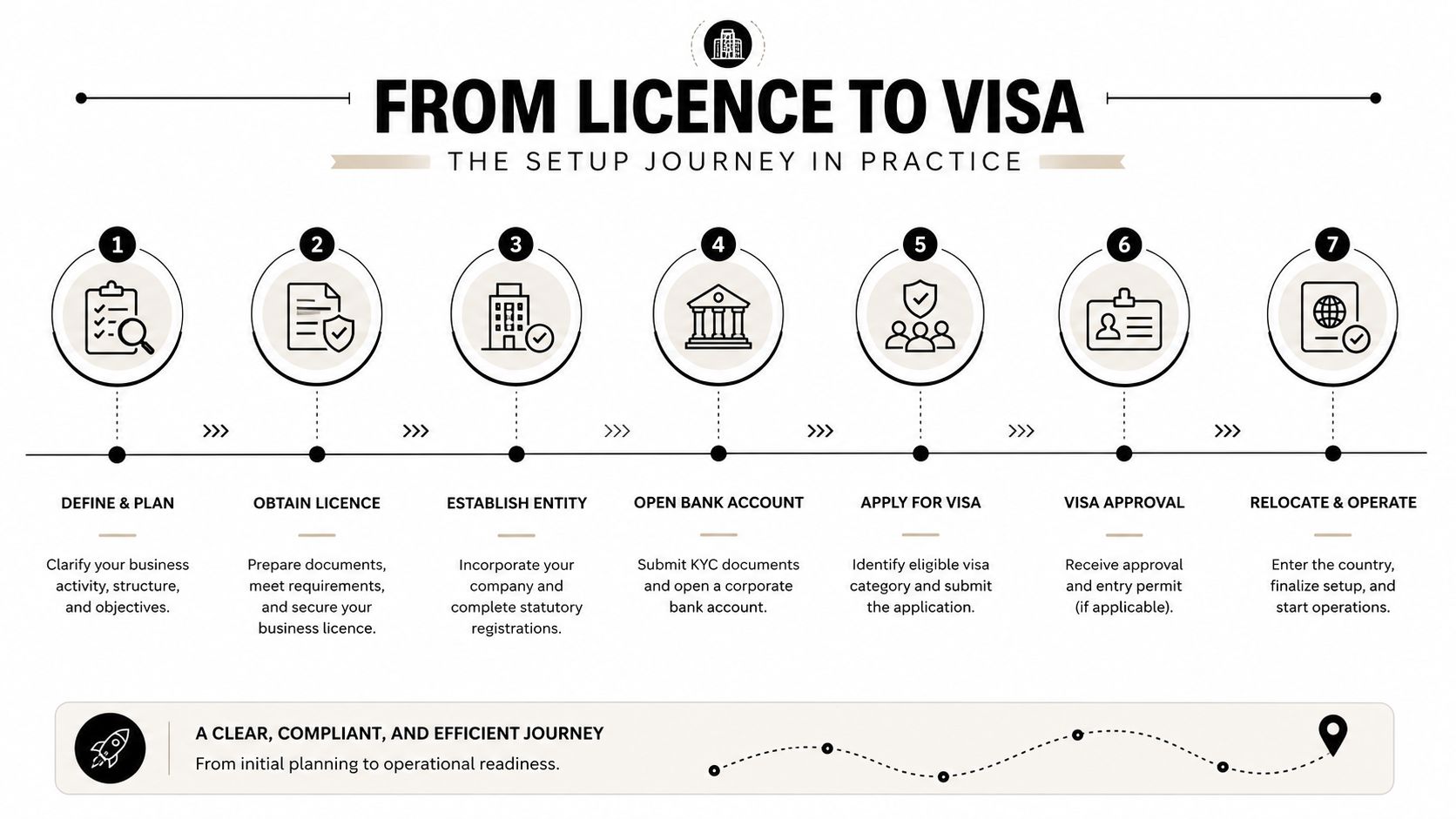
From Licence to Visa, the Setup Journey in Practice
Formation becomes manageable when the sequence is correct. Delays usually arise because founders submit documents before settling the activity, premises, ownership, or immigration requirements.
The practical sequence
Reserve the trade name and secure initial approval. Apply through the relevant emirate economic department or free zone authority. The activity wording must match what the company plans to do.
Choose the premises. Mainland businesses may need physical office space and lease registration. Free zone applicants may select a flexi-desk or another zone package, depending on the activity and visa requirement.
Receive the trade licence and complete related registrations. This can include Chamber of Commerce membership and authority-specific registrations. The UAE business licence process should be planned alongside, not after, the company's operating needs.
Apply for the establishment card. The immigration file allows the company to sponsor eligible investors and employees.
Process residence visas. Applicants usually complete medical fitness procedures, Emirates ID biometrics, and visa stamping or the applicable digital issuance process.
Free zones typically issue licences in three to seven working days, while mainland approvals commonly take five to ten days plus notarisation, according to the supplied formation guidance. These are process expectations, not guarantees. Regulated activities, foreign documents, shareholder structures, and authority queries can extend the timeline.
Documents that commonly stall an application
- Unsigned MOAs: Every required signature and form must be complete.
- Expired passports: Check validity before submitting shareholder or manager documents.
- Missing NOCs: A change from an existing sponsor may require a no-objection certificate.
- Unattested educational certificates: Professional and regulated activities can require properly attested qualifications.
Ask whether the quotation bundles the licence, establishment card, visa quota, medical charges, immigration file, lease, and other government costs. Many apparently low quotes separate these items, making comparison difficult. Request an itemised schedule before paying.
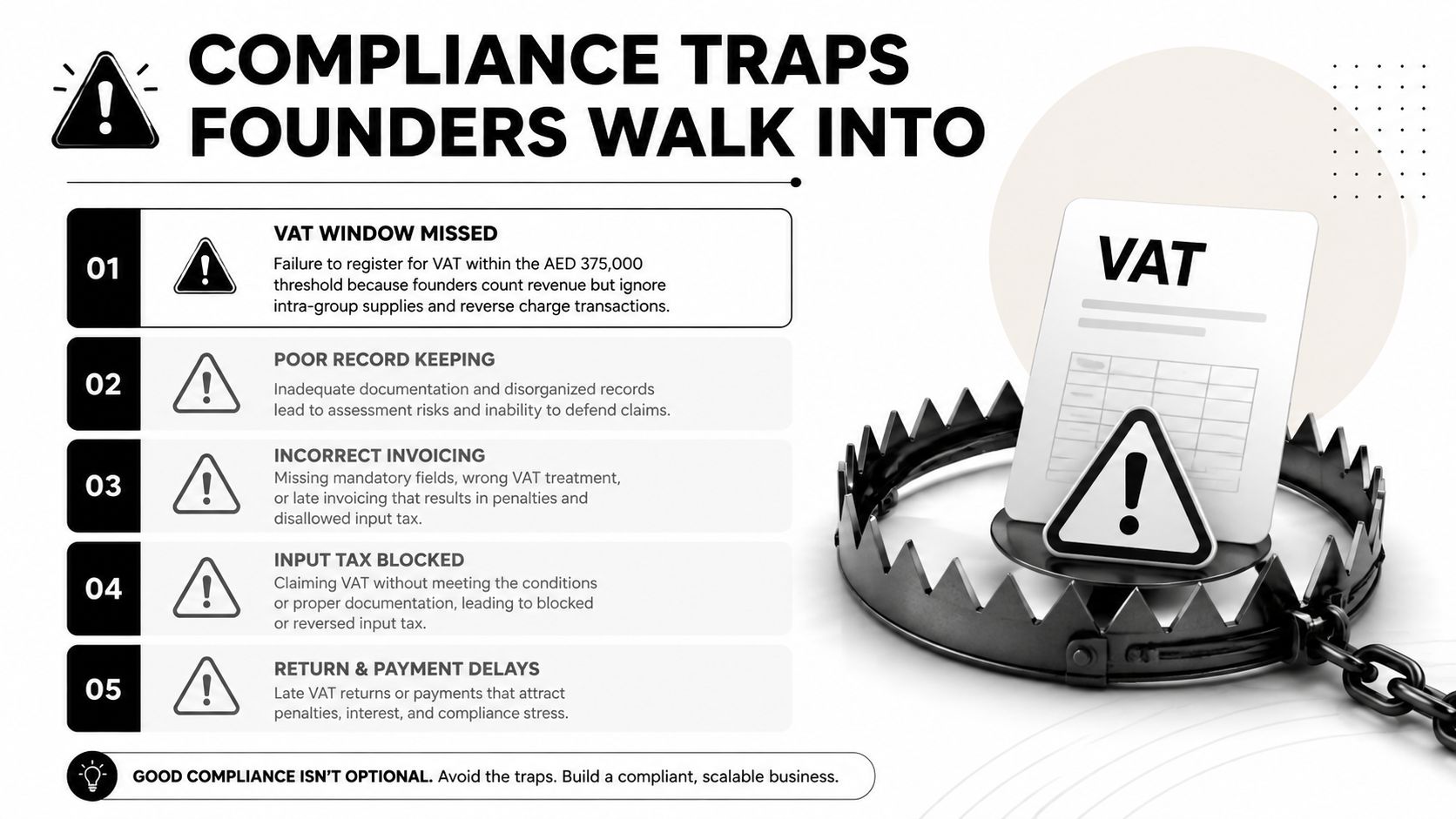
Compliance Traps Founders Walk Into
A founder can choose the right structure for a three-to-five-year revenue plan and still create compliance problems during operations. The licence is only the starting point. Tax registration, invoicing, ownership records, licensed activities, and commercial substance must all match how the company earns revenue.
VAT mistakes start with bad measurement
Track more than customer invoices. Taxable imports, reverse-charge transactions, intra-group supplies, and deemed supplies can affect the VAT analysis. Mandatory registration applies when taxable supplies and imports exceed AED 375,000 in the past 12 months or are expected to do so within the next 30 days, as explained in the cited VAT registration and invoicing guidance.
Do not issue VAT invoices before receiving the tax registration number. Check every required invoice field, apply the correct place-of-supply treatment to cross-border services, and retain export evidence before claiming zero rating.
Other failures expose the structure
Keep beneficial-owner information current and complete the required filings with the relevant authority. A free zone company must operate within its licensed activity and comply with market-access arrangements. Directly serving mainland customers may require a distributor, commercial agent, branch, or specific permit. Ignore that requirement and the formation choice can become a regulatory breach.
Regulated sectors require separate approvals. Tourism, healthcare, education, financial services, and similar activities may sit outside the ordinary trade licence. Confirm those approvals before incorporation and before signing the first customer contract.
Compliance reality: A free zone company with no meaningful staff, meetings, decisions, or activity in the UAE may appear to be a brass-plate operation. That weakens its ability to defend intended tax treatment, including any qualifying free zone position, and to demonstrate commercial substance.
Match premises, staffing, accounting, and governance to the revenue forecast. If the company expects qualifying treatment, keep operational evidence from the start. Rebuilding that record during an audit is expensive and unreliable.
Your Decision Checklist and Next Steps
Treat the choice as a three-to-five-year revenue forecast, not a one-time registration. Score each mainland, free zone, offshore, or branch route against these 12 questions. Mark each answer pass, fail, or conditional, and record the evidence.
- Does ownership comply with activity and sector rules?
- Where are target customers located?
- Does the activity classification match the actual product or service?
- How many founder and employee visas are required?
- What does the three-to-five-year revenue forecast show?
- Can the company preserve Qualifying Free Zone Person status?
- What office footprint does the activity require?
- Will banks accept the activity, owners, and revenue model?
- Can the founders maintain audit-ready records and operational substance?
- Will the entity invoice customers from the correct legal name?
- Could the business need a mainland branch, permit, or distributor?
- What is the expected exit, sale, restructuring, or expansion timeline?
The scorecard should produce a clear recommendation. Mainland fits direct UAE trade, local premises, staff, government work, and unrestricted domestic access. Free zone fits a business whose activity, customers, office model, and tax plan match the authority's rules, including the requirements for qualifying status. Offshore fits holding and international structuring, not active UAE trade. A branch can suit an existing company that needs UAE operations without creating a separate commercial identity, subject to authority and activity requirements.
Take three steps this week:
- Get comparable quotations: Ask three providers to quote the same activity code. Require separate licence, visa, office, establishment, and government costs.
- Pressure-test the scorecard: Book a 30-minute review with a formation adviser who can check current economic-department and free zone authority requirements.
- Brief a tax adviser early: If the forecast approaches the UAE corporate tax thresholds, confirm the intended tax treatment before reserving the trade name. Also confirm whether the planned free zone operation can meet substance requirements.
The cheapest quote rarely identifies the right structure. A small formation saving can become expensive after a tax exposure, forced restructuring, bank delay, or loss of the market access customers require.
Smart Classic Business Hub compares mainland, free zone, and offshore routes against your activity, revenue forecast, visa needs, and compliance obligations. Visit Smart Classic Business Hub to request a structure review covering formation, VAT-compliant accounting, audit readiness, and ongoing UAE compliance.