
The UAE National ID is a mandatory biometric smart card issued by the Federal Authority for Identity, Citizenship, Customs and Port Security to every citizen and resident, and you can't complete a residency visa, open a bank account, or finalise most government transactions without it. In practice, the card sits inside a much larger UAE national identity system that also shapes language, belonging, and state trust.
You're probably here because something has already stalled. The typing centre says one thing, the immigration counter says another, the bank wants a renewed ID, and your company setup agent keeps asking for documents that sound identical but aren't. That confusion is normal in the UAE, because the Emirates ID isn't just an ID card, it's the visible front end of a digital trust stack that runs under residency, banking, healthcare, and government services.
What UAE National Identity Actually Means
A foreign founder usually thinks the UAE identity process starts and ends with a plastic card. It doesn't. The card is only the operational layer, while the deeper idea of UAE national identity comes from the federation created on 2 December 1971, the date now marked as National Day, and from a state-defined identity framework built around Islamic values and ethics, the Arabic language and Emirati dialect, the Union and homeland, heritage, customs, and traditions, history, geography, and collective memory, and the Emirati family as the foundation of society (Ministry of Foreign Affairs facts and figures).
That cultural layer matters because the country's citizen base is small relative to the total population. Government-linked figures cited in regional reporting put Emiratis at about 11.5% of the population in 2010, with expatriates at 88.5%, and later estimates continued to place nationals at roughly 11% to 12% of residents. In a country structured like that, language, institutions, and shared memory aren't decorative. They are the glue that keeps the federation legible to everyone living and working here.
The card is the working layer
The Emirates ID is the part you use. The ICP describes the UAE national ID program as a layered digital trust architecture built around the Population Register, biometric subsystems, AFIS, workflow and document management, smart cards, PKI, and secured network infrastructure, all designed for high-availability, web-based use (ICP briefing on the UAE National ID Card Program). That means the card is not a standalone token. It is a credential that sits on top of a wider system, and that system is what banks, immigration desks, and government portals trust.
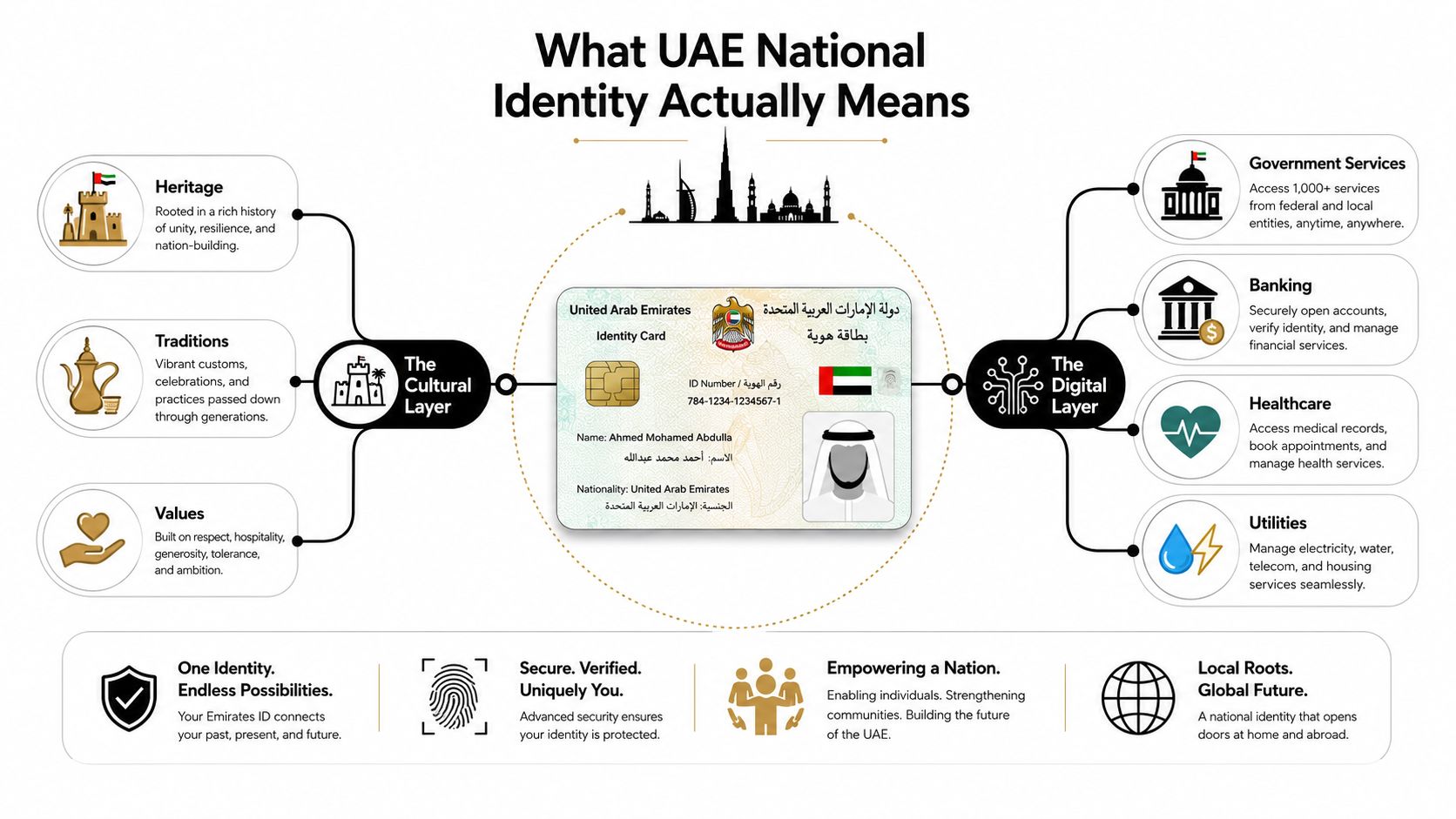
Practical rule: if a service in the UAE asks who you are, it usually wants the card, the card number, the mobile number linked to the record, and often a biometric or OTP check. Treat it as one identity stack, not separate admin tasks.
Citizens, Residents, and the Six Pillars of Identity
A foreign founder usually gets this wrong first. They assume UAE national identity is only about Emiratis and a passport. The state treats identity as policy, administration, and social cohesion at the same time. In a Federal National Council discussion reported by Gulf News, an official said the UAE national identity index stood at 90%, with a target of 100% by 2021.
Why the demographic split changes the policy
The resident mix explains why identity is managed so deliberately. A Ministry of Education-linked forum reported that nationals had fallen from 63% in 1968 to around 20% at the time of the forum, in a country hosting about 200 nationalities speaking more than 100 languages and dialects (Gulf News). That is not a normal identity setup. It is a multinational system that needs active cultural and civic alignment, or it fragments fast.
The six identity pillars show up in daily policy in very practical ways. Islamic values and ethics shape family norms and public conduct. Arabic language and Emirati dialect affect schooling and public signage. Union and homeland sits behind civic messaging and National Day. Heritage, customs, and traditions appear in festivals and dress codes. History, geography, and collective memory shape museums and school content. The Emirati family remains the state's preferred social unit, which is why family policy is never treated as a side issue.
That framework is not decorative. It is managed because a citizen-minority structure makes drift easy, especially in a country built around cross-border movement, company setup, visas, and residency files. The UAE does not leave belonging to chance, and it does not let paperwork sit apart from policy. It standardises identity because standardisation is how trust holds together in a country this diverse.
The insight is simple, identity in the UAE is both symbolic and administrative. If you ignore either side, you will misunderstand how the country works.
Who Needs an Emirates ID and Which Visas Apply
If you're in the UAE legally, you need an Emirates ID. That applies to citizens and to residents on a residence visa, including employment, investor, family, freelancer, golden, student, and domestic worker visas. GCC nationals who take up UAE residency also register for an ID, because the card is tied to the residency file, not just nationality.
The clearest way to think about it is this. The ID number is the identifier. The physical card is the token you present. The residency file is the immigration record underneath it. If any one of those falls out of sync, a bank, landlord, insurer, or PRO can block the transaction even if the visa looks fine on paper.
For founders, the residence visa number and the Emirates ID process are usually intertwined from day one. If you're trying to understand how the file number sits inside the residency process, this practical explainer on the UAE residence visa number is the right place to start.
Don't guess your eligibility
If you're entering the system for the first time, ask one question only, what visa route am I on? The answer determines whether you can move straight into biometrics, whether your sponsor must file first, and whether your card will be issued alongside the residency process. In most real cases, the card isn't an optional add-on. It's part of the residency workflow itself.
Founder's rule: if someone tells you “the visa is approved, so you're done”, they're not done with the process. In the UAE, approved is not the same as activated.
Applying for an Emirates ID Step by Step
The cleanest way to do this is in the correct order, not the order people repeat in WhatsApp groups. For a first-time applicant, the flow usually runs through medical fitness where required, online form submission through ICP channels, biometrics at an ICP-registered typing centre or Amer centre, document upload, fee payment, and card delivery through Emirates Post. The practical reason for this sequence is simple, the system needs identity proofing before it can finalise the credential.
The ICP-linked material says the identity management infrastructure was established in 2005 and that all citizens and residents were registered by the end of 2012, with identity cards carrying a unique ID number, fingerprints, and paired digital certificates for authentication and signature (ICP identity management briefing). That's why biometrics matter so much. The card is built for multi-factor use, not casual display.
For biometrics specifically, this guide to biometrics for Emirates ID is useful if your case is delayed or you've never done the enrolment process before.
What to bring
- Citizens: passport or family book details, plus whatever the typing centre asks for in the current transaction.
- Residents: passport, visa or entry status documents, photo, and sponsor or company documents where applicable.
- GCC nationals: passport and residency-related supporting documents if you're applying through a UAE residence route.
- First-time applicants: be ready for biometrics, because fingerprints and photo capture are part of the record.
The budget and timing depend on your status and transaction type, so don't rely on office gossip. The table below is only a planning snapshot, not a substitute for the current ICP fee schedule at the counter.
| Transaction | Who It Applies To | Indicative Fee (AED) | Typical Processing Time |
|---|---|---|---|
| First issuance | Citizens and new residents | Varies by category | Usually tied to residency processing |
| Renewal | Expiring card holders | Varies by category | Often completed during the renewal cycle |
| Replacement | Lost, stolen, or damaged card holders | Varies by category | Depends on re-enrolment and verification |
| Late renewal fine | Lapsed card holders | Applies after grace period | Accrues until renewal is completed |
Most first-time applications are bundled with the residency visa application and processed together. That's the version to plan for unless your sponsor or consultant tells you, in writing, that your file is being split.
Renewing, Replacing, and Reporting a Lost Card
The renewal habit in the UAE is boring, until it isn't. Renewals can be triggered up to six months before expiry, and if you miss the deadline, a 30-day grace period runs before daily fines start accruing. That's the sort of delay that breaks a bank onboarding, a family sponsorship, or a company filing.
A valid card matters even when the visa looks technically alive. I see this fail most often in three situations. A founder is trying to open a corporate account, the company admin is renewing a trade licence, or a spouse is filing family sponsorship and the card is expired in the background. The bank or authority doesn't care that the renewal is “in progress”. They care whether the record is current.
The replacement route is straightforward if you stay calm. Report a lost card through ICP channels or a customer happiness centre, then follow the replacement and biometrics steps if prompted. Damaged or stolen cards follow the same logic, proof first, reissue second, and verification if the record needs refreshing.
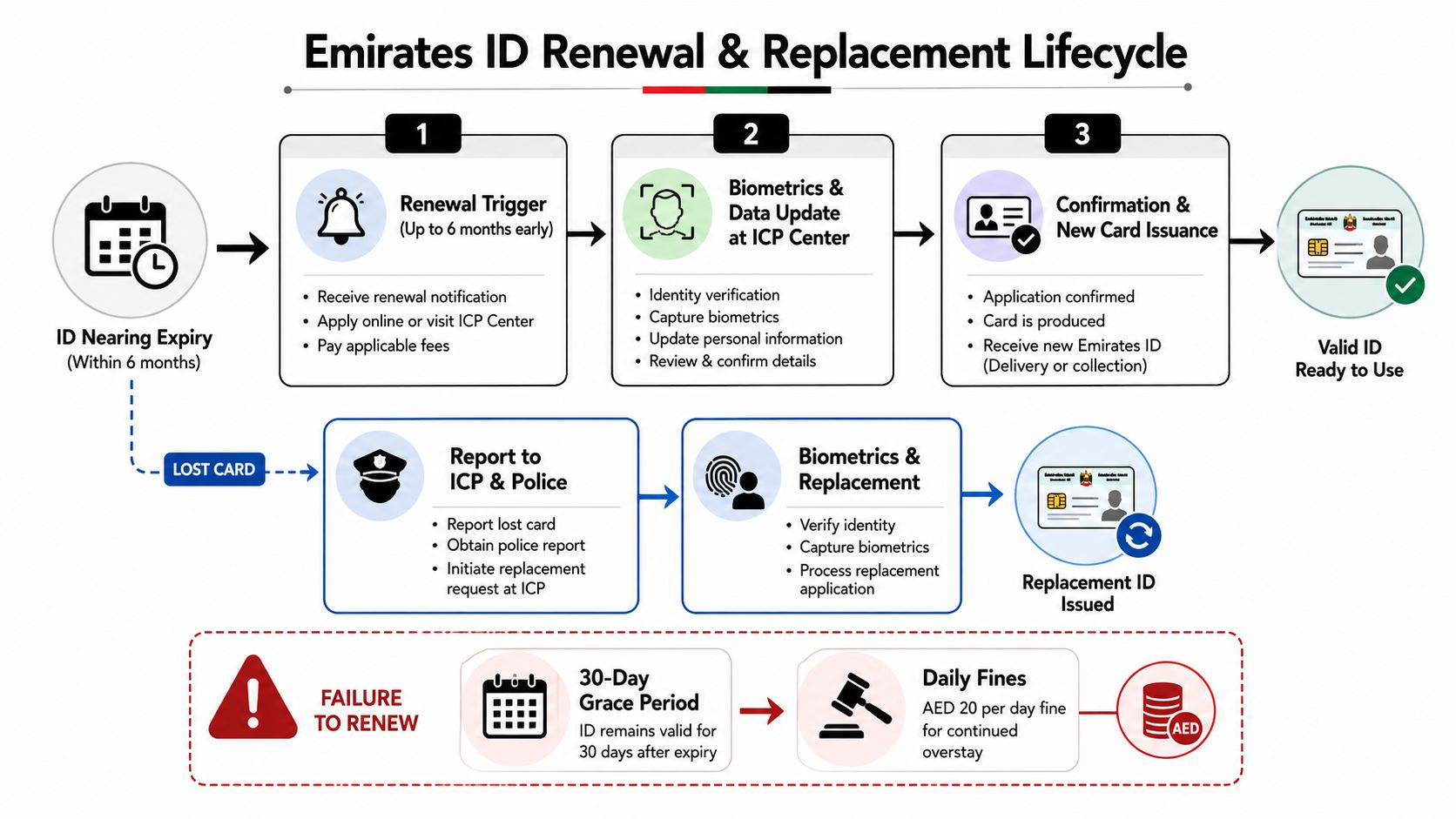
If you want a live-status view of your file rather than guessing from SMS messages, use the Emirates ID tracking workflow and keep your reference number handy. That's faster than calling three counters and hoping one of them has the same record.
Practical Uses of the Emirates ID in Daily Life
The Emirates ID is the card that makes regulated life in the UAE work. Banks use it for KYC, telecom providers use it for SIM activation, healthcare providers use it for patient identity checks, and government portals use it for service access. For citizens, it also sits inside some public processes tied to voting and FNC-related procedures.
Where it shows up first
A foreign investor opening a corporate bank account will usually hit the ID check before anything else. A parent sponsoring a child will need the card details across visa, school, and insurance touchpoints. A freelancer activating a mobile line will find that the telecom counter wants the ID record, not a verbal explanation.
The same pattern repeats across housing and digital access. Ejari, insurer portals, and many government e-services all rely on a matching ID number and linked contact details. That's why UAE Pass matters too, because it acts as the digital layer on top of the physical credential for many public and private services (UAE Pass overview).
If you strip away the admin language, the practical multi-factor combo is usually the Emirates ID, the linked phone number, and the UAE Pass PIN. That trio is what most regulated platforms trust.
Practical rule: keep the card, the phone number, and the login record aligned. If one changes and the others don't, the system treats you like a new person.
Data, Privacy, Penalties, and Common Mistakes
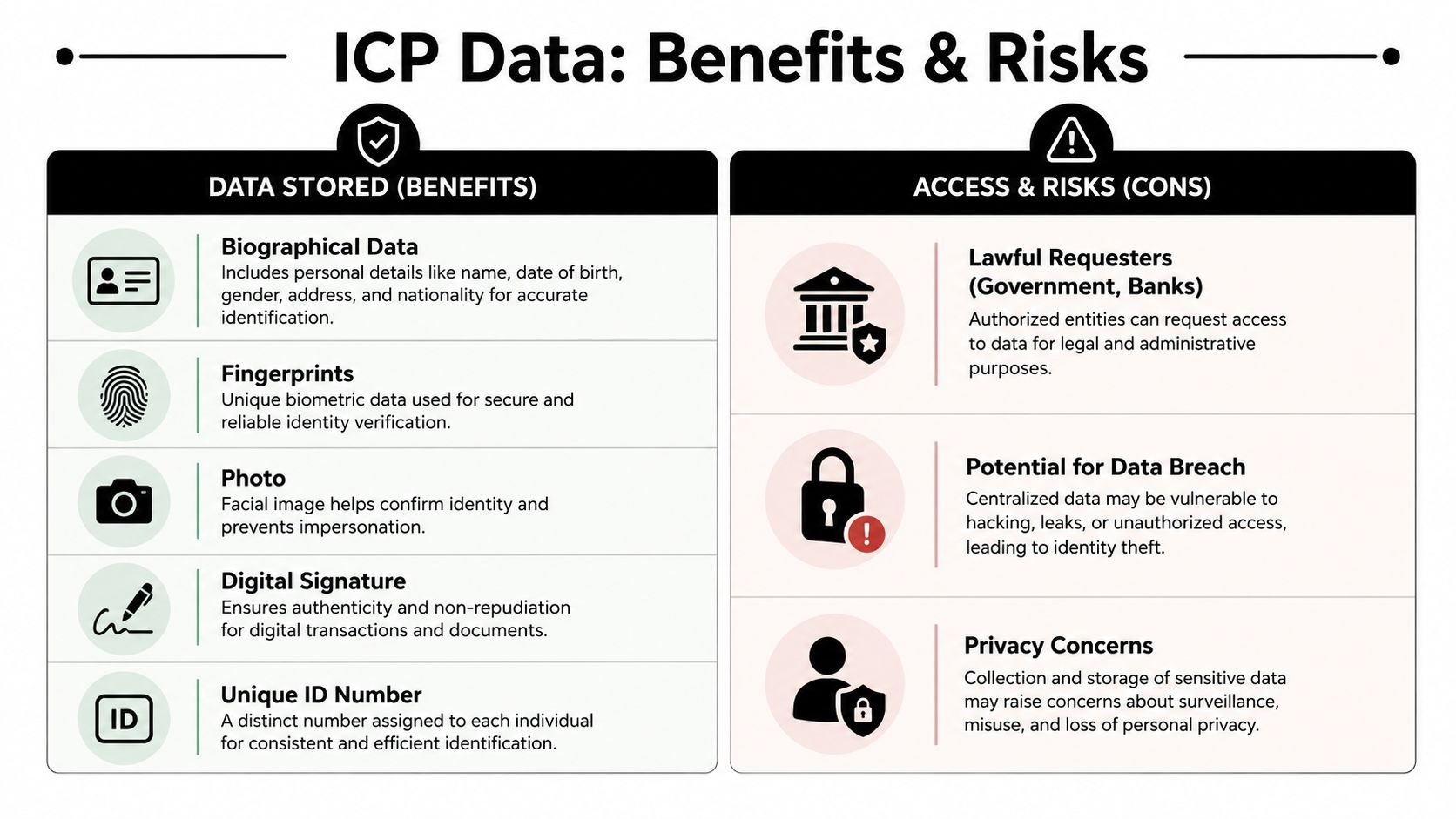
The ICP record is more than a card image. It holds biographical data, fingerprints, photo, digital signature certificates, and a unique ID number tied to the Population Register. That is why the card carries more trust than a photocopy. It is a live identity record with verification hooks.
Banks, telecom providers, landlords, and government authorities can request the card in normal processing. That does not give them unlimited access to your file, it means they can ask for identity proof where the law and procedure require it. Founders often share unmasked Emirates ID photos in WhatsApp groups when onboarding new employees, which exposes biometric and digital certificate data. Other common mistakes are letting a friend use your ID, sending card copies without masking, or ignoring a renewal notice until a penalty lands.
The privacy side matters more than most founders realise. If you store employee records, onboard investors, or handle family applications, you need clean document handling and clear consent practices. For a plain-language guide on how identity data should be handled, how protects data is a useful reference point.
If you file visas, tax residency, or corporate records, keep the Emirates ID copy version-controlled and update it when the card changes. A proper PRO workflow matters here, because sloppy admin turns into blocked bank accounts and delayed government filings fast. Smart Classic Business Hub works in that paperwork layer across setup, PRO, VAT-compliant accounting, audit, and residency-linked filing support, which is where most identity mistakes become expensive.
Emirates ID for Companies, Investors, and Tax Residency
For a company, the Emirates ID is not just an employee file attachment. It's part of the legal and operational proof that shareholders, managers, and authorised signers are who they say they are. Your PRO team needs current copies on file for licence renewals, immigration filings, and anything that touches bank compliance or government approvals.
That matters even more in free zones and nominee structures, where the paperwork can look neat while the underlying identity records are stale. Corporate banks still ask for current ID numbers on the signers. The Federal Tax Authority also expects identity consistency when you apply for a Tax Residency Certificate, because the certificate sits on top of a verified residency and identity record. If your ID expired, your file can stall even when the business itself is active.
For a broader legal lens on company structure and commercial obligations, the Escrow Consulting Group legal explainer is worth reading alongside your setup documents. It helps you see why ownership, authority, and ID records have to line up before filings move smoothly.
What founders get wrong
They assume the company license is the main document. It isn't. The license proves the entity exists, but the Emirates ID proves the people behind it are usable in the government system. That's why banks, immigration, and tax teams keep circling back to the same card.
The workflow gets messier with births, replacements, and visa transitions. A newborn needs the right residency and identity sequence, not just a birth record. A person between cards needs continuity planning so the old card doesn't lapse before the new one arrives. A golden visa holder doesn't get a free pass on identity renewal, because the residence file still depends on current ID status.
If you're managing a setup or expansion in the next 48 hours, do this in order. Confirm your visa type, book biometrics at an ICP-registered centre, and align the ID process with your company formation and tax residency filings. If you want one team to handle the moving parts, Smart Classic Business Hub is the obvious operational option in Dubai, because it can run the government-relations side alongside formation, PRO, accounting, and renewal tracking without splitting the file across four different desks.
If you need this handled without the usual counter-to-counter confusion, visit Smart Classic Business Hub and ask for Emirates ID, PRO, and residency support in one workflow. Their team can line up company formation, government relations, and tax residency filings so your ID file doesn't block banking or immigration later.