
You're staring at three browser tabs. One shows a generic UAE free zone with broad activity lists. Another shows a “publishing” zone that looks polished but vague. The third is your spreadsheet, and the question is blunt, does Sharjah Publishing City solve anything in the Arabic publishing chain, or is it just a licence address with good branding?
That's the right question to ask. Too many founders choose a zone because it sounds sector-specific, then discover they still need separate vendors, separate paperwork, and separate fixes for production, fulfilment, and digital distribution. If you're trying to launch a publishing business, a media operation, or a content-led e-commerce model, launch your book on Amazon is useful tactical reading, but the jurisdiction decision still matters more than the launch checklist.
Why Entrepreneurs Are Choosing Sharjah Publishing City
A client walks in wanting to set up a small publishing house for Arabic and bilingual titles. He has already compared mainland routes, broad free zones, and even an offshore structure that looked cheap until the trade-offs showed up. He does not need another sales pitch. He needs a straight answer on whether Sharjah Publishing City gives him an operational edge or just another licence address.
The attraction becomes clearer once you strip away the branding. SPC was established in 2017 by Royal Decree of His Highness Sheikh Dr. Sultan bin Muhammad Al Qasimi, so it is not an old zone trying to rebrand itself as sector-specific. It is a purpose-built, state-backed project in Sharjah, and that matters because Sharjah has spent years building its position as a cultural and commercial centre, not just a lower-cost alternative to Dubai. The official Ministry of Economy filing shows 254 total licensed companies at SPC Free Zone, with 184 Free Zone Establishments, 55 Free Zone Companies, 11 branches of foreign companies, and 4 branches of local companies. That is a live registry, not a brochure claim. Ministry of Economy filing
What makes it different
SPC is built around publishing and related content work, so founders who need editorial, print, digital sales, and adjacent services under one roof take it seriously. Gulf News reported in 2021 that 2,000 new companies from 106 countries registered with SPC Free Zone, which shows the zone is drawing more than a narrow local user base. Gulf News coverage
That said, do not romanticise specialisation. A niche free zone only helps if your workflow benefits from it. If you are a novelist or small publisher deciding between self-publishing and a traditional route, use launch your book on Amazon as tactical reading, but keep the structure decision in focus. The licence has to fit the business model, not the other way around.
Practical rule: choose SPC because your business needs publishing-adjacent infrastructure and flexible activity coverage, not because you want a zone with a strong brand story.
Understanding the Purpose and Infrastructure of SPC Free Zone
A founder who only wants a licence can get that in many UAE free zones. A founder who needs a publishing base with real operational support has to ask a harder question. Does SPC Free Zone reduce the friction in Arabic publishing, or does it mainly package a licence around a strong brand story? The answer is mixed, and that is why you should look at the infrastructure, not just the marketing.
SPC was introduced as the world's first publishing free zone, with a clear aim of serving the Arab book market and supporting the business side of content production. That positioning matters because it shows the zone was built around publishing economics, not generic free zone activity. It sits between content creation and commercial distribution, which is the right idea for publishers that need a UAE base with sector focus.
The physical setup is part of the thesis
The zone spans 40,000 square metres, with about 600 furnished offices, 6,000 square metres of space for investors who want to build their own facilities, and more than 20 conference rooms. The Ministry of Economy also notes that SPC supports more than 1,500 business licence activities across publishing, printing, e-commerce, IT, and consultancies. That mix tells you something important. SPC is not just selling desk space. It is trying to keep more of the publishing workflow inside one legal and physical environment.
The infrastructure looks good on paper, but the test is whether it helps daily operations. A publishing company does not struggle because it lacks a reception area. It struggles because editorial work, production, and delivery are often broken into separate vendors, separate contracts, and separate approvals.
Why that matters operationally
For a publisher, the core question is whether content acquisition, production, and distribution can move without constant handoffs. That is where the zone's setup becomes relevant. SPC was built with creative space, printing facilities, paper procurement support, access to regional distribution companies, and logistics infrastructure. It was also designed with a print-on-demand press capable of producing up to 1 million books per day. Oxford Business Group report
That is the strongest case for SPC. It tries to compress the gap between editorial work and regional delivery. If your business depends on Arabic catalogue management, replenishment cycles, or cross-border publishing operations, that matters far more than polished common areas or a branded address.
For a founder comparing structure options, the 2026 publishing company roadmap is a useful planning reference, but the decision at SPC comes down to workflow. If the zone's facilities match the way you source, print, and distribute books, the setup supports you. If your business is mostly digital or only needs a licence vehicle, the infrastructure will look better than it performs for your model.
Licence Types and Eligible Business Activities
If you are choosing a structure, start with the licence and the activity list, not the brochure language. In SPC, the licence type affects who can own the entity, how you scale later, and whether the setup fits an actual operating business or just a holding vehicle. The zone covers a wide range of publishing, printing, e-commerce, IT, and consultancy activities, so the key job is selecting the structure that matches your plan from day one.
Use the structure that matches the business model
A Free Zone Establishment suits a single founder who wants direct control and a clean ownership setup. A Free Zone Company fits businesses with more than one shareholder and a more formal ownership structure. Branches, whether foreign or local, are for companies that already exist elsewhere and want a UAE presence without creating a separate standalone entity.
Use the structure that matches what you will do. If you are starting a new publishing brand, keep the setup lean. If you are bringing an existing company into the UAE, a branch usually makes more sense. If your work stretches beyond publishing into services or digital distribution, the activity list must cover the full scope, not just the visible headline.
| SPC Free Zone Licence Structures | Description | Typical Use Case |
|---|---|---|
| Free Zone Establishment | Single-entity company structure | Solo founder or tightly held new venture |
| Free Zone Company | Company with multiple shareholders | Partner-led startup or structured ownership |
| Foreign Branch | Extension of an overseas company | Existing publisher entering the UAE |
| Local Branch | Extension of a UAE company | UAE business adding a publishing arm |
Don't underspec your activity list
Founders often make expensive mistakes. They pick the cheapest-looking activity, then discover later that their actual business needs e-commerce, media support, or consultancy permissions that were never included. SPC gives you enough room to combine editorial work, distribution, and digital commerce under one licence, which is the practical advantage for publishers that want to operate, not just exist on paper.
The licence is only useful if it matches the supply chain you want to run. For Arabic publishing, that matters because the business is rarely only about content creation. It also touches rights management, printing, fulfilment, and distribution. If you are trying to build a real publishing company, the 2026 publishing company roadmap is a useful planning reference, and the choice of structure should be checked against the workflow you need from the start. For founders comparing nearby free zones with a wider operating setup, the Sharjah Airport Free Zone setup options are worth reviewing alongside SPC before you commit.
Step-by-Step Company Setup Process
The setup process at SPC is straightforward if your documents are clean and your activity choice makes sense. It becomes messy when founders rush the name approval, misread the activity scope, or treat the lease as an afterthought. That's when delays start.
The sequence that works
First, choose the business activity with precision. Don't pick a “close enough” category. If your actual plan includes publishing, printing, and online distribution, make sure the activity list can support that workflow from day one.
Second, reserve the company name. Keep it compliant, keep it usable, and don't force a name that creates later branding or legal friction.
Third, submit the incorporation documents. In practice, this usually means passport copies, shareholder details, and the core application set. If a shareholder is a corporate entity, expect additional documents for the parent company.
Practical rule: the fastest file is the one with no ambiguity. Most delays happen because the applicant gives the zone a business description that doesn't match the activity requested.
Fourth, wait for initial approval. Many first-time founders incorrectly assume they're already “approved”. You're not done yet. The lease or office allocation still has to be finalised, and that step is often what turns a draft application into an operating company.
Fifth, sign the lease agreement and collect the trade licence. Only then should you move into bank account opening, visa processing, and vendor onboarding. If you're also comparing nearby zones, this Sharjah Airport Free Zone overview is a useful benchmark, because a lot of founders compare Sharjah options before deciding whether sector focus or broader logistics access matters more.
Comparing SPC with Other UAE Free Zones
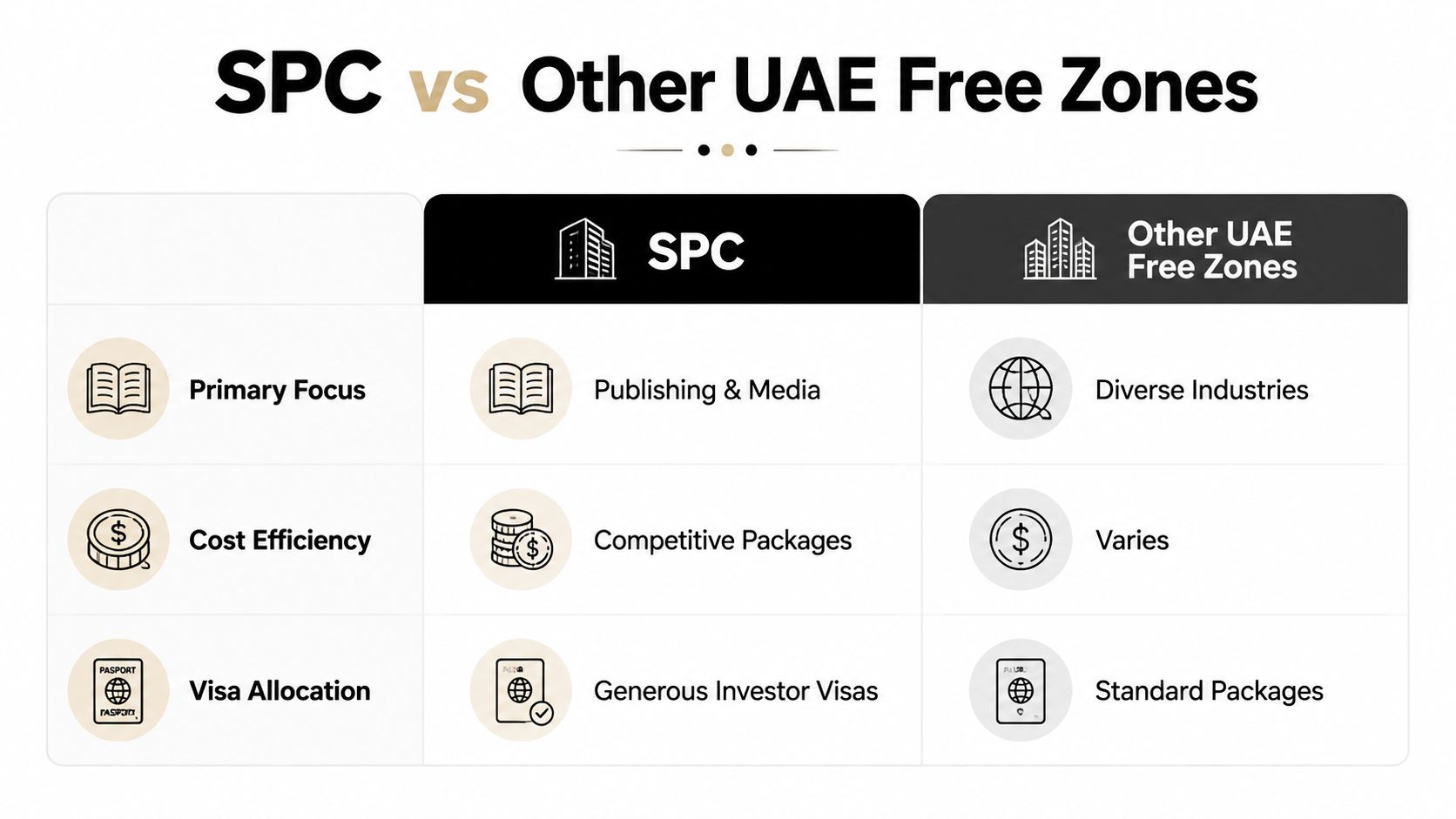
A lot of founders compare SPC with broad free zones because they assume publishing is just another service company. That is the wrong comparison. SPC should be judged against zones that attract publishers, media owners, and content-led e-commerce founders who want flexibility but still need a sector fit.
Where SPC wins
SPC is strongest when the business is publishing-facing. If your operation depends on editorial workflows, print-adjacent services, or content distribution, a specialised zone is more useful than a generalist one. The zone also has clear market pull, as noted earlier, which matters if you want a jurisdiction that already understands this kind of activity.
Where other zones may be better
A broader free zone can be the better choice if publishing is not your core business. If your revenue comes mainly from trading, consulting, or digital services and content is only a small part of the model, SPC's sector focus may be more than you need. In that case, a general jurisdiction can be a cleaner fit.
The test is workflow. A publishing-heavy business benefits from a zone built around that activity, while a wider commercial operation usually does better in a zone with fewer activity constraints. Do not choose based on the lowest headline pitch. Compare the licence scope, office requirement, and the practical fit of the activity you plan to run.
If you want a broader comparison point before making that call, this guide to companies in Sharjah free zones gives a useful side-by-side view without the usual marketing fluff.
Visa Options and Office Facilities
A founder who is serious about sharjah publishing city should look at the workspace before anything else. SPC's office model is part of the pitch, because it combines furnished offices for publishing entrepreneurs with larger space for investors who need to build their own facilities. It also offers 100% foreign ownership, full repatriation of funds, and no corporate or personal income tax, as noted in the Oxford Business Group report. Those terms shape the cost of setup, staffing, and how much capital you need to keep tied up in premises.
A furnished office suits a lean publishing operation. It gives you a ready base, keeps the first move simple, and avoids wasting money on a layout you do not need yet. The larger build-to-suit option makes sense only when your activity demands control over storage, production flow, or a more specialised working setup.
That distinction matters in publishing. An editorial team can work productively in a compact space. A business handling production, inventory, or distribution usually needs more room and a better operational flow. Do not pay for a bigger office because it looks more serious on paper.
Visa planning should follow the office decision. The licence, office type, and expected headcount all need to line up before you start bringing people in. If you plan to hire an editor, operations support, or sales staff, set the company structure first and then map the visa sequence around the actual workspace.
Some founders buy more space than they need because they want to signal scale. That approach drains cash and creates overhead before the business has earned it. Use the office that matches the workload, not the one that flatters the pitch deck.
If you are comparing workspace options across the emirate, offices in Sharjah is a practical reference before you commit to a setup that does not fit how you operate.
For founders deciding whether to build around traditional titles or digital-first models, compare publishing routes for novelists before locking in your staffing and office plan.
Addressing the Arabic Publishing Supply Chain Gap
This is the question SPC content usually avoids. Does the zone solve the Arabic publishing supply-chain problem, or does it mostly make company formation easier? The honest answer is that it does both, but not to the same degree.
A useful way to assess SPC is to go back to its original thesis. Foundational coverage described it as a publishing free zone built to connect Arab publishing with global markets and to address gaps from content acquisition through distribution and sales. The problem is that many public write-ups still focus on the existence of the zone, not the friction points it was meant to reduce. That gap matters if you're trying to run a real publishing business rather than just open a licence. Medium analysis
What SPC can fix
SPC can help compress several operational steps. It gives publishers a dedicated jurisdiction, access to publishing-adjacent infrastructure, and a licensing umbrella that can cover related activities. That's valuable if your bottleneck is legal structuring, office setup, or the need to combine editorial and commercial functions in one place.
What SPC can't fix by itself
It does not magically solve all fragmentation in the Arabic book trade. Distribution remains a relationship business. Rights acquisition remains a negotiation business. Digital publishing still depends on people who understand metadata, XML, and multi-platform release work. Sector commentary says the hardest-to-fill roles are the ones that combine Arabic editorial expertise with digital publishing skills, and it cites a 2024 skills gap report claiming only 12% of regional publishing professionals have that dual competency. It also says senior digital publishing director roles can take 120 to 150 days to fill in Sharjah when Arabic-English bilingual capability and 10+ years' experience are required, versus 58 days for general professional services roles in the emirate. Talent commentary
That tells you SPC is not just a licence play. It's also a labour and capability question. If you can't hire the right people, the licence won't save you. For authors weighing route choice rather than company formation, compare publishing routes for novelists before you assume a free zone solves the commercial problem.
Your Next Steps and How Smart Classic Business Hub Can Help
If SPC fits your model, keep the decision simple. Choose the right activity list, select the correct entity type, prepare your shareholder documents, and decide whether a furnished office or custom space is the better fit for your headcount. Then budget for the full setup sequence, not just the licence headline.
That's where most founders need disciplined support. A Dubai-based consultancy can help with feasibility checks, company formation, PRO services, VAT-compliant accounting, visa processing, and ongoing compliance, which matters more than people admit when they're trying to launch quickly and stay clean with the authorities. Smart Classic Business Hub handles that kind of setup work in a practical way, which is exactly what founders need when they're comparing free zones and trying not to overcomplicate the file.
If you're planning a Sharjah Publishing City setup, don't guess your way through the activity list, office choice, or visa plan. Speak with Smart Classic Business Hub and get a clear setup path, document checklist, and compliance plan before you submit anything.