
Most guides sell the Dubai freezone visa as if it's a neat little add-on to a licence. That advice is wrong, and it leads founders straight into bad budget decisions. The core choice is commercial, not cosmetic, because you're deciding whether to buy a zero-visa licence or a package with visa allocation, and that choice affects your setup, your office, and your hiring capacity.
A free zone visa is tied to the company structure, not just to your passport or your ambition. The UAE government says a free zone business licence is often issued within 14 working days after review and approval, and companies can be set up as branches or free-zone entities before they apply for visas through the zone authority, which is why the licence comes first and the visa comes later. Put bluntly, if the company is not established properly, there's nothing legal for the free zone to sponsor against. The visa sits on top of the licence, the establishment card, and the quota approval, not beside them.
That's the decision most articles skip. A zero-visa licence can look cheaper upfront, but it gives you no residency rights. A visa-bundled package costs more, but it lets the entity sponsor the founder or staff once the upstream registrations are in place. If you're serious about operating in Dubai rather than just reserving a company name, you need to think in that order.
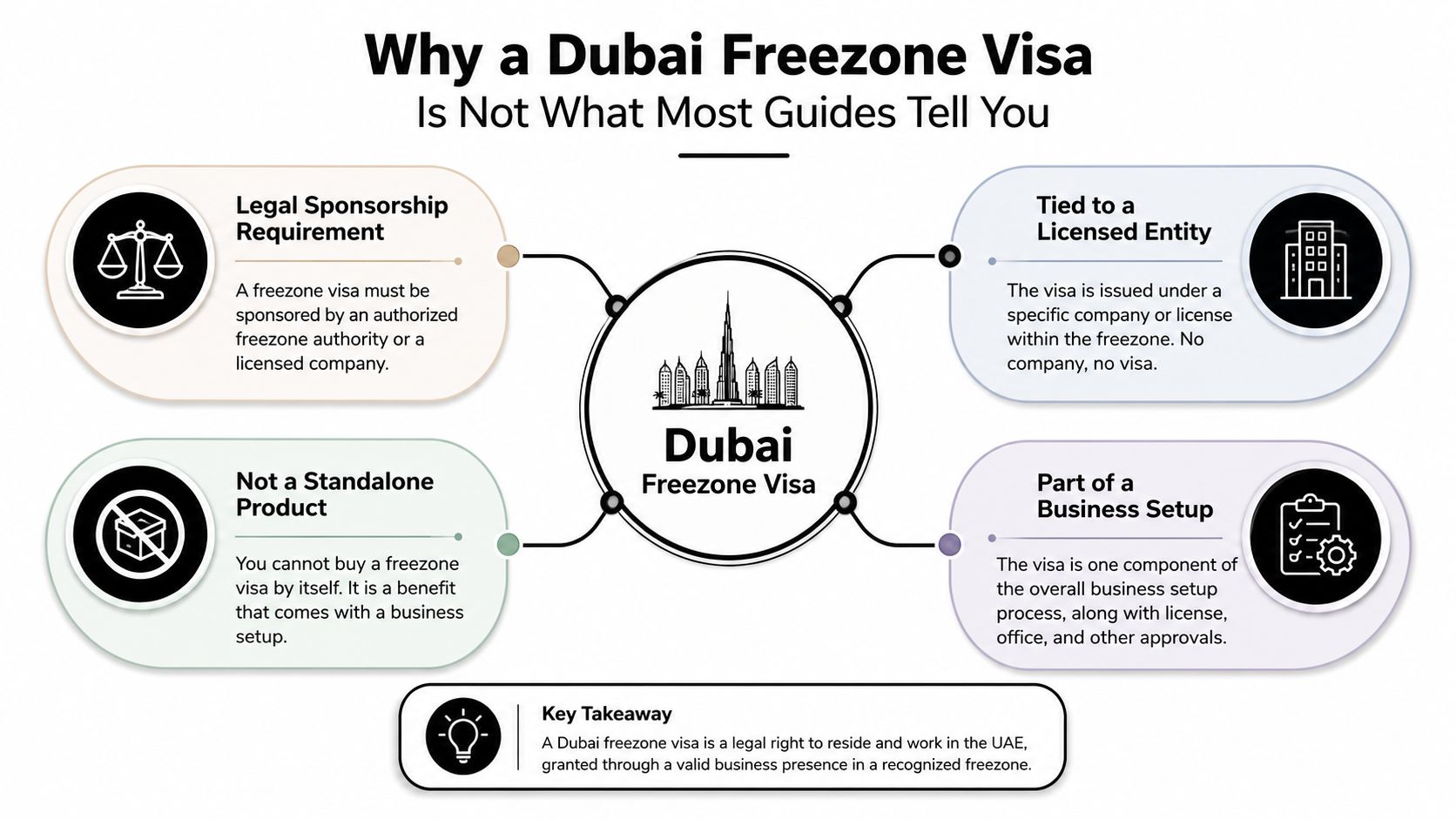
Why a Dubai Freezone Visa Is Not What Most Guides Tell You
The most common mistake is treating the Dubai freezone visa like a standalone product. It isn't. The visa is issued through the free zone authority only after the company has an active licence, an immigration file, an establishment card, and an approved quota, which is why the individual applicant can't “apply for a visa” in isolation.
Licence first, residency rights second
That sequencing matters because the visa is attached to the business structure. Official UAE guidance says companies can be formed as branches or free-zone entities before applying for visas through the relevant authority, and the practical process runs through the zone's immigration channel, then into entry permit, status change, medical fitness, biometrics, and residence issuance UAE free zone business setup guidance Dubai free zone visa process overview.
Practical rule: if your quota is not approved first, the rest of the file can stall or need rework.
Founders waste time here. They choose a package, assume the visa is “included”, and only later learn that visa allocation is a separate commercial feature. Some licences are sold with visa slots, some with zero visa allocation, and that difference changes everything about who the company can sponsor and when.
The right question is not “Can I get a visa?” It's “What licence structure supports the people I need to bring in over the next 12 months?” A solo founder with no immediate staff needs a different setup from a trading business that wants to hire from day one. If you're still comparing freelance-style setups, the internal process differs enough that you should read a focused freelance visa Dubai guide before making a licence decision.
What a smart buyer checks before paying
A serious buyer checks three things before signing:
- Visa allocation terms. Confirm whether the package includes visas or only the right to apply later.
- Licence activity. Make sure the free zone activity matches the business you will run.
- Future headcount. Buy for the team you expect to build, not the smallest version of the business.
The commercial trap is obvious once you see it. Cheaper today can mean more expensive tomorrow if you outgrow a zero-visa package and need to upgrade the entire structure. In Dubai, the visa is not the product. The company is the product, and the visa is one of the rights that company can obtain.
Visa Categories and Who Each One Serves
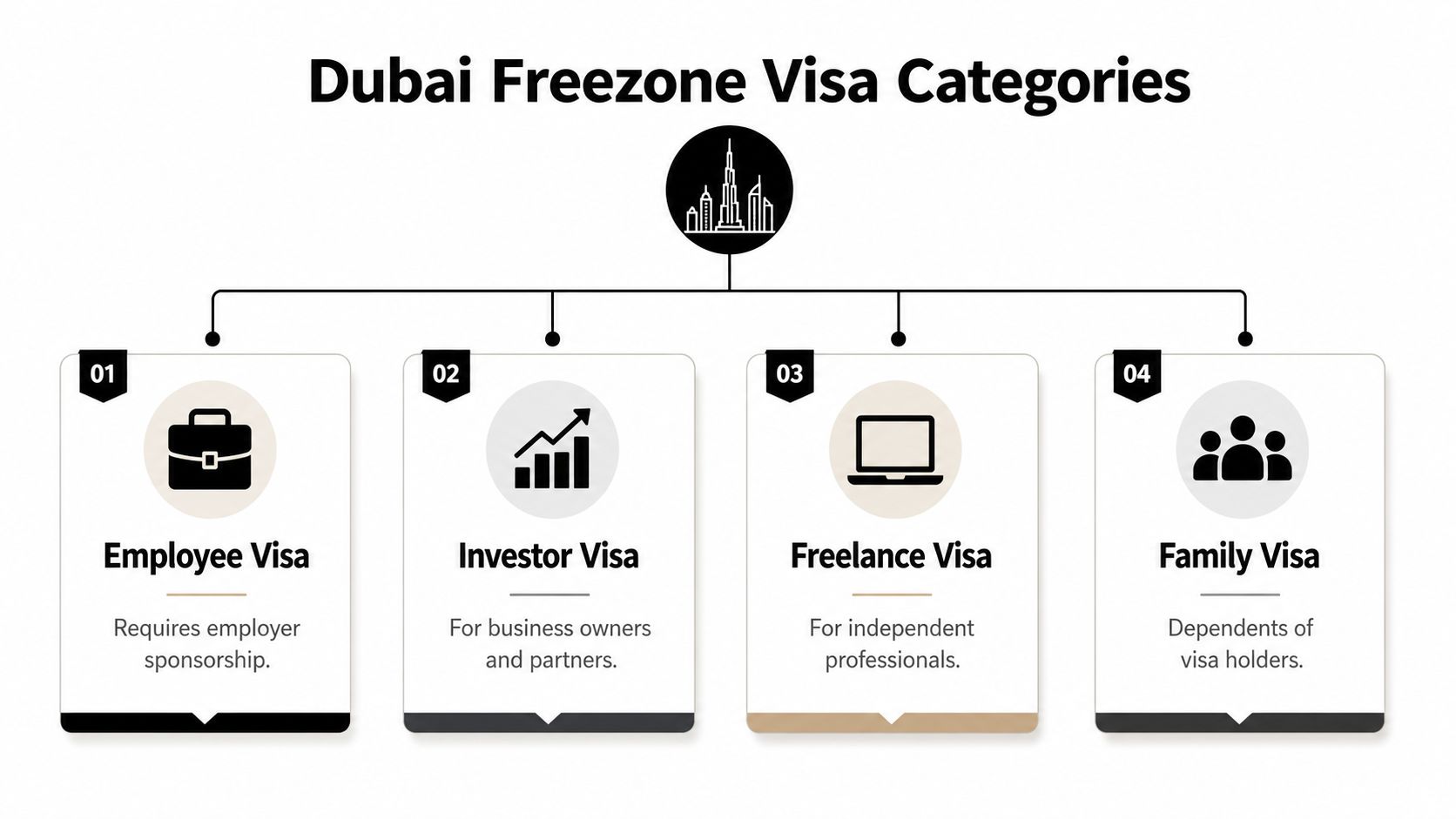
The free zone visa category should match your role in the business, not your wishlist. A founder who needs to sponsor themselves, a company that plans to hire staff, an independent professional, and a resident bringing family members are solving different problems, and the visa route should reflect that. If you pick the wrong category, the file can still look complete and still be the wrong fit.
Employee, investor, freelance, and family routes
An employee visa is the cleanest route when a free zone company is hiring talent. The sponsoring employer handles the file, and the visa supports legal work inside the free zone structure. That works well for managers, specialists, and operational staff who are joining an existing entity.
An investor visa is for the owner or partner of the company. It suits founders who want residency tied to their shareholding and control of the business. DMCC's public guidance shows that partner and investor visas are linked to the company's ownership structure and share capital rules, which is a good reminder that this route is about equity and control, not salaried employment.
A freelance visa is for independent professionals who want to operate under a permitted structure without building a full employer-employee setup. It suits designers, consultants, and other solo operators who need a legal base in the UAE but don't need a large office from day one. If you're evaluating this path, the structure and service model differ enough that you should compare it with the standard company route and the Portugal retirement visa requirements only if you're also weighing a non-UAE residency path for lifestyle reasons.
A family visa is different again. It's a dependent route, not a business route. It follows the primary holder's residency status and is the right fit when the goal is to bring a spouse or children into the UAE under the main visa holder's sponsorship.
How to choose the right category
Use role, not aspiration, as the filter:
- Choose employee if the company needs to onboard staff under a sponsor-managed file.
- Choose investor if you're the owner and want residency through your shareholding position.
- Choose freelance if you're an independent operator and don't need a full team structure.
- Choose family if the primary objective is dependent residency tied to an existing holder.
The practical point is simple. Don't buy the most flexible-looking option if it doesn't match how you'll operate. A freelancer who wants minimal overhead should not pay for a structure built for headcount. A founder planning to hire should not squeeze into a package with no meaningful visa capacity.
That's why the question of visa type is also a question of commercial design. The wrong category can leave you with a lawful entity that still can't do the job you need it to do.
Real Costs and How Office Choice Dictates Your Visa Quota
The price of a Dubai free zone visa is not just a visa price. It's a package of licence fees, workspace choice, quota capacity, and the kind of permit you're buying into. If you focus only on the first invoice, you'll miss the actual operating cost.
What founders actually pay
A standard free zone employment visa in Dubai typically ranges from AED 3,500 to AED 7,500, while freelancer visas can add AED 7,000 to AED 15,000 per year in permit costs Dubai free zone visa cost guide. Regional business-setup guidance also puts total estimated package costs at about AED 14,000 to AED 26,000, depending on the zone, business activity, and office requirement Dubai free zone visa cost guide.
The wrong way to read those numbers is to compare them in isolation. The right way is to ask what level of office footprint and visa capacity they buy you. Some packages are designed for a single founder with minimal overhead. Others are built for team growth and should be judged on how many people they can support, not just the sticker price.
| Dubai Freezone Visa Costs and Quota by Office Type | Visa Quota | Estimated Annual Cost |
|---|---|---|
| Virtual or flexi-desk | 1 to 3 visas | Varies by package and zone, often in the lower-cost setup band |
| Serviced office | 3 to 6 visas | Higher than flexi-desk, tied to the office package |
| Physical office | Roughly 1 visa per 9 square metres of GLA | Scales with space and setup requirements |
Those quota patterns matter because they connect hiring capacity directly to office footprint Dubai free zone visa cost guide. If you buy a tiny setup, you're not just saving on rent or service charges, you're also limiting how many visas the free zone is likely to support. That's a structural decision, not a temporary convenience.
Direct advice: buy the office for the team you'll need, not the desk you can tolerate today.
For a more granular setup comparison, use a detailed Dubai free zone company setup cost guide before choosing a package. That step helps you see how licence type, office format, and visa quota fit together instead of treating them as separate decisions.
Why office type changes the business model
A virtual or flexi-desk package makes sense when cash control matters more than headcount. A serviced office works better when you know you'll need a few visas and want less friction. A physical office is the right move when staffing needs are real and the company needs room to scale.
The mistake is buying office space as an afterthought. In free zones, office choice is a visa strategy. It shapes who you can sponsor, how fast you can grow, and how much you'll pay to stay compliant.
Step by Step Application Workflow from Licence to Residence Visa
The process is sequential for a reason. Each stage depends on the one before it, and if you jump ahead, the file usually gets stuck or sent back for corrections. The fastest applications are the ones that respect the order.
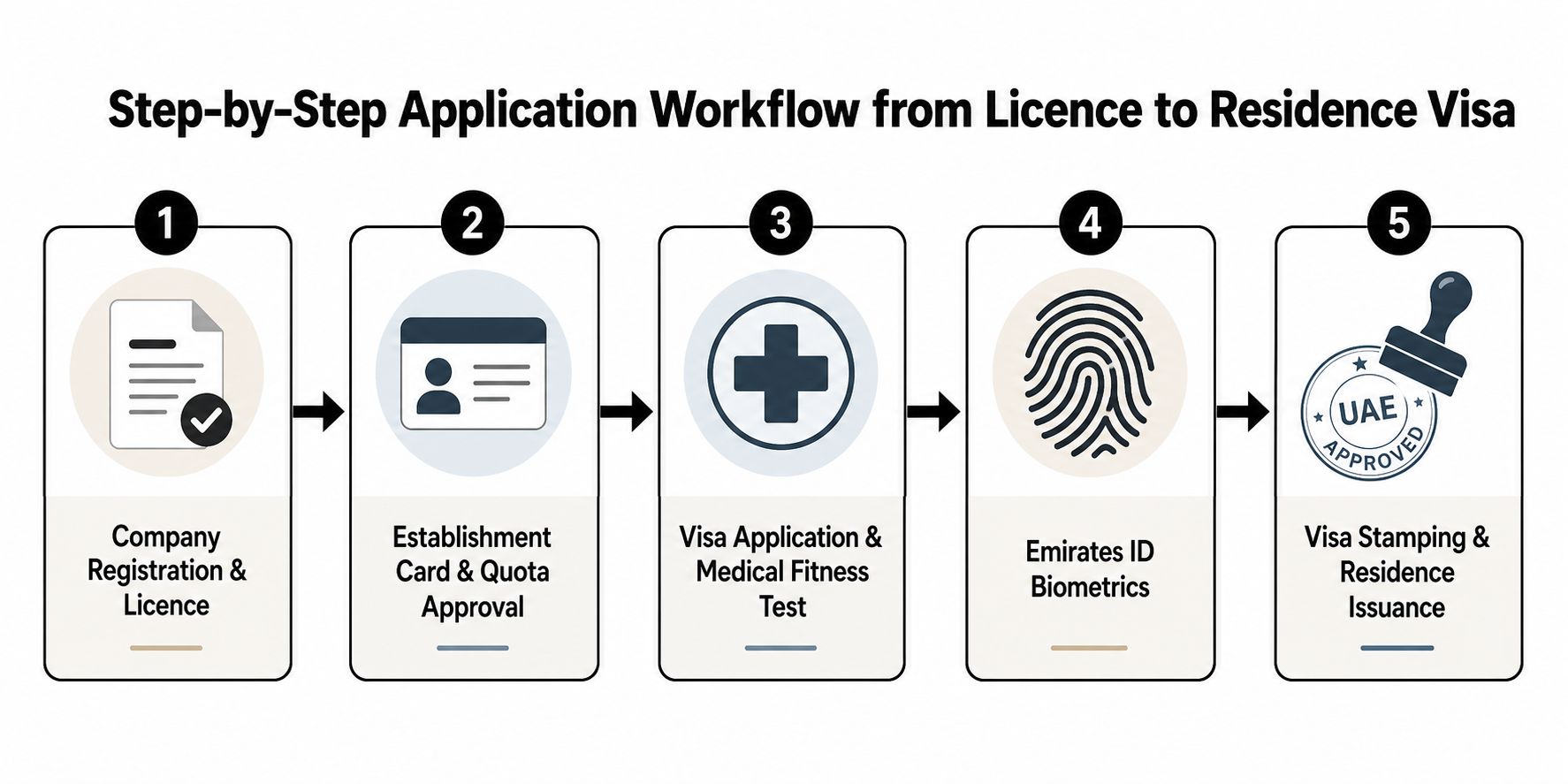
The core sequence
The process starts with company registration and licence issuance. Once the free zone licence is active, the business can open its immigration file and obtain the establishment card, then request visa quota approval through the authority Dubai free zone visa process overview.
After quota approval, the entry permit is applied for. That permit is time-bound, so it isn't something you can leave sitting in the queue while other paperwork drifts. From there, the applicant completes the status change if already inside the UAE, or enters on the permit if outside the country.
Next comes the medical fitness test and the Emirates ID biometrics. The residence visa can only be issued after the medical and insurance clearance requirements are satisfied, which is why delays here can compress the remaining window and force rebooking or document refreshes Dubai free zone visa process overview.
Operational rule: keep the licence, quota, medical, and biometrics moving as one file, not as four separate errands.
Where delays usually start
The biggest slowdown usually appears before the visa file even opens. If the company registration stage drags, everything else gets squeezed. That's why a clean package, correct activity selection, and fast response to authority queries matter so much.
Teams that manage documents well reduce friction. If your business runs multiple approvals in parallel, a system like the document workflow automation guide is useful because it shows how to track approvals, handoffs, and version control without losing time on manual follow-up.
The last step is residence issuance. Once the permit, medical, biometrics, and supporting papers are cleared, the visa gets stamped and the person moves onto full residency status. If the establishment card or quota is wrong at the start, that whole chain becomes slower and more expensive to fix.
The smart move is boring but effective. Get the licence right, lock the quota early, and treat the rest of the process as a controlled sequence rather than a loose checklist.
Free Zone Visas Versus Mainland and Offshore Alternatives
A free zone visa is often the right answer, but not always. The best structure depends on what the business does, where it needs to trade, and how much control the owner wants over setup and sponsorship. If you choose the wrong jurisdiction, you can end up compliant and still inefficient.
Side by side comparison
A free zone visa suits businesses seeking straightforward setup, foreign ownership, and a structure aligned with a specific zone's activity permissions. It's ideal for founders wanting a clear residency path linked to their company who don't require unrestricted mainland trading from day one.
A mainland visa fits businesses that need direct access to the local UAE market and broader onshore trading flexibility. If your customers are mostly in the local market, mainland may be the cleaner commercial route.
An offshore setup is usually about holding, structuring, or international planning rather than operating in the UAE market in the same way a free zone company does. It's not the default answer for someone who wants a live business base and a residence pathway.
| Criterion | Free Zone Visa | Mainland Visa | Offshore Setup |
|---|---|---|---|
| Business scope | Zone-linked activities | Broader onshore access | Holding or structural use |
| Visa eligibility | Linked to zone quota | Linked to mainland structure | Usually not the same operating route |
| Ownership structure | Commonly designed for foreign ownership | Depends on activity and structure | Designed for specific corporate purposes |
| Office requirements | Usually tied to package and quota | Depends on licence and activity | Often different from an operating office model |
If you want a practical comparison focused on setup logic, the mainland vs freezone Dubai guide is the right next read. It helps you separate marketing language from actual operational fit.
When free zone wins, and when it doesn't
Free zone wins when the founder wants simplicity, foreign ownership, and a setup that pairs business licensing with residency access. It also wins when the company's activities are naturally contained within the zone's rules.
Mainland wins when the business needs direct local market trading without the structural limits of a zone-based package. Offshore wins when the objective is ownership structuring rather than on-the-ground operations.
The wrong structure is expensive even when the paperwork is clean.
So don't ask which option is fashionable. Ask which one matches your market, your staffing plan, and your need for residency rights. That answer is usually obvious once the business model is honest.
Hidden Rejection Risks and Common Application Pitfalls
The visible checklist is never the whole story. A file can be complete on paper and still trigger questions if the applicant's financial history, activity selection, or supporting paperwork looks inconsistent. That's where many first-time applicants get caught.
The financial-substance check
A UAE immigration-focused explainer notes that officers may review bank statements, source of funds, account consistency, and sudden deposits when assessing investor or partner cases, and it also points to a safer balance range of roughly AED 30,000 to AED 50,000+ in some practitioner settings, even where no official threshold is published UAE immigration explainer on financial-substance checks. That means your bank profile matters, not just your passport copies.
This is the part most guides leave out. Applicants think the process is pure paperwork. In reality, the authority may look for whether the financial story makes sense. A brand-new account with unexplained deposits can raise more questions than a quieter account with a clear pattern.
Other mistakes that create rework
The usual file problems are more ordinary, but they still hurt:
- Mismatch between activity and visa purpose. The licence says one thing, the visa request implies another.
- Incomplete establishment card details. Missing or inconsistent company data slows the quota stage.
- Expired entry permits. Once the permit ages out, the file often needs extra steps.
- Insurance gaps. If medical or insurance requirements aren't satisfied, residence issuance can stop.
The safest approach is to prepare the whole file as one story. The business activity, the licence, the bank history, and the visa purpose should all point in the same direction.
Candid advice: if your financial profile looks messy, clean it up before you submit, not after the authority asks questions.
Founders also underestimate how often small errors create delay. A tiny mismatch in name spelling, passport details, or company data can turn into a bigger issue once the entry permit is already time-bound. That's avoidable if someone reviews the file carefully before submission.
The honest takeaway is this. Visa approval is not only about eligibility. It's about whether the entire application looks credible, consistent, and ready to support a real business in the UAE.
How Smart Classic Business Hub Streamlines Your Visa Journey
A good consultancy doesn't “speed up” the rules, because no one can do that. What it can do is remove the avoidable friction, help you choose the right zone, and stop you from buying the wrong package first. That matters more than most founders realise.
Smart Classic Business Hub handles company formation across mainland, free zone, and offshore structures, along with PRO services, VAT-compliant accounting, tax residency certificates, and ongoing compliance support. For founders comparing asset structures or operating models, their browse our real estate analyzer can also be useful when a business decision depends on property-related due diligence. The value here is practical: one team can help you look at licence fit, immigration file setup, and the administrative steps that sit around the visa process.
Sequencing is a key advantage. Many applicants lose time by selecting the wrong zone, purchasing an unsuitable office package, or submitting visa paperwork before the company file is established. A consultant who manages licence procurement, immigration file setup, quota approval, and residence visa stamping within a single workflow minimizes that risk.
If you want a setup conversation rather than guesswork, start with Smart Classic Business Hub at its Baniyas Square office or through its website. You'll get a cleaner view of what your licence should include, how many visa slots you need, and whether your plan calls for a free zone, mainland, or different corporate route.
If you're deciding between a zero-visa licence and a visa-bundled package, don't guess. Speak to Smart Classic Business Hub about the licence, quota, and office structure before you sign anything, because the wrong setup is expensive to fix later. If you want a practical route through licensing, immigration file preparation, and residence stamping, they can map the whole process with you from the start.