
You're probably sitting on a structure that looked sensible in 2022 and now feels fragile in 2026. The mainland company invoices local clients, the free zone entity handles “international” work, the bookkeeper keeps the ledgers tidy enough, and everyone assumes the UAE's low-tax reputation still does the heavy lifting. It doesn't. Corporate tax planning in the UAE now lives or dies on substance, entity design, transfer pricing files, and whether your records can survive a real FTA review.
The mistake I see most often is simple. Founders treat corporate tax as a rate problem, then discover it's really a documentation problem. Once the UAE introduced a federal corporate tax framework effective for financial years starting on or after 1 June 2023 with 0% up to AED 375,000 and 9% above that threshold (Bloomberg Tax overview), the old “we'll sort it later” mindset stopped being workable.
Why UAE Corporate Tax Planning Is Really a Documentation Problem
A UAE structure can look tidy on paper and still fail under review. The mainland company books local revenue, the free zone entity signs off on cross-border work, and everyone assumes the setup will hold because the licence stack looks clean. The FTA does not care about appearances. It cares whether you can prove the business reality with records that tie together.
The shift in corporate tax planning is blunt. The winning businesses are not the ones with the most creative story, they are the ones that can show substance, traceability, and consistent accounting from day one. If your invoices, contracts, board minutes, and ledger entries point in different directions, the structure becomes expensive to defend and easy to challenge.
The three evidence buckets that matter
Founders should organise evidence in three buckets. First, legal evidence, meaning the trade licence, constitutional documents, contracts, and ownership records. Second, operational evidence, meaning staff, premises, board decisions, and the day-to-day reality of where management happens. Third, financial evidence, meaning books, reconciliations, transfer pricing support, and tax return working papers.
The failures are usually basic. A business has the licence but no operational file. It has the invoice trail but no support for related-party charges. It has accounting software but no tax reconciliation that explains why the ledger and the return match. The same discipline applies to deductible spend, which is why Receipt Router's guide to deductible expenses is a useful reference on documenting the business purpose before you claim the deduction.
Practical rule: if a position cannot be defended with documents, minutes, and reconciliations, it is not a planning position. It is a future adjustment.
What triggers pain in a review
The FTA does not need your structure to be perfect. It needs it to make sense. The common triggers for pain in a review are mismatched entity roles, weak support for free zone income, undocumented related-party charges, and books that do not tie back cleanly to the tax position. Those are review issues, and review issues turn into penalties quickly.
The old habit of waiting until year-end and then tidying everything up does not work here. Planning now starts with evidence collection, and the businesses that hold up are the ones that can prove their position early instead of improvising it later.
Understanding the UAE Corporate Tax Framework
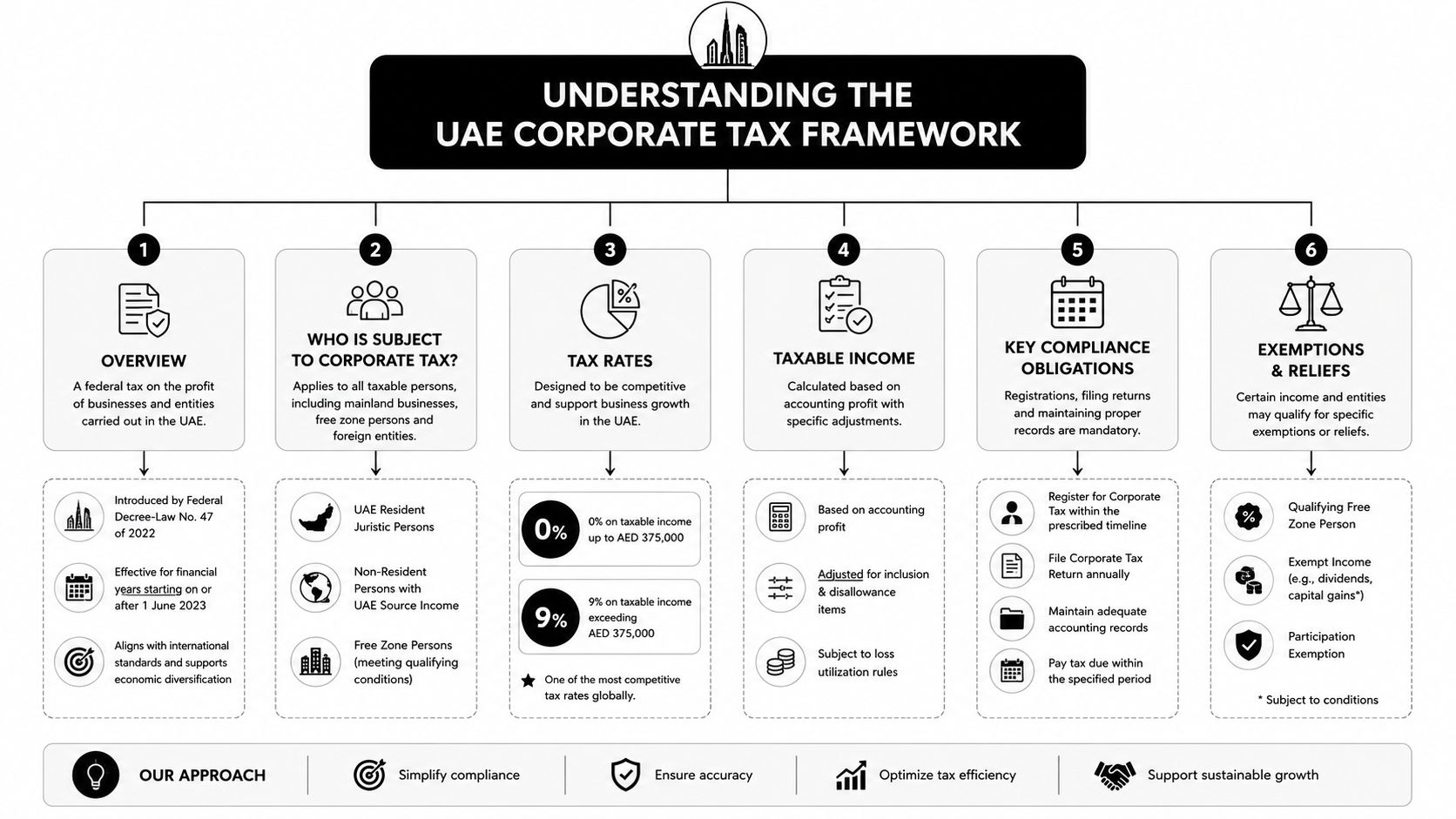
A UAE structure that looks efficient on paper can still fail if the entity classification is wrong from day one. The corporate tax regime treats a taxable person, an exempt person, and a qualifying free zone person differently, and the filing position follows that classification. Get that wrong, and the rest of the work, deductions, reliefs, disclosures, and return mechanics, becomes harder to defend.
The rate structure is straightforward. The UAE applies 0% on taxable income up to AED 375,000 and 9% above that threshold for financial years starting on or after 1 June 2023 (Bloomberg Tax overview). The core challenge lies elsewhere. You need to know what falls into taxable income, what is exempt, what qualifies for the free zone treatment, and what support the file needs before the return is submitted.
A mainland trading company example
A mainland trading company with AED 1,200,000 of taxable income is easy to describe and easy to misstate. The first AED 375,000 is taxed at 0%, and the balance of AED 825,000 is taxed at 9%. That gives you the basic liability on the excess, but only after the taxable income figure is built correctly.
That means supported deductions, brought-forward losses, and any other permitted adjustments have to be reflected before the rate is applied. If the company sits inside a group, the file needs more discipline because intercompany charges and entity boundaries affect the outcome. A tax return is not just a filing exercise. It is the written record of how the business is structured, booked, and defended.
Who's in scope and who isn't
A UAE vehicle is not automatically treated the same as the next one in the same group. A mainland LLC usually falls within scope unless a specific exemption applies. A qualifying free zone person can still access 0% on qualifying income if the regime conditions are met and the entity keeps real substance. Some entities are outside the regime altogether, but that conclusion should come from the licence and legal set-up, not from a sales pitch or a shortcut assumption. If you are comparing legal forms, the limited liability company guide is a useful starting point for the legal side of the decision.
The better question is direct. What entity classification fits the revenue stream and the compliance load? If the answer is clear, the structure is usually defensible. If the answer is vague, the file will not survive a close review for long.
Choosing the Right UAE Entity for Tax Efficiency
The wrong way to choose an entity is to chase the lowest headline rate. The right way is to match the vehicle to the actual flow of contracts, people, and money. A regional HQ, a UAE-facing services company, and a passive holding entity all behave differently under the regime, and forcing them into the same shape usually creates more cost than it saves.
If you're still at the single-entity stage, read the trade-offs carefully before you add another licence just because someone promised “tax efficiency.” A second vehicle only makes sense when the income streams, counterparties, or compliance needs are different enough to justify it. For a corporate setup overview, this limited liability company guide is a useful starting point when you're comparing legal forms.
Mainland, free zone, and offshore by operating model
| Dimension | Mainland LLC | Qualifying Free Zone | Offshore |
|---|---|---|---|
| Regulatory logic | Built for onshore UAE trading and service delivery | Built for regime-based tax treatment on qualifying income | Built for holding or international structuring, not local operating trade |
| Ownership and control | Often used by founders serving UAE customers directly | Often used where substance and qualifying activity can be evidenced | Usually not designed for active UAE trading |
| Income treatment | Standard UAE corporate tax treatment applies unless a relief or exemption exists | 0% on qualifying income only if regime conditions are met | Depends on the facts, but local operating assumptions are usually a mistake |
| Common planning pitfall | Mixing taxable and exempt flows in one ledger | Assuming the headline 0% applies to everything | Using it as a substitute for an operating company |
A regional trading HQ usually needs real people, real contracts, and a clean view of where inventory, risk, and decision-making sit. A service company serving UAE clients is more exposed to substance questions, because the work, the staff, and the client relationships are often local. A holding entity receiving dividends and royalties is different again, because the focus shifts to ownership purpose, upstream documentation, and whether the structure is doing anything other than holding paper.
When a second entity becomes worth it
A second vehicle starts to make sense when one line of business contaminates the tax profile of another. A founder with both mainland trading income and free zone qualifying income should not force both streams into the same ledger without a very good reason. The same goes for a holding company that also performs management services. Once the functions blur, the tax position becomes harder to defend.
Keep the entity model simple until the business reality forces it to become more precise.
That's the test. If the structure lets you separate activities cleanly, you'll spend less time arguing with the tax file later. If it doesn't, the extra entity is just more compliance work with no benefit.
Tax Residency, Treaties, and the Substance Test
Being registered in the UAE is not the same thing as being tax resident in the UAE. That distinction matters because treaty access, withholding outcomes on outbound payments, and the ability to support cross-border positions all depend on residency evidence, not just incorporation papers. Businesses often learn this the hard way when they try to renew a tax residency certificate and discover the file is thin.
What residency actually looks like in practice
The UAE residency file should show where key decisions are made, where the board meets, and who is running the business day to day. A paper company with no physical presence, no local employees, and management decisions taken abroad is vulnerable. That doesn't mean every company needs a huge office. It means the company needs a real centre of administration that can be defended.
Common refusal reasons are predictable. No physical presence. Decisions taken outside the UAE. No qualified local staff. Weak minutes. If those points are missing, the authority has little reason to treat the business as substantively resident for treaty purposes.
Build the file before you need the certificate
A renewal pack should not be assembled at the last minute. It should already contain board minutes, lease or premises evidence, evidence of staff or outsourced operational support, and a consistent paper trail showing that strategic control sits in the UAE. If the group has a foreign parent, the file should also explain the relationship between the UAE entity and the wider group, because the FTA will care about who controls what.
For broader personal and family-linked structuring, the same discipline shows up in residency planning. This is why a practical reference like Smart Classic's UAE personal tax guidance can help founders separate personal residency thinking from corporate residency thinking, which are not the same thing.
Use substance as a governance exercise
Substance is not a slogan. It's governance. If the company's board meets in Dubai, the minutes should say so and support it. If the decision-makers are in the UAE, the records should show that. If employees or contract staff do core work, their role should be visible in the operational file.
A clean residency file is not about impressing the authority. It's about making the authority's job easy enough that it doesn't look for reasons to doubt your setup. That's the standard you should work to.
Transfer Pricing and Documentation for UAE Groups
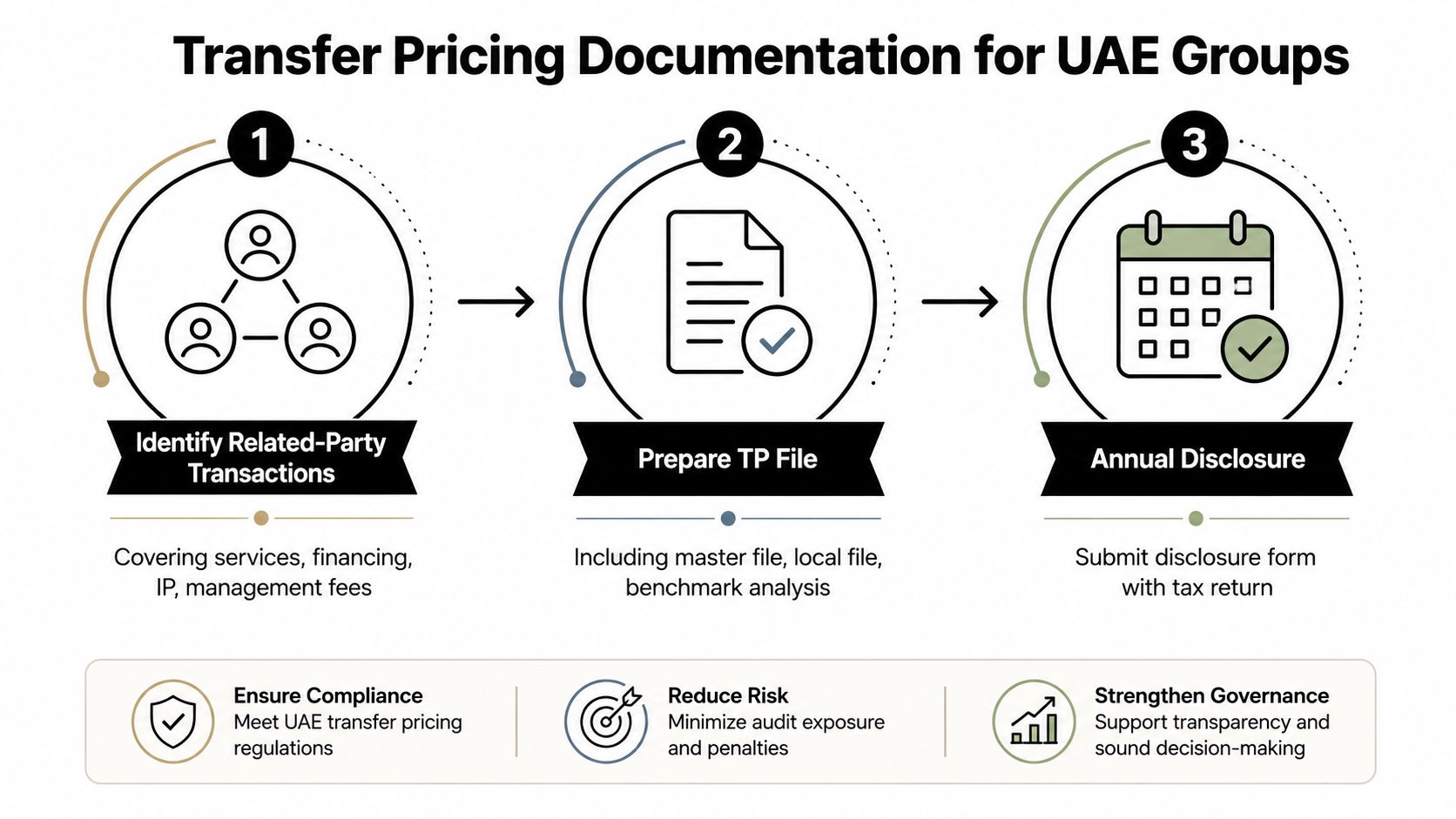
Once a group has related-party transactions, the tax file gets more serious immediately. Intercompany services, financing, intellectual property, and management charges all need to be priced and documented as if an outside party had asked, “Why this amount, and why this entity?” If you can't answer that clearly, the charge is weak.
The OECD's work on aggressive corporate tax planning shows how much revenue can be lost through profit shifting and mismatches between systems, with about two-thirds of the loss linked to profit shifting and about one-third to mismatches and preferential treatment (OECD report). That's the broader policy context. In practice, the FTA cares about whether your intercompany charges reflect commercial reality.
The documentation stack that should already exist
Your group should not wait for a query before building the core file. The basic stack is straightforward:
- Intercompany agreements: Define the service, fee basis, payment terms, and responsibilities.
- Benchmarking support: Show that the charge is commercially defensible.
- Board or management approval: Prove the charge was authorised, not improvised.
- Master file and local file: Keep the group context and the UAE entity facts aligned.
If your group is large enough for country-by-country reporting, treat that as part of the same discipline, not as a separate panic project. The goal is consistency across the entire file, because a mismatch between the agreement, the invoice, and the accounts is exactly what gets reviewed.
Which method fits which charge
Don't overcomplicate every charge, but don't use shortcuts where they don't belong either. Cost plus often fits routine services. Transactional net margin can be useful where the business model is broader and harder to isolate. CUP, resale minus, and profit split each have their place, but only when the facts support them.
If the charge is recurring, material, or linked to profit extraction, document it properly from day one.
That's the decision rule. A small, low-risk recharge might justify a lighter analysis. A recurring management fee, a financing spread, or an IP charge should have a proper file behind it. In a UAE group, the highest-risk flows are usually the ones people think are “obvious” and therefore forget to document.
Accounting, VAT, and Corporate Tax Working Together
A tax return is only as reliable as the accounting behind it. If the ledger, the VAT returns, the financial statements, and the corporate tax computation all tell slightly different stories, you've just created an audit magnet. The FTA doesn't need perfection, but it does expect consistency.
For SMEs still tightening their accounting processes, the tax and VAT layers should be built together. This VAT filing guide is useful because the same recordkeeping habit supports both regimes. Once corporate tax is live, the bookkeeper can't treat VAT and tax as separate silos anymore.
The reconciliations that should exist every quarter
The core reconciliations are not complicated, but they do need discipline:
- Trial balance to tax return: Confirm the figures in the return tie to the accounting records.
- Revenue per financials to revenue per CT computation: Explain any timing or classification differences.
- VAT returns to CT-relevant input tax: Show where recoverable VAT and deductible cost treatment line up, and where they don't.
If these don't tie, the first question from a reviewer is always the same. Which number is right, and why? You want that answer ready before anyone asks it.
Tag the chart of accounts for tax, not just bookkeeping
A generic chart of accounts is usually too blunt for corporate tax. You need tax-specific tags for exempt income, qualifying free zone income, related-party charges, non-deductible expenses, and any adjustment that will later appear in the tax bridge. If the tag is missing, the adjustment gets buried and the return becomes harder to defend.
Accrual accounting is normally the safer base for CT computations because it aligns better with financial reporting and year-end tax review. Cash-based thinking often works against you once timing differences start to matter. That doesn't mean cash management is irrelevant. It means cash management and tax reporting are different jobs.
A good bookkeeper can produce clean VAT returns and still miss the CT view. That's why the chart of accounts matters. It's the foundation for both systems, and if it's not built for tax, your return will always be more fragile than it should be.
Compliance Calendar, Audit Readiness, and When to Call an Advisor
The businesses that handle UAE corporate tax well don't wait for the filing deadline to think about it. They run the year in stages, with named owners, recurring reviews, and a habit of correcting weak positions before they become expensive. That is how you keep the structure alive.

A practical 12-month rhythm
Use the year like this. At onboarding or registration, confirm the entity classification and file setup. During the year, review ETR assumptions, related-party flows, and VAT alignment. At period end, close the books properly and update the transfer pricing file if the transaction pattern changed. At year-end, finalise the tax bridge, review substance evidence, and prepare the return working papers.
Audit-ready means documented early, not reconstructed late.
The audit readiness checklist should map each risk area to one owner. Substance sits with the director or general manager. Related-party pricing sits with finance. Qualifying income allocation sits with the tax lead or external adviser. Record retention sits with the bookkeeper or finance controller. If nobody owns the file, nobody owns the risk.
Call an advisor when the structure stops being simple
You do not need outside help for every routine filing. You do need it when the business crosses into mixed mainland and free zone activity, multiple related-party flows, foreign residency questions, or historical filing issues that need judgement calls. You also need help when your internal team can't produce a clean reconciliation without rebuilding the books from scratch.
Smart Classic Business Hub is one option if you want a local team that handles company formation, VAT-compliant accounting, tax residency certificates, and ongoing compliance in one place. That kind of setup matters most when the cost of one mistake is greater than the cost of getting the file reviewed properly.
The rule is blunt. If a position depends on interpretation, cross-entity logic, or a changing operational footprint, don't wing it. Build the file, assign the owner, and get the advice before the review starts.
If your UAE structure still relies on assumptions, clean it up now. Book a working session with Smart Classic Business Hub, review your entity map, substance file, and CT reconciliation pack, and make sure the next filing cycle is built on evidence instead of hope.