
Your office opens at 8:30. By 8:45, the building management group has sent a notice that staff can't access the premises. The internet line to your branch office is unstable. Your finance lead has payroll due. Sales has client meetings. Your inventory team is waiting on supplier confirmations. Nothing dramatic has happened in the cinematic sense, but the business is already slipping.
That's the reality of disruption in the UAE. It isn't always a flood, a fire, or a headline event. Sometimes it's a building closure, a systems failure, a transport issue, a supplier delay, or a cyber incident that blocks access to the applications your team uses every hour. For startups, SMEs, and foreign investors, the problem is the same. If the operation stops, revenue, compliance, and trust stop with it.
Good business continuity planning doesn't start with a binder on a shelf. It starts with a blunt question. If one critical part of the company fails today, how do we keep serving customers tomorrow?
What Is Business Continuity Planning Really
A Dubai SME usually discovers the meaning of business continuity planning the hard way. A key system goes down. The office becomes inaccessible. A supplier misses a shipment. Suddenly the team is improvising in group chats, forwarding files from personal devices, and trying to remember who has authority to approve urgent payments.
That isn't continuity. That's reaction.
Business continuity planning is the capability to keep the business operating during disruption, not just to recover after it. It covers people, premises, systems, suppliers, data, communications, and decision-making. A disaster recovery plan might restore servers or recover files. A continuity plan asks a broader question: how will you continue invoicing, serving customers, processing orders, meeting payroll, and communicating with regulators while the disruption is still happening?

What preparedness looks like in practice
A workable plan is rarely glamorous. It often includes very practical decisions:
- Alternate workspace: Staff know whether they shift to remote work, a serviced office, or a secondary site.
- Access priorities: Finance, operations, and customer service know which systems must be restored or worked around first.
- Named authority: One person can activate the plan without waiting for a committee meeting.
- Communication scripts: Customers, suppliers, and employees receive clear updates instead of inconsistent messages.
The value of that preparation isn't theoretical. In the Middle East and GCC region, companies with established BCPs maintained approximately 60% of their operational capacity within just two days of a crisis onset, according to this regional resilience analysis.
Practical rule: If your plan only tells IT how to restore systems, you don't have a full continuity plan. You have a technical recovery note.
A useful outside perspective on this point appears in why your company needs BCP. The reason it resonates is simple. Most businesses don't fail during disruption because they lacked effort. They fail because they lacked pre-decided priorities, ownership, and fallback methods.
The difference between a setback and a shutdown
When a company has no continuity plan, every issue becomes an executive issue. Leadership gets dragged into decisions that should already be documented. Staff waste time asking who approves what. Customers hear different messages from different teams. Suppliers don't know whether orders are still active.
When a company does have a continuity plan, the disruption is still inconvenient. But it's contained. People know the sequence. Critical work continues. Non-essential work waits.
That's what business continuity planning really is. It isn't paperwork. It's operational control under pressure.
Why BCP Is a Competitive Edge in the UAE
Many founders treat continuity planning as defensive work. They think of it as insurance, compliance, or something to do later when the business is larger. In the UAE, that's a mistake. A solid continuity capability improves how the business competes, how it protects cash flow, and how it earns trust.
It protects cash flow when operations wobble
Cash flow doesn't disappear only when a business closes completely. It weakens when quotes aren't sent, invoices are delayed, shipments stall, or customer service goes silent. In the UAE's fast-moving market, even a short period of disorganisation can interrupt collections and trigger avoidable contractual friction.
A continuity plan helps management decide, in advance, what absolutely must continue. For one business, that may be payment processing and client support. For another, it may be logistics coordination and access to accounting records. The discipline matters because teams under pressure often try to save everything at once and end up restoring nothing properly.
It builds confidence with customers and investors
Foreign investors and discerning clients rarely ask only about growth. They also look at reliability. If your operation depends on one office, one employee, one supplier, or one undocumented process, that fragility shows up during due diligence.
A resilient company is easier to trust because it can answer practical questions clearly:
| Business question | Weak answer | Strong answer |
|---|---|---|
| If your office is unavailable, what happens? | We'll figure it out | Staff switch to defined alternate arrangements |
| If a system fails, what keeps going? | Depends on the issue | Critical processes have prioritised workarounds |
| Who leads during disruption? | Senior management discusses it | Named incident owner activates the plan |
For management teams that want a sharper operational baseline, a structured benchmarking analysis can reveal whether resilience assumptions match current practice.
Customers don't reward the business with the nicest continuity document. They stay with the business that continues to answer, deliver, and resolve.
It stabilises delivery when others are improvising
The UAE is highly competitive. In many sectors, buyers can switch providers quickly. During a regional disruption, the better-prepared operator often gains ground by remaining available while others are disorganised.
That advantage shows up in ordinary ways. Calls are answered. Orders are confirmed. Service windows are updated clearly. Finance can still issue invoices and process payments. Managers don't lose half a day deciding where staff should work from.
For startups and SMEs, this matters even more. Larger firms may absorb disruption with bigger teams and deeper buffers. Smaller firms need tighter operating discipline. A continuity plan gives them that discipline.
It forces better management habits
The hidden benefit of business continuity planning is that it exposes operational weakness before a crisis does. You find the undocumented process. You discover that one employee holds too much tacit knowledge. You learn that a supplier relationship has no backup. You realise the business relies on one system without a manual fallback.
That kind of visibility improves day-to-day management, not just emergency response. In practice, companies often become more organised, more accountable, and easier to scale after doing continuity work properly.
Navigating UAE Legal and Regulatory Requirements
In the UAE, business continuity isn't only a management choice. In many contexts, it sits inside a formal compliance expectation. That changes the conversation. The question is no longer whether planning is sensible. The question is whether your company can show regulators, stakeholders, and counterparties that key activities can resume within defined limits.
The UAE standard makes continuity measurable
The UAE has formalised its approach through The National Standard For Business Continuity Management, which requires organisations to determine the point at which the impact of not resuming high-priority activities becomes unacceptable by setting precise Recovery Time Objectives, according to the NCEMA publication.
That matters because it removes vagueness. “Restore quickly” isn't enough. “As soon as possible” isn't enough. Management must identify what is critical, decide how long the business can tolerate interruption, and plan accordingly.
What this means in practical terms
If you operate in the UAE, especially with regulated customers, multiple stakeholders, or cross-border ownership, your continuity planning should answer these questions clearly:
- Which activities are high priority: Not every function deserves equal urgency.
- What are the recovery time targets: Each critical activity needs a defined resumption window.
- Which resources are required: Staff, systems, facilities, vendor support, and authorisations must be mapped.
- Who is accountable: Someone has to own activation, escalation, and recovery decisions.
A surprising number of firms believe they are compliant because they have backups or because the IT manager keeps a checklist. That doesn't satisfy the wider operational requirement. Regulators and counterparties increasingly expect evidence that the business can continue its priority services, not merely restore hardware.
Licensing, renewals, and operational legitimacy
Continuity planning also affects routine corporate administration more than many founders expect. Trade licence renewal, document readiness, staff access, accounting continuity, and records availability all become harder during disruption if no one has assigned responsibilities in advance. Businesses that already struggle with document control in normal conditions usually struggle much more during an incident.
That's one reason operational resilience should sit alongside recurring corporate housekeeping such as trade licence renewal support. A compliant company isn't only one that files on time. It's one that can still file, respond, and produce records when the normal workflow is disrupted.
A regulator won't be impressed that the issue was unexpected. They'll focus on whether your business had a credible method to continue critical obligations.
Board-level oversight is getting sharper
For larger organisations, oversight is moving upward. UAE board-level operational resilience obligations in 2026 require formal approval of a unified BCM and cyber resilience policy, establishment of impact tolerances for critical business services, and quarterly resilience dashboards with explicit board sign-off on testing outcomes, according to this UAE resilience framework analysis.
That projected direction is important even for smaller firms. Boards, investors, and partners are no longer satisfied with document reviews alone. They want tested readiness.
Where companies usually go wrong
The most common compliance mistake is treating business continuity as a policy-writing exercise. The document gets drafted, approved, filed, and forgotten. But UAE requirements point toward something more demanding: defined objectives, tested execution, and evidence that the business can resume priority activities within acceptable limits.
In other words, the standard expects a functioning management system, not a decorative manual.
The Core Components of an Effective Continuity Plan
A continuity plan fails at the point where a real disruption exposes guesswork. The usual pattern is familiar in the UAE. The office is inaccessible, a key system goes down, a bank signatory is travelling, or a supplier misses a delivery window tied to customs clearance or free zone operations. Staff then start asking basic questions that should already have answers. Who approves payments? How do we serve customers today? Which obligations cannot slip?
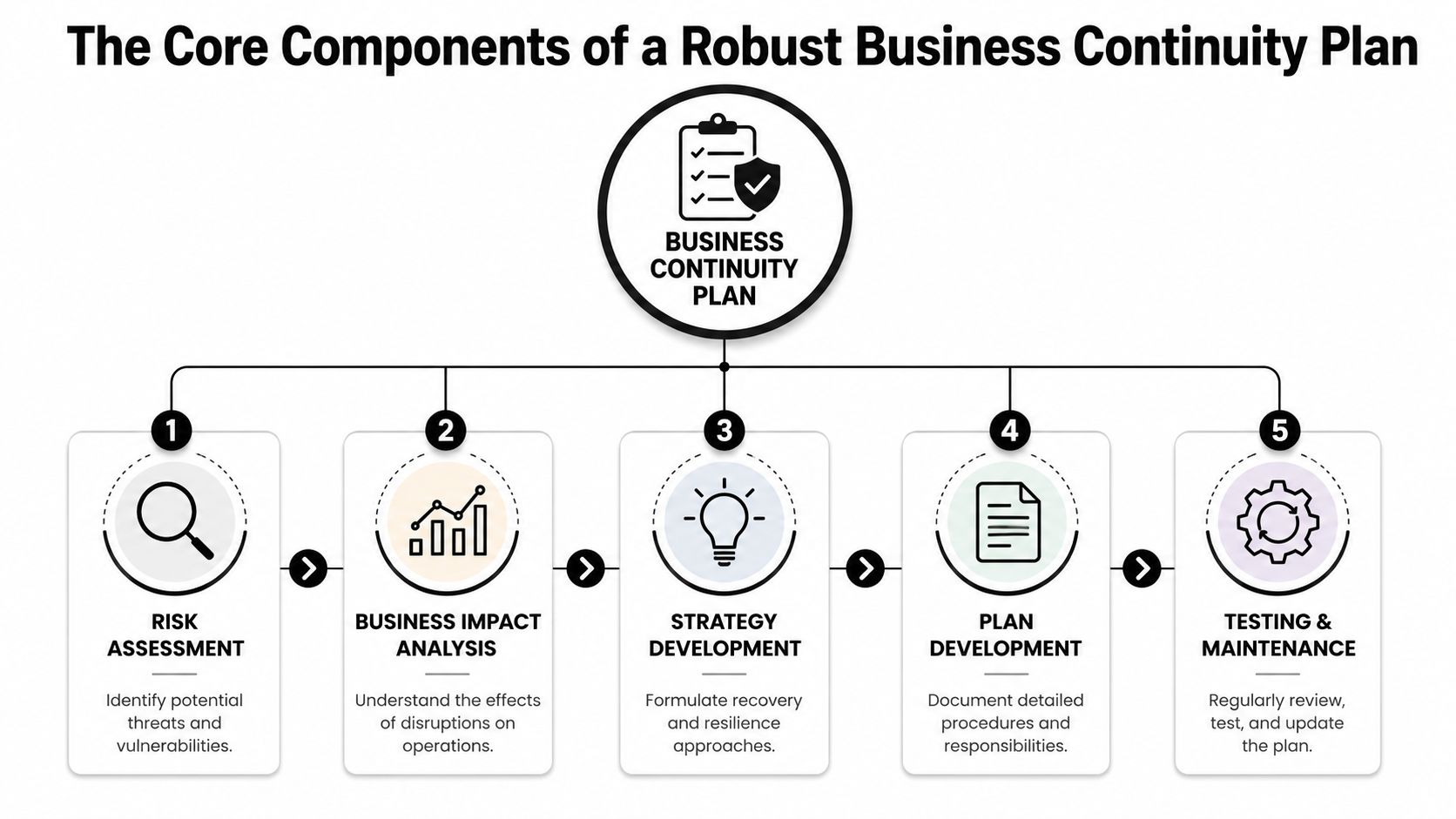
Risk assessment comes first
Risk assessment identifies the events that can stop revenue, delay compliance work, or break customer delivery. In the UAE, that usually means more than fire and flood. It includes premises inaccessibility, internet or utility disruption, cyber incidents, delayed imports, courier failure, dependency on one third-party provider, and the temporary loss of a founder or specialist who holds too much process knowledge.
Generic labels are not enough. “System outage” does not help a team recover. “Loss of access to the cloud accounting platform during payroll week” gives management something concrete to solve.
This is also where weak operating models show up. One approver. One warehouse. One PRO handling all government portal actions. One finance employee who knows the VAT filing sequence. Those single points of failure are common in startups, SMEs, and newly established foreign-owned entities because the business grows faster than its controls.
The business impact analysis sets priorities
The Business Impact Analysis, or BIA, turns disruption into business decisions. It identifies which activities must resume first, how long each one can stay down, and what level of data loss or backlog is acceptable.
The UAE standard AE/SCNS/NCEMA 7000:2021 expects organisations to conduct a BIA and define recovery requirements for critical activities, as outlined in this overview of the UAE standard.
In practice, two measures matter:
- RTO: How quickly the activity must be restored
- RPO: How much data loss the business can tolerate
These choices are commercial, not academic. A retailer may need payment processing back almost immediately. A medical services provider may prioritise appointment records and regulated communications. A consultancy may accept a short delay in internal reporting but not in client access to documents or invoicing. For an importer or distributor, shipment coordination and customs paperwork may rank above several head office functions.
A good BIA forces leadership to say, clearly, what the business protects first.
Recovery strategies must cover people, premises, technology, and process
Many continuity plans look acceptable on paper and collapse in use because they focus too heavily on IT recovery. Companies do not deliver through systems alone. They deliver through people following workable processes from available locations under clear authority.
An effective recovery strategy covers four operating areas:
| Area | What a weak plan says | What a workable plan includes |
|---|---|---|
| People | Staff will work remotely | Named owners, deputies, cross-trained backups, approval authority |
| Premises | Use alternate office if needed | Specific alternate site, home-working rules, site access method |
| Technology | Restore systems quickly | Priority systems list, access controls, vendor contacts, fallback tools |
| Process | Resume normal workflow ASAP | Manual workarounds, exception logs, temporary approval paths |
The trade-off is straightforward. The more money a company saves by concentrating knowledge, authority, and systems in a few hands, the more exposed it becomes during disruption. I see this often with owner-managed UAE businesses and overseas investors setting up lean local teams. It keeps costs down early on, but it can stop operations completely when one person, one portal credential, or one supplier becomes unavailable.
Manual workarounds deserve more attention than they usually get. If the ERP is down, can the team still issue invoices, release deliveries, record collections, approve urgent expenses, and maintain an audit trail? If the normal office is unavailable, can regulated records still be accessed securely? These details decide whether the company keeps functioning or just waits for systems to return.
Insurance supports financial recovery, but it does not tell your team how to operate on day one. For a practical view of that side of risk, see navigating business interruption after disaster.
Crisis communication controls confusion and protects trust
Communication is an operating control, not a public relations extra. During a disruption, silence creates its own damage. Staff make assumptions. Customers chase updates. Suppliers stop prioritising your orders. Regulators, landlords, banks, and free zone authorities may still expect timely responses depending on the issue.
A usable communication plan answers four questions fast:
- Who declares the incident and activates the plan
- Who updates staff, customers, suppliers, and external stakeholders
- Which messages are pre-approved for likely scenarios
- Which backup channels work if email or office systems are unavailable
Contact resilience matters here. Keep key phone numbers, escalation paths, and external contact lists accessible outside the main network. If all critical contacts sit inside one mailbox or shared drive, the communication plan is incomplete.
A strong continuity plan is a set of operational decisions linked to real business priorities. It tells the company what to protect first, who makes calls under pressure, how work continues under UAE operating constraints, and how to keep obligations moving even when normal conditions disappear.
Your Step-by-Step Implementation Roadmap
Most SMEs delay continuity work because they imagine a large, technical project with consultants, workshops, and thick policy folders. In practice, the first version should be much simpler. Start with the parts of the business that would hurt most if they stopped.
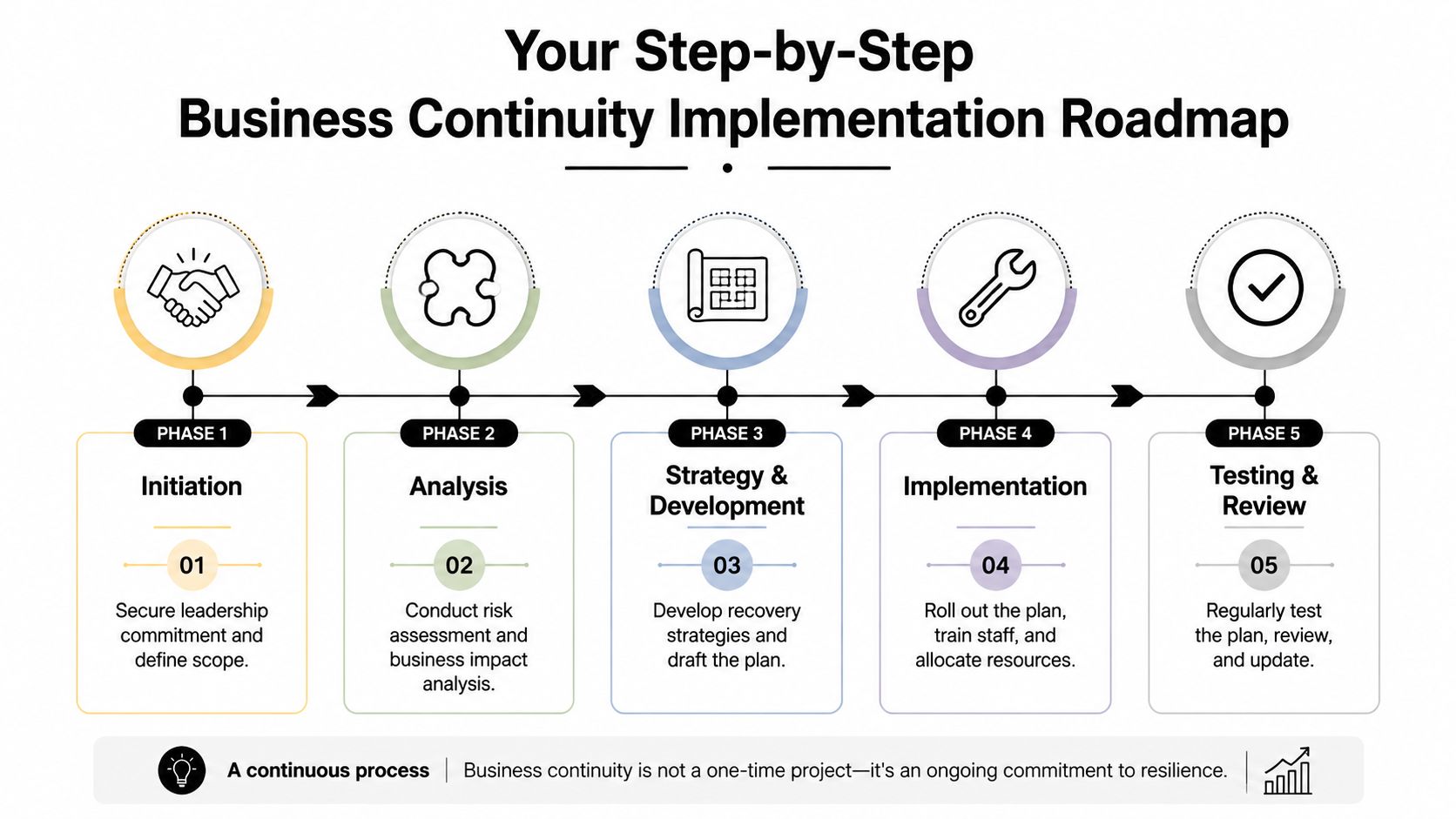
Step 1 and Step 2 set the direction
Get leadership buy-in first. If the founder, managing director, or board treats continuity planning as a side task, the project will stall the moment it requires budget, staff time, or process changes.
Build a small cross-functional team. Don't leave this only with IT. Include operations, finance, HR, and whoever owns customer delivery. In a smaller company, one person may cover multiple roles. That's fine, as long as responsibilities are explicit.
A strong starting team usually answers four questions quickly:
- What must continue no matter what?
- What can pause for a short period?
- Who can make urgent decisions?
- Where is the business currently overdependent on one person or one system?
Step 3 and Step 4 turn assumptions into decisions
The next move is to run the risk assessment and BIA, then translate the results into practical recovery strategies. During this stage, many businesses discover they've been relying on memory and goodwill rather than process.
Use a simple working structure:
- Critical activity: Payroll, billing, customer support, order processing, or compliance filing
- Dependencies: Systems, staff, suppliers, premises, approvals
- Failure scenario: Office closed, system unavailable, key person absent, vendor delay
- Fallback method: Remote work, alternate site, manual process, backup supplier, delegated authority
Don't try to produce perfect language on the first pass. Focus on usable decisions.
Step 5 handles communication before panic starts
A crisis communication plan should be written while everyone is calm. During disruption, people either over-communicate without control or go silent because nobody wants to say the wrong thing.
Create message templates for staff, customers, suppliers, and key stakeholders. Keep them plain. Confirm who approves them. Store them somewhere accessible outside the primary office environment.
Field lesson: The fastest way to lose control of a disruption is to leave communications to improvisation.
Step 6 trains people to act without waiting
Staff don't need a lecture on continuity theory. They need to know what happens if the office is inaccessible, if the core system fails, or if a team leader is unavailable.
Short awareness sessions work better than long policy briefings. Focus on role clarity:
| Team | What they should know |
|---|---|
| Leadership | Activation criteria and decision authority |
| Operations | Priority services and workarounds |
| Finance | Payment, payroll, and records fallback |
| HR and admin | Staff communication and attendance process |
The first implementation cycle should produce a plan your team can use. That matters more than elegant formatting. Once the basics work, you can refine documentation, add scenario depth, and align more closely with formal assurance requirements.
Testing and Maintaining Your Business Continuity Plan
At 9:10 on a working day in Dubai, your office internet drops, a key approver is on a flight, and customers start asking why orders are delayed. That is when a continuity plan stops being a document and starts proving whether the business can keep operating under pressure.
Testing matters because assumptions fail first. A plan may look clear in a boardroom and still break down in practice when people cannot access a system, a signatory is unavailable, or a supplier does not respond. In the UAE, that gap has real consequences. Service delays can affect customer trust, contractual performance, payroll timing, regulatory filings, and bank or free zone documentation that still needs to move on time.
Run the kind of test your business actually needs
Start with the disruption your company is most likely to face, not the most dramatic one. A startup may only need a tabletop session built around a cloud outage or temporary office closure. A trading business with tight delivery commitments may need a live exercise that tests supplier contact, manual processing, and customer communications under time pressure.
The point is to test execution.
Useful scenarios for UAE-based companies include remote work activation, temporary loss of access to premises, payment approval delays, cross-border supply interruption, and failure of a core ERP or CRM platform. If your company operates across mainland and free zone entities, test handoffs between them. If foreign investors or overseas directors must approve decisions, test what happens when that approval chain slows down.
What a good test should expose
A useful exercise answers a small set of hard questions.
- Can the team act without waiting for one person? If every decision still returns to the founder or general manager, the plan is too fragile.
- Can critical work continue with limited systems? Finance, customer service, and operations should know their fallback steps before a real disruption.
- Are records and contacts accessible outside the office? This includes vendor details, staff lists, banking instructions, and key licence or compliance documents.
- Do communication approvals work at speed? Delayed or conflicting updates usually create more damage than the original incident.
- Have third-party dependencies been tested? Many failures sit outside the company, especially with logistics, IT support, payment providers, and outsourced admin functions.
A good test often feels uncomfortable. That is useful because it reveals where the business is still relying on memory, goodwill, or one experienced employee who "just knows how it works."
Review the result like an operator, not an auditor
After each test, record what failed, what was slow, and what created confusion. Keep the review practical. If a workaround depends on a laptop that only one person has, that is not a workaround. If a branch manager cannot approve an urgent payment because authority limits were never updated, that is a governance problem, not a training problem.
This is also where local business reality matters. UAE companies often change premises, add new legal entities, switch banks, appoint new authorised signatories, or outsource functions as they grow. Each of those changes can invalidate the plan. Businesses that want continuity planning tied to their operating model often get better results with UAE business advisory support that connects governance, finance, compliance, and day-to-day execution.
Maintenance needs triggers, owners, and deadlines
An annual review is the minimum. It is rarely enough on its own.
Update the plan after any material change such as a new office, new system, new supplier, revised delegated authority, restructuring, or expansion into another emirate or free zone. Review it after a real incident as well, even if the event looked minor. Near misses are often more valuable than formal crises because they expose weak points before losses become serious.
Assign one owner for document control, but do not leave maintenance with one department. Operations should confirm process changes. HR should check staff contacts and role changes. Finance should verify payment fallback steps and records access. IT should confirm system recovery assumptions. Leadership should confirm that approval authority still matches how the company operates.
If your team cannot find the latest version quickly, cannot recognise their role in it, or cannot use the fallback steps named in it, the plan is already out of date.
How Expert Guidance Streamlines Your BCP Process
For a UAE business, continuity planning sits at the intersection of operations, compliance, technology, governance, and documentation. That's why companies often struggle to do it properly on their own. The individual parts don't seem complicated. The difficulty is making them work together in a way that fits local requirements and the business's operating model.

An experienced advisor helps in three ways. First, they shorten the process. Instead of debating frameworks for months, management gets a practical sequence and clearer priorities. Second, they spot gaps early, especially around licensing, document control, governance, and operational dependencies. Third, they make sure the plan isn't built in isolation from the rest of the business.
That integration matters. A continuity plan is more credible when it reflects how the company is structured, how approvals really work, where records are kept, how finance operates, and what legal obligations continue during disruption. Businesses that need broader strategic support often benefit from working with a firm that already understands setup, compliance, finance, and growth planning in the UAE, such as a specialist in business advisory in Dubai.
The strongest plans are rarely the most elaborate. They are the ones leadership can activate quickly, staff can follow confidently, and stakeholders can trust when normal operations break down.
Smart Classic Business Hub helps founders, SMEs, and investors build resilient UAE businesses from the start. If you need support with company setup, compliance, finance processes, or continuity planning that fits local regulations and real operating conditions, speak with Smart Classic Business Hub.