
An employee resigns. A contract ends. A visa cancellation is pending. Payroll is trying to close the month, and the business owner wants one clear answer. What exactly must be paid in the final settlement?
That's where most confusion starts. People mix up salary, leave encashment, notice, reimbursements, unpaid deductions, unemployment insurance, and gratuity as if they're one bundle. They're not. In practice, end of service benefits are one part of the final settlement, but they're often the part that creates the biggest compliance risk if handled casually.
For UAE business owners, this isn't just an HR issue. It affects payroll accuracy, cash planning, employee relations, and dispute exposure. For employees, it affects whether the amount paid at exit is legally correct.
Your Guide to Final Settlements in the UAE
When employment ends in the UAE, the final settlement needs to be handled with discipline. The most common mistake I see is treating gratuity as a rough estimate to be fixed later. That approach creates avoidable disputes.
End of service benefits, often called gratuity, are a statutory payment tied to service length and calculated under UAE labour rules. They aren't the same as the final salary run, and they aren't a discretionary loyalty bonus. If an employee qualifies, the employer must calculate them correctly and include them in the final settlement.
A practical review usually starts with four questions:
- Has the employee completed the minimum service period?
- What is the final basic salary?
- How long is the eligible service period after excluding any unpaid leave that affects continuity?
- Is the employment ending by resignation or employer termination?
Practical rule: Don't approve a final settlement until HR, payroll, and the signatory are all working from the same service dates and the same definition of basic salary.
Business owners also need to think beyond the maths. The legal formula matters, but the process matters just as much. A correct number paid late still creates problems. An incorrect number paid quickly doesn't solve anything either.
What Are End of Service Benefits
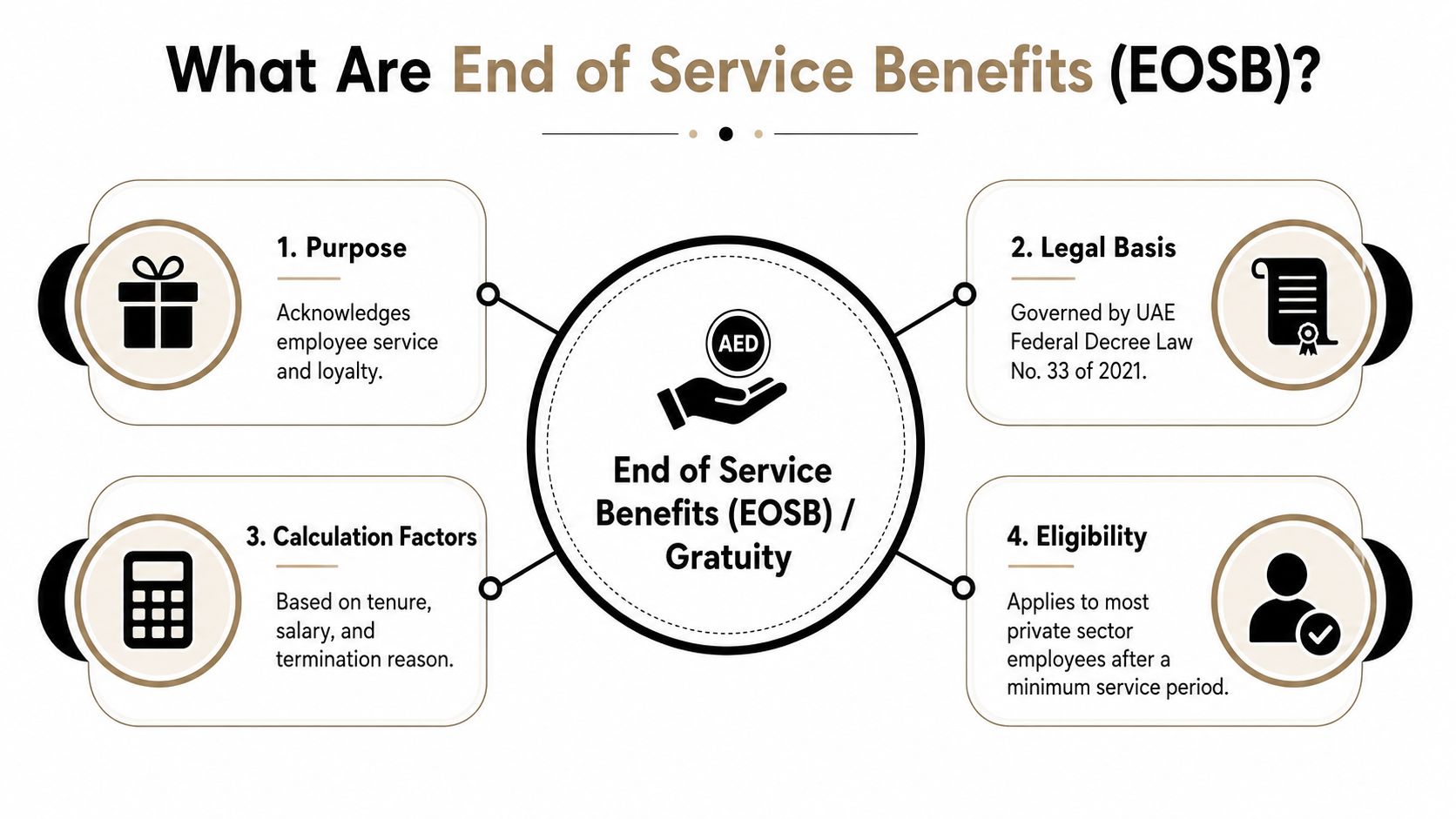
End of service benefits are the statutory gratuity payable to eligible employees at the end of employment. In simple terms, they are the UAE's legally mandated service award. They recognise completed service, but they do so through a strict formula rather than through employer discretion.
The legal baseline
Under UAE Federal Decree Law No. 33 of 2021, the starting point is simple. An employee must complete one full year of continuous service to qualify for statutory gratuity. The benefit accrues at 21 calendar days of basic salary for each of the first five years of service, then 30 calendar days of basic salary for each year after that, and the total gratuity cannot exceed two years' basic salary, as outlined in this Khaleej Times summary of the UAE gratuity rule.
That one-year threshold matters more than many employers realise. If the employee leaves before completing it, there is no statutory gratuity entitlement. In day-to-day operations, that means the service record must be checked carefully before anyone promises a number.
What salary counts and what doesn't
Costly overpayments often happen because the law uses basic salary, not total monthly package.
That means employers shouldn't calculate gratuity on housing allowance, transport allowance, or similar additions. If payroll uses gross salary by habit, the settlement can be wrong from the start. For SMEs with mixed payroll practices, this is one of the first controls worth tightening.
A good internal check is to compare:
- Employment contract basic salary
- Latest payroll record basic salary
- Any amendment letter changing salary structure
If those don't match, pause the calculation and reconcile the file before issuing the settlement.
Why the cap matters
The statutory cap of two years' basic salary gives employers a ceiling on liability. That's useful in budgeting, especially for long-serving employees. It also stops informal assumptions from creeping in, such as the idea that gratuity always keeps rising without limit.
A final settlement should be defensible on paper. If someone asks how the amount was reached, HR should be able to show service dates, the final basic salary, and the legal basis in one file.
For employees, the practical takeaway is just as important. If your total package is much higher than your basic salary, your gratuity may be lower than you expected. That doesn't mean the employer underpaid. It often means the employee assumed allowances were included when they aren't.
How to Calculate End of Service Benefits
The cleanest way to calculate gratuity is to break it into parts. Don't try to estimate from memory. Use the employee's final basic salary, confirm eligible service, then apply the correct rate to each period.
Start with the service band
For full entitlement calculations, the standard structure works like this:
- First service band: use 21 days of basic salary for each year in the first five years.
- Later service band: use 30 days of basic salary for each year after five years.
- Cap check: confirm the result doesn't exceed the statutory maximum.
That sounds straightforward, but errors usually happen in one of two places. Either the wrong salary base is used, or the business forgets that resignation can change the entitlement in certain cases.
A worked example
A practical example helps. For an employee with a basic salary of AED 15,000 and 7 years of service, the gratuity is calculated as:
- First five years: (15,000 ÷ 30 × 21 × 5) = AED 52,500
- Next two years: (15,000 ÷ 30 × 30 × 2) = AED 30,000
- Total: AED 82,500
That exact calculation appears in this UAE gratuity calculation example.
Resignation is where many people slip
Not every departure produces the same gratuity result. For expatriates who resign before completing five years, the entitlement is reduced proportionally. The practical distinction is:
- Service from 1 to 3 years on resignation: entitlement is one-third of the 21-day amount
- Service from 3 to 5 years on resignation: entitlement is two-thirds of the 21-day amount
- Resignation after 5 years: full entitlement applies
This is one reason final settlement reviews should never rely on a generic spreadsheet without a departure-type check.
Comparison table for quick review
| Service Duration | Gratuity if Terminated | Gratuity if Resigning |
|---|---|---|
| Less than one year | No statutory gratuity if the employee has not completed the minimum qualifying period | No statutory gratuity if the employee has not completed the minimum qualifying period |
| 1 to 3 years | Calculated on the standard accrual basis for eligible service | Reduced to one-third of the 21-day amount for expatriates who resign in this band |
| 3 to 5 years | Calculated on the standard accrual basis for eligible service | Reduced to two-thirds of the 21-day amount for expatriates who resign in this band |
| More than 5 years | Full entitlement based on the standard tiered formula | Full entitlement based on the standard tiered formula |
A practical sequence that works
When I review final settlements, the most reliable workflow is this:
Confirm the exit type
Resignation and employer termination shouldn't be treated interchangeably.Lock the salary basis
Use final basic salary only.Verify service dates
Don't rely only on visa dates or only on payroll dates. Check the employment record itself.Review other final settlement items separately
Leave salary, notice, deductions, and expense claims should be computed independently. If you also need to reconcile leave salary, this guide on how to calculate leave salary in the UAE is a useful companion.
If the finance team can't explain the gratuity figure line by line, the number isn't ready to be approved.
For employers, what works is standardisation. Use one approved template, one source for salary data, and one sign-off chain. What doesn't work is letting each department calculate a different version of the same settlement.
Navigating Special Scenarios and Contract Types
A common UAE SME scenario looks like this. A part-time employee resigns after several years, payroll applies the full-time gratuity formula, HR assumes unemployment insurance covers part of the exit, and the final settlement goes out with the wrong figure. The mistake usually starts much earlier, in the contract setup and timekeeping records.
Probation and short service exits
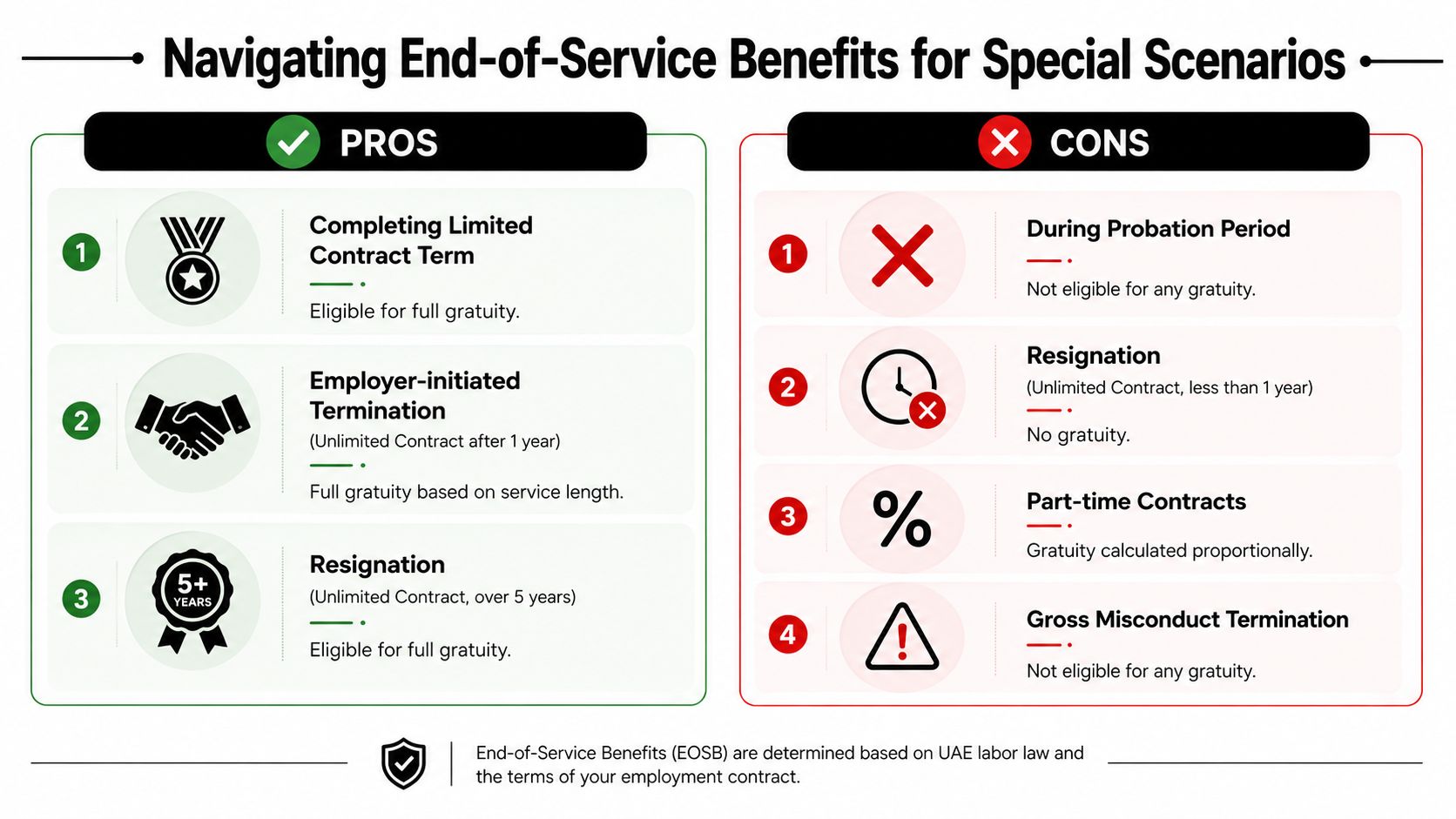
Short service cases need a clean legal check before anyone approves a payment. If the employee has not met the qualifying service period for gratuity, EOSB does not arise. Employers still need to settle earned salary, unused leave if applicable, approved reimbursements, and any other contractual dues. Those items should not be blurred together under the label of gratuity.
Probation exits are often handled badly because managers want a quick release. They agree an ex gratia payment, payroll records it loosely, and later someone treats that payment as statutory EOSB. That creates two problems. The file no longer shows what was legally due, and the business loses a clear audit trail if the employee disputes the settlement later.
Part-time and flexible workers
Part-time and flexible arrangements need closer attention than standard full-time contracts. Under the current private sector framework, EOSB for these workers is not always approached in the same way as a full-time employee with fixed hours. The practical issue is proportionality. The business must be able to show the worker's agreed hours against the relevant full-time benchmark, then apply the formula consistently across the whole service period where required.
Many businesses encounter difficulties in this regard. The contract says part-time. The employee works near full-time hours for long periods. Payroll keeps paying on an exception basis. At exit, nobody can show which hours pattern should govern the gratuity calculation.
The risk is avoidable.
Keep three records aligned from the start:
- the signed contract type
- the approved working hours pattern
- the payroll method used
If one of those changes, update the other two. A part-time arrangement that gradually turns into regular full-time attendance should not stay frozen on an old contract template.
Flexible work patterns and modern staffing models
Flexible workers create a different problem. Hours may vary from month to month, but EOSB still has to rest on a defensible basis. Employers should decide early how they will document the comparison point. In practice, that usually means defining the equivalent full-time role, confirming standard hours for that role, and keeping time records that can support the final calculation.
Without that foundation, the dispute is predictable. The employee points to actual hours worked. The employer points to the original contract. Both sides may have partial records, but neither side has a clean file.
This matters even more for businesses using mixed staffing models across retail, consulting, hospitality, and project-based operations.
EOSB and unemployment insurance are not the same thing
Business owners also confuse EOSB with the UAE's unemployment insurance scheme. They are separate. End of service benefits are an employer settlement obligation where the legal conditions are met. Unemployment insurance is a separate scheme with its own eligibility rules, contribution requirements, and claim process. One does not replace the other, and enrolment in the insurance scheme does not reduce gratuity liability.
That misunderstanding shows up most often after involuntary termination. The employer assumes the employee can claim under the insurance scheme, so the final settlement is treated casually. That is a mistake. The business still has to calculate EOSB correctly, close out all dues properly, and document the basis for payment.
Good offboarding discipline helps here. This employee termination process guidance is useful for aligning HR, payroll, and records before the file reaches final approval.
DIFC and other legal context
Jurisdiction matters. Employers operating in mainland UAE, free zones, and DIFC should not apply one settlement rule set to every employee without checking the governing framework first. The contract, place of employment, and applicable employment law all affect how the final position should be reviewed. For teams working across different structures, this guide to DIFC employment law considerations helps identify where a separate analysis is needed.
Special cases rarely become expensive because the rule was impossible to find. They become expensive because the records do not support the rule that should have been applied.
For SMEs, the practical fix is simple. Treat contract type, work pattern, payroll treatment, and insurance status as linked compliance records, not separate admin tasks. That approach prevents a large share of EOSB disputes before the employee ever reaches the exit stage.
The Claim Process and Employer Obligations
Knowing the gratuity amount is only part of the job. The payment process needs the same level of control.

What employers need to do
When employment ends, the employer should prepare the full settlement file, not just the gratuity line. That usually includes the final salary position, leave balance treatment, approved deductions if any, reimbursement reconciliation, and the gratuity calculation itself.
The practical priority is timing. Delays often happen because one team waits for another. HR waits for payroll. Payroll waits for finance. Finance waits for signed clearance. That chain needs ownership.
A disciplined offboarding process usually includes:
Document review
Contract, amendments, payroll data, service dates, and any unpaid leave records should all be checked together.Settlement approval
One authorised signatory should approve the final figures after HR and finance reconcile them.Clearance and acknowledgement
The employee should receive a clear settlement statement before signing any receipt or settlement confirmation.Visa and labour closure coordination
Offboarding documents should match the actual payment and exit records.
If your team needs a broader offboarding checklist beyond the gratuity issue, this employee termination process guidance is a practical resource for structuring the workflow.
What employees should check before signing
Employees often focus only on the total amount. That's understandable, but it's not enough. They should also review how the employer arrived at the figure.
A sensible review includes these questions:
- Was the calculation based on basic salary or total package?
- Were service dates counted correctly?
- Were any unpaid leave periods treated properly?
- Does the settlement combine gratuity with other amounts in a way that is still understandable?
Before anyone signs a final settlement receipt, both sides should be able to identify each component of the payment without guesswork.
Recordkeeping and labour checks
From an employer's side, proper records matter just as much after payment as before it. If a dispute comes later, the business will need the signed settlement, calculation sheet, payroll support, and proof of payment.
Where verification or status checks are needed during the offboarding cycle, using official and structured labour lookup processes helps reduce confusion. Businesses that regularly manage exits often rely on tools and service support connected with Ministry of Labour inquiry services to keep records aligned before closure is finalised.
What works is a checklist-driven process. What doesn't work is rushing the settlement because the visa cancellation is already in motion.
Common Pitfalls and Advanced Considerations
A common real-world problem looks like this. A company agrees a final settlement figure quickly, visa cancellation starts, and only then someone notices the gratuity was calculated on total package instead of basic salary. By that stage, the business is not dealing with a simple payroll correction. It is dealing with an employee dispute, finance rework, and a preventable compliance risk.
That error is still the one I see most often. The second is weaker recordkeeping around service periods, especially where unpaid leave, flexible scheduling, or irregular attendance patterns were not documented properly. Modern work arrangements create more room for mistakes because the employment relationship is less uniform, but the settlement still has to rest on clear records and the correct legal basis.
Part-time and flexible contracts need particular care.
Employers sometimes assume a non-standard schedule means a simplified exit calculation. It does not. The business still needs to confirm what counts as continuous service, what salary basis applies, and whether payroll records match the actual working arrangement in the contract and attendance history. If those documents do not align, the final settlement becomes harder to defend.
EOSB and unemployment insurance are separate obligations
Another expensive misunderstanding is treating end of service benefits and the UAE unemployment insurance scheme as if one replaces the other. They do not serve the same purpose, and they should never be merged into one settlement discussion or one line item.
EOSB is part of the employee's final dues. Unemployment insurance is a separate scheme with its own eligibility rules, claim conditions, and exclusions. In practice, the confusion usually appears during termination conversations. An employee may believe gratuity automatically gives access to unemployment support, or may assume losing access to insurance means gratuity also falls away. Both assumptions can lead to bad advice and unnecessary conflict.
Resignation, dismissal circumstances, contribution status, and scheme eligibility all matter. Some employees may receive EOSB but not qualify for unemployment support. Others may qualify for insurance support after job loss while also remaining entitled to their EOSB. Employers should avoid informal statements on insurance eligibility unless the position has been checked carefully against the applicable scheme rules.
Controls that prevent disputes
A better approach is to keep each element separate and documented:
- Calculate EOSB on the correct salary basis.
- Check service dates against leave and payroll records.
- Treat part-time, flexible, and irregular work patterns as higher-risk cases for review.
- Keep gratuity, unpaid salary, unused leave, deductions, and insurance matters as separate items.
- Do not give verbal estimates that finance has not verified.
This is also where ownership inside the business matters. If HR starts the process, payroll calculates it, and finance approves payment, each handoff needs a clear check. Businesses reviewing who should control those steps can use this guide to understanding finance roles in UAE businesses.
One final point. Employees usually pay close attention to gratuity because it is one of the largest amounts in the exit package. That makes accuracy more than an administrative issue. It affects trust, timing, and the likelihood of a labour complaint.
Ensure Compliance with Smart Classic Business Hub
Final settlements go wrong when businesses improvise. The law may be clear on the formula, but compliance still depends on clean records, accurate payroll inputs, and disciplined offboarding.
That's why owners should treat end-of-service administration as part of financial control, not just HR paperwork. If nobody owns the process from contract review to payment proof, errors are almost guaranteed to surface at the worst possible time.
Strong EOSB handling also depends on who manages finance internally. If you're building internal controls or deciding what your finance lead should own, this guide to understanding finance roles in UAE businesses helps clarify where payroll accuracy, compliance review, and settlement oversight should sit.
For businesses that want fewer disputes, better records, and smoother employee exits, the right answer is a repeatable process. Standard templates, reconciled payroll data, proper contract records, and timely closure make a substantial difference. They also reduce the chance that a routine employee departure turns into a labour issue.
If you need support with final settlements, payroll coordination, PRO steps, or broader UAE compliance, Smart Classic Business Hub can help you handle end-of-service benefits accurately and keep your offboarding process organised from start to finish.