
You're likely in one of two positions right now. Either you visit the UAE often enough that short-stay visas have become an administrative chore, or you're exploring the market and need a practical way to return repeatedly without rebuilding the paperwork each time.
That's where the 5 year multiple entry visa UAE becomes useful. Not as a residency solution, and not as a substitute for a company-linked permit, but as a flexible access tool for people who need to be in Dubai and the wider UAE regularly while keeping their options open.
Your Gateway to Business Flexibility in the UAE
You fly into Dubai to meet a distributor, spend two days with a free zone authority, review a property tied to a possible investment, and leave with three follow-up trips already needed. If every visit depends on a fresh short-stay application, the friction adds up fast.
That is the practical case for the UAE's 5-year multiple-entry tourist visa. It gives founders, investors, and independent professionals repeat access over a longer period without tying the visa to a local employer or sponsor. For clients who are still testing the market, that flexibility has real value. It lets them keep momentum while they validate suppliers, assess partners, and decide whether a full residence or company structure is justified.

Why this visa matters in real business use
In practice, this visa is useful because it supports repeat entry and longer stays for legitimate visit purposes. That suits people who need time on the ground for due diligence, project meetings, contract discussions, or market testing before they commit to a residence pathway.
The self-sponsored structure matters just as much. A foreign shareholder can enter without waiting for a company to sponsor them. A consultant can meet clients and explore set-up options without being locked into one hiring arrangement. An investor can inspect assets over multiple visits before deciding whether the UAE will be an operating base, a holding location, or merely a market they want to access regularly.
The trade-off is just as important. Flexibility is not the same as operating permission.
A lot of costly mistakes start here. Entrepreneurs assume frequent entry gives them room to work as if they already hold residence status, open the same services a resident can open, or treat the visa as a substitute for proper company formation. It does not. Used correctly, it is a strong access tool. Used carelessly, it creates compliance problems at exactly the stage when a business is trying to establish credibility.
If you're comparing routes as an investor, World Property Investor's visa guide is a useful broader read because it places visit visas alongside investor and residence options. If your actual goal is structuring operations in the UAE, review our guide on company formation in the UAE before choosing a visa route. That is usually where the better strategic decision gets made.
Is This the Right UAE Visa for Your Business Goals
A founder flies into Dubai every few weeks, meets distributors, reviews office options, speaks to free zone authorities, then flies out again. For that person, the main question is not visa length. It is whether the visa matches the way the business will be built.
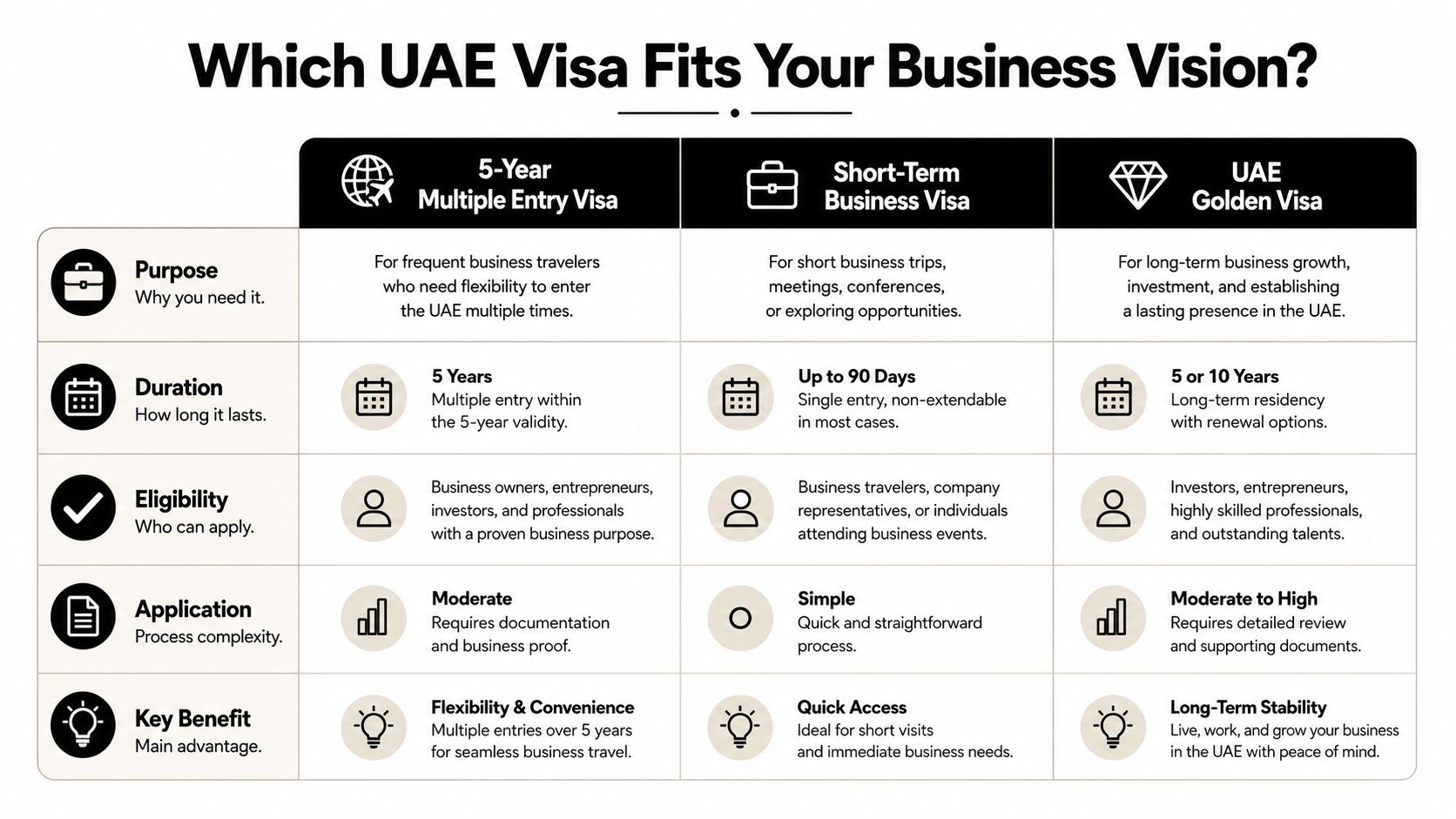
The 5-year multiple-entry visa suits people who need repeated access to the UAE without committing too early to residence, company sponsorship, or a full relocation plan. I usually recommend it to clients who are still validating the market, comparing set-up options, or making investment decisions that need several visits rather than one rushed trip.
Who benefits most from it
The best fit is usually one of these profiles:
- Frequent business visitors attending meetings, supplier reviews, site inspections, or partnership discussions over an extended period
- Early-stage founders testing demand before setting up a company and taking on the cost of residence visas
- Foreign investors reviewing assets, partners, and ownership structures before deciding how to enter the market
- Independent consultants who need lawful entry for meetings and business development without being tied to one employer
The common thread is flexibility. The visa gives access and time to assess the market properly.
What it does not do
This visa does not convert a visitor into a resident, employee, or licensed operator. That point affects real business decisions. If you need to live in the UAE on a long-term basis, hire staff under your own entity, open services tied to residence status, or build day-to-day operations around your physical presence, this visa will fall short.
This assumption leads to problems. Entrepreneurs often start with a valid short-term strategy, then stretch it into something the visa was never designed to support.
If your end goal is residence through capital deployment or a qualifying business route, it makes more sense to compare this option against the UAE investor visa requirements before you file anything.
This visa is best used as a market-entry tool, not as a substitute for residence planning.
Side-by-side decision view
| Feature | 5-Year Multiple Entry Visa | Golden Visa | Standard Tourist Visa |
|---|---|---|---|
| Purpose | Repeated visits for tourism and business travel | Longer-term residence for eligible categories | Short visit for tourism or business travel |
| Stay pattern | Flexible repeated visits over long validity | Built for residence | Single trip or limited short-term trips |
| Sponsorship | Self-sponsored | Based on qualifying category | Varies by route |
| Work rights | No | Depends on the residence framework | No |
| Best fit | Frequent visitor not ready for residency | Investor or eligible talent seeking residence | Occasional visitor |
When it's the wrong choice
Choose a different route if any of the following applies:
- You need residence status soon. This matters for local administration, personal banking access in some cases, tax residency planning, and long-term living arrangements.
- You are taking up a role with a UAE company. A visit visa does not replace employment authorisation.
- Your business model depends on continuous presence. Repeated travel can become inefficient if you are managing staff, premises, or regulated activity on the ground.
- You need resident-linked services from the start. Many practical set-up steps become easier, or only possible, once residence status is in place.
Used well, the 5 year multiple entry visa UAE gives entrepreneurs and investors room to test, negotiate, and structure carefully. Used carelessly, it delays the proper immigration and business set-up decisions and creates avoidable compliance risk at the exact point when credibility matters most.
Eligibility Criteria and Required Documents Checklist
Entrepreneurs often lose time here for avoidable reasons. The visa itself is flexible, but the file still needs to be clean, consistent, and easy for an officer to review. A weak application usually fails on document quality, mismatched details, or poor financial evidence, not on business intent.
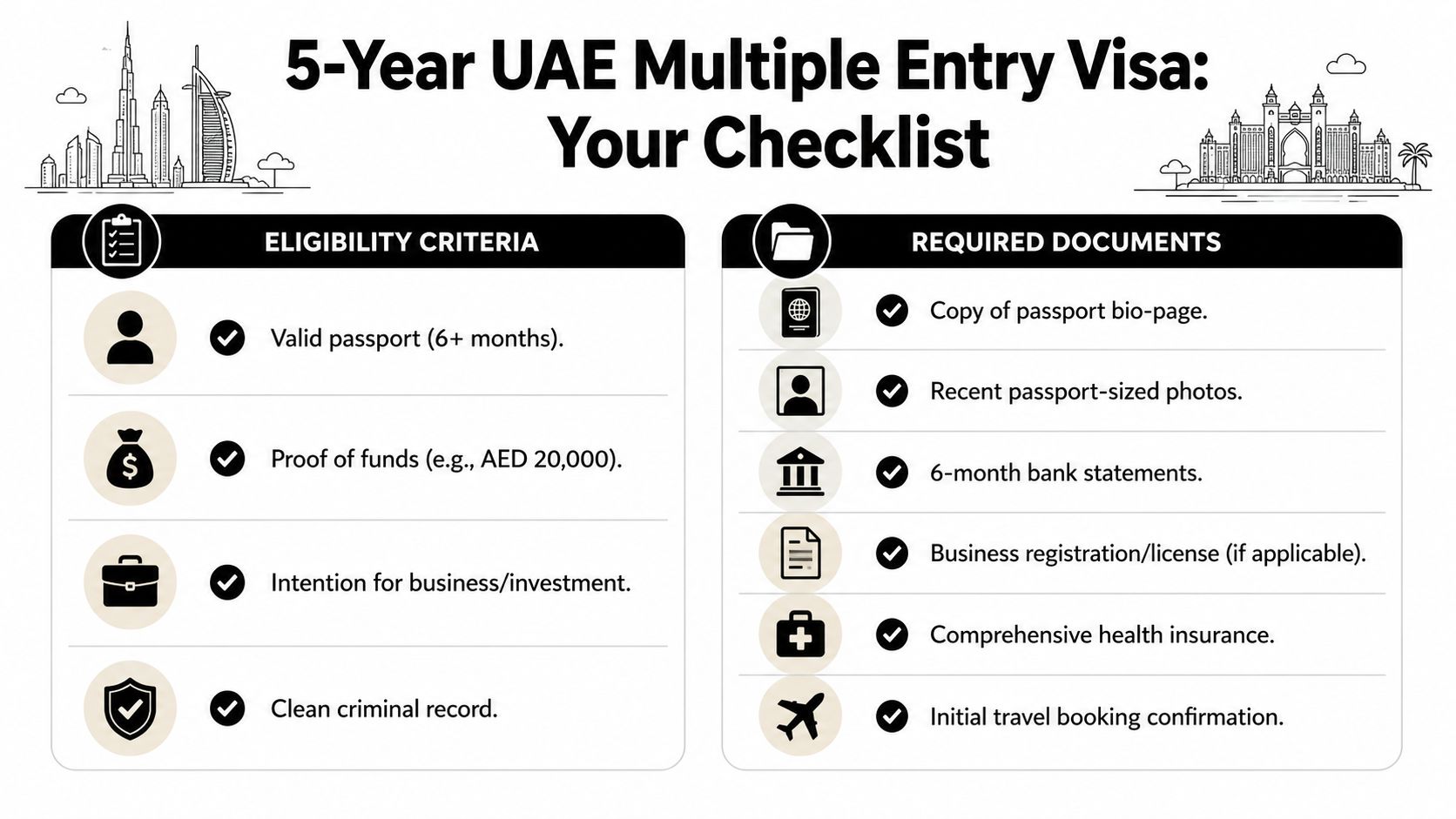
Core eligibility points
As noted earlier, the standard criteria generally include a valid passport, evidence of financial capacity over a sustained period, health insurance, and confirmed travel documentation. The practical point is simple. Officers are not just checking whether you uploaded documents. They are checking whether the file shows a credible visitor who can enter, stay lawfully, and leave without creating compliance issues.
For founders and investors, the financial proof deserves the most attention. A single strong balance is less persuasive than statements that show stability over time. If funds appeared recently, if the account holder name is inconsistent, or if the statements are hard to read, expect delays or extra scrutiny.
Working checklist before you apply
Review these items before submission:
- Passport validity: Use a passport with enough remaining validity for the application and planned travel window.
- Bank statements: Prepare clear statements that show stable funds over the required period, with your name and account details visible.
- Health insurance: Check that the policy covers the UAE and matches the expected duration of travel.
- Flight or onward travel proof: Keep booking details ready and make sure the name matches the passport exactly.
- Readable copies: Upload high-quality scans. Cropped pages, glare, and blurred text cause unnecessary follow-up.
- Consistent personal details: Names, passport numbers, and dates should match across every document.
Documents that cause the most trouble
Bank statements are the first pressure point. I regularly see applicants submit screenshots instead of proper statements, or provide an account summary that does not show the full holding period. That creates a weak file even if the applicant is financially qualified.
Insurance is the next problem area. Many policies look acceptable at first glance but do not clearly show territorial coverage, policy dates, or the insured person's details. If any of that is unclear, the document stops helping.
Travel documents also matter more than people expect. A booking with a spelling mismatch, a different passport number, or an unrealistic itinerary can trigger questions that were easy to avoid.
Strong visa files are dull to read. Every date matches, every name is consistent, and every document answers the obvious question before it is asked.
One strategic check before you choose this route
Before you submit, decide whether you are applying for a long-validity visit solution or whether your real objective is residence tied to ownership or investment. That distinction affects banking, tax planning, operating presence, and how quickly you will need to switch immigration status after market entry. If you need that comparison, this breakdown of investor visa requirements helps clarify where a visit visa works well and where it creates limits.
A well-prepared application does more than improve approval odds. It also gives you cleaner footing for the next step, whether that is repeated market visits, company formation, or a later move into residence status.
Navigating the Application Process and Costs
A common mistake looks like this. A founder sees one price on a government portal, another from a typing centre, and a much higher quote from a consultant. He assumes someone is overcharging. In many cases, the numbers are describing different levels of service, and that distinction matters more than the headline fee.
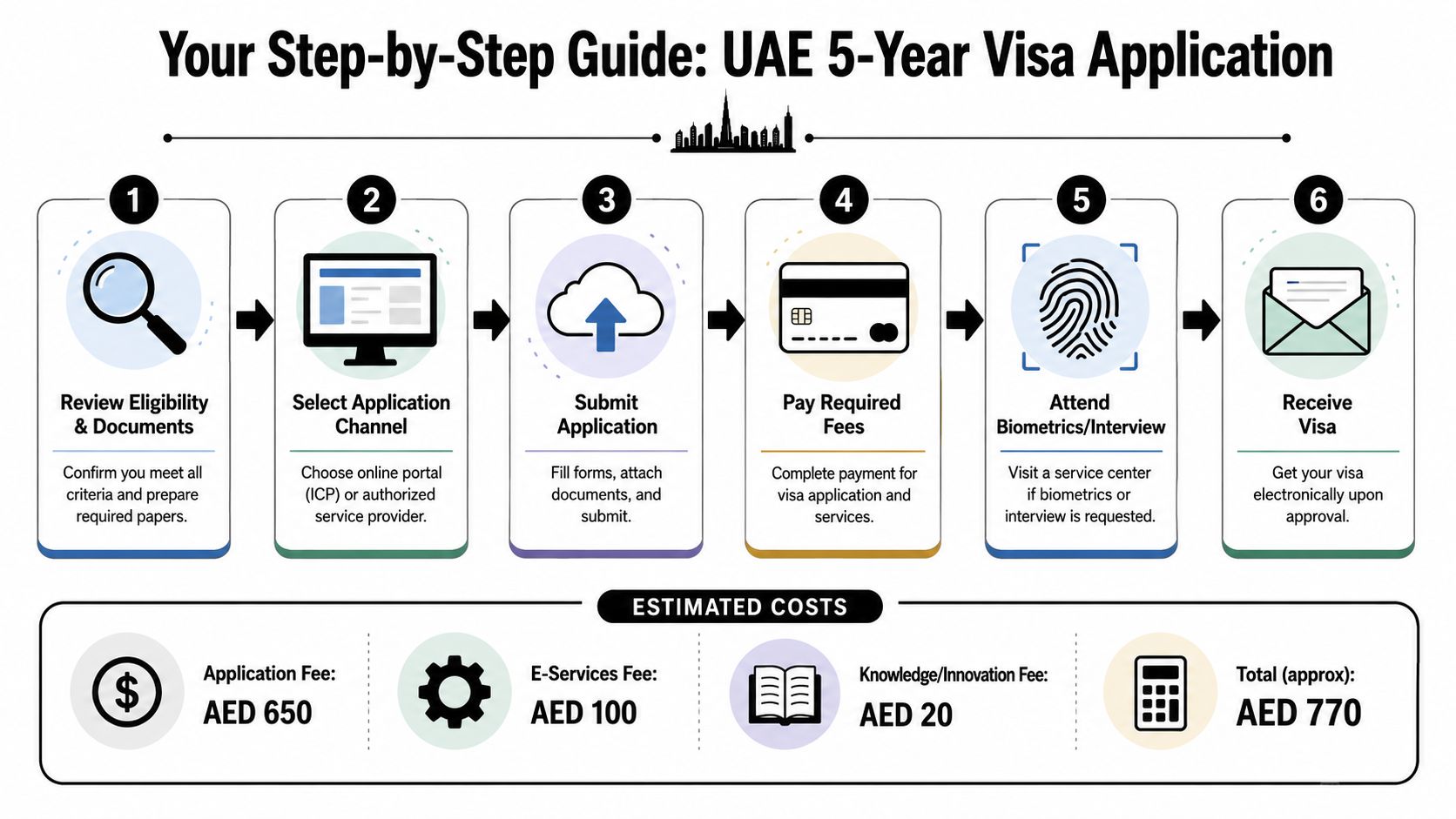
For entrepreneurs and investors, the right application route is not only about saving money. It is about controlling delay, reducing document risk, and avoiding a weak filing that creates problems just when you need to travel for a bank meeting, lease review, or company setup step.
The main application routes
In practice, there are three common ways to apply:
- Direct government submission through the official portal
- Typing centre submission where a third party prepares and uploads the file
- Professional support through a consultancy that reviews documents, checks consistency, and manages follow-up
All three can work. The trade-off is simple. Lower upfront cost usually means more responsibility stays with the applicant. Higher service fees may buy better document control, faster issue-spotting, and less time spent correcting avoidable mistakes.
Where cost confusion starts
Applicants often compare prices that are not built the same way. One quote may cover only the government charge. Another may include typing, file preparation, insurance coordination, follow-up, and status checks. A third may include urgent handling.
That is why I tell clients to ask one direct question before paying anything: what exactly is included, and what will trigger extra charges later?
Use this checklist before you approve a quote:
| Cost factor | What to check |
|---|---|
| Base visa amount | Is this only the government fee, or part of a bundled service price? |
| Portal or admin fees | Are they listed separately or hidden inside one total? |
| Urgent processing | Is priority handling optional, and who is charging for it? |
| Typing centre cost | What work is the centre doing for the added fee? |
| Consultancy support | Does the service include document review, corrections, and follow-up after submission? |
Ask for the full fee breakdown in writing. If a provider cannot separate government charges from service fees, treat that as a commercial risk, not a minor admin issue.
Choosing the route that fits your situation
A direct application usually suits applicants with clean documentation, straightforward travel plans, and enough time to handle portal uploads themselves. It can keep costs lower, but the savings disappear quickly if the file is inconsistent and you need to rework supporting documents.
Typing centres sit in the middle. They can reduce admin effort, but quality varies. Some are careful and efficient. Others are data-entry vendors. Before using one, check whether they are reviewing the substance of the file or only uploading whatever you hand over.
Professional support makes the most sense when the trip has business value and timing matters. I usually recommend it for founders entering the UAE repeatedly for market validation, property review, investor meetings, or early-stage setup work. In those cases, one preventable delay often costs more than the service fee.
The process in practical terms
The submission itself is usually straightforward. Most of the effort happens before you press submit. Documents need to align across passport details, bank evidence, insurance, travel records, and contact information. Small mismatches create unnecessary friction.
After filing, monitor the application instead of assuming silence means progress. Use a proper UAE visa status check by passport number so you can catch status changes early and respond quickly if further action is needed.
That habit saves time.
When the 5-year visa makes financial sense
This visa usually works best for people who expect repeated entry over time, not a one-off exploratory trip. The strategic value comes from reducing repeated application cycles and giving you more flexibility to enter the UAE as opportunities develop.
For a tourist, the math may be weak. For an entrepreneur testing suppliers, meeting free zone teams, reviewing office options, and returning for follow-up meetings, the calculation is different. The right comparison is not just visa fee versus visa fee. It is total admin time, repeat application effort, travel flexibility, and the cost of disruption if you need to come back on short notice.
Understanding Stay Limits and Avoiding Common Pitfalls
A common failure point looks like this. A founder lines up supplier meetings, signs a short-term office arrangement, books follow-up meetings with a bank and a free zone, then realizes the travel plan assumed a level of stay flexibility this visa does not give.
That mistake is expensive because it usually appears halfway through execution, not at the planning stage.
The 5-year multiple entry visa gives you long-term entry access to the UAE. It does not give you open-ended residence. The practical rule is simple. You must track how long you can lawfully remain on each trip and plan business activity around those limits.
The stay limit that trips people up
The visa validity period and the permitted stay period are different things. That distinction matters more than the headline name of the visa.
If you treat a 5-year visa as permission to remain in the UAE continuously, your business calendar will drift out of line with your immigration position. I see this most often with entrepreneurs who are still in the exploratory stage but start operating as if they already have resident continuity.
For short, defined visits, that is manageable. For ongoing operational oversight, it creates pressure fast.
Where founders and investors misjudge the risk
The problem usually starts with good intentions. Someone wants to stay close to a company formation process, supervise a fit-out, review a property purchase, or attend repeated investor meetings. Those are sensible reasons to travel in and out of the UAE. The issue is assuming the visa can handle a role that really calls for residence status.
A visit visa can support market testing, relationship-building, due diligence, and structured follow-up. It is a weaker fit for situations where your presence needs to be continuous, your schedule is uncertain, or third parties expect you to have local resident status for linked administrative steps.
That trade-off is where many online guides stop too early. The form may be approved, but the visa still needs to fit the way you plan to run the business.
Extension flexibility still has limits
There may be room to extend a stay in some cases, as noted earlier in the article. That can help during a transaction period or a concentrated setup phase.
It still does not turn a visitor route into a residence solution.
If your project timeline depends on being physically present in the UAE for long uninterrupted stretches, solve that before signing contracts, scheduling launches, or committing to staff timelines. Fixing the immigration structure after commitments are in place is usually harder and more expensive.
Mistakes I see repeatedly in practice
- Reading the visa name too strictly. Long validity does not equal unrestricted stay.
- Building a launch plan around assumed physical presence. If a founder must be in Dubai continuously, the visa choice may already be wrong.
- Blurring business visits with work authorization. Meetings, site visits, and commercial discussions are one category. Employment rights and ongoing operational presence are another.
- Ignoring date control. Entry and exit records need active tracking, especially when several trips are tied to one commercial objective.
- Using the wrong visa as the base for tax, banking, or long-term compliance planning. Those decisions should follow the business model, not convenience.
How to use the visa more safely
Use this visa for defined business blocks. Come in with a purpose, a timetable, and a clean exit plan. That approach works well for market validation, investor discussions, property review, supplier selection, and staged setup work.
Keep a simple log of entry dates, expected exit dates, extension approvals, and document validity. Before each trip, check whether your next set of meetings fits inside your permitted stay rather than assuming you can adjust later. A reliable UAE visa status check by passport number helps you confirm status while planning travel and avoid preventable overstay problems.
Good operators do this discreetly. They do not guess, and they do not build a UAE expansion plan on a visa category that cannot support it.
Integrating This Visa into Your UAE Business Strategy
Used properly, this visa can be a strong market-entry tool. It gives entrepreneurs and investors breathing room to evaluate opportunities, return for negotiations, and maintain momentum without forcing an early commitment to a full residence structure.
Its value is highest when your need is flexibility. You want access. You want legal repeat entry. You want enough time on the ground to move from interest to informed decision. That is where this visa performs well.
Its value drops when people ask it to do jobs it was never meant to do. It won't replace a residence visa. It won't solve work authorisation. It won't remove the need for proper planning if your business requires sustained local presence.
The best results come when the visa sits inside a wider UAE strategy. Travel planning, company formation timing, tax considerations, operational staffing, and compliance should all point in the same direction. When they don't, visa problems usually appear as a symptom of a larger planning gap.
If you're serious about building a presence in the UAE, don't treat immigration as a standalone task. Treat it as part of the business model.
If you need help choosing the right visa route, setting up a company, or aligning your travel status with your UAE expansion plans, Smart Classic Business Hub can support the full process from business setup and PRO services to tax residency, accounting, audit, and ongoing compliance.