
You're ready to register a business in the UAE. You may already have a name in mind, a service to sell, or a partner asking when invoices can start going out. Then the first serious decision lands on your desk. Should you operate as a Sole Proprietorship or form an LLC?
This choice affects more than paperwork. It changes how risk sits on your shoulders, how easily you can add partners, what clients think when they review your licence, and how much flexibility you have if the business grows faster than expected. In the UAE, it also connects directly to jurisdiction, visa planning, foreign ownership rules, and the kind of activity you want approved.
A lot of founders search for “sole proprietor vs LLC” and get generic advice that could apply anywhere. That's not enough here. In the UAE, the practical answer depends on whether you're setting up on the mainland or in a free zone, whether your activity is professional or commercial, and whether you want a lean solo setup or a structure built for expansion.
Your First Big Decision in the UAE Business Journey
Most founders at this stage want clarity, not theory. They want to know which structure gets them licensed properly, keeps avoidable risk under control, and won't create headaches a year later.
In the UAE, Sole Proprietorships and Limited Liability Companies (LLCs) are two of the structures new business owners look at first. One is usually chosen for simplicity and direct control. The other is chosen for legal separation, stronger commercial positioning, and room to grow.
The problem is that many people compare them too narrowly. They look only at setup convenience. That's a mistake. The better way to decide is to test each structure against five realities:
- Risk exposure. If the business runs into debt, dispute, or liability, where does that risk stop?
- Ownership needs. If you want to stay solo, your answer may differ from someone planning to add shareholders.
- Licence activity. Some activities fit more naturally under one structure than the other.
- Visa planning. Your structure can affect how practical your immigration and staffing plan becomes.
- Growth path. What works for a solo consultant can become limiting for a trading company.
A founder starting with a professional service often leans one way. A founder building a retail, trading, or investor-backed company often leans another.
If you're still deciding how the wider setup process works, a practical starting point is this guide on how to start a business in UAE. It helps frame the structure decision in the context of licensing, approvals, and launch planning.
Practical rule: Choose the structure for the business you want to run after the first year, not just the cheapest version of week one.
Understanding Liability and Ownership in the UAE

The primary divide in the sole proprietor vs LLC decision is liability and ownership. Everything else sits on top of those two foundations.
Liability changes the personal risk
With a Sole Proprietorship, the owner and the business are not separated in the same way they are under an LLC. In practice, that means the owner carries the commercial exposure directly. If the business faces a payment dispute, contractual claim, or debt issue, the risk can move beyond the business itself.
With an LLC, the company is set up as a separate legal entity. That separation matters. It creates a stronger boundary between business obligations and the owner's personal assets, subject to proper compliance, sound record-keeping, and lawful conduct. Founders often underestimate how valuable that separation becomes once they start signing supply contracts, hiring staff, leasing premises, or taking on larger clients.
A low-risk business can still create high-risk moments. One unpaid claim, one contract dispute, or one operational error can change how safe a “simple” structure feels.
This is why solo professionals sometimes start as sole proprietors, while businesses handling products, stock, teams, delivery exposure, or multiple counterparties usually favour an LLC much earlier.
Ownership rules are more nuanced in the UAE
Ownership in the UAE can't be reduced to a generic “one owner versus multiple owners” explanation. The right answer depends on mainland or free zone, the licensed activity, and whether the business is professional or commercial in nature.
A sole proprietorship is generally built around one individual owner. That can suit independent consultants, designers, specialists, or other service-led operators who want direct control. But the moment you want to bring in a co-founder, allocate shares, or split economic rights clearly, the sole proprietor route becomes restrictive.
An LLC is more flexible for shared ownership. It also sits more comfortably in conversations with investors, strategic partners, and institutional clients who expect a company structure rather than a person-led licence.
For legal context on how company forms fit within the broader framework, Escrow Consulting Group on UAE company law is a useful read.
Foreign ownership depends on activity and jurisdiction
Foreign founders often assume the answer is universal. It isn't. In many free zones, full foreign ownership is a standard feature. On the mainland, foreign ownership options have expanded significantly for many activities, but the applicable rule still depends on the specific business activity and regulatory path.
That means two businesses can look similar commercially but face different ownership treatment because their approved activities differ. This is one of the most common reasons founders get poor advice when they rely on broad internet summaries.
The practical takeaway is simple:
- Choose a Sole Proprietorship if you are operating as one person and the activity supports that model.
- Choose an LLC if ownership flexibility, liability separation, or partner participation matters from the outset.
Sole Proprietor vs LLC A Detailed Comparison
The cleanest way to compare these structures is side by side. Before looking at details, use this table as a quick filter.
| Feature | Sole Proprietorship | Limited Liability Company (LLC) |
|---|---|---|
| Legal identity | Closely tied to the owner | Separate company entity |
| Liability | Owner carries direct business risk | Liability is generally contained within the company |
| Ownership | One owner | One or more shareholders, depending on structure and rules |
| Best fit | Independent professionals and solo operators | Trading firms, growth-stage companies, partner-led ventures |
| Branding flexibility | Can be more limited depending on licence type and rules | Usually more flexible for standalone company branding |
| Investor readiness | Weak fit | Stronger fit |
| Operational complexity | Lower | Higher |
| Scalability | More limited | Better suited to structured growth |
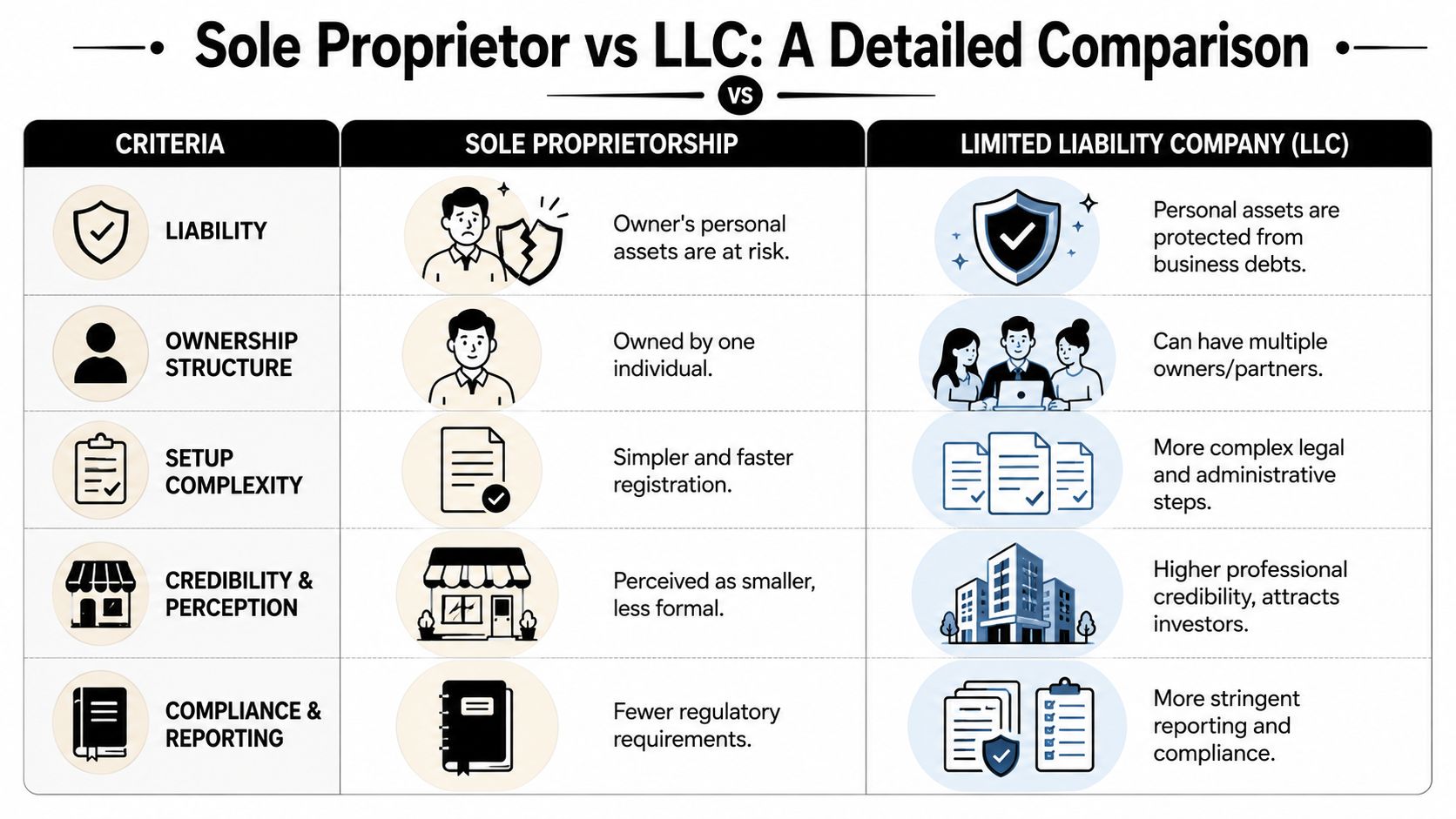
UAE Sole Proprietorship vs. LLC at a Glance
The comparison gets clearer when you look at how each structure behaves in day-to-day business.
Control and decision-making
A sole proprietorship is straightforward. One person owns it, one person decides. There's no shareholder coordination, no partner approval cycle, and no internal ownership negotiation. For a consultant or specialist practitioner, that's often ideal.
An LLC can still be simple if there is only one shareholder, but once more than one person is involved, decision-making needs clearer governance. That's not a weakness. It's often what makes the business more durable.
Trade name and market perception
Founders often overlook branding at setup stage. They shouldn't.
A sole proprietorship can work well for a personal brand, especially when the business is built around the founder's expertise. But if the plan is to build a company that operates independently of the owner's name, an LLC usually gives a cleaner commercial identity. It tends to look stronger on proposals, supplier onboarding forms, and partnership discussions.
What clients often notice first: not your legal structure itself, but whether your business looks set up to last.
Visas and staffing practicality
This is where UAE reality matters. Some founders start with a structure that suits solo work, then realise they need employee visas, additional approvals, or a broader operational footprint. At that point, changing course can be disruptive.
A sole proprietor setup can be perfectly workable for a solo operator with limited staffing needs. But if you know from the start that you'll need a small team, more formal hiring, or a larger commercial presence, an LLC often fits better.
The same logic applies to investors and co-founders. If the business will involve multiple stakeholders, it's cleaner to structure that at the start than retrofit it later.
Compliance and administration
A sole proprietorship is usually easier to run administratively. The compliance burden is lighter in many cases, and the operating model is simpler. That appeals to freelancers, advisors, and owner-operated service businesses.
An LLC brings more structure. You may need more documentation, stronger bookkeeping discipline, and in some cases extra compliance obligations depending on the jurisdiction and activity. The trade-off is that the business becomes easier to formalise, delegate, and scale.
If you're comparing structure options in more detail, this page on a UAE limited liability company is useful for the LLC side of the equation.
Mainland and free zone implications
The same structure doesn't behave identically across jurisdictions. A sole proprietor model in a free zone may suit a freelancer or independent professional very well. A mainland setup may make more sense if the business model depends on broader onshore activity or a specific local licensing pathway.
An LLC also varies by jurisdiction. A free zone LLC can be efficient for certain ownership and operational goals. A mainland LLC can be the better fit where the activity, client base, or commercial plan points in that direction.
Tax and record-keeping mindset
Founders shouldn't assume “simple structure” means “ignore systems”. Even where the structure is lighter, you still need proper invoicing, clean books, and a compliance mindset. That matters for banking, tax administration, renewals, and due diligence later.
For founders who want a plain-English explanation of wider digital tax admin changes affecting small operators, simplify 2026 tax digital changes is a useful external reference on how administrative expectations are moving in general, even outside the UAE-specific framework.
A practical scorecard looks like this:
- Choose Sole Proprietorship when the business depends mainly on your own skill, has limited operational risk, and doesn't need shared ownership.
- Choose LLC when the business will sign larger contracts, carry commercial exposure, add shareholders, or build beyond the founder.
Analyzing the Costs and Timelines
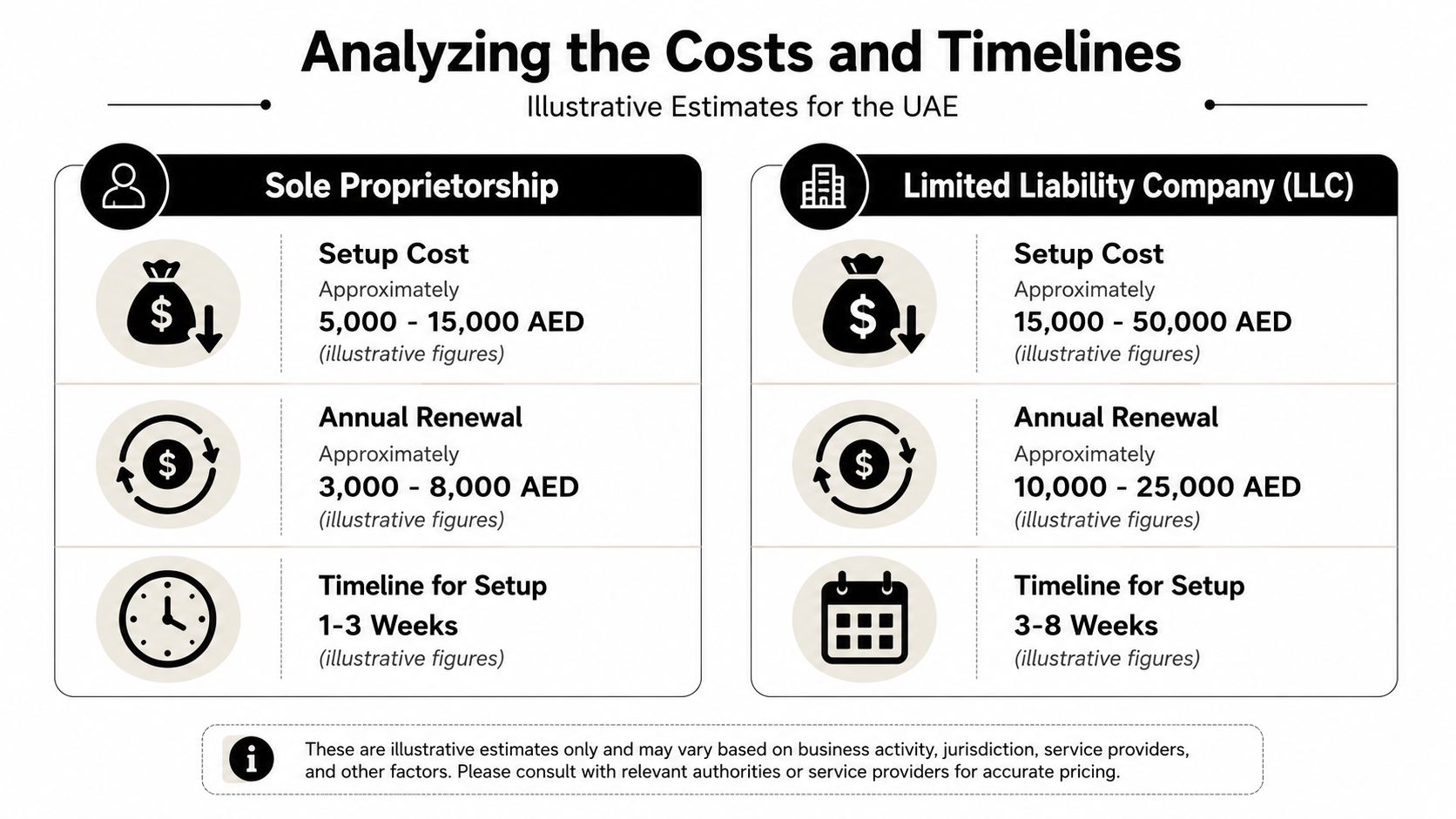
Cost is where many founders make the wrong call. They compare only the first invoice from the setup provider and ignore the structure's effect on renewals, amendments, visas, and later restructuring.
Setup cost is only the first layer
A sole proprietorship is often the leaner entry point. In many cases, the paperwork is simpler and the initial licence path is less involved. That's why solo professionals often start there.
An LLC usually costs more to establish because it involves a more formal legal and administrative structure. Depending on jurisdiction and activity, you may also face more supporting documentation, internal drafting, and broader approval steps.
The right comparison isn't “Which one is cheaper?” It's “Which one avoids the more expensive mistake later?”
Annual cost depends on what the business needs
Recurring cost can differ just as much as setup cost. Some founders assume the annual spend stays flat after formation. It rarely does.
Look at the ongoing components before deciding:
- Licence renewal. Every structure has renewal obligations, but the practical cost profile can differ by authority and activity.
- Visa-related cost. If your business will sponsor yourself, staff, or dependants, the immigration side matters.
- Professional support. Bookkeeping, tax administration, and compliance support often become necessary sooner for LLCs.
- Amendments. Adding activities, changing shareholders, or restructuring usually lands more cleanly under an LLC, but not always more cheaply.
For a broad orientation on pricing factors, this 2026 Dubai business license guide gives useful context on how licence costs are typically broken down in the market.
Timelines depend on approvals, not just forms
A sole proprietorship can often move faster because the ownership and approval chain is simpler. But that doesn't mean every sole proprietor application is automatically quick. Timelines can change based on activity classification, name approval, office requirements, and document readiness.
An LLC can take longer because there are more moving parts. If there are multiple shareholders, foreign documents, regulated activities, or coordinated visa planning, the process naturally becomes more layered.
The fastest setup is usually the one with the fewest corrections. Founders lose more time to wrong activity selection and missing documents than to the structure itself.
If budgeting is part of your current planning, this breakdown of UAE business setup cost helps frame the categories you should price before committing.
A practical way to budget is to split your plan into three buckets:
- Formation spend for licence and registration
- Operational spend for office, visas, and support
- Contingency spend for amendments and compliance fixes
That approach gives a more honest picture than looking at the licence fee alone.
Common Use Cases Who Should Choose Which Structure
The best structure becomes obvious when you place it in a real business scenario.
The UAE's small business ecosystem is broad, and SMEs contribute up to 60% of the UAE's non-oil GDP, with LLCs and Sole Proprietorships being the two most popular structures for new entrepreneurs entering the market according to the UAE government's SME and innovation overview. That popularity makes sense. Both structures have clear use cases. They just solve different problems.
The freelance digital marketer
This founder sells expertise, not stock. The business is built around personal delivery, direct client service, and a lean operating model. There are no shareholders, no inventory risks, and no immediate plan to hire a team.
A Sole Proprietorship is often the cleaner fit here if the licensed activity and jurisdiction support it. It keeps control direct and usually aligns with how the business runs.
The e-commerce retailer
This business may look small on day one, but risk appears quickly. Products are sold, payments are processed, customer complaints happen, supplier obligations build up, and fulfilment errors can turn into legal and financial problems.
For that reason, an LLC is usually the stronger choice. The business needs a structure that separates personal exposure from trading activity and gives more room for operational growth.
If money, products, and customer claims move at scale through the business, personal-risk separation stops being optional.
The foreign founders launching a tech company
Where there are co-founders, future funding conversations, equity discussions, or the possibility of onboarding specialised staff, a sole proprietor structure usually becomes too narrow too quickly.
An LLC fits better because it handles shared ownership more naturally. It also presents a stronger commercial face when the founders need contracts, software agreements, or strategic partnerships signed under a company entity rather than one person's licence.
The solo professional services practice
This founder is a specialist. Think consultant, trainer, analyst, or advisor. The business sells expertise under tight owner control and may stay intentionally small for a long time.
This is the use case where a Sole Proprietorship can work very well, provided the activity, licence authority, and immigration plan line up. If the founder later decides to add partners or broaden the operation, restructuring can be considered then.
The business with expansion on the horizon
Some founders know from the beginning that they want to open branches, hire several employees, build a brand that runs without them, or prepare for a future sale.
Those founders should usually skip the minimalist route and form an LLC early. It's easier to build on a scalable structure than to unpick a personal one after the business gains traction.
Your Decision Checklist and Expert Next Steps
The right answer usually appears once you stop asking which structure is “better” and start asking which one fits the business model honestly.
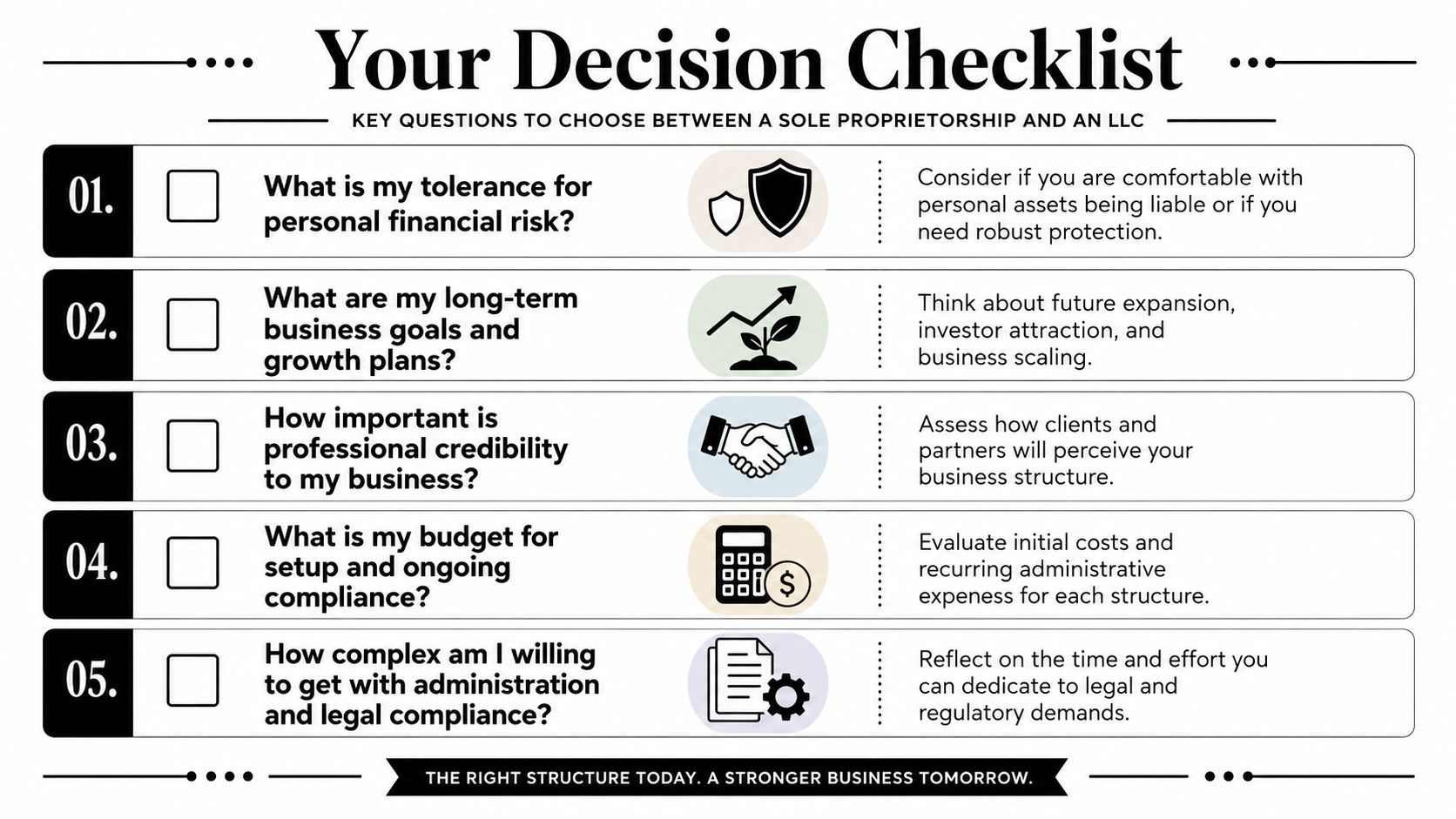
Ask these before you file anything
Run through this checklist carefully:
- How much personal risk can you accept? If a dispute, debt issue, or claim would be painful at a personal level, an LLC deserves serious weight.
- Will you stay solo? If the answer is no, or even maybe, shared ownership planning points towards an LLC.
- What does your activity involve? Personal services and independent professional work often fit sole proprietor models more naturally than broad commercial operations.
- Will you need visas beyond your own? Staffing plans often push founders towards a more structured setup.
- Do you want the business to outgrow you? If yes, build on a company structure rather than a personal one.
What usually works and what usually doesn't
What works is matching structure to reality. Solo expertise businesses often do well with a sole proprietor route when risk is contained and operations stay simple. Commercial ventures, product-led businesses, and founder teams usually do better with an LLC from the start.
What doesn't work is choosing solely on the lowest opening cost. That decision often creates expensive amendments, weak protection, or a restructuring exercise just as the business starts moving.
Decision lens: If the business depends on you personally, a Sole Proprietorship may fit. If the business needs to stand apart from you, form an LLC.
If you're unsure, the best next step isn't guessing. It's checking the proposed activity, jurisdiction, ownership plan, and visa requirements together before submission. That prevents the most common setup mistakes, especially for foreign founders balancing mainland and free zone options.
Frequently Asked Questions About UAE Business Setup
Can I start as a sole proprietor and convert later?
Yes, many founders begin with a simple structure and move to an LLC later when the business grows, risk increases, or new owners come in. The key issue isn't whether conversion is possible. It's how much operational friction the switch creates. Contracts, banking, licences, and internal records may all need updating.
Is a sole proprietorship always cheaper?
Usually it's lighter at the beginning, but “cheaper” isn't always “better value”. If the structure doesn't fit the business model, the savings disappear once amendments, restructuring, or compliance problems appear.
Can a foreigner own an LLC in the UAE?
In many cases, yes, depending on the activity and jurisdiction. Free zones often provide a straightforward route for full foreign ownership, while mainland treatment depends on the licensed activity and applicable rules.
Does an LLC automatically solve every risk issue?
No. An LLC gives stronger legal separation, but it doesn't replace proper contracts, compliant operations, clean accounting, and disciplined governance. Founders still need to run the company properly.
Which structure is better for visas?
There isn't one universal answer. It depends on the authority, licence type, business activity, and how many visas the business is expected to support. This should be checked before formation, not after.
Do both structures need proper bookkeeping?
Yes. Even if one structure is administratively simpler, both need organised records, compliant invoicing, and financial discipline.
If you want help choosing the right structure and getting it set up properly, Smart Classic Business Hub can guide you through the full process, from company formation and PRO support to visas, accounting, and ongoing compliance in the UAE.