
Growth usually exposes recruitment problems before it exposes anything else.
A UAE business can win new contracts, open another branch, launch a new function, or enter a free zone with a solid commercial plan. Then hiring slows everything down. Agencies send mixed candidate quality. Internal teams spend too much time screening CVs, coordinating interviews, and chasing approvals. HR gets pulled into operational admin when it should be focused on workforce planning and compliance.
That's where recruitment process outsourcing becomes useful. Not as a trendy label, but as a practical operating model for companies that need to hire at scale without turning recruitment into a constant bottleneck. In the UAE, that matters even more because hiring isn't just about speed or cost. It also sits inside labour law, visa processing, MOHRE expectations, and, increasingly, Emiratization obligations that many standard vendor agreements still treat far too lightly.
The Scaling Challenge Every UAE Business Faces
A familiar pattern shows up in growing UAE companies. Sales moves faster than hiring. Department heads approve expansion. Operations needs people on the ground. Finance wants predictability. HR is expected to deliver all of it with limited bandwidth.
At first, the company uses a few agencies. That seems manageable when hiring is occasional. Once volume rises, the model starts to break. One agency understands the role but misses deadlines. Another sends CVs quickly but doesn't screen properly. Internal managers repeat the same briefing calls, review the same misaligned profiles, and still don't have a stable hiring pipeline.
Where the drag starts
The complete cost isn't only the invoice from a recruiter. It's the accumulation of delays and handoffs across the business.
- Hiring managers lose productive time: They spend hours re-explaining role requirements and joining interviews that should never have been scheduled.
- HR carries fragmented workflows: Sourcing, interview scheduling, candidate follow-up, document collection, and onboarding all sit in different places.
- Growth plans slow down: New teams can't launch properly when key roles stay open or are filled inconsistently.
- Compliance pressure increases: The larger the workforce, the harder it becomes to manage hiring cleanly without a defined process tied to the local labour environment.
Many owners and operators discover that recruitment is no longer an HR task. It has become an operational constraint.
For companies trying to expand in a competitive hiring market, understanding the Dubai labour market environment helps explain why ad hoc hiring often fails. Demand shifts quickly across sectors, and companies that rely on a purely reactive approach usually feel that pressure first in time-to-hire and candidate quality.
Recruitment problems rarely look strategic at the start. They look like late shortlists, interview no-shows, and overloaded HR teams. The strategy issue appears later, when growth plans slip.
Why traditional fixes stop working
The usual fixes don't hold for long. Hiring another internal recruiter adds headcount but doesn't automatically add process. Using more agencies increases noise. Asking line managers to “be more involved” typically creates more inconsistency, not more control.
Recruitment process outsourcing enters the conversation at exactly this point. It gives the business a structured hiring function without forcing it to build everything internally from scratch.
What Is Recruitment Process Outsourcing Exactly
Recruitment process outsourcing is best understood as an outsourced recruitment function, not an outsourced vacancy. That distinction matters.
A traditional recruiter works role by role. An RPO partner works process by process. Instead of waiting for a vacancy and charging a transactional fee, the provider operates as an embedded extension of the company's hiring team. It can manage sourcing, screening, interview coordination, offer support, reporting, and onboarding workflows depending on the scope agreed.
Think of it like outsourced IT, not a CV supplier
Most business leaders already understand the logic of outsourcing parts of finance, payroll, or IT support. They don't do it because those functions are unimportant. They do it because execution matters, specialist systems matter, and consistency matters.
Recruitment process outsourcing follows the same logic. The provider doesn't just send talent. It helps design and run the hiring engine.
That often includes practical elements such as:
- Workforce planning support: translating hiring demand into recruiter capacity and hiring priorities
- Employer brand alignment: presenting roles and outreach in a way that reflects the client's business accurately
- Workflow ownership: taking responsibility for defined parts of the recruitment lifecycle
- Performance reporting: tracking service delivery against agreed recruitment outcomes
How it differs from an agency
The cleanest way to explain the difference is this.
| Model | Main focus | Typical relationship | Accountability |
|---|---|---|---|
| Traditional agency | Filling specific vacancies | External supplier | Usually tied to placements |
| Recruitment process outsourcing | Running all or part of recruitment operations | Embedded partner | Tied to process performance and delivery |
With an agency, the client still owns most of the hiring system. With an RPO arrangement, the provider helps operate that system.
That doesn't mean RPO replaces every external hiring option. Some companies still use specialist search firms for rare executive or niche technical roles. In other cases, firms combine RPO with expert staff augmentation partners when they need short-term delivery capacity in a specific function. The key is to know which model solves an operating issue and which one only fills a temporary gap.
Practical rule: If your problem is repeated hiring friction across multiple roles or business units, you probably need process ownership, not more agency CV flow.
What clients often misunderstand
The most common misconception is loss of control. A well-built RPO engagement doesn't remove control from the client. It formalises it. The company still sets hiring criteria, approves offers, and defines talent priorities. The provider executes within that framework.
The second misconception is that RPO only suits very large enterprises. In practice, any UAE business with recurring hiring demand, uneven recruitment performance, or expansion pressure can benefit from a model that adds structure, visibility, and accountability.
Decoding RPO Models and Pricing Structures
Not every business needs the same outsourcing model. The right structure depends on hiring volume, urgency, internal HR maturity, and how much of the recruitment process the company wants to keep in-house.
The three models most UAE companies consider
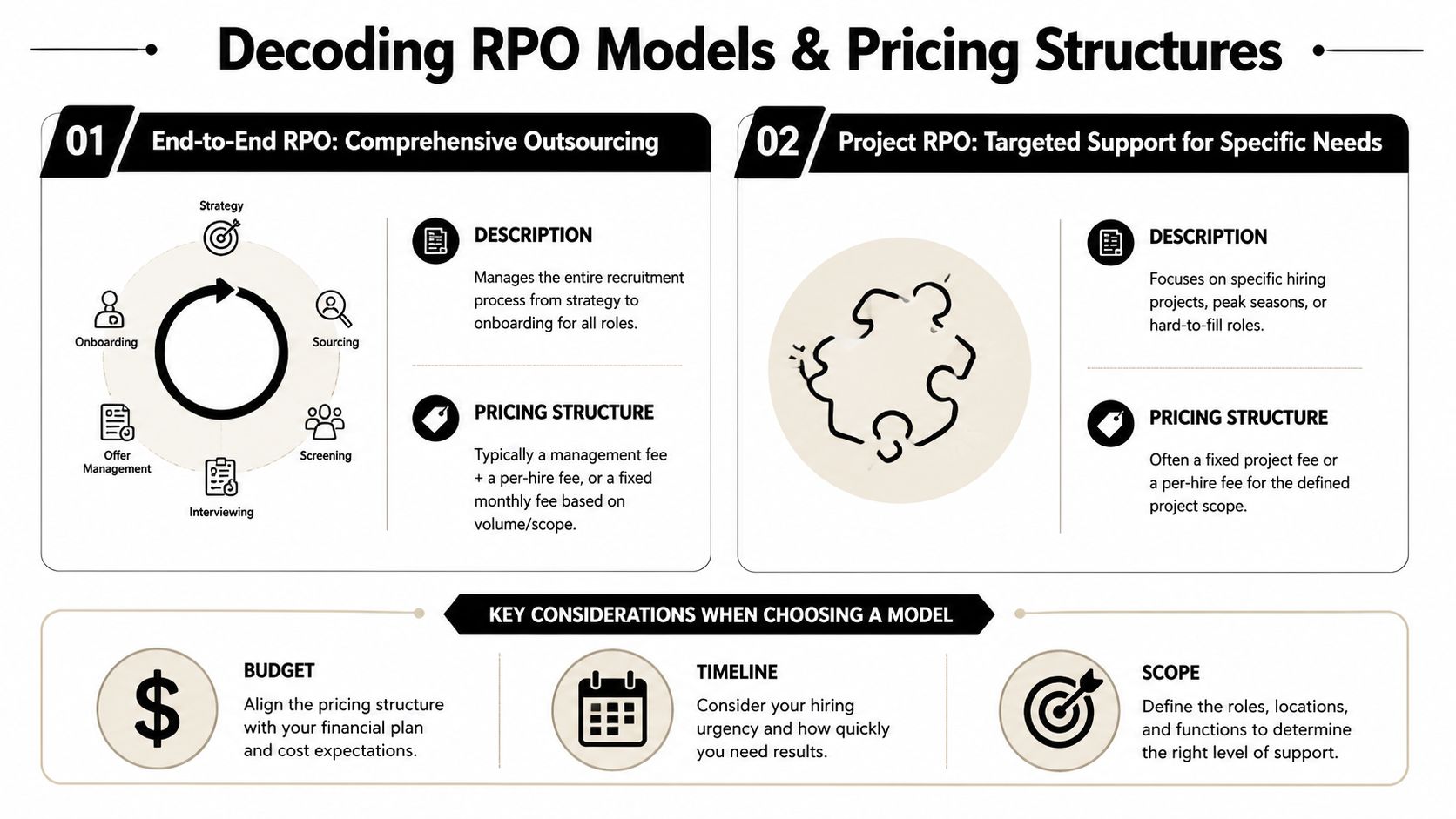
End-to-end RPO suits businesses that want a partner to manage the full recruitment lifecycle. This model works well when hiring is continuous across multiple departments and leadership wants one operating framework instead of several disconnected vendors.
Project RPO fits a defined hiring event. A new branch opening, a rapid team build-out, or a fixed recruitment campaign are typical examples. The scope is narrower, but the delivery expectation is still structured and deadline-driven.
On-demand RPO is the flexible option. It's useful when a company has an internal HR team but needs external recruitment capacity for a period of time. This model is common when demand spikes or when specialist recruiter support is needed without a permanent overhead increase.
How pricing usually works
Pricing reflects both scope and accountability. In practical terms, clients usually see one of three approaches.
| RPO model | Common pricing logic | Best fit |
|---|---|---|
| End-to-end | Management fee, per-hire fee, or fixed monthly structure | Ongoing multi-role hiring |
| Project | Fixed project fee or defined per-hire arrangement | Time-bound recruitment campaigns |
| On-demand | Monthly support fee tied to recruiter capacity or limited scope | Flexible short-term support |
For UAE volume hiring, the commercial case is stronger than many companies assume. In the UAE, recruitment process outsourcing delivers a 40 to 60% lower cost-per-hire than traditional agency recruitment for volume hiring, and pricing typically ranges between AED 3,000 and AED 8,000 per placement depending on role level and volume, according to RFS HR's UAE RPO analysis.
That matters most when the business is hiring repeatedly, not occasionally. A single expensive hire is painful. A repeated expensive process becomes a planning problem.
What works and what doesn't
What works is matching the model to the business reality.
- Stable growth plans: End-to-end RPO usually performs better because the provider can build repeatable workflows and talent pipelines.
- Short hiring surges: Project RPO is often cleaner because both parties can define the objective tightly.
- Mixed internal capability: On-demand support helps when an internal team exists but can't absorb current volume.
What doesn't work is buying the cheapest model without checking process ownership. Low headline pricing often hides weak screening, poor hiring manager communication, or limited reporting. That's where technology evaluation also matters. If you're comparing systems alongside provider capability, reviewing HR tech solutions pricing can help frame what should sit inside the delivery model versus what you may need to procure separately.
Companies should also look at recruitment cost in the context of wider workforce setup. Visa and onboarding costs affect total hiring economics, so it helps to understand the broader UAE employment visa cost landscape before finalising the commercial model.
The Strategic Business Case for RPO in the UAE
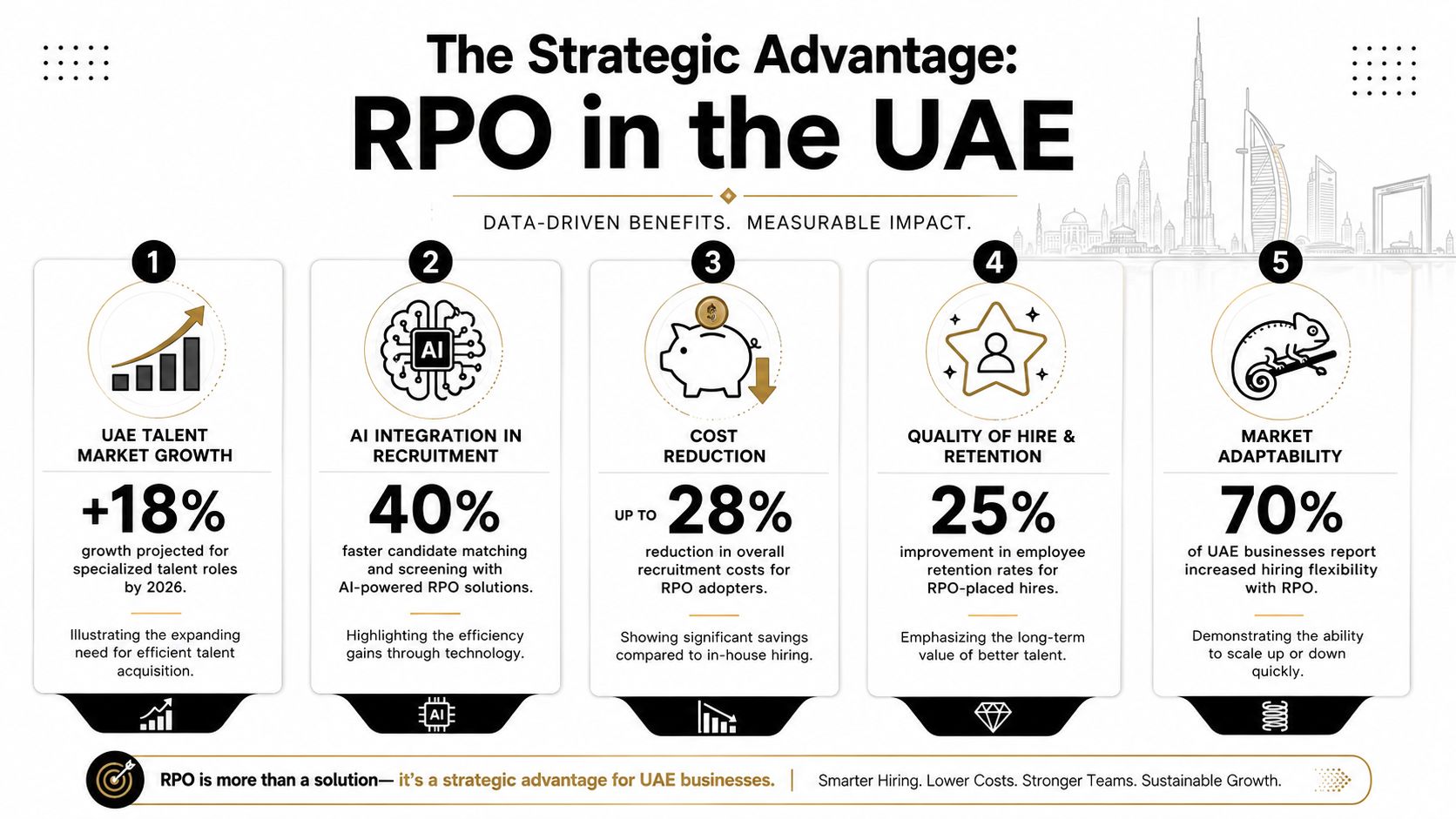
A lot of companies first look at recruitment process outsourcing because hiring feels expensive. The stronger reason is that unmanaged recruitment creates operational drag. RPO becomes strategic when the business needs hiring to be repeatable, measurable, and scalable.
Why the model is gaining ground
The market signal is clear. The global RPO market was valued at USD 7.33 billion in 2022 and is projected to reach USD 24.32 billion by 2030, growing at a 16.1% CAGR from 2023 to 2030, according to Grand View Research's RPO market analysis. That projection matters because it reflects a wider shift in how businesses treat recruitment. More companies are moving away from a reactive, vacancy-by-vacancy model and towards a managed talent acquisition function.
In the AE region, RPO providers are also using AI-driven sourcing and workforce analytics to reduce hiring cycles by an average of 58% while increasing hiring consistency by 51%, as noted in the verified data set. For a UAE company that has to scale across changing workforce requirements, that kind of operational consistency is often more important than any single placement fee.
The practical business outcomes
A strong RPO setup changes how hiring behaves inside the business.
- It shortens decision cycles: Recruiters work from a defined process instead of rebuilding the search every time.
- It improves visibility: Leaders can see open roles, bottlenecks, pipeline quality, and recruiter throughput more clearly.
- It supports scaling: Capacity can expand with hiring demand instead of forcing the client to hire a full internal talent team immediately.
- It creates measurable accountability: Delivery is judged against service levels, not vague promises.
A company doesn't outsource recruitment because hiring is unimportant. It outsources because poor hiring execution affects revenue plans, operational readiness, and compliance at the same time.
The control question
Some management teams hesitate because they think an external provider will weaken hiring governance. In practice, weak governance usually exists before the outsourcing decision. The business has fragmented approvals, inconsistent role briefs, and little agreement on what “good” looks like.
A serious RPO partnership fixes that by forcing clarity. Who approves headcount. Who signs off job descriptions. How quickly hiring managers respond. What counts as a qualified shortlist. How compliance checks sit inside the workflow. Those are governance decisions, not vendor decisions.
The UAE context makes that even more important. Companies often need recruitment to connect properly with onboarding documents, labour requirements, visa timelines, and workforce planning. An RPO model that only focuses on sourcing won't solve that. An RPO model tied to operating discipline can.
Your Step-by-Step RPO Implementation Roadmap
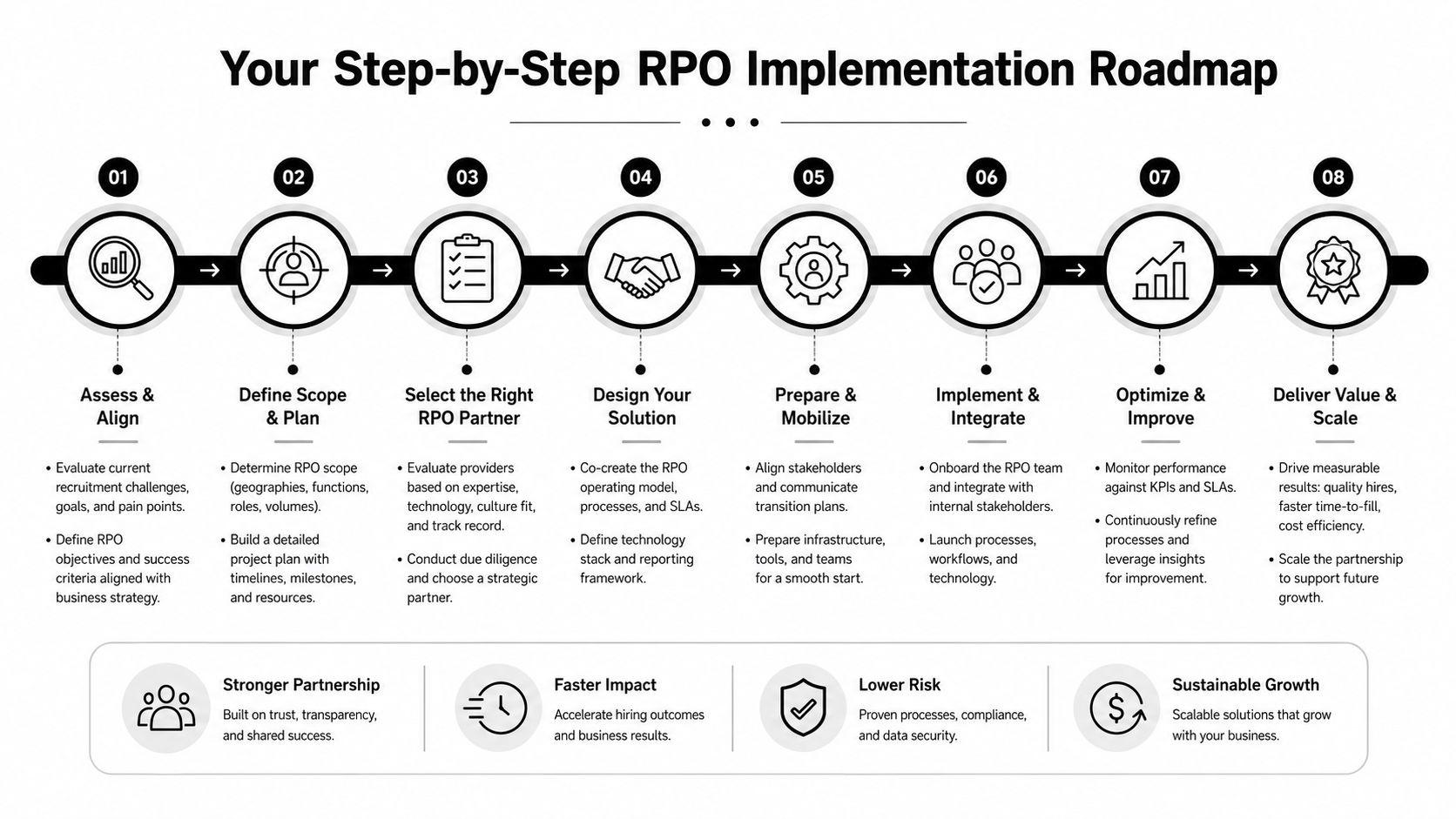
Most RPO failures don't come from the concept. They come from rushed implementation. The company signs an agreement before it has defined scope, internal ownership, or success criteria. Then both sides spend the first months correcting avoidable confusion.
Start with internal diagnosis
Before speaking to vendors, get clear on the current hiring reality.
Ask practical questions. Where do roles stall. Which departments generate the most urgency. How many people are involved in approvals. Which parts of hiring are broken because of capacity, and which are broken because the process itself is poor.
A short internal review usually reveals patterns such as duplicated effort, weak intake meetings, inconsistent screening criteria, or no reliable reporting.
Build the engagement in phases
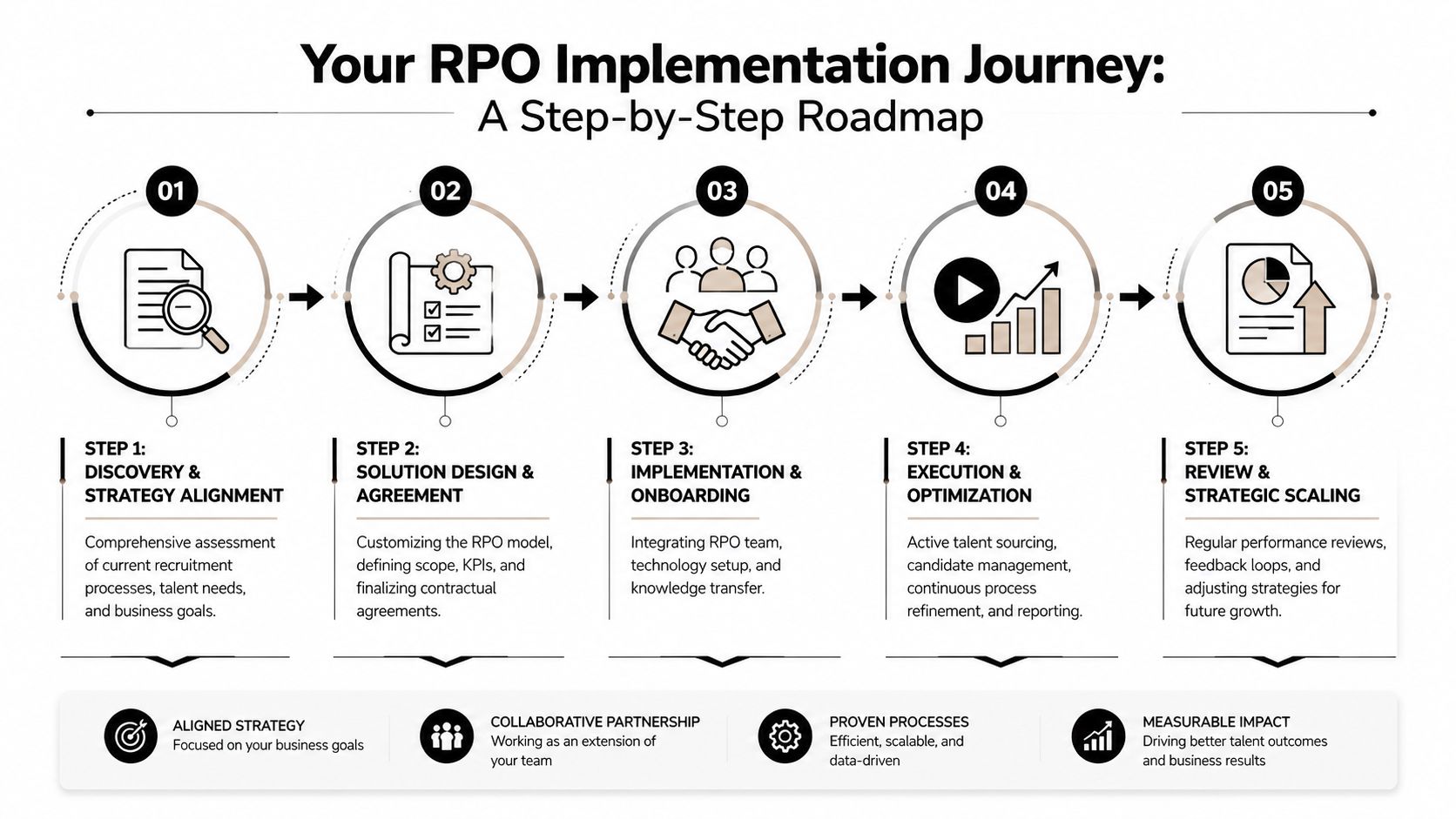
A workable implementation path usually follows this sequence:
Define the scope
Decide whether you need end-to-end ownership, project support, or on-demand recruiter capacity. Don't outsource everything by default.Set business outcomes
The contract should reflect the actual problem. Faster hiring, better process discipline, stronger reporting, localisation support, or a mix of these.Map current workflows
Document the handoffs between HR, hiring managers, approvers, and onboarding teams. If the process is invisible, the provider can't improve it.Run a proper vendor assessment
Test how each provider handles intake, screening, escalation, compliance coordination, and reporting. Don't rely on slide decks.Agree implementation responsibilities
Decide who owns system access, recruiter onboarding, hiring manager training, and escalation paths from day one.
Protect the transition period
The handover phase matters more than many clients expect. A provider can only represent your business well if role requirements, brand positioning, approval routes, and internal expectations are clearly documented.
Use a live transition tracker. Keep weekly review meetings tight. Resolve bottlenecks early. If a hiring manager ignores SLAs or changes the brief mid-search, log it and fix it immediately.
Operational advice: Treat the first phase of an RPO launch like a business change project, not a procurement event.
Don't try to optimise too early
Some clients want dashboards, automation, and process redesign before the basics are stable. That usually creates noise. First make sure job intake is consistent, recruiter ownership is clear, and candidate communication is professional. Then improve technology layers, analytics, and workflow refinements.
A calm, staged rollout beats a flashy launch every time.
Choosing Your Partner UAE Compliance and Vendor Selection
Most RPO selection checklists are too generic for the UAE. They focus on recruitment delivery but underweight local compliance risk. That's a mistake.
A provider can be excellent at sourcing and still be the wrong choice if it doesn't understand the local employment framework, document flow, labour expectations, and Emiratization obligations attached to your workforce plan.
The Emiratization gap most contracts miss
This is the issue many standard RPO agreements still fail to address properly. A 2024 ManpowerGroup UAE report indicates that 68% of SMEs in the UAE struggle with RPO providers who lack the specific localisation sourcing channels required to hit the mandatory 2% annual Emiratization growth targets. The same report notes potential monthly penalties of AED 5,000 to AED 15,000 per employee where targets are missed, as outlined in ManpowerGroup UAE's discussion of RPO and localisation risk.
That changes the conversation completely. Emiratization cannot sit as a soft objective in the background. If your business falls within the relevant category, localisation needs to be built directly into the service model and the SLA.
What to test before you sign
Use vendor selection to pressure-test operational depth, not just sales confidence.
- Localisation sourcing capability: Ask where Emirati candidate pipelines come from and how the provider validates channel effectiveness.
- Compliance literacy: Test whether the team understands how recruitment interacts with labour requirements, offer documentation, and onboarding obligations.
- Escalation discipline: Ask for examples of how they handle missed approvals, candidate drop-off, and business-side delays.
- Reporting quality: You need actionable reporting, not decorative dashboards.
- Hiring manager integration: Good providers train the client side as well. Poor providers only talk about their own process.
A practical due diligence process should also include screening standards. If you're refining your own approach to safer candidate evaluation, this guide for effective hiring is a useful reference for structuring pre-employment checks more carefully.
Build localisation into the SLA
If Emiratization matters to your business, put it in writing in a way that can be measured and managed.
That usually means defining:
| SLA area | What to include |
|---|---|
| Localisation scope | Which roles or functions fall under Emiratization efforts |
| Candidate pipeline expectations | How Emirati sourcing activity is tracked and reviewed |
| Escalation routes | What happens if localisation shortlists are not materialising |
| Reporting cadence | How frequently localisation progress is reviewed |
| Shared responsibilities | What the provider owns and what the client must do internally |
The compliance side also needs visibility. Businesses should keep access to official labour information and verification channels rather than relying only on vendor interpretation. For that reason, many clients benefit from reviewing MOHRE-related inquiry pathways alongside their vendor selection process.
If an RPO proposal mentions compliance generally but says nothing precise about Emiratization, treat that as a gap, not a minor omission.
Measuring Success A Framework for RPO KPIs
An RPO relationship should never be judged on volume of CVs sent. That's activity, not performance. Success has to be measured against business outcomes and process discipline.
The KPIs that matter most
Time-to-fill shows how long it takes to close a role from approved requisition to accepted offer. It matters because open positions affect delivery capacity, team workload, and expansion timelines.
Cost-per-hire helps evaluate efficiency. Through its use, many businesses determine whether the model is improving spend or only shifting costs into a different format.
Candidate quality needs a clear internal definition. In practice, this often comes down to shortlist relevance, interview conversion, and early performance feedback from hiring managers.
Offer acceptance rate highlights whether the process is attracting and managing the right candidates. Repeated offer rejections usually indicate a market alignment problem, a communication problem, or both.
How to make the KPI set usable
Don't overload the contract with metrics nobody reviews. A smaller scorecard that leadership discusses is more valuable than a long report ignored after month one.
Use a simple framework:
- Speed metrics: time-to-fill, stage turnaround times, approval delays
- Efficiency metrics: cost-per-hire, recruiter workload, source effectiveness
- Quality metrics: shortlisted candidate fit, interview-to-offer ratio, early new-hire feedback
- Compliance metrics: document completeness, localisation progress where applicable, onboarding readiness
Read the data in context
Metrics can mislead when they're isolated. Fast hiring isn't a success if the shortlist quality is poor. Low cost-per-hire isn't a win if managers reject most candidates. High candidate volume says very little if interview conversion remains weak.
Review KPIs together, not separately. Recruitment performance is a system. One strong metric can hide two weak ones.
The best KPI reviews sound operational, not ceremonial. What slowed approvals this month. Which roles need a different sourcing approach. Where did candidates drop out. Which hiring managers are creating delays. That's where an RPO partnership becomes useful: not in producing reports, but in helping management act on them.
From Outsourcing Tasks to Building Your Future
Recruitment process outsourcing works when a company stops treating hiring as a series of isolated vacancies and starts treating it as an operating function. That shift is especially important in the UAE, where scaling brings together recruitment pressure, workforce planning, onboarding complexity, and compliance obligations.
The strongest RPO engagements don't just reduce admin. They create structure around how the business hires, who owns which decisions, how performance is measured, and how risk is controlled. That's why the Emiratization issue matters so much. A contract that ignores localisation may still fill roles, but it can still leave the client exposed.
For UAE businesses, the practical question isn't whether to outsource for the sake of outsourcing. It's whether the current hiring model can support growth without driving up cost, delay, and compliance risk. If the answer is no, recruitment process outsourcing deserves serious consideration.
The difference between a weak and strong outcome usually comes down to three things. Fit the model to the actual hiring need. Choose a provider with local operational depth, not just recruitment language. Build SLAs that reflect business risk, especially around localisation and labour compliance.
Do that well, and recruitment stops being a recurring bottleneck. It becomes part of the infrastructure that supports growth.
If you're setting up or expanding in the UAE and need support that goes beyond recruitment alone, Smart Classic Business Hub can help you align hiring, company formation, PRO support, and ongoing compliance so your growth plan works operationally as well as commercially.