
You've registered in the DIFC, issued a few offer letters, and hired your first team. Then the practical questions start. Which law applies. Can you use your mainland template. What counts as basic wage. How much notice do you need to give. What happens if an employee resigns and claims your conduct forced them out.
Those are the right questions to ask early. DIFC employment law is its own regime, and the mistakes are usually not dramatic at first. They show up later in payroll, contract disputes, gratuity calculations, and termination claims. For SMEs, that's where costs rise quickly.
A lot of online summaries stop at broad statements. That isn't enough if you're employing people in the DIFC. You need to know which rules create day-to-day operational risk, where the grey areas sit, and what habits reduce exposure before a problem reaches HR, legal, or the DIFC Courts.
The Legal Framework of DIFC Employment
A common early mistake looks harmless. A company opens in the DIFC, issues an offer letter based on a mainland template, sets salary with a heavy allowance split, and lets managers handle hours informally. The problem usually appears later, during a resignation, a payroll query, or a termination dispute, when the documents do not match DIFC rules.
The starting point is DIFC Law No. 2 of 2019, in force from 30 August 2019, as amended. It applies to employers with a place of business in the DIFC and to employees engaged under DIFC law. For SMEs, the point is practical. DIFC employment needs its own contract set, payroll logic, and HR process from the start.
Some rules catch employers out because they affect daily operations, not just legal drafting. Pay structure is one example. The split between basic wage and allowances matters because it affects later calculations and can create disputes if salary is designed carelessly. Working time is another. If managers run overtime, rest, and scheduling informally, compliance risk accumulates in attendance records, payroll approvals, and employee complaints.
If you are still deciding how the DIFC fits within your wider setup, this guide to free zones in the UAE gives useful background on why the DIFC should be treated as a separate operating environment.
The same applies to hiring documents. Offer letters often create the first inconsistency, especially where the commercial team wants speed and HR copies a form used elsewhere. A simple cross-check against your DIFC contract pack prevents expensive corrections later. For practical drafting support, many employers start with SheetMergy for offer letters, then adapt the wording to fit DIFC requirements rather than using it unedited.
Where SMEs usually get exposed
Founders and lean HR teams rarely get into trouble because they ignored the law completely. The usual issue is partial compliance. The contract looks acceptable, but the wage structure is wrong. The handbook exists, but grievance handling is vague. A resignation is treated as straightforward, but the employee argues they were pushed out by the employer's conduct. That is where grey areas such as constructive dismissal start to matter.
The DIFC framework is workable if the business is disciplined. Keep terms consistent across offer letters, contracts, payroll records, policy documents, and manager communications. That reduces the risk of disputes and puts the company in a much stronger position if an employee later challenges how they were treated.
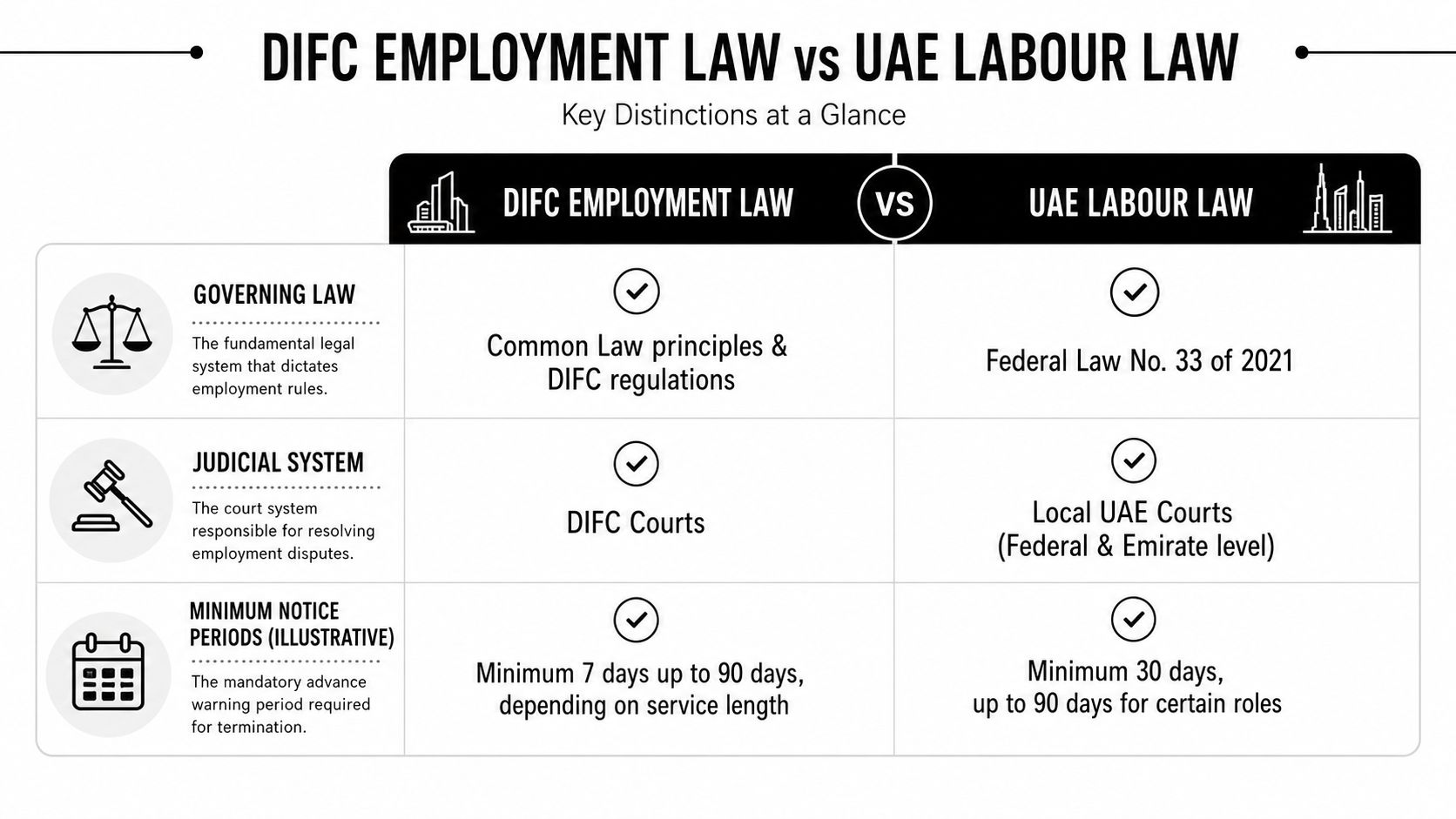
DIFC Employment Law vs UAE Labour Law Key Distinctions
A common failure point looks like this. An SME hires staff on the mainland, opens in the DIFC, then reuses the same contract set, disciplinary wording, and manager practices across both populations. The mistake usually stays hidden until a resignation, complaint, or termination puts the documents under pressure.
The legal system changes the risk profile
DIFC employment law does not operate as a light variation of mainland UAE labour rules. It sits within a separate framework, and that has practical consequences for contracts, internal investigations, grievance handling, and termination records. A template that feels acceptable in a wider UAE business can create avoidable exposure inside the DIFC because the drafting logic, statutory rights, and dispute route are different.
That distinction matters most for SMEs with lean HR support. The issue is rarely complete non-compliance. It is mixed compliance. One set of documents follows DIFC standards, another reflects mainland practice, and manager communications create a third version of the employment relationship.
For businesses that also manage mainland employee administration, tools such as Ministry of Labour inquiry services still have value in the wider UAE context. They do not answer DIFC-specific questions on contract structure, notice handling, or employee claims.
Notice rules affect cost, timing, and restructuring plans
Under DIFC law, statutory notice is linked to length of service. Employees with less than three months of service are entitled to 7 days' notice. Employees with service from three months to under five years are entitled to 30 days. Employees with five years or more are entitled to 90 days.
This is not just a legal drafting point. It affects headcount planning, settlement strategy, and cash flow. I often see founders budget for salary, visa costs, and recruitment fees, then underestimate the cost of exiting a role quickly when the business needs to restructure.
The same issue carries into pay design. If an employer is building a total rewards strategy, DIFC notice obligations should be considered alongside fixed pay, variable pay, and contractual benefits. Otherwise, the package looks efficient on hire and expensive on exit.
Anti-discrimination duties require manager control, not just policy wording
DIFC employers also need to take discrimination risk more seriously than many SMEs initially expect. The law expressly prohibits discrimination on protected grounds, and the operational mistake is usually informal behaviour rather than formal policy language. Interview notes, promotion discussions, side comments about maternity, age, nationality, disability, religion, or family status, and inconsistent responses to complaints all create evidence problems.
Constructive dismissal risk often develops in the same environment. An employee may resign, but argue that discriminatory treatment, exclusion, or a sustained failure to address complaints left no real choice. That is one of the grey areas generic summaries tend to skip, but it is exactly where small businesses get pulled into costly disputes.
A short comparison helps clarify where employers go wrong:
| Area | DIFC position | What employers should do |
|---|---|---|
| Legal framework | Separate DIFC system | Use DIFC-specific contracts, policies, and records |
| Notice | Statutory notice tied to service length | Price exit costs before restructuring or dismissal |
| Discrimination | Express statutory protections | Train line managers and document decisions carefully |
| Disputes | Written record carries significant weight | Keep emails, warnings, grievance notes, and payroll terms aligned |
The practical rule is simple. Separate your DIFC employment model from your mainland one. Separate templates, separate manager guidance, and separate compliance checks usually cost far less than defending a dispute built on inconsistent paperwork and avoidable assumptions.
As discussed by Littleton Chambers on the DIFC Employment Law changes, employers face clear obligations around discrimination and other employee protections. The safer approach is to treat DIFC compliance as an operating system, not a document exercise.
Crafting Compliant DIFC Employment Contracts
A common SME failure looks like this. The founder agrees salary and start date over email, HR pulls a mainland template from an old hire, and the manager changes the employee's duties within the first month. Nothing feels urgent until a pay dispute or resignation forces the business to defend terms that were never drafted for the DIFC in the first place.
In the DIFC, the contract is not routine paperwork. It is the first compliance record a tribunal will read when pay, duties, notice, benefits, or termination terms are challenged. Employers must issue a written contract in English shortly after commencement. Leaving details to policy documents, side emails, or verbal explanations creates avoidable risk.
The drafting standard should be practical. The contract needs to match how the business hires, pays, manages, and exits staff.
Clauses that need precision
Broad wording rarely protects an employer for long. Clear wording usually does.
- Role and scope: Define the function with enough detail to show what the employee was hired to do, who they report to, and how far the business can reasonably vary duties.
- Pay structure: Set out salary, allowances, variable pay, payment timing, and any conditions attached to incentives. Ambiguity here often turns into disputes over unpaid sums or end-of-service calculations.
- Working pattern: Record the actual arrangement, including location, flexibility expectations, and whether the role involves irregular hours. If managers operate outside the written model, the contract will not save the business later.
- Probation and notice: Use wording that fits the employee's status and planned management process. Poor notice drafting often becomes expensive during restructures, performance exits, and senior departures.
- Policies: Refer to policies carefully and keep them consistent with the contract. If the handbook says one thing and the contract says another, the employer usually ends up arguing against its own documents.
One point deserves extra care. The split between basic wage and allowances should be deliberate, not cosmetic. If payroll is structured aggressively, the business may create compliance problems and distort later termination payments. I usually tell clients to test the pay model before the contract is issued, not after the employee has started and payroll is already live.
Where SMEs get caught
The usual mistake is speed. A business wants to hire quickly, so it recycles an old template and promises itself it will clean up the wording later. Later rarely comes.
The harder issue is inconsistency across documents. Offer letter, contract, payroll setup, visa paperwork, and handbook terms should describe the same employment deal. If they do not, the employee can point to whichever version helps their claim most. That becomes especially risky in grey areas, including resignation disputes framed around unilateral role changes, reduced pay, or conduct that may be argued as constructive dismissal.
A safer workflow is simple. Finalise compensation first. Confirm reporting lines and actual working arrangements with the line manager. Issue the offer and contract from aligned templates. Then check that payroll and policy documents match the signed terms.
If your team needs a cleaner starting point for pre-contract documents, this guide to SheetMergy for offer letters is a useful reference because it helps standardise the offer stage before the full contract is issued.
Good DIFC contracts do not try to say everything. They record the points that matter, in wording the business can follow in practice. That is what reduces disputes and gives an SME a defensible position if a disagreement reaches the formal stage.
Managing Working Hours Leave and Benefits
A common DIFC problem starts on an ordinary Thursday. A small team stays late to finish client work, someone answers messages again after dinner, payroll processes salary as usual, and no one records the extra hours or checks whether rest periods were protected. Nothing looks serious that day. The risk appears later, when an employee challenges leave, pay, or working patterns and the company has no clear record of what happened.
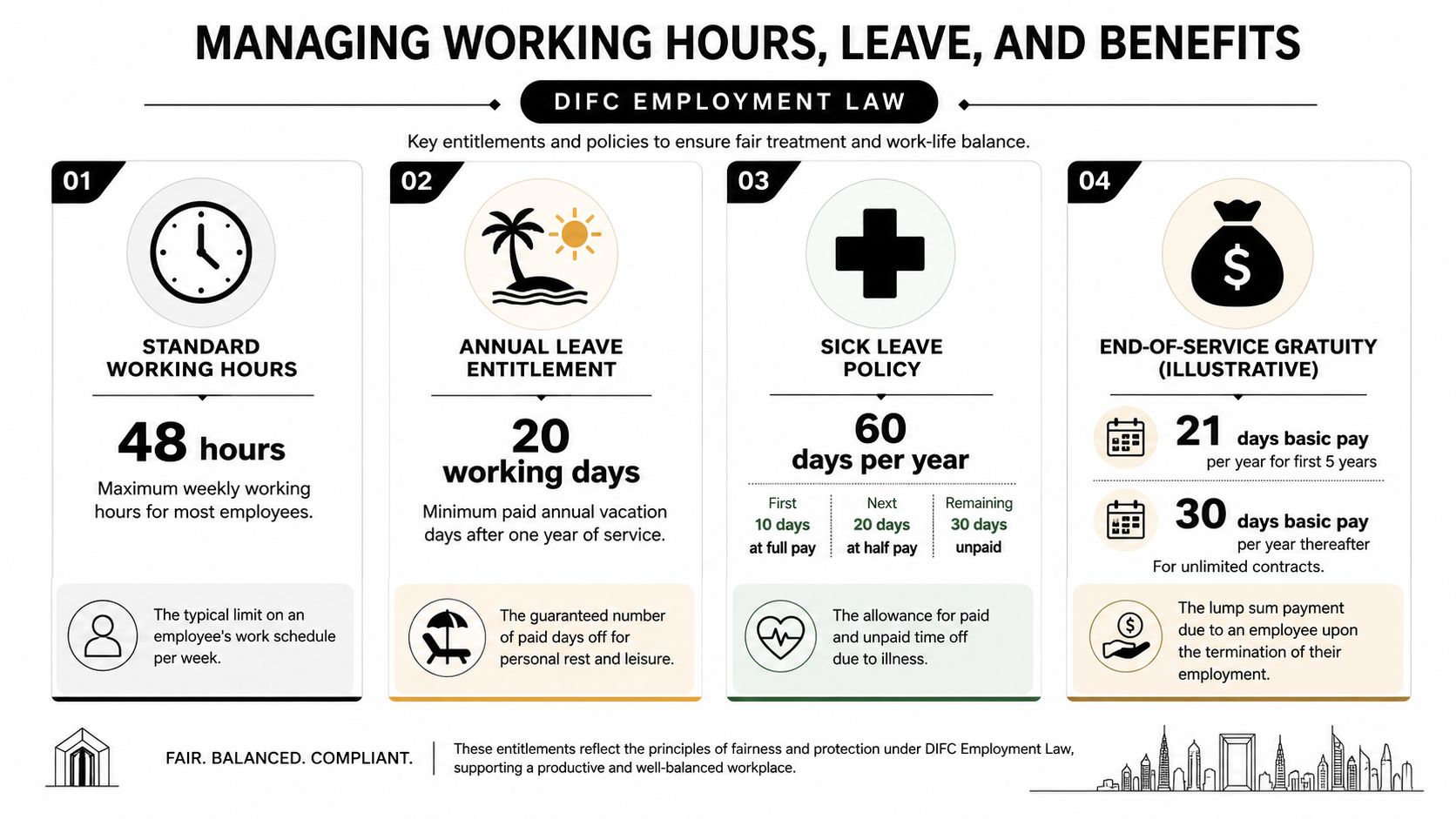
Working time rules need day-to-day control. The DIFC framework limits average weekly working hours, requires daily rest, and also requires a weekly rest period. Employees working longer days are also entitled to breaks. For SMEs, the practical issue is not usually the written rule. It is the gap between the written rule and how line managers schedule work.
Where SMEs lose control
Flexible working can be lawful. Unmonitored working patterns create the problem.
A lean business often relies on goodwill. Staff stay online for a product launch, cover client calls across time zones, or work through weekends during a busy month. If that becomes routine, the company needs records, manager oversight, and a clear rule on time off and rest. Without that, it is hard to defend the position that hours were reasonable and properly managed.
This also affects disputes that are not obviously about working time. Repeated excessive hours, ignored leave requests, or inconsistent treatment between employees can feed broader complaints about conduct and fairness. In a smaller business, those facts often sit behind later arguments that management acted unreasonably.
Leave and benefits need clean definitions
Leave administration goes wrong when payroll, contracts, and policy documents use different definitions of salary. Annual leave pay, sick leave handling, and end-of-service exposure all depend on how the package is structured and recorded.
For DIFC employers, the point to watch is Basic Wage. If allowances, commissions, or other payments are treated casually in the contract or payroll system, finance may calculate liabilities one way while HR explains them another way. That mismatch is avoidable, but only if the pay structure is defined clearly from the start and applied consistently.
The same discipline matters when reviewing benefits more broadly. Employers adjusting salary mix, incentives, or non-cash benefits should connect compliance with cost control, not treat them as separate exercises. Teams reviewing reward design often benefit from guidance on building a total rewards strategy, especially if they want packages that are competitive without creating avoidable admin and termination risk.
Practical controls that prevent expensive mistakes
Use a short operating checklist:
- Track actual working patterns. Stated office hours are not enough if teams regularly work outside them.
- Train line managers on rest periods and break rules. Many breaches start with casual scheduling decisions, not deliberate policy choices.
- Keep leave records current. Manual spreadsheets are where entitlement disputes often begin.
- Align payroll with contractual pay definitions. If Basic Wage is the legal reference point, payroll needs to reflect that cleanly.
- Test your leave calculations. If your team uses broader UAE payroll references, this guide on how to calculate leave salary in the UAE is a useful operational cross-check, but DIFC treatment still needs its own review.
Well-run SMEs do not rely on memory or manager discretion here. They document hours, approve leave in a consistent way, and make sure payroll treatment matches the employment terms. That is what reduces day-to-day friction and gives the business a much stronger position if an employee later disputes pay, leave, or working conditions.
Navigating Termination and End-of-Service Obligations
Termination is where weak HR systems become expensive. A business can operate informally for months, then one exit exposes every gap at once. In the DIFC, employers need a clean process, reliable records, and disciplined communication.
The area that deserves special caution for SMEs is constructive dismissal. Under the DIFC framework, an employee can claim up to one year's wage if they terminate because of the employer's unreasonable conduct. A discrimination remedy is also capped at one year's wages, based on the cited discussion of the DIFC law.
Constructive dismissal is where SMEs underestimate risk
This is the point many generic guides gloss over. They mention the remedy cap, but they don't explain the practical problem. The legal threshold turns on reasonableness, employer conduct, and evidence. For smaller businesses, that's difficult because management decisions are often informal.
A manager delays salary, changes duties abruptly, excludes an employee from key work, or ignores repeated complaints about conditions. The company may think it's handling a performance or budget issue. The employee may frame the same conduct as the employer making continued employment untenable.
A background analysis highlighted in the research notes that this area remains difficult because the test is highly fact-sensitive and there isn't a simple standard checklist that guarantees safety. That's exactly why SMEs need process, not just good intentions.
What helps in real disputes
When employers defend terminations well, they usually have three things:
- A documented reason tied to role, conduct, or business need.
- A paper trail showing the issue was handled consistently.
- A respectful process without retaliation, humiliation, or sudden contradictory decisions.
What weakens a case is usually the opposite. Verbal warnings with no notes. Salary issues dismissed casually. A resignation accepted immediately after a heated exchange. No investigation record. No formal response to a grievance.
If an employee resigns after a pattern of ignored complaints, the employer shouldn't assume it's a clean voluntary exit.
End-of-service calculations need finance and HR to agree
Even where the exit itself is lawful, final dues create another pressure point. If gratuity, unpaid salary, or accrued entitlements are calculated inconsistently, the dispute can widen quickly.
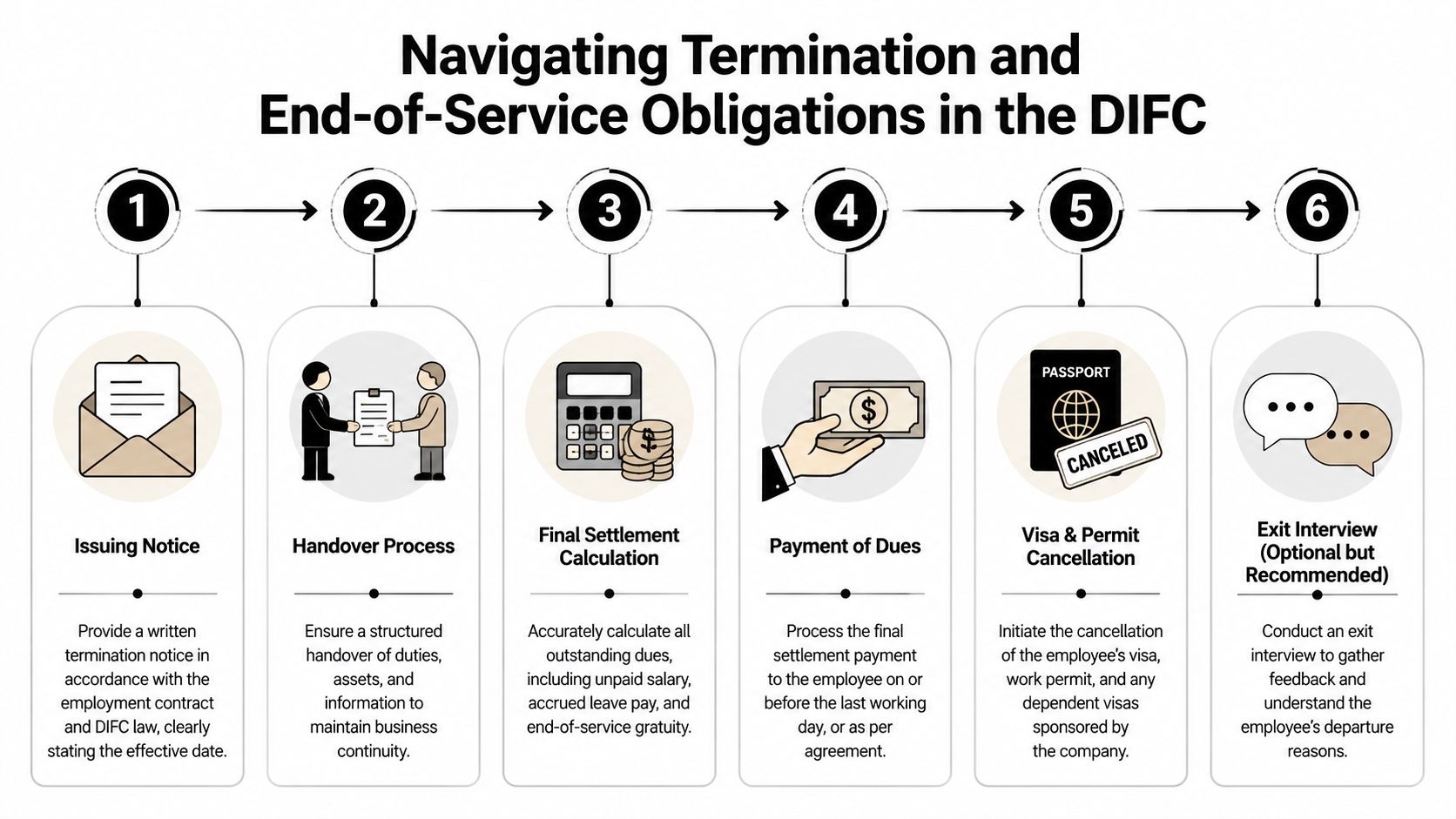
A workable termination process usually includes:
- Written notice management: Use clear dates and confirm whether the employee is working through notice or not.
- Final dues review: HR and finance should reconcile salary, leave balance, and gratuity logic before communicating figures.
- Asset and access control: Recover property and close systems access in an orderly way.
- Complaint handling: If there's an allegation tied to discrimination, harassment, or pay, don't treat exit administration as a substitute for investigation.
For SMEs, the key trade-off is speed versus defensibility. Fast exits feel efficient. Well-documented exits are usually cheaper.
A Practical Compliance Checklist for DIFC Employers
A common SME failure point in the DIFC is simple. The business hires quickly, uses a contract template that does not match the actual pay arrangement, leaves managers to handle day-to-day issues informally, and only checks the file when a complaint or resignation lands. By then, the problem is usually not one breach. It is a chain of small gaps that are expensive to explain.
A workable DIFC compliance system should let you answer four questions fast. What did the contract say? What happened in practice? What records prove it? Who checked the process before it became a dispute?
Hiring and onboarding checks
Use this as a live audit tool.
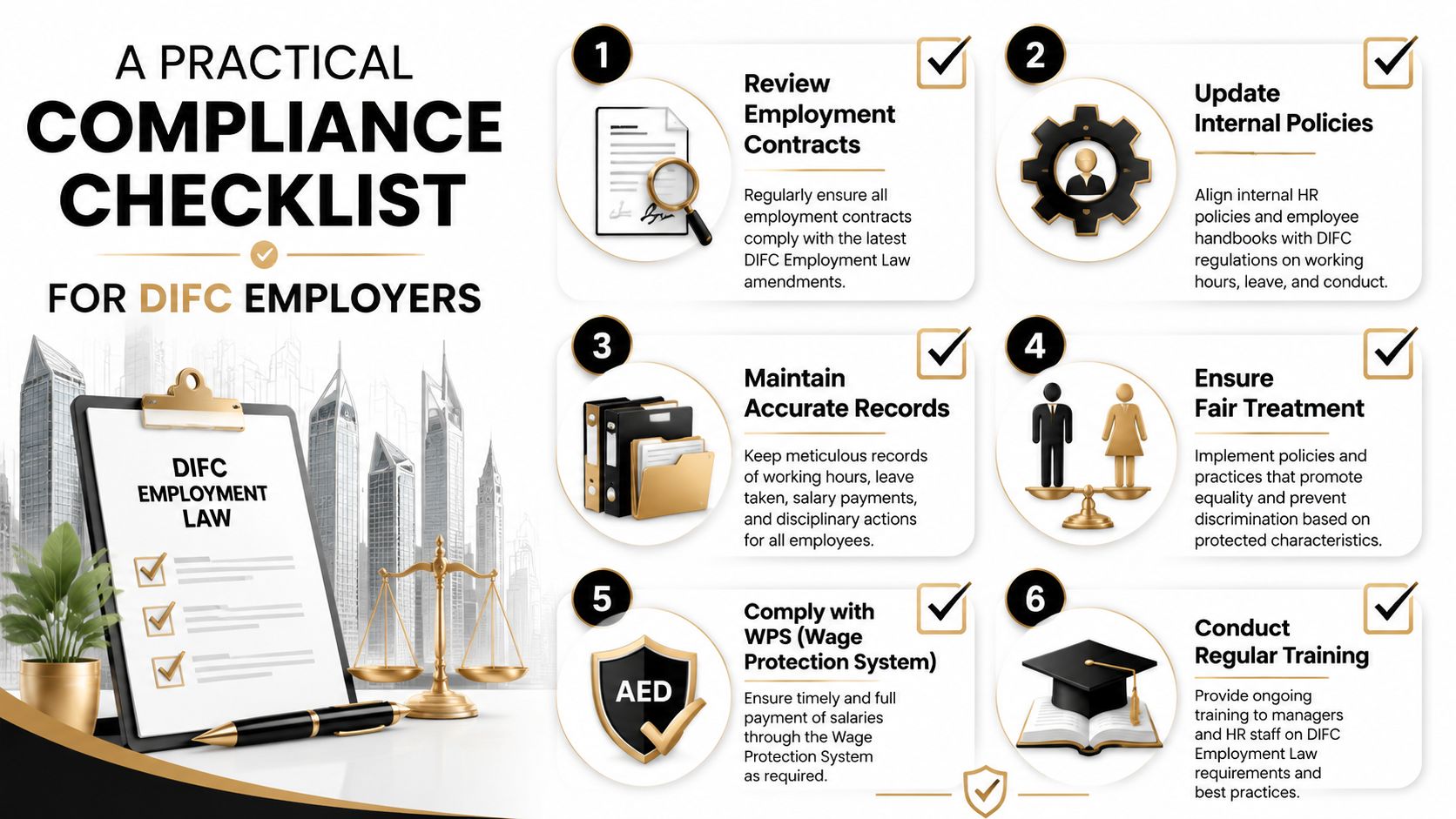
- Contract timing: Confirm each employee received a written employment contract in English within the required period after commencement.
- Role accuracy: Check that job title, reporting line, duties, workplace expectations, and pay terms match the actual duties and responsibilities.
- Offer-to-contract consistency: Resolve any mismatch between the offer letter, visa discussions, payroll setup, and signed contract before day one.
- Salary structure: Test whether fixed pay, variable pay, allowances, and benefits are defined clearly enough for payroll and end-of-service calculations.
- Jurisdiction separation: Make sure DIFC employees are on DIFC documents and processes, not mainland UAE templates reused for convenience.
In this context, SMEs often create avoidable risk. A borrowed template can look fine until someone challenges notice, leave, commission, or a later change in duties.
Record-keeping and manager controls
Compliance does not sit with HR alone. Line managers usually create the documents, messages, scheduling practices, and complaint history that decide whether an issue stays internal or turns into a legal problem.
Check these controls regularly:
- Working time records: Keep records that show actual attendance and working patterns, especially where teams work irregular hours or across time zones.
- Rest periods: Scheduling should allow employees to receive the required weekly rest in practice, not only in policy wording.
- Leave tracking: Annual leave, sick leave, and approvals should be recorded consistently so balances are reliable at exit.
- Complaint handling: Give employees a clear route to raise concerns, then log the intake, review, response, and follow-up.
- Manager documentation: If managers raise performance, conduct, or behavioural concerns, require dated notes and consistent wording.
- Change control: Any change to title, reporting line, pay, duties, or working pattern should be reviewed before it is announced.
That last point matters more than many employers expect. Poorly managed changes can feed later allegations that the employee was pushed out, especially where grievances were already in play. For SMEs, constructive dismissal risk often starts as an operational shortcut, not a deliberate decision.
Resources on managing compliance for frontline teams are useful because they focus on how supervisors apply rules consistently, which is where many DIFC gaps occur.
Policy and exit checks
A policy set is only useful if managers follow it and HR can prove that they did.
| Checkpoint | What to verify |
|---|---|
| Handbook alignment | Policies match actual DIFC practice on conduct, complaints, leave, working time, and investigations |
| Payroll consistency | HR and finance use the same definitions for salary components, deductions, leave balances, and final dues |
| Exit workflow | Notice dates, handover steps, final pay calculations, and approvals follow a standard process |
| Escalation triggers | Discrimination, harassment, retaliation, pay complaints, and resignation after unresolved concerns are escalated before exit is processed |
| Manager training | Supervisors understand what they can change, what needs HR review, and what can create dispute risk |
If you need practical support implementing this, Smart Classic Business Hub provides business setup and ongoing compliance support in Dubai, including legal support as part of its services.
The test is practical. If an employee disputes pay, leave, a resignation, or the fairness of a management decision, can you produce the contract, payroll logic, leave record, grievance history, and manager notes quickly and in a form that makes sense together? If not, the system needs work before the next issue surfaces.
Your Next Steps for DIFC Compliance
Most DIFC employment issues are preventable. They don't usually come from one dramatic mistake. They come from a chain of small decisions. A borrowed template, unclear salary structure, missing records, rushed termination, or a manager who was never trained on what the law requires.
That's why the practical goal isn't perfect paperwork. It's a repeatable employment system. Contracts should reflect the actual pay model. Working arrangements should be trackable. Managers should know when a people issue is becoming a legal issue. Final dues should be calculated from a process, not improvised at exit.
For SMEs, the highest-risk area is often the one that looks least obvious. Constructive dismissal is a good example. If the business handles grievances poorly, changes terms casually, or creates pressure that an employee later says forced their resignation, the cost isn't just legal. It's management time, reputational stress, and operational distraction.
Good DIFC compliance is manageable when you separate jurisdictions, keep records clean, and review your employment documents before problems surface. If you're hiring in the DIFC now, review your contracts, wage structure, working-time controls, and termination workflow before the next employee joins or leaves.
If you need help reviewing DIFC employment contracts, tightening HR processes, or aligning your employment practices with your wider UAE setup, Smart Classic Business Hub can advise on the compliance side of your business structure and support the practical steps needed to keep your operation organised.