
You're probably at the stage where Dubai looks full of opportunity, but the setup path still feels murky. You know DMCC is well known. You've heard it's efficient. You may also have heard stories about applications stalling over the wrong activity, office choices affecting visas, or bank account opening taking longer than expected.
That mix of excitement and uncertainty is normal. In practice, company formation in DMCC Dubai is usually straightforward when the structure is right from day one. It becomes frustrating when founders rush the early decisions, treat the licence as a formality, or budget only for the filing step and not the operating reality that follows.
Why DMCC Is Dubai's Premier Free Zone for Business
An entrepreneur can stand in Dubai, look at the skyline, and see dozens of ways to enter the market. The first real decision isn't the logo, the website, or the sales plan. It's the jurisdiction. That choice affects how smoothly you get licensed, how credible you look to banks and counterparties, and how much friction you face in the first year.
DMCC stands out because it isn't a thinly populated free zone still building its ecosystem. It was established in 2002 and has grown to become home to over 26,000 companies, according to Trident Trust's DMCC overview. That matters more than most first-time founders realise. Scale usually signals that the setup environment is tested, the operational model is familiar to service providers, and the surrounding business district can support companies after incorporation.
Its location in Jumeirah Lakes Towers also helps in practical terms. Clients know the area. Staff can commute. Suppliers, consultants, and other businesses already operate there. You're not setting up in an isolated zone that works on paper but feels disconnected in daily operations.
Why scale changes the risk profile
A mature free zone generally creates fewer surprises. Banking teams have seen the jurisdiction before. Landlords know the process. Professional firms understand the documentation flow. Internal compliance standards are better understood by people who deal with DMCC companies regularly.
That's why many founders prefer DMCC over less established alternatives. It gives you a business address with recognition, a known regulatory environment, and a large peer base around you. If you're still comparing jurisdictions, this wider view of benefits of setting up a business in Dubai helps place DMCC in the broader UAE context.
Practical rule: Choose a free zone for how it performs after incorporation, not just how attractive the brochure looks before it.
What works and what doesn't
What works is choosing DMCC when your priority is a recognised Dubai base, a structured licensing process, and a business environment where many other firms already operate.
What doesn't work is choosing it blindly because it's popular. DMCC is strong, but only if your activity, office plan, visa expectations, and banking profile are aligned with how you'll trade.
A lot of generic guides stop at “DMCC is a top free zone”. That's true, but incomplete. The better reason is simpler. It gives many founders a more reliable operating platform. When you're entering a new market, reliability matters as much as speed.
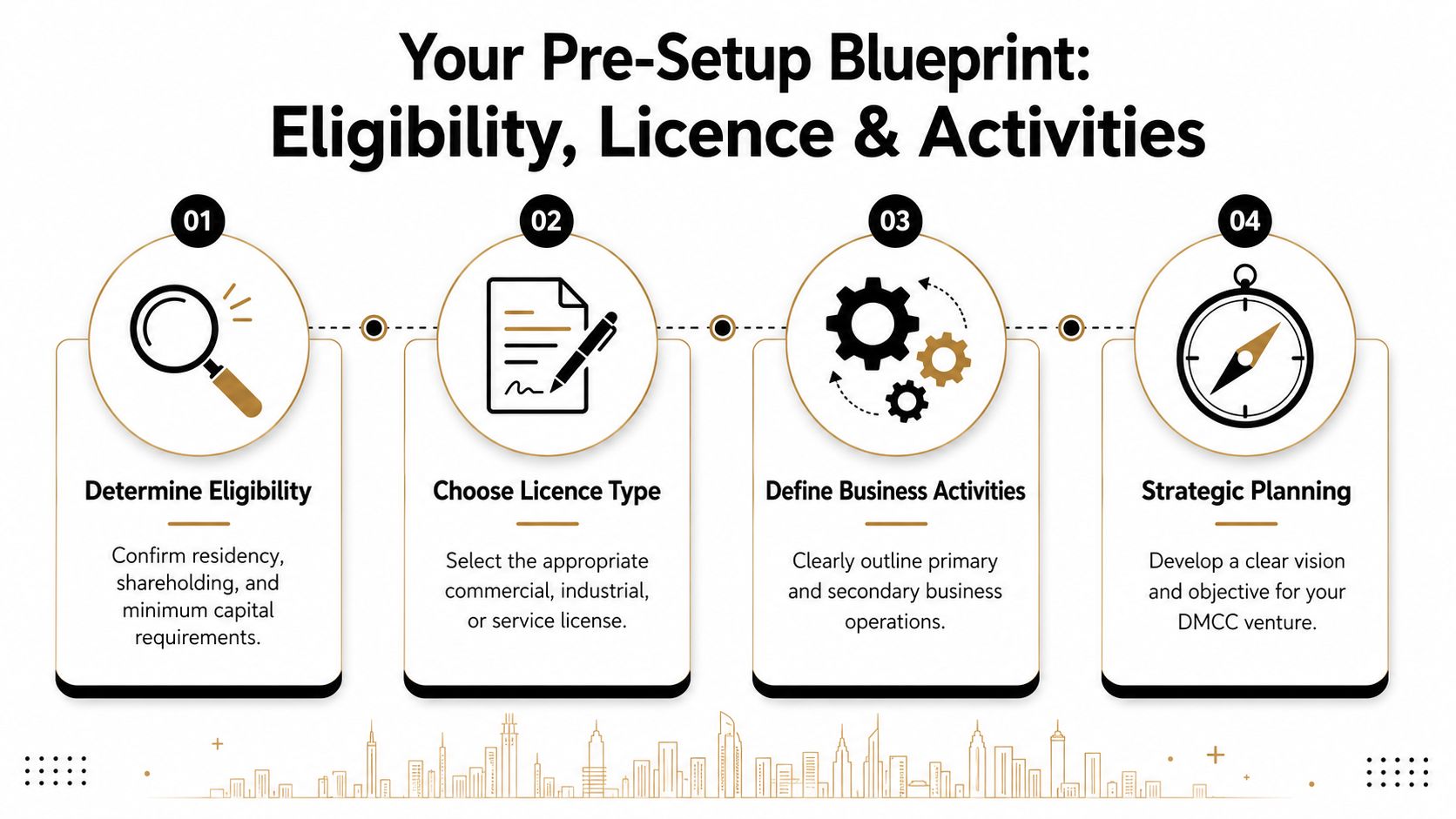
Your Pre-Setup Blueprint Eligibility Licence and Activities
A DMCC file can look fine on the portal and still create problems later. We see that when a founder chooses an activity that sounds close enough, adds a shareholder without checking the document trail, then runs into questions from compliance or the bank after the licence is issued. The setup form is only the final recording of decisions you should settle first.
Start with shareholder readiness
Eligibility is rarely the difficult part. Documentation is.
DMCC can accommodate individual and corporate shareholders, but each structure creates its own review points. If one passport copy shows a shortened name, the corporate documents use a different spelling, or the signing authority is not clear, the application slows down while those gaps are fixed. With corporate shareholders, the ownership chain also needs to be easy to follow. If it takes three documents to understand who owns what, expect questions.
Beneficial ownership needs the same discipline. DMCC expects clear UBO disclosure, and that becomes more sensitive when ownership is layered, held through a parent company, or shared between several parties. Founders often treat this as an admin item. In practice, it affects how cleanly the file moves.
A useful reference point before you lock the structure is this guide to a business licence in the UAE. It helps you compare licence logic before applying it to DMCC.
Choose the licence around the operating model
The first critical decision isn't the logo or the company name. It is whether the licence reflects how you will earn revenue.
Founders usually speak about the business in broad commercial terms. Trading, consulting, software services, design, sourcing, holding assets, or light industrial work. DMCC then asks you to convert that commercial story into licence categories and approved activities. That is where generic articles become too simplistic. On the ground, small wording differences can matter.
These are the broad directions most applicants start with:
- Commercial activities for trading, distribution, import, export, and sale of goods
- Service activities for consultancy, advisory, technology, marketing, design, and other service delivery
- Industrial activities for production, processing, or manufacturing-related operations
The trade-off is straightforward. A narrow activity can limit what you can invoice for. An overly broad or poorly matched activity can trigger extra review, create inconsistencies with your website and contracts, or make bank onboarding harder because the commercial profile looks unclear.
Activity selection is where many files become messy
This is usually the point where a founder says, “We might also add training later,” or “We may trade a related product line next year.” That thinking is understandable, but it often leads to a licence that tries to cover too much on day one.
A better approach is to define the initial business with precision:
State the revenue model in plain language
Describe what the company sells, to whom, and how payment is earned.Separate current operations from future expansion
Planned services or product lines can often be added later if they become real business lines.Check whether the activity needs external approval
Some regulated or sensitive activities bring extra review and a longer setup path.Match the activity to the evidence
Your business plan, website copy, supplier agreements, and invoices should all describe the same operation.Test the banking story early
If a banker reads the licence activity and then sees a different business model in your pitch deck, questions follow.
The wrong activity choice often looks harmless during filing. The problem appears later, when you open a bank account, issue invoices, amend the licence, or explain the business to a compliance team.
Good company formation in DMCC Dubai starts with clean scoping. If we get the ownership, licence type, and activity mapping right at the beginning, you save time later and avoid fixes that cost more than doing the groundwork properly.
The DMCC Application Workflow Demystified
You decide on the structure, submit the file, and expect the rest to be administrative. Then DMCC comes back with a question about the activity wording, a shareholder name does not match the passport exactly, or the office choice no longer fits the visa plan. That is usually where founders realise the workflow is straightforward on paper but less forgiving in practice.
The application itself follows a clear sequence. Submission comes first, then pre-approval, then registration documents, then licence issuance. If the file is clean and the activity does not trigger outside approval, the process often moves within a few weeks, as outlined in Offshore in Dubai's DMCC setup guide.
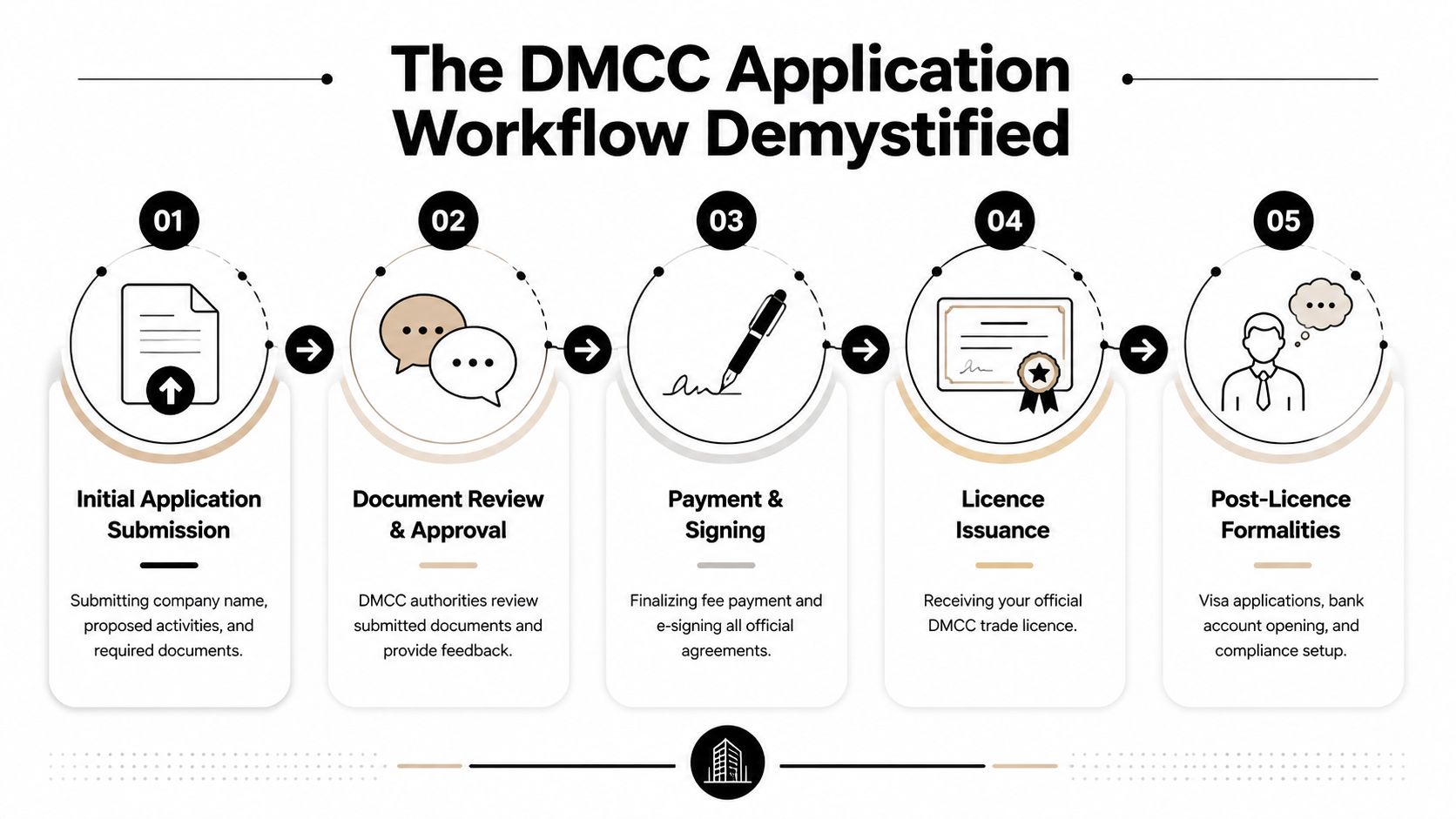
Submission is administrative only if the planning is already settled
At portal stage, you are locking in decisions that affect the rest of the file. Company name, legal form, shareholder details, and activity wording need to line up from day one. Small inconsistencies create avoidable review cycles.
We often see three issues here. The trade name is available but does not match the brand the founder plans to use publicly. The activity description is technically valid but too broad for what the company will do. The shareholder information is correct in substance but inconsistent across passports, proof of address, and application entries.
None of those problems are dramatic. All of them slow the file down.
Pre-approval is where weak files get exposed
Pre-approval is DMCC's first real check of whether the application makes sense as a whole. The authority is not only checking whether documents were uploaded. It is checking whether the business description, licence selection, shareholding, and supporting records tell one coherent story.
That matters more than generic guides usually admit. If your licence says consulting, your website suggests trading, and your business plan mixes both without explaining the revenue model, questions tend to follow. The same issue comes up later with banks, so it is better to fix it before approval rather than after incorporation.
A practical way to prepare is to review the file as if you were a compliance officer seeing the company for the first time. If the narrative feels patchy, it probably is.
Registration is the point of commitment
Once pre-approval is granted, the company starts becoming legally fixed. Constitutional documents are signed, shareholding is confirmed, and the office arrangement has to make operational sense, not just fit the lowest entry price.
Founders sometimes discover that a cheap desk package is not the right choice if they expect to add visas quickly, hold client meetings, or satisfy a bank that wants to see a credible operating presence. Cost and suitability are not always the same thing. If you are comparing office-related setup options, this guide to Dubai free zone company setup costs helps frame the trade-offs properly.
Typical friction points at registration include:
- passport spellings that do not match supporting documents
- delayed decisions on office type
- activity wording that still needs clarification
- shareholder structures that require extra explanation or proof
These are not rare exceptions. They are the normal reasons a file stalls.
Licence issuance is the start of the operational work
Founders usually treat the licence as the finish line. In practice, it is the handover point from formation to activation.
Once the licence is issued, you still need to get the post-setup steps moving in the right order. Corporate documents should be checked carefully. Immigration planning should match the office package and headcount expectations. Banking preparation should start immediately, because account opening often takes more time and scrutiny than the company registration itself.
That last point catches many founders off guard. A DMCC company can be formed correctly and still face delays if the banking file is thin, the business model is hard to explain, or expected transaction flows do not match the licence. This is also why cash planning matters early. Before you commit to launch timing, it helps to calculate your startup's runway alongside setup, visa, and banking lead times.
The workflow is not difficult once the file is coherent. The hidden complexity is that each step affects the next one. Good preparation shortens the process. Poor scoping moves the problem from incorporation to banking, visas, or licence amendments later.
Decoding the Costs and Timelines for Your DMCC Company
A founder gets a quote, sees a low starting figure, and assumes the budget is settled. Two weeks later, the crucial questions start. Which office package best fits the plan, how much cash should stay available after incorporation, and how long can the business wait before revenue starts covering monthly obligations?
That is the practical way to look at cost in DMCC. The setup fee matters, but it is only one part of the launch budget. Your total outlay depends on the licence scope, the office package, the number of visas you expect to support later, and how much post-incorporation work is needed to get the company fully operational.
DMCC publishes a broad range for initial setup costs, and that range is wide for a reason. Two companies can both be "setting up in DMCC" and still have very different cost profiles. A single-shareholder consultancy with a straightforward file does not spend like a trading business that needs a larger office footprint, more drafting precision, and tighter coordination across formation documents.
The same applies to share capital. DMCC commonly requires a minimum share capital of AED 50,000 for a company, and that figure should be treated as part of the company structure, not as a footnote in a quotation. It affects how you plan your funding, how you present the business to banks later, and how much liquidity you keep available for early operations.
Many budgets fail to account for all expenses. Founders reserve enough for incorporation, but not enough for the first operating cycle.
We usually advise clients to split the budget into three buckets:
| Cost Component | What to Budget For | Type |
|---|---|---|
| Initial setup fees | Registration, licensing, and formation-related charges | One-time |
| Share capital | Company structuring requirement | Structural |
| Launch cash buffer | Office commitments, early admin costs, and pre-revenue operating period | Working capital |
That third line is the one generic guides often skip. If you want a practical way to pressure-test that cash buffer, use this guide to calculate your startup's runway before finalising the setup package.
Timelines need the same treatment. A simple file can move quickly. A file with open commercial questions usually does not. Cost and timing are tied together because delays affect cash. If your launch slips, you may still be carrying lease costs, professional fees, and staff planning assumptions while the company is not yet generating income.
A useful budgeting conversation sounds like this:
- What must be paid to get the entity formed
- What must stay available after formation
- What could trigger extra spend if the file needs amendments or added documentation
- How long the business can operate before incoming revenue becomes dependable
If you are comparing jurisdictions or trying to benchmark your assumptions, this overview of Dubai free zone company setup cost can help frame the wider cost picture.
The founders who stay in control are usually not the ones who found the cheapest starting number. They are the ones who budgeted for the actual setup path, the realistic timeline, and the cash gap between licence issuance and day-one trading.
Beyond Formation Visas Banking and Annual Compliance
You get the DMCC licence, the certificate arrives, and the obvious question is, “Can we start trading now?” On paper, you are formed. In practice, a few of the hardest operational steps are just starting. Visas, banking, and ongoing compliance are the areas where a clean setup either holds together or starts showing gaps.

Visas need to be planned around how the business will actually operate
Visa planning is tied to your office solution, lease terms, and intended headcount. If you plan to sponsor yourself first and add staff later, the initial package may work. If you already know you need multiple employee visas or family sponsorship, the cheapest office option can become restrictive very quickly.
We usually advise clients to decide three points early:
- who needs residency first
- how many employee visas are likely in the first year
- whether the office package supports that plan without a later amendment
That saves time and rework. It also avoids a common problem where the company is formed correctly, but the immigration setup does not match the hiring plan.
Banking is often where weak setup decisions surface
A bank does not only check whether the company exists. It checks whether the business makes sense.
Generic setup advice often proves insufficient. A founder may have a valid licence, but if the activity wording is too broad, the website describes a different service, or the shareholder profile does not clearly connect to the proposed business, the account opening process slows down. Sometimes it stalls entirely until the file is clarified.
Banks usually want a clear answer to a short list of practical questions:
- What will the company sell?
- Who are the customers?
- Why is the business based in Dubai?
- Where will funds come from and where will they go?
- Do the licence activity, company documents, and commercial profile all match?
That last point matters more than many founders expect. We have seen companies approved by the free zone but challenged by banks because the operating story was not consistent enough. The issue was not legality. The issue was coherence.
A stronger banking file usually includes a concise business summary, ownership documents that line up cleanly, and support material that reflects the licensed activity rather than a broader idea of the business.
Annual compliance is not complicated, but it is easy to mishandle
After incorporation, the company has to stay current. That means keeping ownership records accurate, renewing the licence on time, and checking whether the business has any reporting or regulatory obligations linked to its activity and structure.
Two areas deserve regular attention. The first is beneficial ownership information. If the ownership chain changes, the records should be updated promptly. The second is annual compliance review. Founders often assume that if nothing caused an issue in year one, the same position automatically applies in year two. That assumption creates avoidable risk.
A practical annual routine looks like this:
- Review shareholder and control records after any change in ownership or authority
- Check licence activity against actual trading so the company remains aligned on paper and in practice
- Prepare renewals early so lease, immigration status, and company records do not fall out of sync
The on-the-ground reality is simple. Formation gets you a company. Good post-setup management keeps it usable, bankable, and ready for growth.
Common Pitfalls and How Expert Guidance Streamlines Success
You file the application, pay the first fees, and assume the hard part is done. But challenges emerge. The licensed activity does not match how the business will earn money, the shareholder documents raise follow-up questions, or the office package no longer fits the visa plan. These are the problems that slow a DMCC setup and make a straightforward case feel heavier than it should.

The pattern is familiar. Founders rarely get into trouble because of one dramatic mistake. They run into delay because several small assumptions stack up. An activity sounds close enough, so they select it without testing how a bank or counterparty will read it. They budget for incorporation, but not for the full first operating cycle. They prepare documents that are technically available, but not fully aligned. Each decision looks manageable on its own. Together, they create avoidable rework.
Underbudgeting is one of the most common examples. Earlier in this guide, we covered the need to account for more than the incorporation stage. In practice, you need a realistic view of setup fees, immigration costs, renewals, and any compliance work linked to the company's structure and activity. Founders also miss a basic point. Some early-stage fees may not be recoverable if the file changes direction midway.
The pitfalls we see most often
Activity mismatch
The licence covers something adjacent to the actual business model. That can create problems later with banking, contracts, or internal compliance checks.Weak document alignment
Passports, shareholder records, proof of address, and ownership support documents do not present one clear story. DMCC may still process the file, but extra questions add time.Office decisions made too early
A low-cost office option can look sensible at the start, then create pressure when the visa allocation or staffing plan becomes clearer.Formation-only planning
The company gets incorporated, but the founder has not prepared for the next steps, especially banking, immigration sequencing, and ongoing record maintenance.
I have seen clean applications stall because the founder treated setup as an admin task rather than an operating plan. DMCC formation is paperwork, but good paperwork depends on accurate commercial thinking.
Good setup work reduces future disputes with banks, regulators, landlords, and your own team.
Where expert help actually adds value
The best time to get support is before submission. That is when we can test the activity selection against the actual revenue model, check whether the shareholder file is internally consistent, and flag practical issues that generic checklists do not catch. That includes trade-offs clients often miss, such as whether a cheaper office package today could limit flexibility later, or whether a broad business description could create more banking questions after the licence is issued.
Smart Classic Business Hub provides UAE company formation, licensing, PRO support, visa processing, and ongoing compliance services. That kind of support helps when you want one team to handle the setup file and the operational follow-through that comes after approval.
The right adviser does not make decisions for you. We make sure the decision you choose is workable on paper, acceptable in practice, and less expensive to fix later.