
You've submitted your visa file, accepted the job offer, or started company setup. Then someone asks for a good conduct certificate and the process suddenly stops feeling straightforward. The same questions often arise at this point. Is this the same as a police clearance certificate? Should you get it from the UAE, your home country, or both? Does attestation come before translation or after?
In Dubai, this document often becomes urgent only when a deadline is already close. That's why it causes so much stress. The certificate itself isn't complicated in principle. The confusion comes from the fact that the route changes based on where you are, whether you previously held a UAE residence permit, and what authority is asking for it.
Your Essential Guide to the UAE Good Conduct Certificate
A client accepts a job in Dubai, books a medical, starts the Emirates ID process, then HR asks for a good conduct certificate. Another client is already outside the UAE and needs the same document for immigration or a regulated role. The name sounds simple. The process is not, because the correct route changes based on one question first: are you a current UAE resident, a former resident, or someone who has never held UAE residence?

In UAE practice, a good conduct certificate usually refers to a police clearance or criminal status certificate issued for employment, immigration, licensing, study, adoption, or other official use. The confusion starts because people use the same label for different documents. An employer may ask for a "good conduct certificate" but mean a UAE police certificate if you lived here before, or a home-country police clearance if you are entering the UAE for the first time.
That is the point of this guide. It gives one roadmap for all the common UAE scenarios instead of treating them as if they follow the same process. Residents and former residents do not apply in the same way. Applicants outside the UAE often miss the fingerprint, legalization, or translation stage and lose days fixing a file that could have been prepared correctly from the start.
The bottleneck usually appears after the certificate is issued, not before. I see delays caused by documents that are valid in substance but unusable in practice because the receiving authority wants Arabic translation, attestation, or a legalized copy from the right chain of authorities. If your visa file is already active, timing also matters because related steps such as the Emirates ID biometrics process in 2026 often run on a tight sequence.
Use a simple rule at the start. Match the certificate to your status and to the authority asking for it. That avoids the two mistakes that waste the most time: applying through the wrong channel, and assuming every police certificate can be submitted without further legalization.
For employers, this issue often sits inside a larger hiring and compliance workflow. If you need broader screening support alongside police documentation, review Digital Footprint Check's employer services as a separate layer from the UAE certificate process itself.
Essential Prerequisites and Required Documents
A good conduct certificate application usually goes wrong before anyone clicks "submit." The problem is rarely the portal itself. It is the file. A passport scan is blurry, an old visa is missing, the applicant selects the wrong purpose, or the name on one document does not match the others exactly.
Get the file right first. That saves far more time than trying to fix a rejected application after the fact.
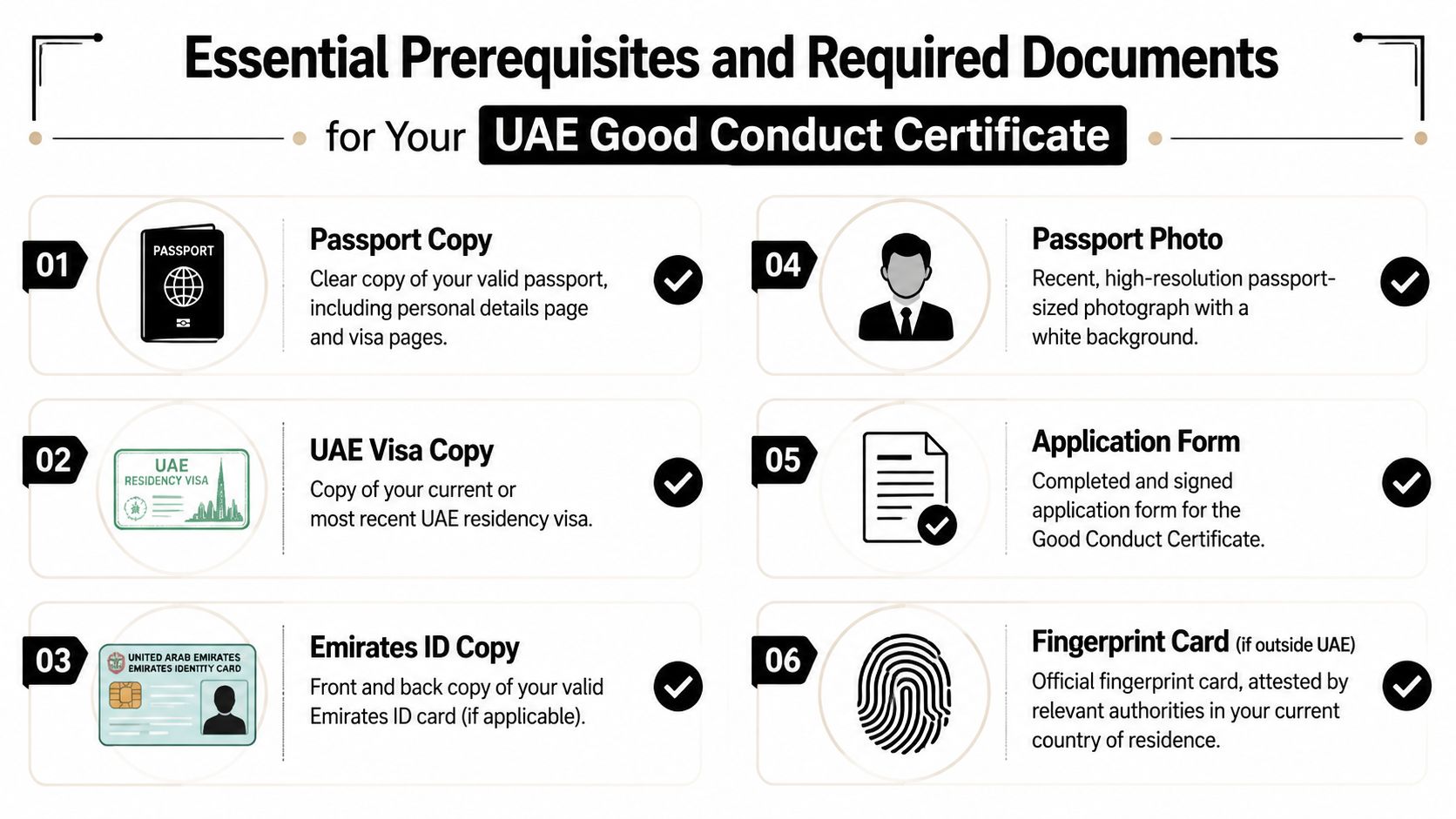
Build the application file in one sitting
Prepare the full set of documents before you choose a police channel or ask an embassy what to do next. Residents and former residents often need slightly different supporting records, but the core file is usually the same:
- Passport copy. Use a clear, full scan of the biodata page. If you have renewal history that changed your passport number, keep the old passport copy ready as well.
- UAE residence visa copy. Current residents should use the latest visa copy. Former residents should include any previous UAE visa they still have, even if it is expired, because it helps match the old record.
- Emirates ID copy. If available, upload both sides. Expired cards still help identify former residents in many cases.
- Recent passport photo. Use a plain background and proper resolution. Screenshots taken from other documents are a common reason for upload failure.
- Purpose of application. Select the purpose carefully. Employment, immigration, licensing, or foreign submission can affect how the certificate needs to be prepared later.
- Fingerprint card for applicants outside the UAE. If you are applying from abroad, this can become the document that determines whether the application moves forward or stalls.
Details that prevent matching problems
Police systems match records based on identity history, not just the current passport page. That is why small inconsistencies create outsized delays.
Check these points before uploading anything:
- Name format. Use the same spelling and order of names shown on your passport, visa, Emirates ID, and any supporting form.
- Date of birth and nationality. Make sure these match across every document, especially if you hold dual nationality or renewed your passport abroad.
- Residence history in the UAE. Note the emirate where you lived, your rough period of stay, and any old UID or Emirates ID number you still have.
- Active contact details. Use an email address and phone number you regularly monitor. Missed portal notices can leave an application sitting untouched.
- Current identity steps. If your certificate is part of a wider immigration file, align it with related procedures such as the Emirates ID biometrics process in 2026, especially when submission deadlines are tight.
Two preparation checks that save time later
The first is document quality. Upload PDFs and image files that are readable at normal zoom. Cropped corners, glare, and compressed WhatsApp copies waste time because they often trigger manual review.
The second is downstream use. If the certificate is for a residency, relocation, or investment move, confirm what the receiving authority will ask for after issuance. Many applicants focus only on getting the certificate and ignore what comes next. Anyone planning a broader move can compare the certificate step against a wider Dubai residency roadmap for HNWIs so the police certificate, visa, and supporting documents stay in the right sequence.
A clean file does not guarantee approval. It does prevent the avoidable objections that slow down residents, former residents, and overseas applicants alike.
Applying as a UAE Resident or Former Resident
If you're in the UAE now, the process is usually more straightforward. If you used to live here, the process is still possible, but your route depends on whether the authority can verify you through prior UAE records or requires extra identity proof from abroad.
For UAE visa and employment workflows, the good conduct certificate is treated as a pre-issuance compliance gate. Applicants already in the UAE are generally directed to local channels such as the Ministry of Interior e-service, while those outside the country follow a different route. Using the wrong jurisdictional path can invalidate the application and force a restart, according to UAE Embassy guidance on obtaining a certificate of good conduct.
Which channel usually makes sense
Current residents typically look first at the police platform tied to their emirate or at the federal route. Former residents need to pay more attention to whether the platform supports applications without a current Emirates ID or active residence status.
| Feature | MOI UAE App | Dubai Police App/Website | Abu Dhabi Police App/Website |
|---|---|---|---|
| Best fit | Applicants using a federal route within the UAE | Applicants with a Dubai connection or preference for Dubai Police channel | Applicants with Abu Dhabi-related records or local preference |
| Typical user | Current resident, and in some cases former resident depending on record availability | Current resident, former resident in some cases | Current resident, former resident in some cases |
| Main strength | Broad official route for UAE-based processing | Familiar option for many Dubai applicants | Useful where Abu Dhabi records or local processes apply |
| Main caution | Applicant must match the route to current status | Don't assume Dubai route suits every case | Requirements can vary by applicant history |
| Purpose selection | Often asks why the certificate is needed | Usually purpose-led submission | Usually purpose-led submission |
| When to avoid guessing | If you're outside the UAE or your residence is cancelled | If your records are from another emirate and instructions point elsewhere | If your residence history doesn't align with local requirements |
A practical resident workflow
Most resident applications follow this rhythm:
- Choose the authority first. Don't start with whichever app appears first in a search result.
- Match your current legal status. Active resident, cancelled resident, and former resident abroad are not treated the same.
- Upload complete records in one go. Portals are faster when your file is clean.
- Select the purpose carefully. The stated use can matter when the receiving authority checks the document.
- Download the issued certificate and check every field immediately. Name spellings, passport number, and purpose should all match.
If your residence history is mainly tied to Dubai, this practical guide to the police clearance certificate in Dubai helps applicants sort out the local route before they submit.
Former residents often assume they should apply exactly like current residents. That's one of the quickest ways to lose time.
For investors or senior professionals planning a broader move, police clearance usually sits alongside visa strategy, asset planning, and document legalization. In that context, a wider overview such as this Dubai residency roadmap for HNWIs can help place the certificate requirement in the bigger relocation process.
Securing a Certificate from Outside the UAE
This is the part that causes the most confusion because two very different situations get lumped together.
First, there's the former UAE resident now living abroad who needs a UAE-issued good conduct certificate based on prior residence here. Second, there's the new applicant for a UAE visa who has never lived in the UAE and needs a police clearance from the home country for submission into a UAE immigration or employment file.

If you lived in the UAE before
A former resident abroad usually needs to prove identity in a way the UAE authority can rely on remotely. In practice, that often means a fingerprint-supported application plus copies of old UAE residence documents and passport records.
The sequence usually works better when handled in this order:
- Confirm the receiving requirement. Some authorities want a UAE-issued certificate because you previously held UAE residence.
- Collect your prior UAE identifiers. Old Emirates ID, visa copy, passport number used during residence, and emirate of residence all help.
- Arrange official fingerprints in your current country. The fingerprints must be taken through an authority or authorised channel that the next step will accept.
- Check embassy or portal instructions before submission. Don't assume the same route works in every country.
If you have never lived in the UAE
In this case, the UAE side may ask for a police clearance from your home country or your legal country of residence. The key point is jurisdiction. The document must come from the authority the receiving UAE body recognises.
That's why I usually tell clients not to improvise with local municipal checks unless the requesting authority explicitly accepts them. A national or federal criminal history document is often the safer route where the home country has multiple layers of police records.
A useful benchmark from Uganda's police INTERPOL process shows how many jurisdictions treat the certificate as an identity-based, time-limited document. Uganda states that the certificate is issued after fingerprint verification against the police fingerprint database, costs 64,000 shillings, is valid for six months, takes close to four days, and is used especially for foreign employment, according to Uganda Police INTERPOL guidance on the certificate of good conduct. The practical lesson for UAE-facing applicants isn't the local fee. It's that many countries treat police clearance as a biometric compliance record with a short shelf life.
If you're outside the UAE, don't treat the certificate as a generic background letter. Treat it as a jurisdiction-specific legal document that must match the exact use case.
The Critical Steps of Legalization and Translation
Getting the certificate issued is only half the job. For many UAE applications, the document must also be legalized, sometimes called attested, before the receiving authority treats it as valid.
Applicants often fail here because they think any embassy stamp will do. It won't. Legalization usually follows a sequence, and sequence matters.
The normal attestation order
For a certificate issued abroad and intended for use in the UAE, the order commonly looks like this:
- Issuance by the correct authority in the home country
- Authentication by the relevant authority in that country
- Attestation by the UAE Embassy in that country
- Final attestation by the UAE Ministry of Foreign Affairs if required on arrival in the UAE
If you reverse steps or skip one because “the employer probably won't mind”, you can end up with a perfectly genuine document that still isn't usable.
Translation is separate from attestation
Translation problems are less dramatic than attestation errors, but they still derail files. If the receiving party requires Arabic or English and your certificate is in another language, use a certified legal translator. Don't submit a personal translation, and don't assume a general translation office understands immigration standards.
A good translation process usually includes:
- Matching every field exactly. Names, dates, document numbers, and issuing authority must mirror the original.
- Keeping the original and translation together. Many authorities want both presented as one file set.
- Checking whether the translation itself needs legal recognition. Some use cases require the translated version to be handled through an approved legal translation route.
If your application ties back to a Sharjah record or local processing requirement, this guide to the police clearance certificate in Sharjah is a useful reference point before you submit translated or attested documents.
A certificate can be genuine and still be rejected. Most rejections at this stage are about format, sequence, or legal acceptance, not about the person's record.
Common Pitfalls That Cause Delays and Rejections
Most applicants assume rejection happens because someone has a criminal issue. In routine cases, that isn't the main problem. Procedural mistakes cause more disruption than people expect.
UAE-focused immigration guidance notes that a common failure mode is incomplete attestation or submitting a police clearance certificate that doesn't match the applicant's current status. It also notes that processing can be around 7 to 10 working days in many cases, but that timing isn't guaranteed and sequencing mistakes are a major cause of delay, according to Envoy Global's UAE police clearance requirement update.
Problem and consequence
Using the wrong jurisdiction
You submit a home-country local police check when the file needs a national record, or you apply for a UAE resident route while you're no longer treated as a resident. The result is usually rejection or a request to reissue the certificate through the proper channel.
Attestation in the wrong order
Applicants sometimes get a UAE Embassy stamp first and discover later that a prior authentication step was missing. That usually means repeating legalization from the beginning.
A certificate that is too old
Some police clearances are accepted only for a limited period. If the visa file, licence file, or onboarding process moves slowly, the certificate may expire before final submission.
Name mismatches
One missing middle name or a different passport number format can trigger manual review. Manual review means delay even when the underlying record is fine.
Weak fingerprint documentation
This affects remote applicants most. Smudged prints, unofficial cards, or missing authority verification can stop the application before record matching even starts.
Small mistakes that quietly slow the file
A lot of business owners run into this when they're handling several compliance tasks at once. Someone signs one document digitally, scans another one poorly, and assumes all document workflows are interchangeable. They aren't. If your company is also standardising contracts and approvals, it helps to understand related rules such as e-signature regulations for UAE small businesses, because legal acceptance depends on the document type and the authority receiving it.
The fastest applications usually aren't the simplest ones. They're the ones where every document matches the exact legal route from the start.
How Smart Classic PROs Eliminate the Hassle
A client often reaches this stage after losing a week on the wrong route. They filed as a resident when the record had to be processed as a former resident, or they got fingerprints done abroad without the certification the UAE authority expects. The application itself is rarely the hard part. The delays usually start before submission.
That is where professional handling saves time. A UAE good conduct certificate can sit inside a larger visa, hiring, licensing, or incorporation file, and one mistake in the document chain can hold up everything attached to it. The practical job is to identify the correct path at the start, resident, former resident, or overseas applicant, then prepare the file to match that route.
Where professional handling helps most
A PRO team adds value when the true question is not how to complete a form, but which authority should receive the file, which supporting documents match the applicant's status, and which order avoids rework.
That usually includes:
- Case assessment before any filing. The process changes depending on whether the applicant still holds a valid Emirates ID, has left the UAE, or needs to apply entirely from abroad.
- Document review against official records. Names, passport numbers, prior visa details, and fingerprint documents are checked together, because small mismatches can trigger manual review.
- Correct sequencing for attestations. If legalization is needed, each stamp has to follow the right order. Getting one authority's stamp too early can force the whole chain to be repeated.
- Translation control. Arabic or English translation must match the receiving authority's requirements, especially where immigration, licensing, or regulated employment is involved.
- Coordination across the wider file. If the certificate is only one part of a company setup or visa application, the timing matters. Submitting it too early can create expiry problems. Submitting it too late can hold the whole file.
Clients usually come to Smart Classic Business Hub when the certificate is not a standalone task, but one item inside a broader PRO and company formation process. In that situation, the benefit is operational. One team checks the route, the document set, the legalization steps, and the submission timing together, instead of leaving the applicant to coordinate between police channels, translators, attestation offices, and visa processing deadlines.
That reduces avoidable rejection, repeat courier costs, and lost time.
If you need help deciding whether your good conduct certificate should come from a UAE police channel, your home country, or a fully attested overseas route, Smart Classic Business Hub can help you map the correct process before you spend time and money on the wrong one.