
You're probably in the same position as most founders who first look at the UAE. The market looks attractive, the setup sounds fast, and every free zone brochure makes the process look simple. Then the important questions begin. Which zone fits your activity? What specific licence do you need? How much will it really cost once visas, office requirements, and banking enter the picture?
That's where company formation in a UAE free zone stops being a checklist and becomes a strategy exercise. The difference between a smooth launch and an expensive reset usually comes down to a few early decisions: activity selection, legal structure, document quality, and timing around visas and banking. Get those right, and the process is straightforward. Get them wrong, and even a low-cost package can become a slow, frustrating file.
Why a UAE Free Zone Is Your Global Business Launchpad
For most foreign founders, a UAE free zone is the practical starting point because the system was built for outside investors, not just local trading groups. The Ministry of Economy and Tourism states that free zones allow up to 100% foreign ownership, and the UAE government also identifies the common legal forms available there as FZE, FZ Co., LLC, PJSC, or a branch of a local or international company on its free zone business setup guidance.
That matters because it changes the setup logic completely. In most free zones, you don't need a local sponsor to hold your company shares. You can build a formal UAE entity under recognised legal structures, with a licensing process designed for speed and standardisation.
What a free zone really means in practice
A free zone is not just a cheap licence. It's a regulated business jurisdiction inside the UAE with its own authority, approved activity lists, registration process, and facility options. Some zones are broad and flexible. Others are more designed for sectors such as media, logistics, technology, consulting, or light industrial activity.
For a founder, the attraction is simple:
- Ownership control: You keep the equity structure clean.
- Operational clarity: The authority tells you what activities are allowed and what documents are needed.
- Faster launch conditions: The paperwork is usually more standardised than many first-time investors expect.
This is why free zones became the default route for startups, solo consultants, small trading firms, and foreign-owned holding or service businesses entering the UAE.
Practical rule: If your first priority is full ownership, a clean corporate structure, and a faster route to licensing, a free zone is usually the first model worth testing.
Why founders choose this route first
The first-time investor often compares the UAE as a whole when the better comparison is narrower. They should compare entry models. Mainland may suit some businesses. Offshore may suit others. But free zones tend to win when the founder wants a formal operating company with manageable setup friction.
That doesn't mean every free zone is suitable. It means the model is suitable. The primary task is choosing the right authority, not just choosing “free zone” as a category.
A good consultant looks beyond the headline benefits and asks harder questions. Will the activity wording satisfy the bank later? Is the visa quota enough for the next stage of hiring? Does the lease type match the authority's expectations? Can the company grow without needing a restructuring in year one? Those are the questions that protect your launch.
Choosing Your Strategic Home and Business Licence
A founder comes in asking for the lowest-cost free zone package. Ten minutes later, the actual issue usually appears. They need the right activity, enough visa capacity for the first hires, a licence description the bank will accept, and an address that does not weaken credibility with clients or suppliers.
That is why this decision needs strategy, not package shopping.
The first consultant-level call is choosing the right type of free zone. In practice, most options fall into three groups, and each serves a different commercial purpose.
The three free zone archetypes
Industry-focused zones work well for businesses that gain from sector identity. Media, logistics, design, manufacturing, and specialist trading businesses often benefit when the authority, infrastructure, and market perception match the company's work. That alignment can help later with counterparties who read the licence and company profile closely.
General-purpose zones suit many service-led businesses. Consultants, agencies, software firms, e-commerce operators, and small professional teams often choose them because activity options are broader and the setup model is less rigid.
Cost-conscious zones outside the usual shortlist can suit solo founders and early-stage companies watching cash flow. The lower entry cost is attractive, but the trade-off may show up elsewhere. Office choices can be narrower, the authority may be less familiar to banks or overseas counterparties, and the address may carry less weight in the market.
A practical comparison looks like this:
| Business profile | Usually suits | Main decision point |
|---|---|---|
| Solo consultant or developer | General-purpose free zone | Activity flexibility and lower fixed overhead |
| Trading team | Zone that supports commercial activity well | Warehousing, visas, and banking profile |
| Creative or specialist firm | Industry-focused zone | Sector alignment and market perception |
| Foreign branch | Zone that handles branch structures cleanly | Documentation and parent company support |
Many founders also need a clearer view of the difference between mainland and free zone in Dubai before they commit, because the right structure depends on where revenue is earned, how staff will be hired, and whether the business needs direct access to the local UAE market.
Licence choice is a commercial decision
Founders often treat the licence as paperwork that follows the zone selection. In real files, the two decisions are tied together. The zone must allow the activity. The licence wording must also match what the company will sell, invoice, advertise, and explain to the bank.
Costly mistakes begin at this point.
A solo software developer may only need a service activity, one visa, and a simple structure that keeps annual costs under control. A small import-export business needs something very different. It may need commercial activity wording, support for trade documents, room to add staff, and a free zone that will not create avoidable friction once suppliers, customs paperwork, or account opening enter the picture.
I often tell clients the licence should survive three tests. It should make sense to the authority, make sense to the bank, and make sense to the customer reading your invoice or contract. If it fails one of those tests, the problem usually surfaces after incorporation, when changes cost more time and money.
Legal structure affects more than ownership
The legal form is not just a label on the licence. It shapes how the company file is built and how the setup will be viewed by the authority and third parties.
The common options are straightforward:
- FZE: Usually used for a single shareholder.
- FZ-LLC or FZC: Common where there are multiple shareholders.
- Branch: Used when an existing UAE or foreign company wants an extension in the UAE rather than a new standalone entity.
The right structure depends on the shareholder plan and the operating model. A branch can look efficient on paper, but it also ties the UAE operation more closely to the parent company's documents and approvals. A standalone free zone entity can be cleaner for some founders, especially when they want a separate cap table, a separate banking story, or a simpler future sale.
This is the part many low-cost setup sellers skip. Smart Classic Business Hub reviews the structure, activity wording, and authority fit together, because an approval at incorporation stage does not guarantee an easy path later.
A consultant's playbook starts with the operating model. If the legal form, activity, and authority do not align, the company may still be formed, but the strain usually appears later in banking, visas, client onboarding, or contract review.
What works in practice
A remote consulting business usually does better with flexibility, moderate overhead, and licence wording that clearly matches advisory work. A goods trader usually does better with a zone that understands commercial activity and can support the practical side of trading. A founder planning to hire within months should choose with visa growth in mind, not just first-year cost.
Copying another company's setup is where problems start. Two businesses can look similar from the outside and still need different activity wording, office arrangements, and authority selection. The free zone approves specific activities, not assumptions. If the licence, website, proposals, and actual business model do not match, the file becomes harder to defend later.
The strongest setup choice is the one that still makes sense after the company is formed. That is the standard a good consultant works to.
The Blueprint for a Flawless Application
A file can look complete and still be built to fail.
I see this often with founders who select the right free zone and licence category, then lose time on avoidable application issues. The authority is not only checking whether documents are attached. It is checking whether the story is consistent. If the activity wording, shareholder records, name choice, and supporting papers point in different directions, the file slows down before serious review even begins.
Good applications are tight, consistent, and easy to verify. That is the standard Smart Classic Business Hub works to, especially for founders dealing with overseas shareholders, regulated activities, or visa-linked setup plans.
Your pre-submission toolkit
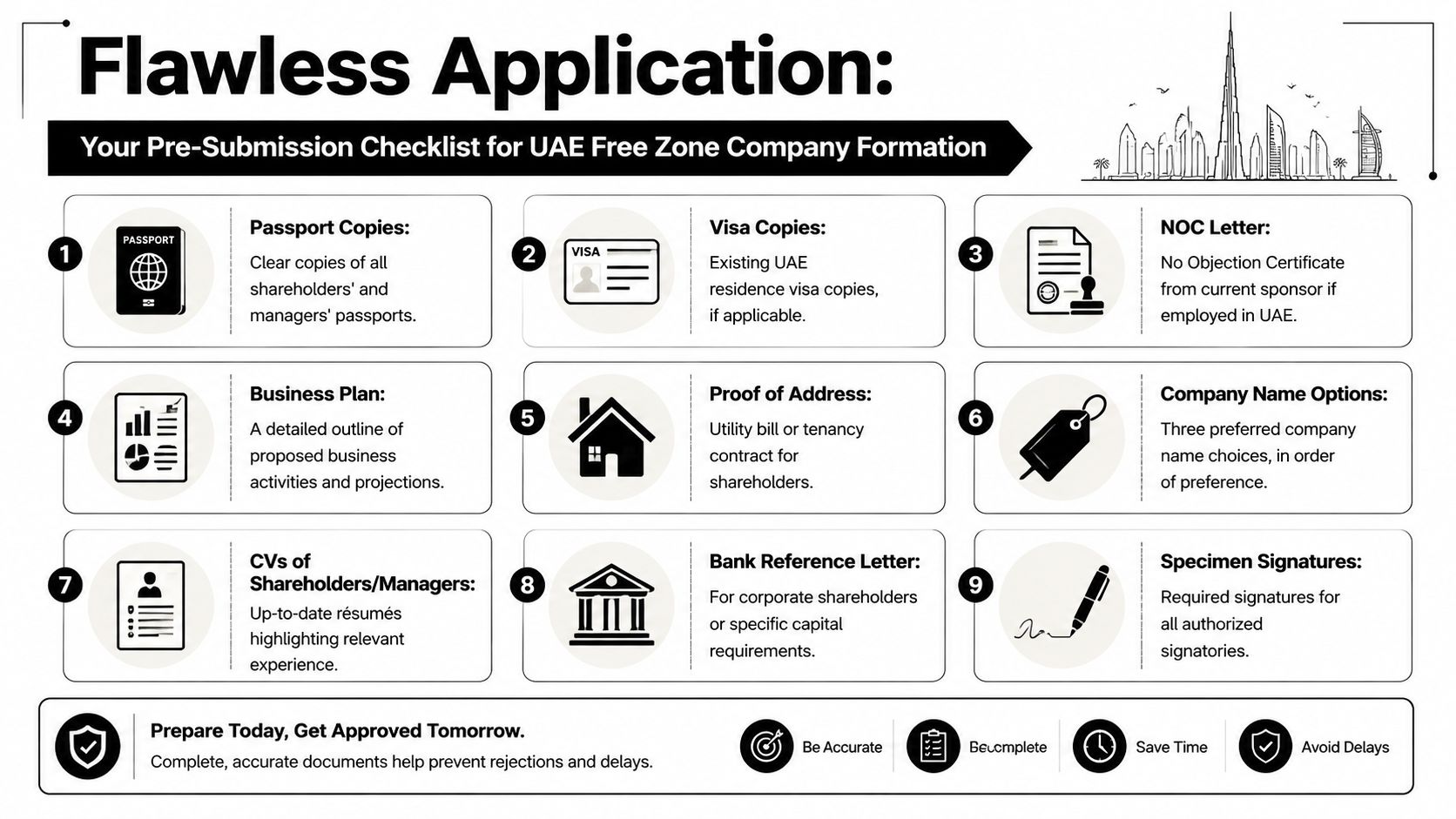
Start with the documents that tend to affect approval quality, not just submission speed:
- Passport copies: Clear copies for each shareholder, manager, and director named in the file.
- Current visa or entry status documents: Existing UAE immigration status can change the next steps.
- Proof of address: This supports both authority checks and later banking review.
- Business activity summary: A plain-language description of what the company will do.
- Trade name options: Several acceptable names, in priority order.
- Supporting profile documents: CVs, corporate records, or references where the authority or bank is likely to ask for them.
The activity summary is where many files weaken. Some founders submit wording that is too broad. Others describe services that do not sit cleanly inside the approved activity. A consultant reads this part with two questions in mind. Will the authority accept it, and will the same wording still hold up when the bank, a client, or an internal compliance team reviews the company later?
Trade name and form accuracy
Trade name reservation causes more friction than founders expect. Names are rejected for conflicts, restricted words, or simple mismatch with the chosen activity. A name that sounds harmless from a branding angle can still create questions if it suggests a regulated service, a financial role, or a line of business the licence does not cover.
Accuracy across the whole file matters just as much. The same spelling, same passport details, same addresses, and same shareholder information should appear everywhere. A minor mismatch can trigger clarification requests, revised forms, or document reissue.
Corporate shareholders need extra care. If one shareholder is another company, the free zone may ask for incorporation documents, board resolutions, and attested papers from the home jurisdiction. That is usually the point where low-cost setup providers get exposed. They submit first and diagnose later. A better approach is to check whether the foreign documents are usable before the application goes in. If you need context on one of the core records in that chain, this guide to a certificate of incorporation in the UAE gives a useful baseline.
The strongest application files read like one coherent record. The activity matches the licence. The name fits the activity. The shareholder documents support the ownership story without gaps.
Where consultants actually save time
Consultants save time in the review stage, not by filling in forms faster.
The primary value is in catching the issues founders usually do not spot on their own. A passport copy that is too faint for compliance review. A business description that sounds broader on the website than in the application. A foreign shareholder resolution signed in the wrong format. A manager listed on one form but not properly supported in the rest of the file.
Smart Classic Business Hub handles this stage as a document control exercise, not an admin task. We review the file the way an authority officer and a bank reviewer are likely to read it. That changes what gets checked before submission.
A proper dry run should cover every signature field, every date format, every identity document, every activity line, and every ownership record. The authority approves the file in front of it. If the file is precise, the process usually stays on track.
Navigating the Setup Process Timelines and Milestones
Once the application is submitted, the founder's expectation often becomes unrealistic in one of two ways. Some think everything will be done within days, including visas and banking. Others assume the process is slow across the board. Reality is more uneven. Incorporation can move quickly. Banking often doesn't.
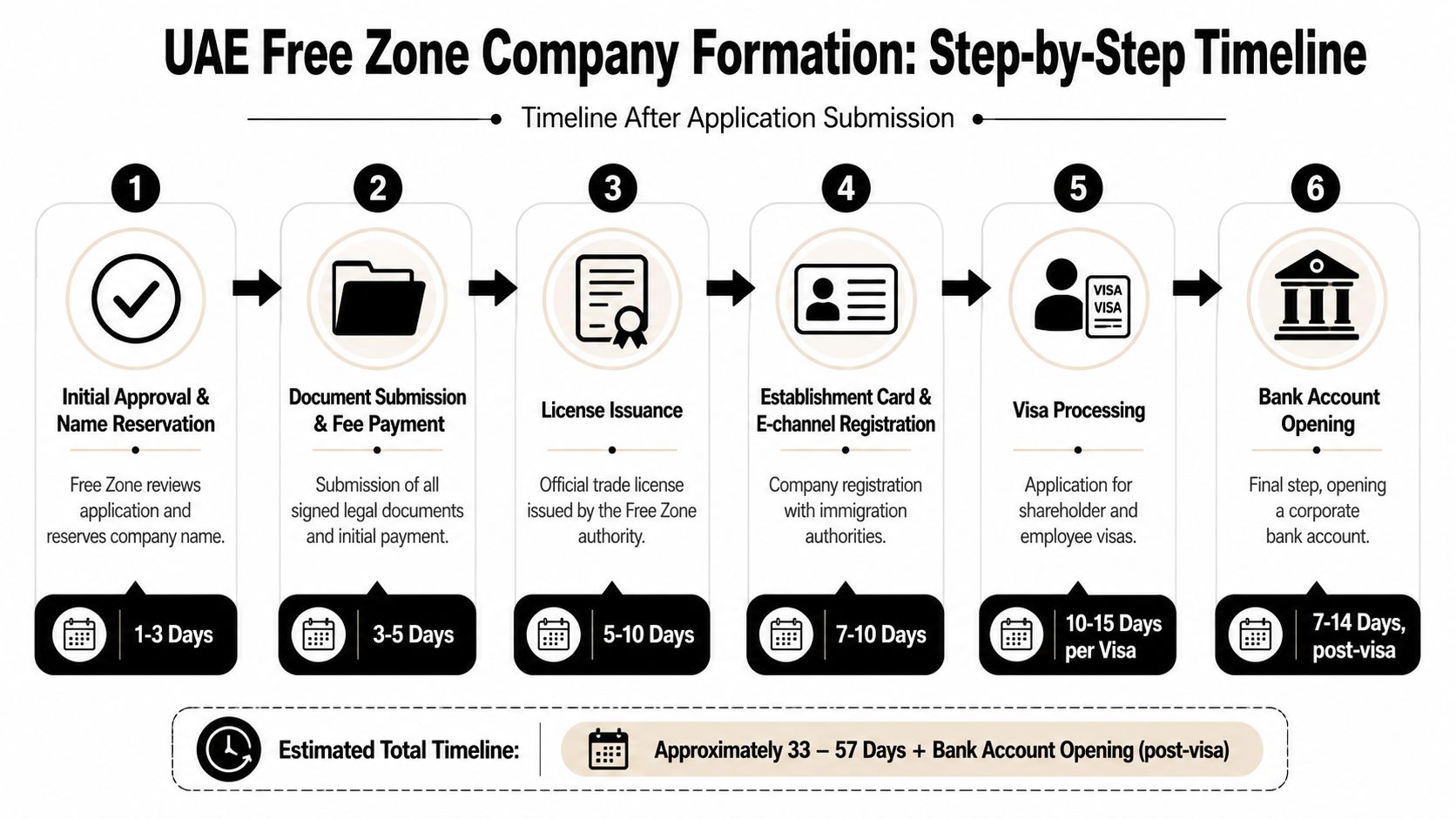
A typical file progresses through approval, licence issuance, immigration registration, visa processing, and account opening. Each stage has its own gatekeeper, and the handover between them is where timing usually changes.
What the timeline looks like on the ground
A practical setup walkthrough notes that licence approval can take 2 to 5 business days, visas often require 10 to 15 working days, and bank onboarding can take 2 to 6 weeks on this UAE setup walkthrough video. For planning purposes, that makes the bank account the primary bottleneck in many cases, not the licence.
That distinction matters because founders often schedule launch activities around the wrong milestone. They celebrate the licence issuance, then discover they still need immigration steps completed and a bank willing to onboard the company based on a credible commercial profile.
The visa stage that founders underestimate
After licence issuance, the next practical track is immigration registration and visas. On paper, this sounds routine. In real files, it requires coordination. Medical fitness steps, biometrics, Emirates ID processing, and status changes all need sequencing.
What causes trouble is poor scheduling. A founder enters the UAE on the wrong assumption, books travel too tightly, or starts employee onboarding before the visa quota and process are fully clear. That doesn't mean the system is unreliable. It means the founder needs a realistic execution plan.
A good working rhythm looks like this:
- Secure the licence first: Don't book downstream commitments before the legal entity is in place.
- Map immigration steps early: Confirm who needs a visa and in what order.
- Prepare for in-person requirements: Some stages can't be rushed by paperwork alone.
- Keep document copies organised: Immigration and banking both depend on a clean file history.
Why bank onboarding is the real test
Banks don't just open accounts because a company has a licence. They assess whether the company's business model is understandable, whether shareholder profiles make sense, and whether the expected transactions fit the stated activity. A clean incorporation file helps, but it doesn't guarantee a fast outcome.
Unwritten rules hold importance. Banks usually want consistency across the licence, website, contracts, shareholder background, and intended use of the account. If the company says it is a consultancy but presents trading-style transaction patterns, questions follow. If the founder can't explain clients, suppliers, source of funds, or commercial rationale clearly, the review slows down.
Open the company with the bank in mind from the start. The authority checks if the file is registrable. The bank checks if the business is credible and usable.
What works in practice
The founders who move fastest usually do three things well. They choose an activity that reflects reality. They prepare a clear narrative for the bank. They avoid treating banking as an afterthought.
What slows cases down is often self-inflicted. Inconsistent business descriptions, no supporting commercial material, unclear source of funds, or a structure that looks neat on paper but makes little sense operationally. A consultant's value here isn't magic. It's sequencing, document discipline, and expectation management.
Decoding the Costs of UAE Free Zone Formation
Cost is where founders are most likely to hear half-truths. One adviser quotes a very low entry number. Another bundles everything into one figure that sounds inflated. Both can be misleading if they don't explain what is and isn't included.
The market is tiered. A lean solo setup has one cost profile. A company with visas and workspace has another. Banking and immigration also affect the actual launch budget even when the incorporation itself is straightforward.
What the market figures actually tell you
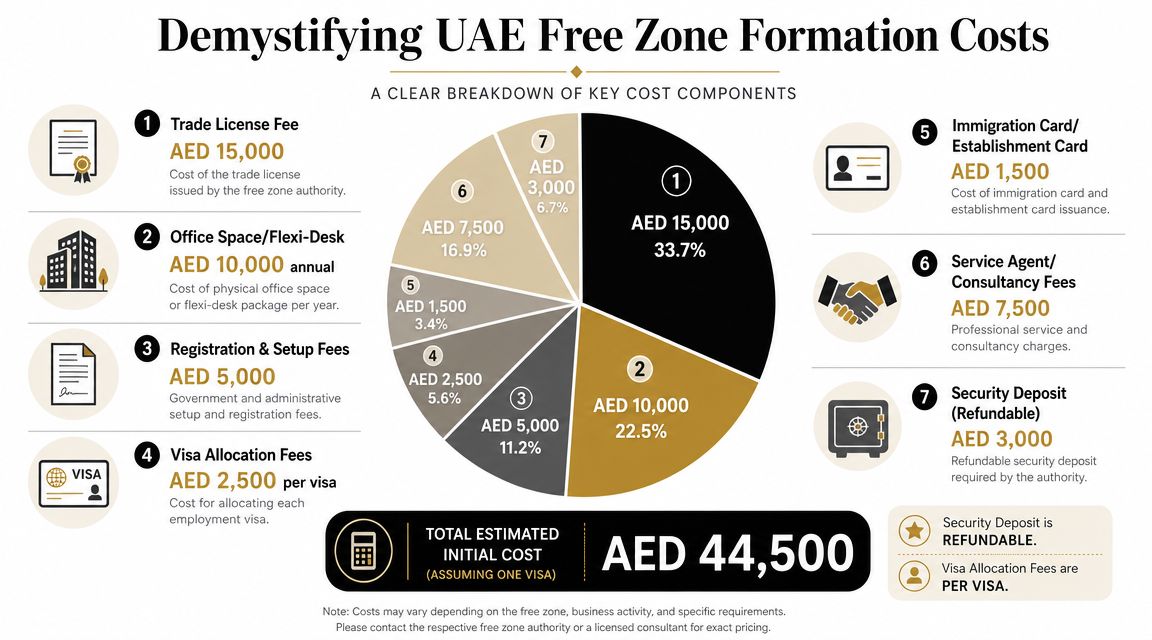
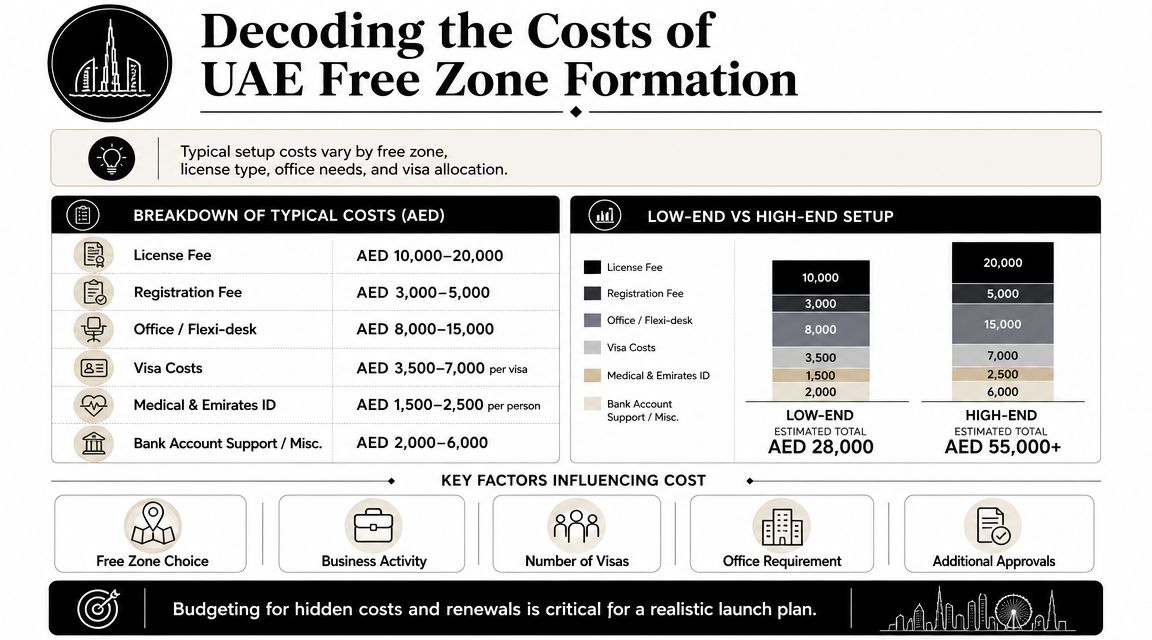
A 2026 setup guide places a basic free-zone company licence at about AED 10,000 to AED 18,000 in the first year, while a company with 1 to 2 visas and a flexi-desk is estimated at AED 18,000 to AED 35,000 on this UAE free zone cost guide. The same source also notes entry-level packages in some zones starting from AED 4,999 to AED 5,500, with broader market commentary placing common startup packages around AED 12,500 for a single-activity licence.
That tells you something important. There isn't one true cost for company formation in a UAE free zone. There is a range based on structure, visa needs, facility type, and the authority chosen.
How to think about your budget
Break the cost into three buckets:
- Formation cost: Licence, registration, and authority fees.
- Operating access cost: Flexi-desk, office requirement, establishment records, and visa-related processing.
- Advisory and document cost: Translation, attestations, drafting support, and coordination where needed.
The cheapest advertised package is often the least useful budgeting tool because it may exclude the practical items a founder needs to become operational. A no-visa, low-entry licence can be perfectly valid for some founders. It is the wrong benchmark for someone who needs residency, staff visas, or a stronger operating footprint.
The hidden costs that surprise first-time founders
Most unexpected costs are not hidden by design. They're just omitted from casual conversations. Founders often forget about foreign document preparation, translation requirements, extra signatures, couriering, and the cost of correcting mistakes after submission.
A more reliable budgeting method is to decide these points first:
| Decision area | Why it changes cost |
|---|---|
| Visa requirement | Adds immigration processing and downstream admin |
| Office type | Flexi-desk and private office setups are priced differently |
| Shareholder profile | Corporate shareholders usually require more paperwork |
| Activity type | Some activities have stricter approval or support needs |
If you want a customized estimate rather than a generic package number, a practical starting point is to review a dedicated Dubai free zone company setup cost calculator and guide. That helps frame the budget around your actual setup model instead of a headline offer.
Low cost only matters if the company can operate properly after incorporation. Founders should budget for the business they intend to run, not just the certificate they want to obtain.
Life After Launch Your Compliance and Growth Partner
Getting the licence is not the finish line. It's the point where the company becomes accountable. Free zone companies still need renewals, immigration follow-up, financial records, and ongoing compliance discipline. Founders who ignore that usually discover the problem when a visa is blocked, a licence renewal is delayed, or a bank asks for records that should already exist.
The obligations that don't go away
A free zone company normally needs attention in four areas:
- Licence renewal: The company must remain active and renewed on time.
- Visa renewals and immigration records: Missed timelines create avoidable disruption.
- Bookkeeping and financial records: Even small companies need organised records.
- Tax and reporting awareness: The company must know what registrations and filings apply to its situation.
Many founders are strong operators but weak record-keepers. That's manageable early on, but it becomes risky as soon as the company starts invoicing regularly, hiring staff, or dealing with more formal counterparties.
Why ongoing support matters
The practical issue isn't just paperwork. It's continuity. The same founder who rushed the initial setup often doesn't want to monitor renewals, government liaison, accounting quality, VAT obligations, audit support where required, and tax changes as the business grows.
That's why setup should be treated as the first stage of a longer operating plan. If you're reviewing the wider tax environment, this practical guide to UAE corporate tax is a useful resource for understanding the compliance context around new and growing entities.
The companies that stay trouble-free tend to do the simple things consistently. They renew on time. They maintain proper books. They don't wait for a deadline notice before fixing their records. That discipline protects visas, banking relationships, and expansion options later.
If you're planning company formation in a UAE free zone and want a setup route based on your real activity, visa needs, and budget, Smart Classic Business Hub can help you assess the right structure, prepare the file properly, and manage the process from incorporation through ongoing compliance.