
You're probably looking at Sharjah for the same reason many founders do. Dubai feels expensive too early, a home office won't support licensing forever, and the cheap listing you found online doesn't tell you whether the space is usable for your company setup.
That's where most office searches go wrong.
People compare rent first, then deal with licensing, municipality approvals, fit-out, access, and contract conditions later. In practice, that order causes delays. A lower headline rent can still become the more expensive choice if the office isn't suitable for your activity, can't support your registration path, or needs extra work before you can occupy it.
Finding Your Business Home in Sharjah
Sharjah is not a fringe option for office-based businesses. It's a serious operating market with scale. Sharjah's non-oil sector contributed AED 142.5 billion to its AED 145.2 billion GDP in 2023, and the emirate's population reached about 1.8 million in 2022, including 1.6 million expatriates according to the official UAE overview of Sharjah. That matters because office demand in Sharjah comes from services, administration, trading, consulting, logistics support, and SMEs, not only from industrial activity.

A practical office search starts with a different question. Not “what's available?” but “what kind of business am I registering, where can it legally operate, and how quickly do I need to start?”
What usually matters most
For most clients searching for offices in Sharjah, the decision comes down to four filters:
- Licence fit: The office has to match the legal structure of the business.
- Occupancy speed: Some spaces are ready for immediate use. Others need approvals, fit-out, or landlord action.
- Cash exposure: Rent is only one line item. Deposits, fit-out, service charges, telecoms, and registration all affect the total budget.
- Mobility: If your team or clients move between Sharjah and Dubai often, location can matter more than a small rent saving.
Practical rule: If the office can't support your licence path, it isn't a cheap office. It's a delay.
A lot of general advice online is too broad to help with that shortlist. If you want a wider framework for evaluating lease options before you commit, this 2026 guide for entrepreneurs and businesses is useful because it helps you think through the decision from an operator's point of view, not just a property listing point of view.
The real decision behind the address
Founders usually think they're choosing a building. They're choosing a compliance path, an occupancy timeline, and a cost structure.
That's why the right office in Sharjah isn't always the cheapest, newest, or largest. It's the one that lets you register properly, move in without avoidable delays, and operate without discovering extra obligations after the contract is signed.
Choosing Your Zone Mainland vs Free Zone Offices
The first major choice is legal, not architectural. Before you compare towers, fit-outs, or rental terms, decide whether your business belongs in the mainland or in a free zone.
This point gets missed constantly in property listings. A listing may show a flexible office, private suite, or commercial unit, but that doesn't automatically mean it's suitable for your trade licence or visa allocation. That gap is one of the most important issues for foreign investors looking at offices in Sharjah, as noted by this Sharjah office market page.
Sharjah Mainland vs Free Zone Comparison
| Feature | Mainland Office | Free Zone Office |
|---|---|---|
| Business reach | Usually chosen when the company wants direct access to the local UAE market | Often chosen for businesses focused on international trade, specific free zone ecosystems, or a streamlined setup path |
| Regulatory authority | Governed through mainland authorities and local approvals | Governed by the relevant free zone authority |
| Office acceptance | The office must match mainland licensing and municipal requirements | The office must meet the free zone's rules for licence issuance and occupancy |
| Flexibility of workspace format | Some activities need a conventional leased office rather than a virtual or lightly bundled format | Some free zones offer more flexible packages, but acceptance still depends on the licence and facility rules |
| Client access pattern | Often better for businesses serving clients across the UAE on a day-to-day basis | Often practical for founders prioritising ownership structure, administrative simplicity, or sector-specific free zone benefits |
| Common mistake | Signing a lease before confirming whether the office fits the intended activity | Assuming any flexi-desk or serviced office automatically qualifies for the intended licence and visa plan |
When mainland usually makes sense
A mainland office is usually the right move when your business will operate directly in the local market, meet clients frequently, or needs a conventional commercial presence outside a controlled zone framework.
This matters for consulting firms, trading businesses with local clients, service providers, and companies that don't want to discover later that their operating model is restricted by where the licence sits.
A cheap office in the wrong legal jurisdiction costs more than a compliant office in the right one.
When a free zone office is the cleaner option
A free zone office often suits founders who want a more contained setup route, sector alignment, or a workspace package that combines address, support services, and administration under one authority. That's why many first-time foreign investors start by reviewing options such as the Sharjah Airport Free Zone setup route.
The attraction is clear. Ownership structure can be simpler, the package can be more manageable, and the setup process is often easier to forecast. But founders still need to verify the office type attached to the package. A desk product, private office, or licence bundle isn't interchangeable across every activity.
What to confirm before you pay anything
Ask these questions before reservation or deposit:
- Activity approval: Is this office format accepted for the exact business activity?
- Visa implications: Does the space support the visa allocation you expect?
- Authority control: Which authority issues the licence and checks the premises?
- Upgrade path: If you need more staff later, can you expand within the same building or zone?
- Usage restrictions: Are client meetings, signage, storage, or daily walk-ins allowed?
Most mistakes happen because people treat office selection as a real estate exercise. In Sharjah, it's a licensing exercise first.
Decoding Sharjah's Commercial Space Options
A founder picks a unit with a low annual rent, signs quickly, and expects to be operating within weeks. Then the actual bill starts. Fit-out drawings, contractor coordination, internet setup, furniture, signage rules, and authority approvals turn a cheap unit into an expensive delay. That is why office type matters as much as location in Sharjah.
The practical choice usually comes down to how much time, capex, and operational complexity the business can absorb in its first few months.
Shell and core space
A shell and core office gives maximum control. It also gives maximum exposure to cost overruns and delays.
This format suits companies that need a custom layout, client-facing branding, specialist rooms, or a larger footprint they plan to use for years. It is less suitable for a new SME that still needs to conserve cash and launch fast. The base rent may look attractive, but the actual commitment includes design work, fit-out approvals, MEP coordination, partitions, flooring, lighting, cabling, furniture, and final snagging before staff can move in.
I usually tell clients to treat shell and core as a project, not a lease. If the business does not have a clear fit-out budget, a reliable contractor, and enough buffer for approval delays, this option often becomes a distraction from the actual launch.
Fitted office space
A fitted office is the middle ground. You usually get a completed internal layout with basics such as flooring, ceilings, lighting, and partitions, but not a fully operational workplace.
For many Sharjah occupiers, this is the most sensible balance between control and speed. It works well for firms that want a conventional office, some branding flexibility, and a shorter setup cycle without building everything from scratch. It also makes budgeting easier because the remaining scope is narrower. You are usually dealing with furniture, IT, branding, and minor alterations rather than a full construction process.
The warning is simple. “Fitted” is a marketing label, not a technical standard. Some units are close to move-in ready. Others look finished in photos but still need electrical work, repairs, internet coordination, or municipality-related adjustments before they are usable.
Fully furnished and serviced offices
A fully furnished or serviced office reduces setup friction and gives the clearest path to occupancy. For startups, small teams, and foreign founders who need an address, working space, and basic support from day one, this is often the most efficient route.
In Sharjah, business centres in areas such as Al Majaz and Al Nahda commonly package furniture, Wi-Fi, reception support, meeting room access, cleaning, and shared amenities under one monthly or annual fee. Providers in locations such as Al Fardan Centre and Sahara Healthcare City are typically chosen for speed and convenience rather than deep customization.
That convenience has a trade-off. The headline price may look higher than a conventional lease, but the all-in cost can still be lower once you remove fit-out spend, office equipment purchases, service activation, and the staff time needed to manage multiple vendors. The opposite is also true. A cheap serviced package can become poor value if meeting room use, visa capacity, parking, signage, Ejari-style registration requirements, or security deposits are more restrictive than expected.
The smaller the team and the shorter the launch timeline, the more a serviced office tends to make commercial sense.
A practical way to choose
Use the decision that matches your operating reality:
- Choose shell and core if the business needs a customized layout, has fit-out budget available, and can tolerate a longer pre-opening period.
- Choose fitted if the business wants a standard office with moderate customization and fewer moving parts.
- Choose serviced if the priority is speed, lower upfront setup work, and a clearer all-in operating cost.
Poor decisions usually come from underestimating execution risk. Founders assume contractors will finish on time, approvals will come through quickly, and small setup tasks can be handled in parallel. In practice, each unresolved item can delay licence progress, staff onboarding, or client-facing operations.
The Step-by-Step Leasing and Registration Process
A good office search becomes a problem if the paperwork sequence is wrong. In Sharjah, delays rarely happen because a landlord takes too long to discuss rent. They happen because the office documents, compliance status, signatory paperwork, or authority approvals aren't lined up properly.
For Grade-A benchmarking, Citygate Office Tower is marketed at AED 60 to AED 75 per ft², and a common pitfall is assuming a marketed office is immediately compliant when municipality approvals or fit-out clearances are still pending, as shown in this Sharjah office listing benchmark.
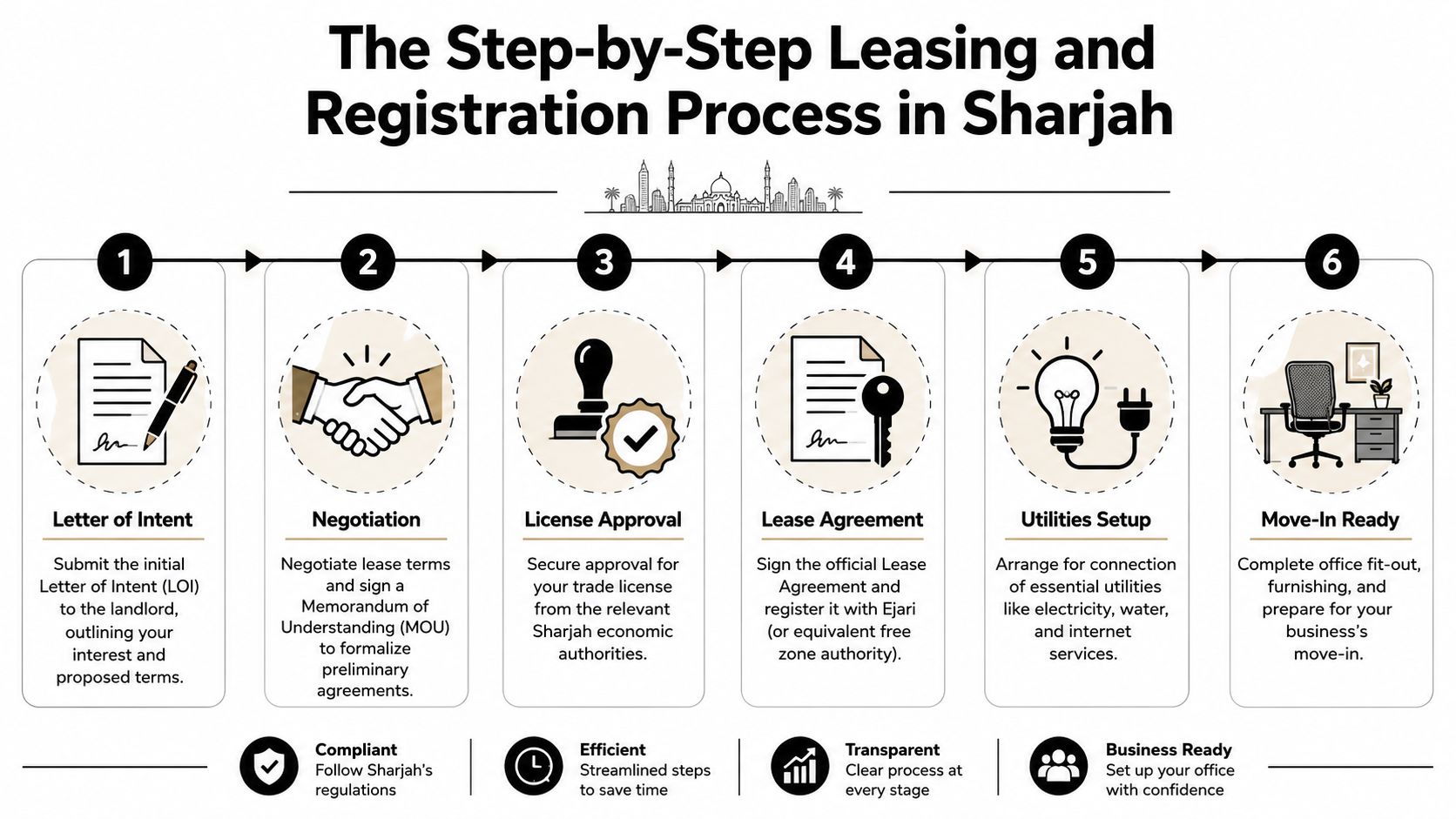
1. Shortlist only compliant candidates
Don't start with the prettiest unit. Start with the units that appear licensable for your activity and workable for your timeline.
At this stage, check the building classification, landlord readiness, current fit-out status, and whether the premises are already approved for the intended commercial use. If something is still “in process”, treat that as a delay risk, not a minor footnote.
2. Submit the commercial offer or LOI
The Letter of Intent or commercial offer usually records the headline terms before the final contract. During this phase, many tenants focus only on annual rent.
That's too narrow. The better negotiation points are often:
- Rent-free period: Useful if you need time for mobilisation or minor fit-out.
- Included items: Clarify whether parking, service components, furniture, meeting room use, or utilities are bundled.
- Commencement date: It should reflect actual handover readiness, not only signature date.
- Renewal logic: Avoid vague renewal language if continuity matters to your licence or client-facing location.
3. Verify signatory documents early
A surprising number of office activations stall because the tenant isn't document-ready. If the signatory is overseas, if the company is still being incorporated, or if the shareholder resolution isn't aligned with the lease signer, the deal can pause at the wrong moment.
For serviced and flexible offices, operators commonly ask for identity documents and signatory paperwork before activation. For conventional leases, landlords and authorities may also need corporate documents that clearly support who has authority to sign.
If the authorised signatory chain is unclear, the office isn't ready to lease yet.
4. Check approvals before you plan your opening date
This situation causes founders to lose time. A landlord may say the office is available. That doesn't mean it's cleared for immediate occupation.
Look for three practical checkpoints:
- Building permit status
- Fit-out approval status
- Completion or occupancy-related municipal documentation
If any of those are incomplete, your opening timeline is uncertain.
5. Execute the lease and register it properly
Once terms are agreed and the document set is complete, sign the formal lease. Then make sure the tenancy is registered through the correct channel for that jurisdiction, whether mainland registration or the equivalent process within the relevant free zone framework.
A signed lease that isn't properly registered may not support the next steps you need for licensing and operations.
6. Treat move-in as a controlled launch
After signature, founders still need utilities, internet, access cards, furniture completion, branding, and internal readiness. A move-in date should be based on all of those being complete, not only on getting the key.
The most reliable Sharjah office setups are the ones where leasing, compliance, and operations are handled as one sequence rather than three separate tasks.
Budgeting Your Sharjah Office Uncovering the Real Costs
Most articles become unhelpful at this point. They mention broad listing prices, then stop. That doesn't answer the question a founder has, which is whether the office is affordable once everything required to occupy and use it is included.
That gap shows up clearly in Sharjah office sale content, where listings may quote AED 450,000 to AED 30 million with an average around AED 3.7 million, but still fail to explain how location, building class, and licensing needs affect the total cost of occupancy, as noted by this Sharjah office market overview.
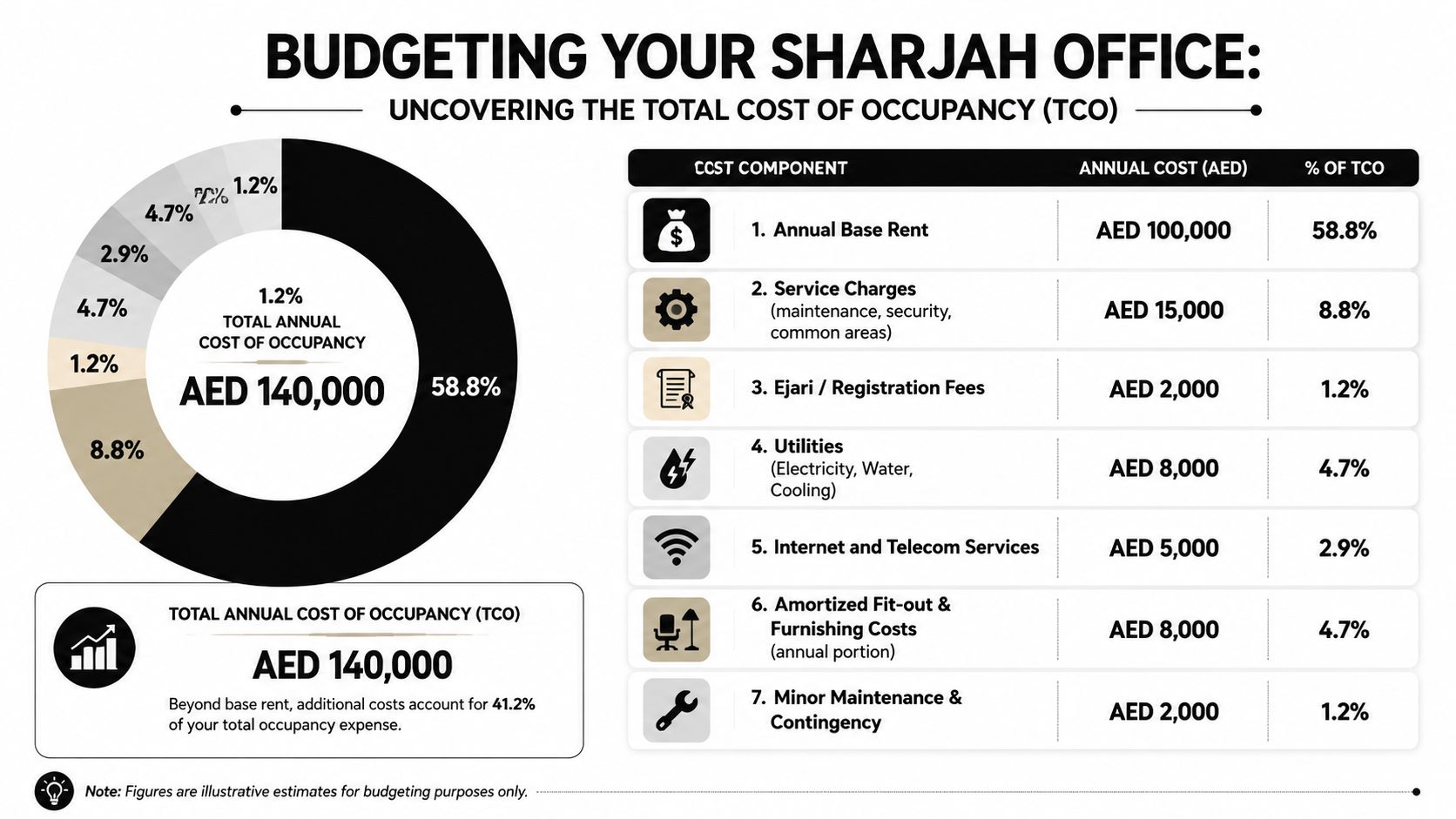
What the headline rent does not tell you
The listed rent is only the entry point. The actual budget usually includes a wider set of costs that affect cash flow from the first day.
Common cost lines include:
- Deposit exposure: Security deposits tie up cash even before operations begin.
- Service charges: Building maintenance, common areas, and shared operational costs can materially change occupancy cost.
- Fit-out and furnishing: Shell and core is the obvious example, but even fitted space often needs work.
- Telecoms and utilities: Internet activation, electricity, water, and related setup costs are often separate.
- Registration and document costs: Contract registration and supporting paperwork still need budgeting.
- Access costs: Parking, extra access cards, meeting room usage, or after-hours support can appear outside the base rent.
Why “cheaper than Dubai” can be the wrong question
Sharjah often enters the conversation because founders want lower occupancy costs than Dubai. That's a valid reason, but it isn't enough on its own.
A Sharjah office only becomes the better value if three things are true:
| Decision test | Why it matters |
|---|---|
| The office supports the intended licence | A cheaper space that can't support your setup path is wasted time |
| The building is actually occupiable | Missing approvals can delay launch and extend your pre-revenue period |
| The transport pattern works | If clients and staff are constantly crossing emirates, location friction becomes an operating cost |
A more useful budgeting method
When reviewing offices in Sharjah, build two numbers for each option:
Entry cost
This is the cash you need before or at signing and activation.Operating cost
This is what the office will cost you to run each month once the team is inside.
That simple split gives a clearer picture than annual rent alone.
Reality check: Founders rarely regret rejecting an office that looked cheap on paper. They often regret signing one before calculating what it takes to use it properly.
The better office is the one with a cost structure your business can carry comfortably while it grows. That usually means fewer surprises, not only lower rent.
Exploring Flexible Alternatives to a Traditional Lease
A founder signs for a full-year office, then discovers six months later that the team only uses half the space, the visa package is misaligned, and the business still needs meeting rooms in a different part of Sharjah. That is an expensive way to learn that flexibility has real value.
For many new market entrants, a traditional lease is too rigid at the start. A coworking desk, serviced office, or virtual office can reduce upfront commitment and shorten setup time, but only if the package matches the licence route and operating plan. The wrong flexible option still creates delays, duplicate paperwork, and wasted spend.
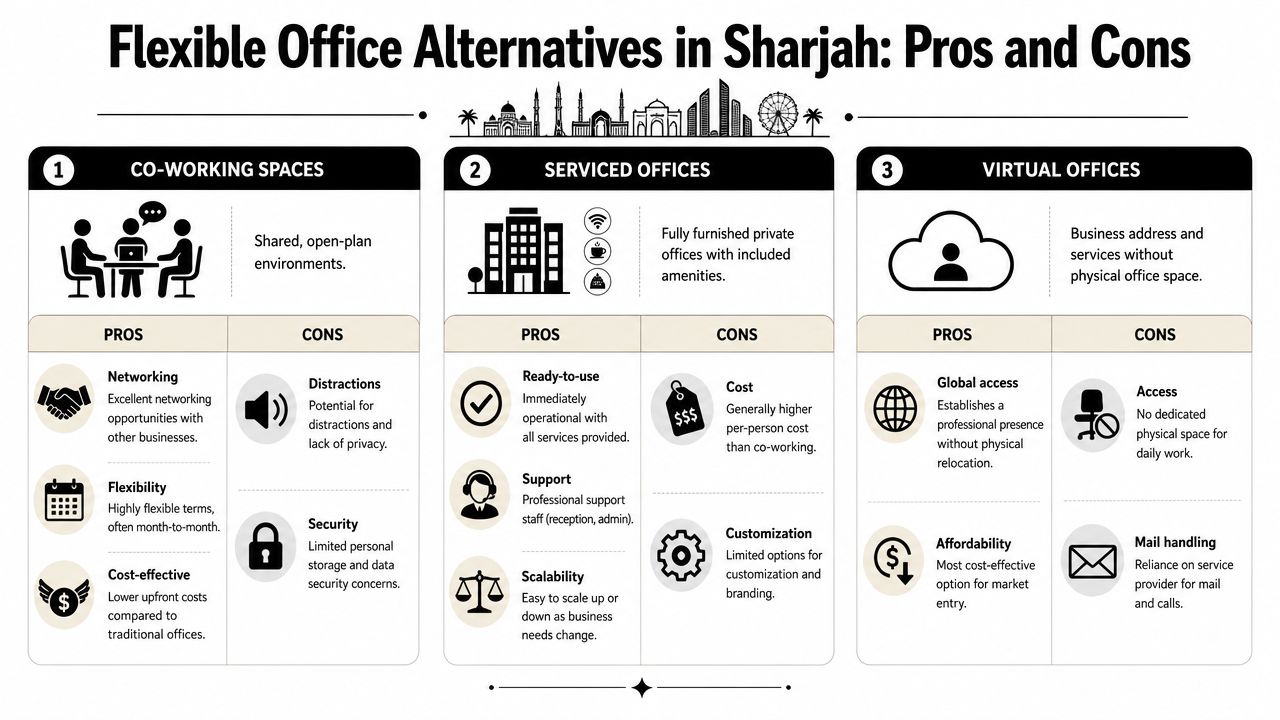
Which flexible format fits which business
| Format | Works well for | Watch-outs |
|---|---|---|
| Coworking | Freelancers, solo founders, very small teams, early-stage market testing | Less privacy, shared facilities, and limited suitability for some regulated or client-facing activities |
| Serviced office | SMEs, consultants, trading support teams, companies that need to start operating quickly | Bundled pricing can look simple, but meeting room caps, signage limits, and deposit terms still need checking |
| Virtual office | Early market presence, mail handling, businesses with minimal physical usage | Physical access is limited, and many founders assume it works for every licence when it does not |
Serviced offices are often the practical middle ground. They usually include reception, internet, furniture, cleaning, and some meeting room access. That saves time more than it saves money. In Sharjah, speed matters when the business needs to activate operations quickly without spending weeks managing fit-out, utilities, and facility vendors.
That said, bundled does not mean all-inclusive.
Operators may charge separately for extra meeting hours, printing, access cards, parking, signage, Ejari-style tenancy documentation where applicable, or after-hours air conditioning. Ask for the full commercial sheet before paying a reservation amount. I also advise clients to ask one blunt question early: which documents will the operator issue for licensing, banking, and immigration processing, and how long will that take?
Where founders misjudge flexible workspace
The usual mistake is treating flexibility as a purely commercial decision. It is also a compliance decision.
Before committing to any coworking desk, virtual office, or serviced suite, confirm these points:
- Licence compatibility: The space must be accepted for the intended business activity and setup route.
- Visa allocation: Some packages support only a limited number of visas, or none at all.
- Registration documents: The operator should confirm what tenancy or occupancy documents will be issued and whether they match authority requirements.
- Use case fit: A sales rep who works remotely has different needs from a medical consultancy, training business, or trading company with regular client visits.
- Upgrade path: If headcount grows, check whether you can move into a larger office in the same facility without changing address.
Space efficiency matters even in a small office. A poorly planned 250 square foot suite can feel more restrictive than a well-organized smaller unit. This guide on how to optimize office space efficiently is useful if you want to plan desk layout, storage, and meeting flow before the team moves in.
Some companies also benchmark Sharjah against nearby workspace models before they commit. Reviewing options such as coworking spaces in Dubai helps clarify whether the business needs low-cost desk access, a private suite, or a more formal address that supports client meetings and future expansion.
Flexible offices work well for companies that need a compliant base now and the freedom to change format later. The right choice is the one that supports the licence, keeps documentation clean, and avoids paying for space the business cannot use yet.
From Office Lease to Full Company Operation
A signed office contract is not the finish line. It's the document that enables the rest of the company setup process.
Once the tenancy is properly executed and registered through the relevant authority, you can move into the next operational steps. That usually includes trade licence issuance, immigration file setup, labour-related processing where required, and visa applications for owners or staff. If the lease paperwork is incomplete or inconsistent, everything behind it slows down.
What the office enables
The office is often the foundation for:
- Licence processing: Authorities usually need proof of premises that match the business setup route.
- Immigration and labour files: These depend on the company being fully established and documented.
- Banking and administration: Many practical business tasks become easier once the company has a proper registered address and complete setup file.
- Team mobilisation: Staff visas, onboarding, and internal operations usually sit downstream from the office and licence.
Where founders lose momentum
The lease gets signed, then the file stalls because someone still needs attestations, translations, authority submissions, or follow-up with multiple departments. That's where professional support becomes useful.
A consultancy such as Smart Classic Business Hub handles company formation, PRO coordination, compliance support, and Sharjah-related setup pathways, including guidance relevant to companies in Sharjah Free Zone. For many founders, that matters less as a convenience and more as risk control. The fewer handovers between landlord, authority, signatory, and licensing file, the fewer preventable delays.
The office decision is only successful when the business can operate from that address. That means the lease, the licence, and the post-licensing steps all have to align.
If you're weighing offices in Sharjah and want a practical view of licensing fit, lease structure, and the actual setup path after signing, Smart Classic Business Hub can help you assess the options, organise the paperwork, and move from office search to a compliant company launch without unnecessary delays.