
You're probably looking at Abu Dhabi because the setup looks fast on paper. You can register online, move quickly, and get a trade licence without the kind of bureaucracy founders used to expect in the region.
That part is real. What catches many new business owners off guard is what happens after the licence arrives. The company exists, but the bank account is still pending. The visa process is still moving. The office evidence, compliance file, and supporting documents still need to line up before the business can trade smoothly.
That's where most practical mistakes happen in company formation in Abu Dhabi. Not in choosing a trade name, but in choosing the wrong structure, the wrong activity, or the wrong assumptions about what “setup complete” really means.
Why Choose Abu Dhabi for Your Business
Abu Dhabi works well for founders who want a serious base, not just a licence certificate. The emirate sits inside a business environment that has scaled quickly and become much easier to manage digitally. Across the UAE, the number of registered companies reached 1.021 million by mid-2024, up 152% from 405,000 at the end of H1 2020, according to this report on UAE business growth. The same reporting notes that setup can be completed in as little as 15 minutes through Basher.
That shift matters because it changes how founders should plan. The old model was slower and more document-heavy from the first day. The current model lets you move quickly through the filing stage, but it also punishes poor preparation. If your activity needs extra approvals, if your legal form doesn't match your operations, or if your bank file is weak, speed at the licence stage won't save you later.
What founders usually want from Abu Dhabi
Most clients who choose Abu Dhabi are trying to solve one of three problems:
- Market access: They want a base that can support local UAE business, regional expansion, or both.
- Regulatory clarity: They don't want to spend months figuring out whether their activity is even permitted.
- Operational credibility: They need a company structure, visa path, and banking profile that counterparties will take seriously.
Abu Dhabi can support all three. But the right outcome depends less on the city itself and more on whether the setup is aligned with the actual business model.
Speed helps, but only if the file is clean
A digital-first system like TAMM or Basher reduces friction at the front end. It doesn't remove decision-making. Founders still need to decide where to incorporate, which activity to register, which legal form to use, and whether the activity triggers external approvals.
Practical rule: Fast incorporation is useful. Fast incorporation with the wrong activity or incomplete post-licensing plan creates expensive rework.
The strongest Abu Dhabi setups are usually boring in the best possible way. The activity is matched correctly. The ownership structure is clear. The tenancy or office arrangement supports the application. The shareholder documents are consistent across all stages. That's what makes the process feel smooth.
Why Abu Dhabi is a strategic choice, not just an administrative one
Abu Dhabi is attractive because it combines institutional stability with a setup environment that no longer feels stuck in paperwork. That appeals to first-time founders, international investors, and existing businesses opening a UAE arm.
The mistake is treating Abu Dhabi as a place where you “open a company” and start operating the same afternoon. The better way to think about it is this: Abu Dhabi gives you a fast doorway into the market, but you still need a properly built business structure on the other side of that door.
Choosing Your Path Mainland Free Zone or Offshore
Your first real decision isn't the trade name. It's the jurisdiction.
That choice determines where you can operate, how you'll contract, what kind of office evidence you may need, and how easy your company will be to explain to a bank, a client, or a government counterparty.
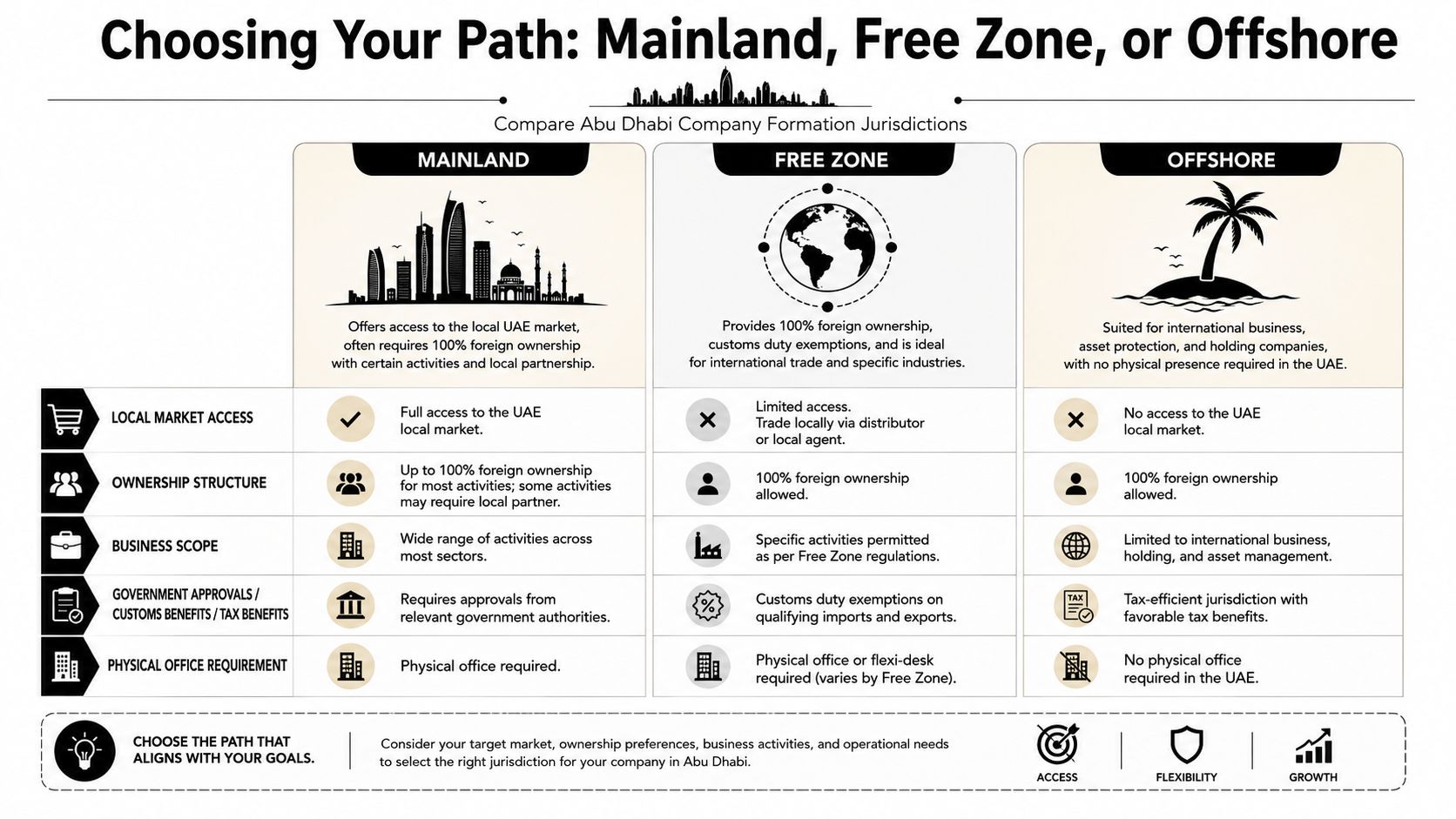
Mainland vs Free Zone vs Offshore at a Glance
| Criterion | Mainland | Free Zone | Offshore |
|---|---|---|---|
| Local market access | Direct access to the UAE market | Usually suited to operating within the zone or internationally, with local market access handled through the right structure | Not the practical choice for trading directly in the UAE market |
| Ownership structure | Depends on the activity and legal route chosen | Commonly used where founders want full foreign ownership within the zone framework | Commonly used for international ownership and holding purposes |
| Business scope | Broad operating flexibility inside the UAE, subject to approvals and activity rules | Often a strong fit for cross-border services, trading, or sector-specific ecosystems | Usually used for holding, asset ownership, or international structuring rather than active local operations |
| Government approvals | Can involve multiple authorities for regulated activities | Depends on the free zone and the business activity | Depends on intended use, but not usually structured for mainstream onshore operations |
| Physical office requirement | Often tied to licence conditions and tenancy evidence | Varies by free zone package and activity | Typically lighter physical presence expectations |
Mainland works when local access matters
If you plan to invoice UAE clients directly, lease premises in the local market, or pursue work that depends on an onshore presence, mainland is usually the cleaner route.
This is often the best fit for consulting firms with domestic clients, retail businesses, service providers that need local visibility, and companies that expect to hire and expand inside the UAE under a straightforward operating model.
Mainland also tends to be easier to explain when your business model is clearly local. If the company will sell, deliver, and employ locally, the structure should reflect that.
Free zone works when the business model is focused
Free zones suit founders who know exactly how they'll operate. That may mean international trading, remote services, digital delivery, or a business that benefits from being inside a specific ecosystem. If you're still exploring options, review a practical overview of Abu Dhabi free zone setup options before committing.
The trade-off is that some founders choose a free zone because it looks simpler at the start, then discover the structure doesn't fit how they want to sell. A cheap or fast setup becomes expensive when contracts, banking, or local commercial activity need a different arrangement later.
Offshore is narrower than many founders think
Offshore structures have legitimate uses, but they're not a default answer for someone who wants to run an active business in Abu Dhabi. They're generally considered for holding assets, international structuring, or specific ownership purposes.
If your real aim is to hire staff, secure residency, open a straightforward operational bank account, and trade in the UAE, offshore often isn't the practical path.
The right jurisdiction is the one that matches how money will move, how contracts will be signed, and where the company will actually operate.
A simple way to decide
Use the business model, not the brochure.
- Choose mainland if your customers are in the UAE and you need an operational onshore presence.
- Choose free zone if your model is international, specialised, or suited to the rules of a particular zone.
- Choose offshore only if the company's purpose is ownership, structuring, or international holding rather than day-to-day local trading.
Founders get into trouble when they optimise for setup convenience instead of operational fit. Jurisdiction should support the next few years of the business, not just the next few days of paperwork.
Selecting the Right Licence and Legal Form
Once the jurisdiction is decided, the next issue is precision. You don't just open a company. You open a company for a defined activity under a defined legal form.
The UAE recognises 6 main types of economic licences and more than 2,000 economic activities, and the country issued more than 200,000 new economic licences in 2024, according to this summary of UAE licensing growth. That gives founders flexibility, but it also means there's plenty of room to choose badly.
Start with the activity, not the company name
Founders often start with branding. Regulators start with activity.
If the business will provide consulting, the activity needs to reflect that. If it will trade goods, distribute products, manufacture items, or provide a regulated service, the licence category and approval path may change. The activity also influences whether you'll need third-party approvals later.
A mismatch here causes unnecessary complications. The licence may be issued, but your contracts, invoices, visa allocations, or bank review can become more difficult if the activity doesn't match what the company does.
Licence type answers one question
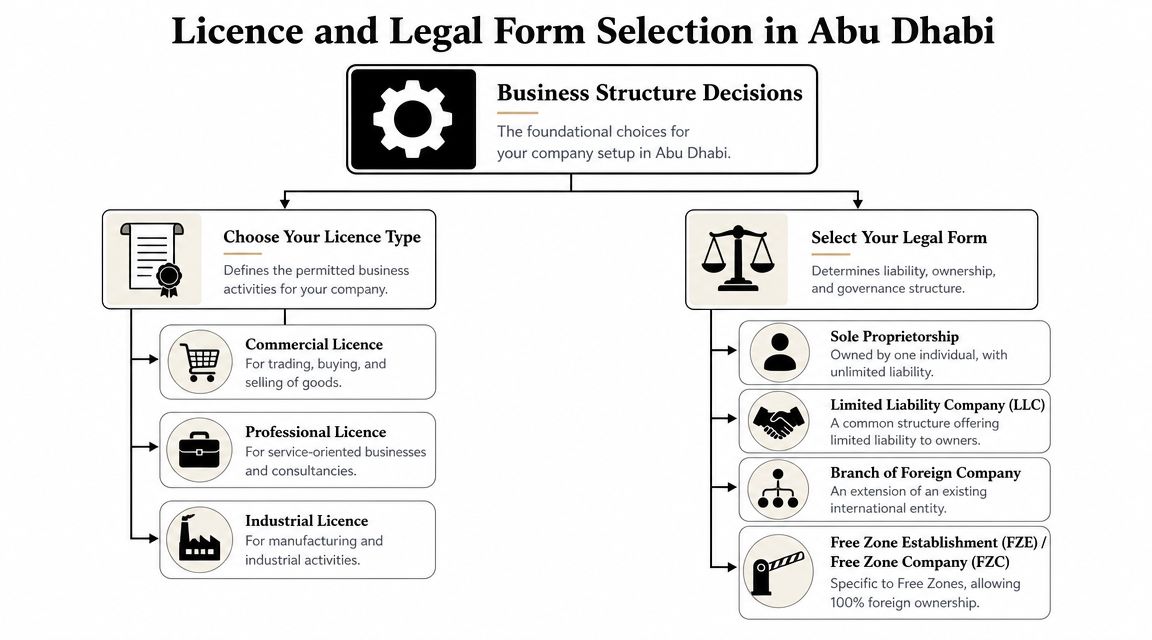
Your licence type defines what the company is allowed to do. In practical terms, founders usually think in categories such as:
- Commercial licence: Used for trading, buying, selling, and broader commercial operations.
- Professional licence: Used for service-based businesses, advisory work, and many consultancy models.
- Industrial licence: Used where manufacturing or industrial processing is central to the business.
The broader framework also includes other recognised categories. What matters is choosing the one that fits the core operating activity, not forcing the business into a category because it seems easier to obtain.
Legal form answers a different question
Your legal form determines how the company is legally built. It affects liability, governance, ownership presentation, and how the company interacts with banks and counterparties.
Common structures include:
- Sole proprietorship or sole establishment for some individually owned activities
- Limited Liability Company where a more standard operating company structure is needed
- Branch of a foreign company when an existing overseas entity is extending into Abu Dhabi
- Free Zone Establishment or Free Zone Company where the chosen free zone uses those forms
Operational advice: Choose the legal form based on liability, ownership clarity, and future expansion. Don't choose it purely because someone said it's “the quickest”.
What works in practice
A solo consultant may be well served by a professional activity and a simple legal form that doesn't create unnecessary administration.
A trading business importing and selling products needs a structure that supports commercial activity, contract execution, and banking scrutiny.
A foreign company opening a UAE presence shouldn't automatically create a fresh standalone entity if a branch structure is more suitable for its reporting and ownership needs.
The key is alignment. When the licence type, legal form, and actual operations tell the same story, the rest of the process becomes easier.
The Company Registration Workflow Explained
The official process is structured, with each stage depending on the one before it. Abu Dhabi's workflow follows a 7-step sequence: choose the activity, select the legal form, register the trade name, obtain initial approval, complete contractual agreements, secure any additional approvals, then submit documents and pay fees to obtain the licence, as outlined by the Abu Dhabi Registration and Licensing Authority.
Digital filing through Basher can take 15 minutes, but that only describes the filing layer. It doesn't remove the need for the underlying documents and approvals to be right.
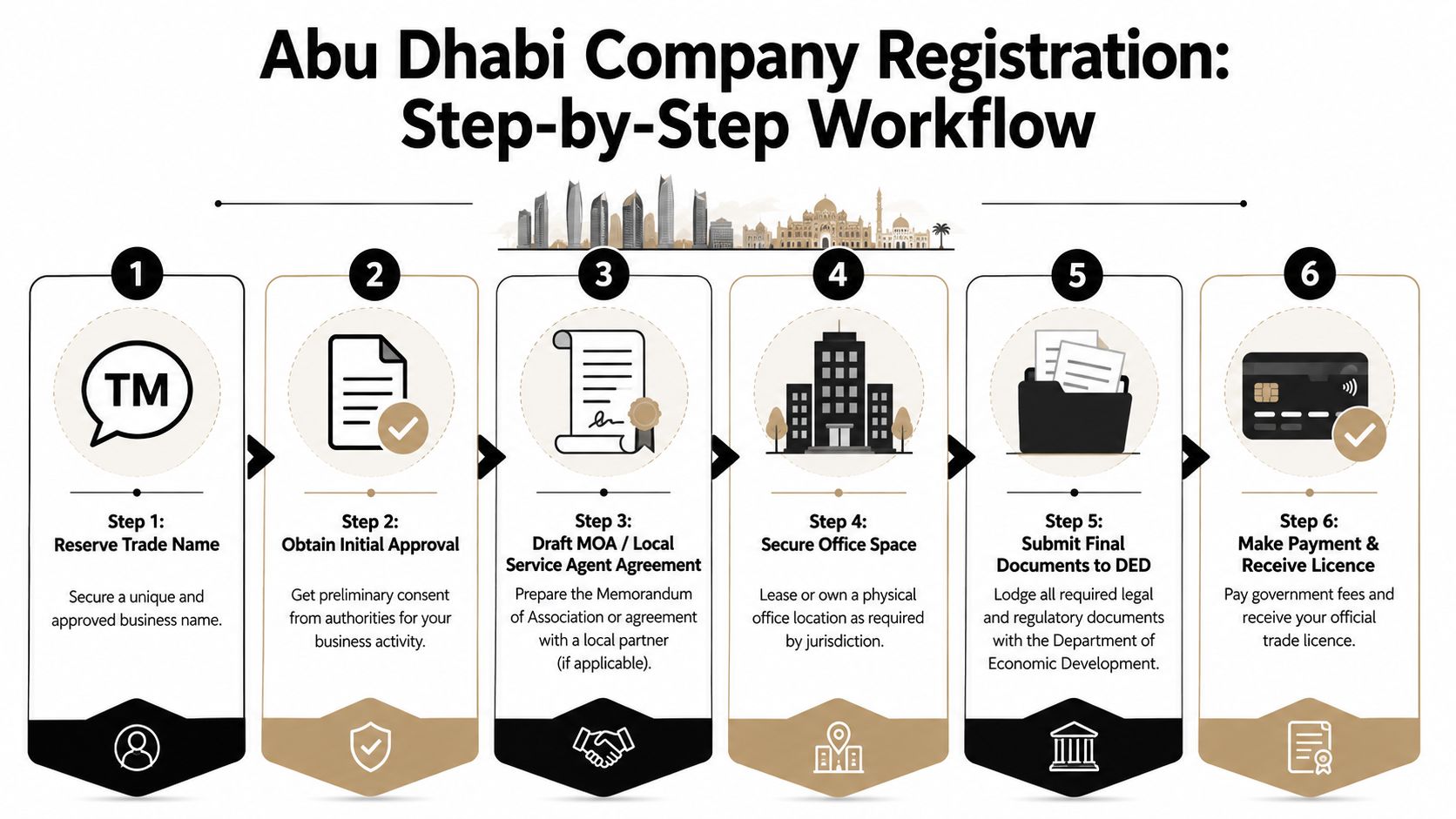
Trade name and initial approval
The trade name stage looks simple, but it's often the first sign of whether the application has been properly thought through. The name should fit the planned activity and legal form. If the branding suggests one kind of business while the registered activity suggests another, it can create unnecessary questions later.
Initial approval is where the authorities effectively say the proposed structure can move forward in principle. It isn't the final green light to operate, and founders shouldn't treat it that way.
Contractual documents and office evidence
Once the early approvals are in place, the file usually moves into contracts and supporting records. Depending on the structure, that may include constitutional documents, shareholder agreements, or related formation paperwork.
Office evidence matters more than some founders expect. Even where digital setup feels quick, the practical file may still depend on tenancy, lease support, or location-related documentation. If that evidence is weak, inconsistent, or obtained too early before the activity is confirmed, the process can become messy.
Additional approvals are where delays begin
This is the stage many founders underestimate. If the activity is regulated, additional approvals may be required from authorities such as Abu Dhabi Municipality, the Department of Health, or the Department of Culture and Tourism Abu Dhabi, as noted in the official workflow.
That doesn't mean regulated activities are a problem. It means they need to be identified early. If you wait until after initial approval to discover that another authority must review the file, timelines stretch and documents often need to be revised.
Regulated activities don't fail because they're impossible. They fail because founders discover the regulatory path too late.
Final submission and licence issuance
When the file is complete, the final submission stage is usually straightforward. The company pays the required fees, the authority reviews the completed application, and the trade licence is issued.
That's the moment most marketing material focuses on. In practice, it's a milestone, not the end of the setup journey.
What usually works and what usually doesn't
What works:
- Pre-checking the activity: Especially if the business touches healthcare, tourism, education, media, or another regulated area.
- Building the document pack early: Passport copies, corporate documents, and tenancy-related records should be internally consistent.
- Treating filing and approvals as separate issues: A quick portal submission doesn't mean the overall process is automatic.
What doesn't work:
- Choosing a “close enough” activity: That often creates friction later in banking or compliance.
- Signing premises too early: If the licence conditions change, the property arrangement may need rework.
- Assuming the portal will guide strategy: Portals process applications. They don't design the right structure for you.
After the Licence Visas Banking and Compliance
Many founders realise their launch date is later than they thought.
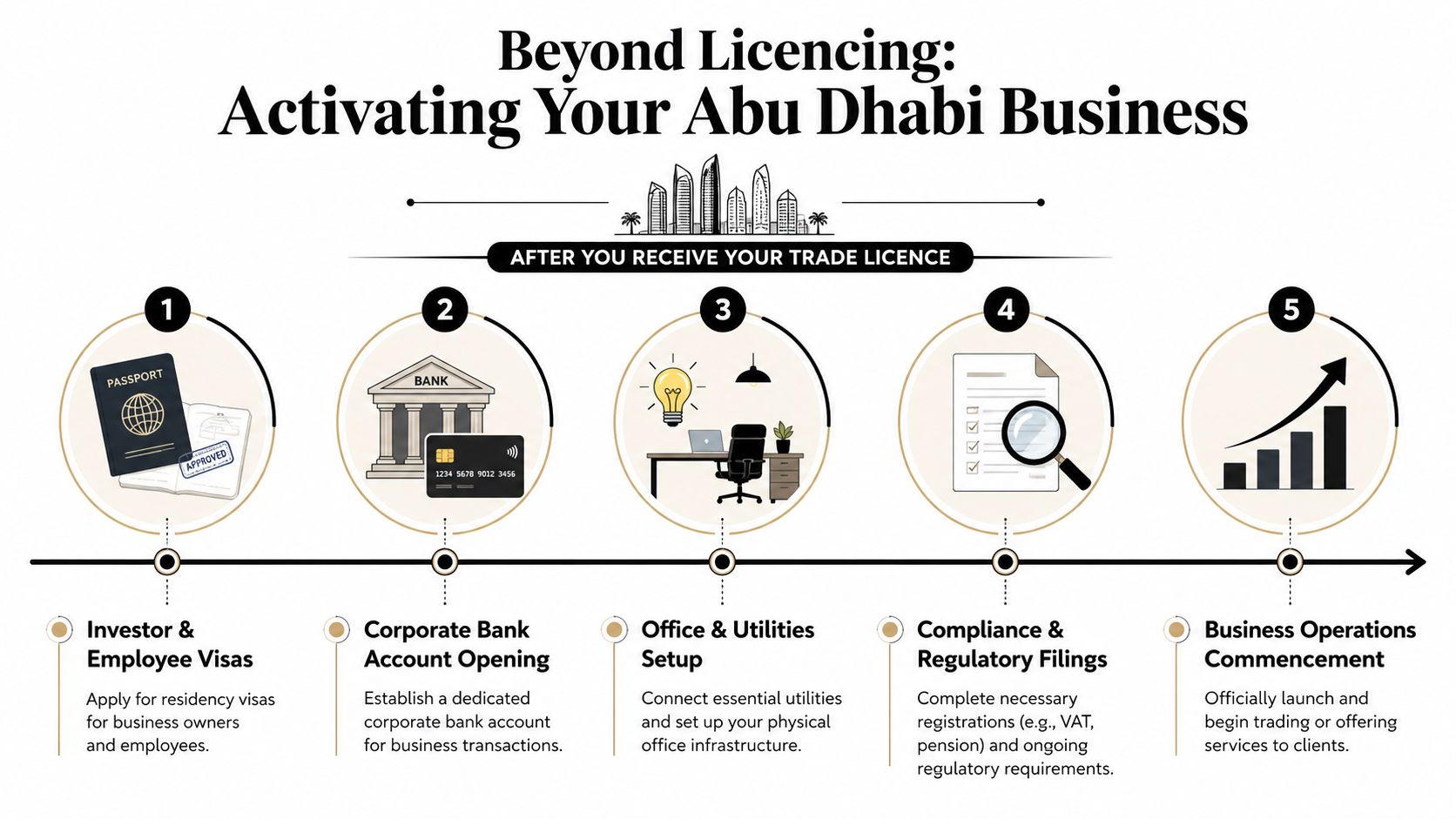
Receiving the trade licence feels like the finish line, but post-licensing readiness is often the actual bottleneck. Neutral setup guidance estimates around 1 week for initial planning and document preparation, up to 4 weeks for registration and licensing, 2 to 3 weeks for visa processing, and 6 to 8 weeks for corporate bank account opening, according to this UAE setup guide from Hawksford.
Visas are procedural, but still need planning
Investor and employee visas are usually manageable if the company file is clean and the office and licensing position support the applications.
Problems tend to appear when founders haven't aligned the visa plan with the actual structure. If the business expects to onboard staff quickly, that needs to be considered before the licence is issued, not after. Visa work is an operational track of its own, and it should be treated that way.
Banking is often the slowest part
Bank account opening deserves its own checklist and timeline. It is not an automatic add-on to incorporation.
Banks commonly ask for documents such as the trade licence, certificate of incorporation, MOA or AOA, share certificates, board resolution, passports, and personal bank statements for the last six months. Even where the business itself is legitimate and straightforward, delays happen when the company's activity isn't easy to understand, when the ownership trail is incomplete, or when the operational story is still vague.
If you're comparing practical options, this guide to good banks for business accounts in the UAE is useful as a starting point.
Banking reality: The bank wants to understand who owns the company, what it does, where funds come from, and how transactions will make sense once the account is live.
Compliance starts immediately, not later
Founders often postpone compliance thinking they'll handle it after revenue starts. That approach creates avoidable stress. Once the company exists, record-keeping, document maintenance, and any applicable regulatory registrations should be managed from the beginning.
A clean compliance posture also helps with banking, renewals, and future growth. When documents are scattered, unsigned, or inconsistent, every later process becomes slower.
The practical launch mindset
Treat the trade licence as the legal birth of the company. Treat visas, banking, and compliance as the activation stage.
If you plan those tracks in parallel, the launch feels organised. If you wait for the licence and only then start thinking about residency, account opening, and supporting compliance records, the business can sit in limbo for weeks.
Streamline Your Abu Dhabi Launch with Expert Guidance
Most advice on company formation in Abu Dhabi stops too early. It explains how to obtain the licence, then leaves founders to figure out the rest. Official UAE guidance itself treats bank account opening as a separate later step, which you can see in the mainland business setup process published by the UAE government.
That gap is where founders lose time. The company is formed, but the operating file still isn't ready. The bank asks follow-up questions. The visa path needs supporting documents. The lease, activity, and legal form now have to make sense not just to a licensing authority, but to every institution the business deals with next.
Good support closes that gap. It doesn't just submit forms. It helps decide the correct jurisdiction, pressure-tests the activity selection, organises the document flow, and prepares for post-licensing requirements before they become bottlenecks. If you're comparing providers, this article on choosing the right business formation service is a useful framework for evaluating what real support should look like.
One practical option is UAE business setup services from Smart Classic Business Hub, which covers company formation, PRO support, and related setup needs. The value in that kind of support isn't just faster filing. It's reducing rework between licensing, visas, banking, and ongoing compliance.
A clean launch in Abu Dhabi usually comes from disciplined preparation, not improvisation. That's the fundamental difference between “company formed” and “business operational”.
If you want help planning the full process, not just the licence stage, Smart Classic Business Hub can assist with structuring, formation, documentation, and the post-licensing steps that often slow founders down.