
If you're looking at business setup in Dubai Silicon Oasis, you're probably in one of two positions. Either you already know DSO fits your business and you want a clean path through licensing, visas, and banking, or you're comparing it with other Dubai free zones and trying to avoid an expensive wrong turn.
Both situations are common. What usually causes problems isn't the headline decision to open in DSO. It's the sequence after that. Founders pick the wrong activity, lease the wrong workspace, underestimate banking checks, then realise the licence was only the first administrative milestone, not the point where the business is fully operational.
Dubai Silicon Oasis works well for a specific type of company. It can be a very practical base for service, technology, trade, and certain industrial activities when the structure is matched properly to the business model. The key is to treat setup as a full operating roadmap, not a one-page registration task.
Why Choose Dubai Silicon Oasis for Your Business
A typical founder reaches this point after comparing three or four Dubai free zones that look similar on paper. The licence fees may sit in the same general range, the setup timelines sound manageable, and every zone claims flexibility. The key difference shows up later, once the company needs visas, a bank account, an office that matches the licence, and clean records for VAT or Corporate Tax. Dubai Silicon Oasis tends to work well because it supports that wider operating cycle, not only the first approval.

DSO has a clear commercial identity. It attracts technology-led companies, professional service firms, digital businesses, and other knowledge-based operations that want a structured Dubai base without committing too early to a heavy physical footprint. The surrounding ecosystem directly affects day-to-day operations. It influences the type of neighbours you work around, the service providers you find nearby, and how practical the zone feels once the licence is issued and the business has to function properly.
A zone built for operating businesses, not just registrations
One reason DSO remains a strong option is maturity. Founders are not dealing with a newly marketed address that still needs to prove how its internal processes work in practice. The authority has handled a broad range of company setups over time, and that usually shows in clearer procedures, more realistic workspace options, and fewer surprises once post-incorporation steps begin.
That does not mean every case is simple.
A straightforward consultancy with one shareholder and a clear activity will move very differently from a trading company with multiple partners, visa requirements, and bank compliance questions. In DSO, the advantage is that the zone is generally used to these real operating scenarios. For a new business owner, that often reduces friction after the licence is issued, which is where many low-cost setup decisions start to become expensive.
Why DSO fits some business models better
DSO usually makes sense when the company needs a practical base for growth, not just a certificate of incorporation. It is often a good fit for businesses that want:
- a free-zone structure aligned with service, technology, consulting, digital, engineering, or similar activities
- workspace options that can match the actual stage of the business
- a location that is commercially credible when dealing with banks, clients, and future hires
- a setup path that supports the next steps, including visas, account opening, and ongoing compliance
This point is often missed. A founder may save money at setup, then lose time correcting the structure later because the licence activity, lease arrangement, or documentation stack does not support banking or tax registration cleanly.
DSO is not the right answer for every company. If the business model is heavily tied to retail footfall, depends on a mainland-first operating pattern, or sits outside the zone's practical strengths, another jurisdiction may be more efficient. Good advice starts with fit. It does not start with whichever package is cheapest that week.
If you want broader context before choosing a zone, this guide to the benefits of setting up a business in Dubai is a useful comparison point.
Your Foundation Licenses Structures and Workspaces
A founder can choose the wrong setup in DSO and still get a licence issued. The problem shows up later, when the bank asks sharper questions, visa planning changes, or tax registration becomes harder to organise cleanly. The three decisions that shape that outcome are your licence category, legal structure, and workspace.
Get those right early and the rest of the company lifecycle is easier to manage.
Choosing the right licence category
Start with the actual activity of the business, not the broadest description that sounds attractive on paper. DSO commonly suits service, trade, and industrial models, but each category creates different paperwork, operating limits, and review points later.
Service licence
Usually the best fit for consulting, software, digital services, advisory, design, and other expertise-led businesses. If revenue comes mainly from knowledge, retainers, or project work rather than stock movement, this is normally the first route to test.Trade licence
Better for companies buying, selling, importing, exporting, or distributing goods. Activity drafting is particularly important in this context. A business that advises clients and also sells products needs its activity mix checked properly at the start, otherwise customs, banking, and invoicing can become messy.Industrial licence
Suited to production, assembly, technical processing, or similar operations. This route needs more preparation because the premises, approvals, and operational description usually come under closer review.
One common mistake is forcing a mixed business model into the cheapest category available. That can save money at incorporation and create expensive corrections once the company starts issuing contracts, opening accounts, or applying for tax registrations.
Legal form is a commercial decision
Your legal structure should reflect ownership, control, and future plans. It affects who signs, which documents are needed, how banks assess the file, and what happens if new shareholders come in later.
| Feature | Free Zone Establishment (FZE) | Free Zone Company (FZCO) | Branch Office |
|---|---|---|---|
| Shareholding style | Single shareholder structure | Multiple shareholder structure | Extension of an existing company |
| Typical use case | Solo founder or single-owner entity | Partners or investor group | Existing local or foreign company entering DSO |
| Liability separation | Separate free-zone entity | Separate free-zone entity | Linked to the parent company structure |
| Documentation intensity | Moderate | Higher where multiple parties are involved | Parent company documents carry more weight |
| Planning focus | Founder control and simplicity | Shareholder alignment and governance | Parent company authority and consistency |
In practice, the trade-off is straightforward. An FZE keeps a single-owner setup cleaner. An FZCO works better where ownership is shared, but the document pack usually takes more coordination. A branch can be efficient for an existing company expanding into DSO, but it ties the local file closely to the parent company's legal and compliance position.
That choice should also be tested against what comes after incorporation. If the founder expects investors, senior hires, multiple visas, or a more detailed bank review, the structure should support that from day one rather than being revised later.
Workspace affects banking, visas, and daily operations
Office selection is often treated like an admin detail. It is not. In DSO, workspace influences how practical the company will be once the licence is live.
A flexi-desk can suit:
- solo founders entering the UAE market
- advisory or digital businesses with remote delivery
- companies that need a formal base but limited daily office use
A private office is often the better choice for:
- businesses planning local hiring
- companies that expect a larger visa requirement
- firms that need regular staff presence
- businesses that want a stronger profile during bank compliance checks
Cost matters, but function matters more. A lower-cost desk package may be perfectly adequate for a lean consulting company. The same package can become restrictive for a trading business with staff growth plans, frequent client meetings, or a bank that wants to see a more established operating setup.
I usually tell clients to choose workspace based on the next 12 months, not just the first invoice. That one decision affects lease commitments, immigration planning, and the overall credibility of the file.
If you need help comparing these options in a wider UAE context, this guide to free zone company setup in the UAE is a useful starting point.
The foundation stage is where avoidable friction usually begins. A licence that matches the actual activity, a structure that fits ownership, and a workspace that supports actual operations will save time long after the certificate is issued.
Navigating the Setup Process and Documentation
A typical delay looks like this. The founder has chosen the activity, paid the initial fee, and expects the licence to follow quickly. Then the review team comes back with questions because the trade name, business plan, shareholder documents, and lease choice do not line up. The issue is rarely speed at the authority level. It is file quality.
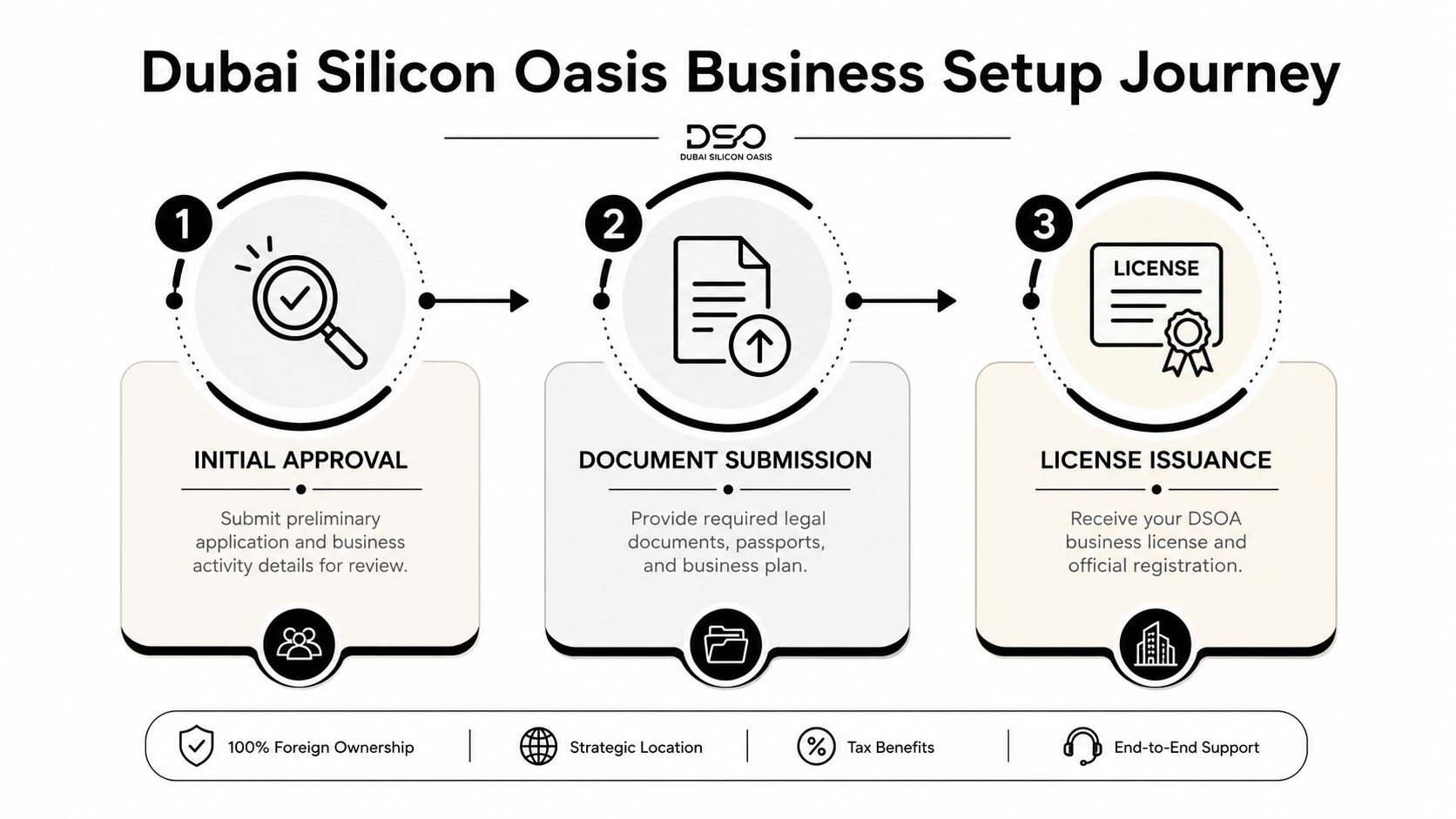
DSO follows a structured approval path through its portal, with legal documents, agreements, and facility paperwork feeding into final licence issuance. On paper, the workflow is straightforward. In practice, the file needs to be consistent from day one, because the same information will later affect banking, visas, and tax registration. A weak submission at setup stage often creates follow-up problems well after the licence is issued.
How the workflow actually moves
The usual sequence looks like this:
- Submit the application through the DSOA portal
- Pay the applicable setup fees
- Upload the legal document set
- Sign the e-agreement for the chosen company form where required
- Complete the lease documentation
- Receive final registration documents and licence issuance
The timing depends less on the form itself and more on whether the authority receives a clean legal pack. I tell clients to treat the application as one joined file, not a set of separate uploads. If one part changes, review the rest. That habit saves days.
The documents that usually determine the timeline
The supporting pack normally includes:
- Passport copies for shareholders, managers, and other relevant parties
- A business plan or activity summary that matches the selected licence activity
- Corporate documents if a shareholder is an existing company
- Share capital documents where the structure requires them
- Lease and facility papers tied to the workspace already chosen
For overseas shareholders, there may also be practical work around attestations, translations, and signing formalities. Such complexities frequently cause many files to slow down, especially when a foreign corporate shareholder is involved. A simple individual-owned consultancy and a multi-shareholder corporate structure do not move at the same pace, even if both are applying in the same free zone.
Where delays usually start
The common problem is mismatch, not absence.
I see the same patterns repeatedly:
- the proposed trade name suggests one activity, while the business plan describes another
- the shareholder structure in the application does not match the corporate documents
- the lease decision is left too late, even though it is part of the registration file
- draft documents are uploaded before names, spellings, and share details are checked properly
Those errors look minor. They are not. They lead to clarification requests, revised forms, and fresh signatures. If a founder is outside the UAE, each correction can add more time because document coordination is slower.
The fastest applications are not the cheapest or the simplest. They are the ones prepared as a complete operating file.
What experienced applicants do differently
Good preparation is practical, not complicated.
What works well:
- Confirm the activity wording early
- Match the company form to the actual ownership structure
- Prepare the legal pack before making assumptions about timing
- Decide on the facility in time for the lease paperwork
- Review every document as one file, not one page at a time
What causes avoidable friction:
- selecting broad activities without checking whether they fit the business
- using a generic business plan that could describe any company
- treating the lease as an afterthought
- assuming corrections can be handled later without affecting the timeline
This stage is more than an admin exercise. It sets the quality of the company record the bank will review, the immigration file will rely on, and the finance team will use later for VAT or Corporate Tax registration. Getting the documents right at setup stage makes the rest of the DSO business lifecycle much easier to manage.
Beyond the License Visas Bank Accounts and Costs
A founder gets the trade licence, celebrates, and then hits the part that usually decides whether the business can start trading. The visa file is still pending. The bank asks for more documents. The cost plan turns out to be too thin for the first six months.
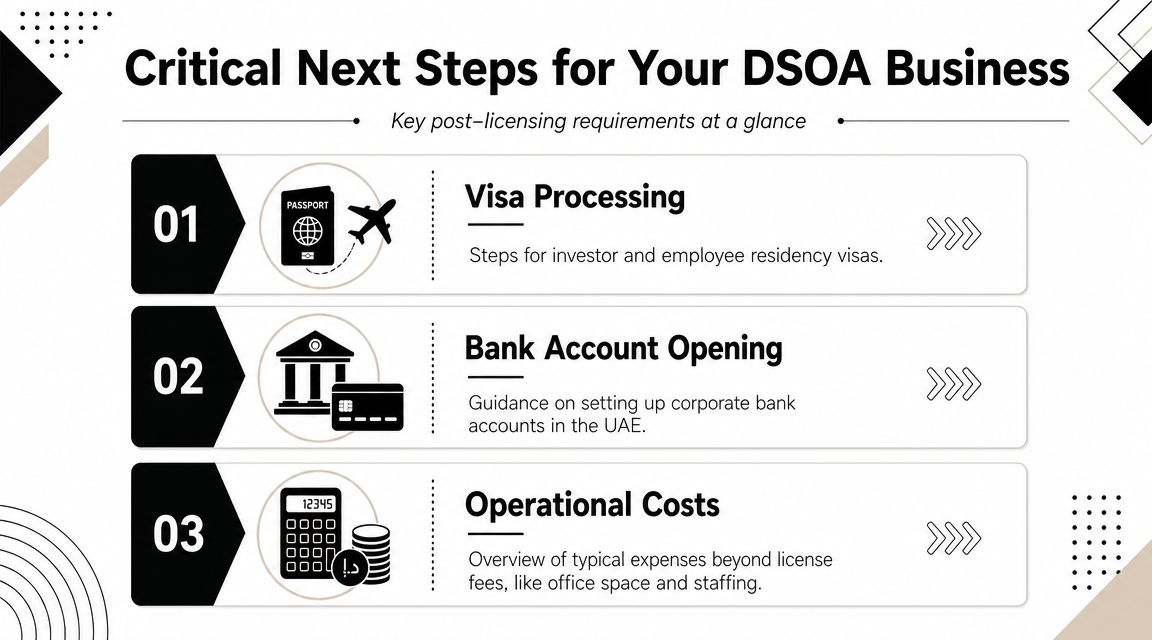
This stage matters because every choice made during setup starts showing its operational effect here. A licence category affects how the company presents to the bank. A workspace decision affects visa capacity. Early accounting discipline affects how easily the business can handle VAT filing requirements in the UAE once revenue starts coming in. DSO setup works best when these steps are planned as one operating sequence, not as separate tasks.
Visa planning starts before the first application
Residency is not just an immigration step. It sits on top of the company structure already approved.
Founders should align three points early:
Who needs a visa first
Founder only, founder plus family, or founder plus employeesWhat headcount is expected in year one
A business that plans to hire soon should not choose a facility package that creates restrictions laterHow quickly the company needs to become active
If client work starts immediately, delays in immigration can affect onboarding, contracts, and payroll timing
A common mistake is treating visas as an add-on after incorporation. In practice, the visa plan should be checked against the lease, establishment card requirements, and expected hiring pattern before the company file is finalized.
Banking is often the primary bottleneck
Banks review the business as a live commercial profile, not as a completed registration file. A clean licence helps, but it does not guarantee account opening.
Expect detailed questions on:
- Actual business activity
- Source of funds
- Shareholder and UBO background
- Expected monthly transactions
- Client and supplier countries
- Reason for using a DSO entity
I usually advise founders to prepare the banking file with the same care as the licence application. Clear activity wording, a believable business model, matching invoices or draft contracts where available, and a consistent ownership trail make a major difference. If the company looks generic on paper, the bank often slows down. If the story is coherent, the review is usually easier to move forward.
A weak banking file can delay operations longer than the company formation itself.
Cost planning should cover the first operating cycle
The licence fee is only one part of the first-year budget. Founders run into trouble when they price the setup and ignore the costs that follow immediately after it.
A practical DSO budget usually needs room for:
- Licence and registration charges
- Workspace or lease costs
- Establishment card and immigration expenses
- Visa processing for each person
- Medical, Emirates ID, and related residency steps
- Banking support documents and attestations if needed
- Bookkeeping, tax registration, and renewal planning
The amount changes based on activity, office type, and visa count. A founder-only service business can stay relatively lean. A company that needs staff visas, a larger office, and frequent banking support should budget much more conservatively from day one.
The better approach is to price the business through its first operating cycle. That means asking a harder question than "What does the licence cost?" Ask what it takes to get licensed, banked, staffed, and ready to trade without cash stress or compliance gaps. That is the point where a DSO company becomes usable, not just incorporated.
Staying Compliant Tax Accounting and Renewals
A founder gets the DSO licence issued, opens the bank account, starts invoicing, and assumes the hard part is over. Then the first renewal cycle arrives, bookkeeping is incomplete, tax registrations were left too late, and simple admin turns into a scramble. I see this often. The setup was clean, but the operating discipline after setup was weak.
That is why DSO company formation should be planned as a full business lifecycle, not a one-time registration exercise. The licence starts the company. Accounting, tax filings, and renewals keep it usable.
Corporate tax needs to be built into the company from the start
The old assumption that a UAE company can be opened first and organised later no longer holds. DSO businesses need proper books, a clear expense trail, and a tax position that can be defended if reviewed.
In practice, that affects decisions made much earlier than many founders expect. Salary structure, owner drawings, intercompany charges, and expense classification all become more important once the company is trading. If those records are loose in the first quarter, the year-end cleanup is slower, more expensive, and less reliable.
A simple rule works well. Record transactions monthly, not when a filing deadline is already close.
VAT and bookkeeping usually become a problem before founders expect
Many businesses do not start with a VAT issue. They start with a record-keeping issue that later becomes a VAT issue. Missing invoices, mixed personal and company spending, and inconsistent sales records create avoidable risk.
The practical baseline is straightforward:
- Keep bookkeeping live from month one
- Issue invoices in a consistent format
- Separate personal and company expenses fully
- Store supplier bills, contracts, and bank records in one place
- Track filing dates, renewal dates, and internal approval deadlines
Founders who want a clearer picture of the filing process can review this guide to VAT filing in the UAE.
The trade-off is simple. Early bookkeeping feels like an extra cost. Late bookkeeping usually costs more, takes longer, and creates more pressure across tax, audits, banking, and renewals.
Renewals should be treated as an annual file review
Licence renewal is not difficult when the company records have been maintained properly. It becomes difficult when the business has changed during the year and none of the supporting files were kept in order.
Check the basics well before renewal is due. Confirm the licence activity still fits the actual business. Make sure tenancy or workspace records are current. Review immigration and establishment documents where relevant. Match accounting records to bank activity. If the company has tax obligations, confirm those filings are not trailing behind the renewal cycle.
Many founders find themselves in this predicament. The company is active commercially, but the admin file tells a messy story.
Strong compliance makes renewal routine. Weak compliance turns a standard renewal into a repair job.
The best approach is to treat every quarter as preparation for renewal. If the books are current, taxes are handled on time, and company records stay organised, DSO remains a practical base not just for launch, but for stable long-term operations.
Your DSO Setup Checklist and Expert Tips
Most founders don't need more theory at this stage. They need a clear operating checklist that keeps the process in the right order and reduces avoidable delays.
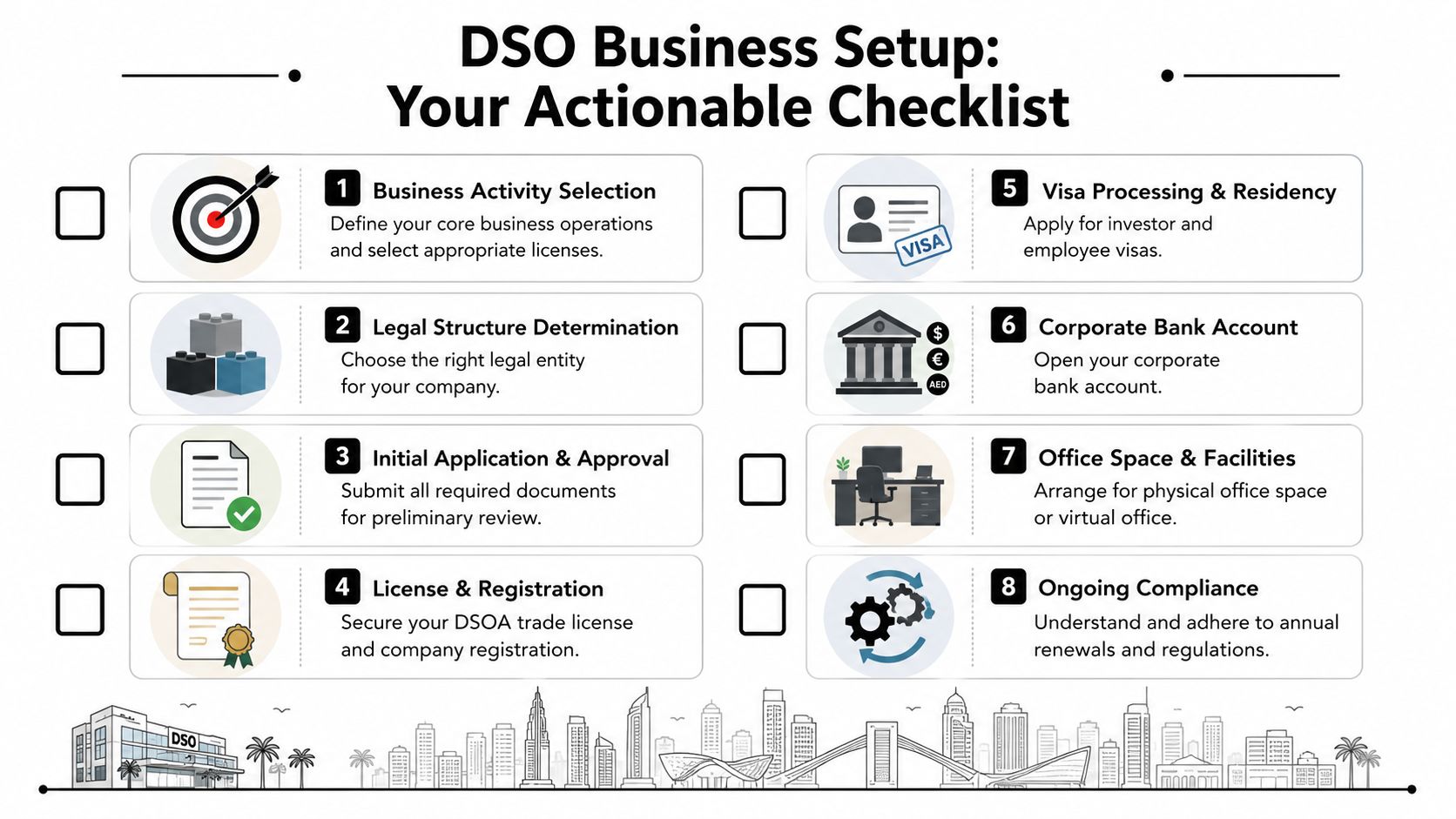
The checklist that keeps the process clean
Confirm business activity first
This is the anchor decision. If the activity is wrong, the licence, bank profile, and even client-facing positioning can all become harder to defend.Choose the legal structure with ownership in mind
Solo founder, multiple shareholders, or branch entry each create different filing realities.Decide the workspace before full submission
The office decision isn't just commercial. It affects cost, visa planning, and practical operations.Prepare a consistent document pack
Passport copies, business plan, corporate papers where applicable, and any supporting capital evidence should all tell the same story.Submit through the DSOA process properly
Don't treat the portal submission like a draft application. Review the file as if it were final.Plan visas immediately after licence issuance
Residency should be scheduled, not improvised, especially if the founder must relocate quickly.Prepare the banking file early
A strong KYC presentation starts before the bank meeting.Set up accounting and compliance controls from day one
Tax, renewal, and internal record-keeping shouldn't be postponed until the business is “bigger”.
Practical tips for foreign founders
Don't choose activities for marketing reasons
Choose them for regulatory accuracy. A sharper activity description usually creates fewer banking and compliance issues later.Don't underestimate lease timing
Founders often assume the office decision can be finalised after approval. In practice, lease execution is part of the operational path to completion.Treat banking as a separate project
Licence approval doesn't guarantee account opening. Prepare ownership documents, business narrative, and transaction logic in advance.Build the company for year one, not just week one
Cheap setup can become expensive if it forces a restructure when staff, visas, or tax obligations arrive sooner than expected.
If you're weighing DSO against other UAE options, or you want the setup structured correctly the first time, a detailed review of your activity, ownership model, and compliance path is worth doing before the first filing.
If you want a practical review of your business model before you start, Smart Classic Business Hub can help you assess the right DSO structure, prepare the setup file, and map the post-licensing steps such as visas, banking, VAT, and ongoing compliance.