
You're likely in one of two positions right now. Either you've decided the UAE is the right market and want to move quickly, or you've started researching and found yourself buried in terms like mainland, free zone, offshore, activity code, Ejari, initial approval, NOC, and attestation.
That confusion is normal. A business license uae search gives you plenty of options, but not much help with the decision that matters most: which setup fits the way your business will operate next year, not just how fast you can get a certificate this week.
The right licence isn't only a registration requirement. It shapes where you can trade, what you can invoice for, what compliance follows, and how much friction you'll face when you grow.
Your Gateway to the UAE's Booming Economy
The UAE continues to attract founders, investors, consultants, traders, and digital businesses for a reason. By the end of September 2025, the country had reached nearly one million active commercial licenses nationwide, with activity concentrated in sectors such as e-commerce, general trade, and real estate, according to the National Economic Registry milestone report.
That matters because it tells you something practical. You're not entering a speculative market. You're entering an organised one where businesses are already forming at scale across multiple sectors.

Why the licence decision comes first
Many founders start by asking, “How much does it cost?” That's understandable, but it's the wrong opening question.
Ask these instead:
- What exactly will the company do? The activity drives the licence.
- Where will revenue come from? Local UAE clients, overseas clients, or both.
- Will the business need staff, visas, or premises? Those choices affect cost and compliance.
- Will the company need flexibility later? A cheap starting point can become an expensive mismatch.
A UAE business licence works like the legal blueprint of the company. If the blueprint is wrong, the setup may still get issued, but problems tend to appear later during banking, invoicing, renewals, contract reviews, or expansion.
Practical rule: The cheapest setup is often the one you replace first.
What a good setup process looks like
A sound approach is simple in principle:
- define the business model clearly
- match it to the right activity and jurisdiction
- prepare the documents correctly
- account for ongoing obligations, not only the first invoice
That's where most wasted time comes from. Not from difficult rules, but from making a fast decision on incomplete assumptions.
Decoding Your UAE Business License What It Really Means
A business licence in the UAE isn't just permission to operate. It's the operating framework of the company.
The easiest way to understand it is to think of it as choosing an operating system for your business. You're not only picking a label. You're choosing the environment your company will run inside.
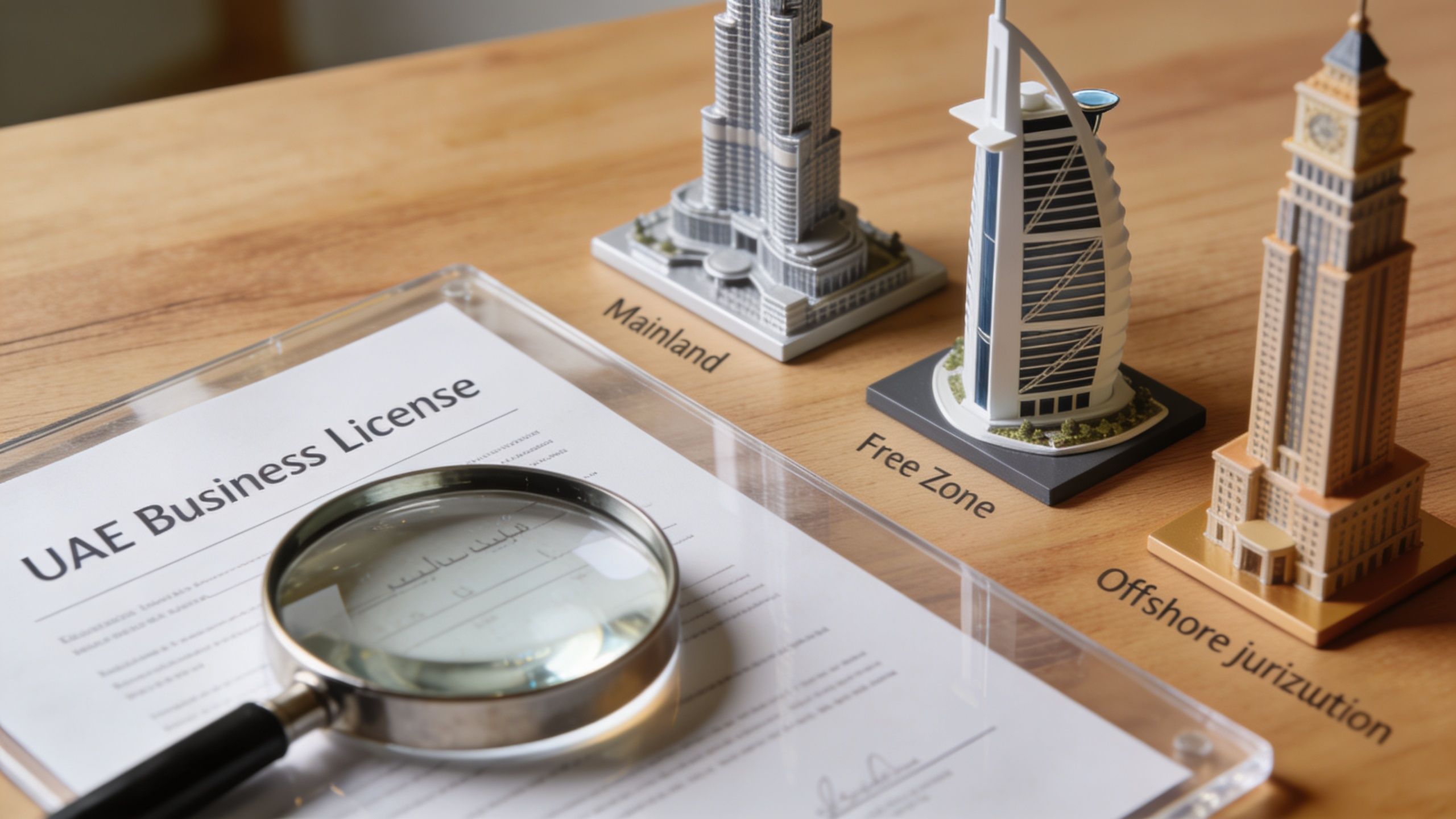
Mainland as the open operating system
A mainland company gives the broadest access to the UAE market. If your business plans to trade directly in the local market, sign contracts widely across the country, or keep flexibility across service lines, mainland is usually the most open structure.
That openness comes with more practical administration. You need to think about office arrangements, renewals, and the exact activity scope from day one. But if your business model depends on local market access, that flexibility often matters more than a headline incentive.
Free zone as the specialised ecosystem
A free zone setup works well when the company has a clearer operating lane. International trade, remote services, digital businesses, holding structures, and certain sector-specific models often fit neatly here.
The appeal is obvious. Free zones are designed to simplify setup for certain use cases and often package business services in a way new entrants find easier to manage. The catch is that not every free zone suits every commercial reality. A founder can register smoothly, then realise the setup doesn't match how the business specifically needs to sell.
Offshore as the ring-fenced structure
Offshore isn't the standard choice for an operating company that wants a visible day-to-day presence inside the UAE market. It's better understood as a ring-fenced structure used for specific ownership, asset-holding, or international business purposes.
For the wrong founder, offshore creates confusion because it looks efficient on paper but doesn't support the practical needs of active local trading.
A licence doesn't just say what your business is. It quietly determines what your business can and can't do.
What the licence controls in practice
Your licence influences several operational realities:
| Area | Why it matters |
|---|---|
| Permitted activity | You can only operate within approved activity scope |
| Jurisdiction | It affects where and how you trade |
| Regulatory pathway | Some activities trigger added approvals |
| Visa planning | Staffing and investor residence planning depend on structure |
| Banking and contracts | Counterparties often review licence wording closely |
That's why the business license uae decision should never be treated as admin alone. It's legal design, tax positioning, market access planning, and operational control wrapped into one early decision.
Mainland vs Free Zone vs Offshore The Critical Choice
This is the decision that shapes everything after incorporation. Most mistakes happen here because people compare jurisdictions like they're comparing prices for the same product. They're not. They're different operating environments with different long-term costs.
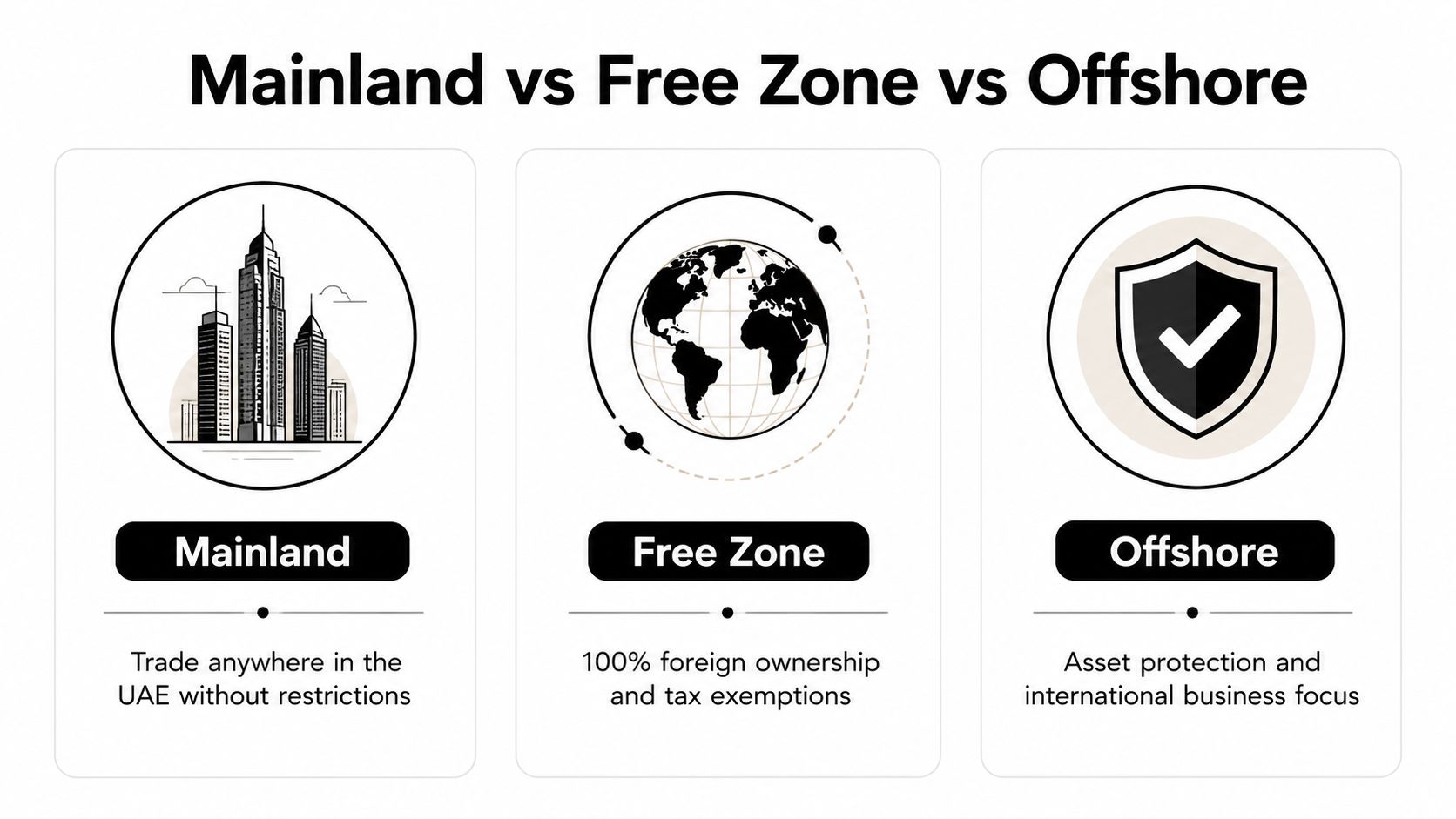
Start with business reality, not tax headlines
A lot of first-time founders focus on the phrase “0% tax” and stop their analysis there. That's risky.
According to this mainland versus free zone cost analysis, free zones offer 0% tax incentives, but the final decision should account for real estate premiums and compliance overhead. The same analysis notes that mainland licences can cost AED 12,000 to 25,000 per year, plus office lease costs, and may be more cost-effective for businesses targeting the local market, especially when profits are below the AED 375,000 corporate tax threshold.
That's the practical lesson. Tax is one line in the model. It isn't the model.
A strategic comparison
| Jurisdiction | Best fit | Main strength | Main limitation |
|---|---|---|---|
| Mainland | Businesses serving the UAE market directly | Broad commercial flexibility inside the UAE | Office and compliance planning usually matter more |
| Free Zone | International, digital, and sector-specific models | Structured ecosystem and tax incentives | Can be restrictive if local market access becomes central |
| Offshore | Holding or international ownership structures | Clean separation for specific corporate purposes | Not suitable for many active operating models |
Where founders usually misjudge the choice
Some businesses are obvious fits. If you expect to trade broadly inside the UAE, mainland usually deserves serious attention. If your work is cross-border, remote, or tied to a zone-specific ecosystem, free zone can make sense. Offshore is narrower and should be chosen for a defined legal purpose, not because it sounds efficient.
The hard cases sit in the middle. For example:
- A consultancy serving UAE clients and overseas clients may value mainland flexibility more than a free zone package.
- An e-commerce brand selling regionally may find a free zone efficient at launch, but only if fulfilment, banking, and customer contracting align.
- A holding structure for investments may have no reason to pay for operating flexibility it won't use.
Total cost of ownership matters more than entry cost
A proper decision should account for:
- Licence spend in the first year and at renewal
- Premises cost or workspace obligations
- Compliance workload attached to the jurisdiction
- Whether the company can sell where it intends to sell
- How painful expansion will be if the original setup is too narrow
Many online comparisons fail because they compare registration packages rather than operating consequences.
If a jurisdiction saves money at setup but blocks revenue or creates restructuring later, it wasn't cheaper.
For a more detailed side-by-side review of trading flexibility and setup implications, this guide on mainland vs free zone in Dubai is a useful reference point.
What tends to work
Choose mainland when local market access is central to the business model. Choose free zone when the activity, customer base, and operating style fit that ecosystem. Choose offshore only when the company's purpose is structural rather than operational.
What doesn't work is choosing based on a single headline. Cheap can become rigid. Fast can become limiting. Tax-efficient can become commercially awkward.
Navigating the Application Process Step by Step
The application process becomes straightforward once the business model is clear. Before that, it feels harder than it is because every document seems equally important. In reality, a few items carry most of the risk.

Step one is activity selection
Experienced guidance matters in this context. In the UAE, the licence doesn't start with the trade name. It starts with the exact commercial activity.
The UAE business licence requirements guide notes that there are over 2,000 activity options, and that for a professional licence such as management consulting under activity code 7020, failing to provide educational certificates attested by the UAE Embassy in the home country is a leading cause of rejection. The same source states that DET data indicates this issue accounts for 20 to 30% of failures.
That tells you two things. First, activity selection is not a formality. Second, documentation requirements are often tied directly to the selected activity.
The application journey in practical terms
The sequence usually looks like this:
Clarify the commercial scope
Write down what the company will sell, who it will sell to, and where delivery happens. This prevents selecting an activity that's too broad or too narrow.Reserve the trade name
The name has to fit local naming standards and align with the proposed business structure.Apply for initial approval At this stage, the authority effectively says the proposed structure can move forward, subject to the remaining requirements.
Prepare legal documents
Depending on the jurisdiction and activity, this may include incorporation documents, shareholder papers, passport copies, and supporting corporate records.Handle attestations and external approvals Delays usually appear at this stage. If the activity requires qualification evidence or regulated approvals, document quality matters.
Secure office or workspace documentation where applicable
The physical setup requirement depends on the chosen path and operating model.Issue the licence and proceed to establishment steps
After issuance, the work typically continues with immigration files, banking support, and compliance registration.
Where applications go wrong
Most failed or delayed applications are not dramatic. They're preventable.
Mismatch between real activity and selected code
A company may describe itself as “consulting” when its actual work touches regulated advisory areas.Unattested supporting documents
Founders often assume a degree certificate is enough. If attestation is required, an unattested document can derail the file.Overbroad business scope
Trying to include everything at the beginning can create more scrutiny, not more freedom.Late thinking on visas and premises
Some founders obtain the licence first and only then ask how staffing or office requirements will work.
Choose the activity like you're choosing the company's legal job description. Because that's exactly what you're doing.
A workable approach for international founders
For overseas applicants, the cleanest process is to prepare the personal and corporate documents before filing, especially when the activity depends on qualification evidence. A setup adviser can map the required chain in advance, including trade name, approvals, attestations, and post-licence actions.
Smart Classic Business Hub handles company formation, PRO coordination, and compliance support for applicants who need that process managed in one workflow rather than in disconnected steps.
Understanding the Costs and Timelines
A realistic budget for a business license uae should separate setup cost, annual cost, and variable cost. When founders ask for one all-in number, they usually get a sales figure, not a planning figure.
The three cost buckets
| Cost bucket | What it usually includes |
|---|---|
| Initial setup | Trade name reservation, initial approval, legal documentation, incorporation processing |
| Recurring annual cost | Licence renewal, lease or workspace cost where required, ongoing administrative obligations |
| Variable cost | Visas, regulated approvals, attestation handling, professional support |
This structure helps you compare options properly. A low first-year package may exclude practical items that appear quickly after the licence is issued.
Why timelines vary
Not every licence follows the same path. A simple service activity in a straightforward jurisdiction can move quickly when documents are complete. A regulated activity, a file that needs attestations, or a structure involving added approvals takes longer because the authority is checking more than identity and name availability.
The key point is that timelines are driven by fit and completeness. Missing or mismatched documents slow things down more than the authority itself in many cases.
What to budget for from the start
Treat these as planning categories, not afterthoughts:
- Jurisdiction choice affects not only registration spend but also operating overhead.
- Office or workspace obligations can change the annual cost profile significantly.
- Visa planning often becomes urgent right after issuance.
- Professional support can reduce error costs if the file is not straightforward.
A useful first step is to build a rough budget before submitting anything. This overview of the cost of starting a business in Dubai is helpful for organising those assumptions into a more practical estimate.
The right question isn't “What's the cheapest licence?” It's “What will this structure cost me to operate properly?”
Life After Your License Renewal and Ongoing Compliance
Getting the licence issued feels like the finish line. In practice, it's the start of the company's compliance life.
Well-run UAE companies treat renewals and filings as operating discipline, not as emergency admin. That approach protects bank relationships, visas, contracts, and day-to-day continuity.
The obligations owners should expect
Your main responsibilities usually include:
Licence renewal
The company must stay current with its renewal cycle and any supporting lease or premises requirements tied to that renewal.Visa and immigration administration
Investor and employee files need orderly tracking. Delays here can disrupt onboarding, travel, and payroll readiness.Financial compliance
Businesses need proper bookkeeping, tax registration where applicable, and timely filings under the rules that apply to their structure and activity.Corporate records
Ownership records and internal registers need to stay accurate and updated.
Why workspace choices affect compliance too
Many founders underestimate the operational side of physical presence. Workspace decisions influence renewal paperwork, staff practicality, and how comfortably the business can scale.
If you're still evaluating flexible premises, Seat Leasing BPO workspace options are useful to review because they help founders think through whether they need a desk, private office, or a more adaptable arrangement for a growing team.
What works after incorporation
A strong post-licence routine usually includes a simple compliance calendar, central document storage, and one clear owner for deadlines. That can be the founder in a very small company, or an external support provider once operations become busier.
Many businesses also benefit from assigning renewals and related paperwork to a specialist. This keeps the founder focused on contracts, hiring, and cash flow instead of chasing expiry dates. For businesses that need that support, this page on trade licence renewal services outlines the type of administrative help often used after setup.
Good compliance is quiet. When it's handled properly, the business keeps moving and nobody has to scramble.
Common Pitfalls and How to Avoid Them
Most business setup problems in the UAE don't come from hidden rules. They come from ordinary decisions made too quickly.
Pitfall one. Choosing on price alone
A founder sees a low entry figure and commits before checking whether the structure fits the actual revenue model. The result is a company that exists on paper but doesn't suit local trading, staffing plans, or future expansion.
Smart solution: decide based on commercial use, not package cost. Ask where clients are, what contracts will require, and whether the structure will still make sense after the first year.
Pitfall two. Treating the activity as a label
This is one of the most common errors. People assume broad terms like “consultancy” or “trading” are enough, then discover that the approved activity doesn't match what the company is selling.
Smart solution: define the service or product precisely before filing. The activity should reflect the actual work, not a marketing description of the business.
Pitfall three. Ignoring the second-year burden
Some founders budget for incorporation and forget renewals, premises, tax administration, document maintenance, and visa management. The setup looked affordable. The operation feels messy later.
Smart solution: build a one-year operating budget before choosing the jurisdiction. That budget should include recurring obligations and the practical cost of staying compliant.
Pitfall four. Leaving documents to the last minute
International founders often underestimate attestation, corporate paperwork, and document sequencing. A file that looked simple becomes stuck because one required paper wasn't prepared correctly.
Smart solution: gather personal and corporate documents early, then check whether any document needs legalisation or embassy-level attestation before submission.
Pitfall five. Assuming the licence is the end of the process
The licence opens the door. It doesn't remove the need for renewals, visa administration, accounting discipline, and regulatory housekeeping.
Smart solution: set compliance ownership immediately after issuance. If nobody is responsible for deadlines, deadlines will be missed.
The best setups are rarely the fastest-looking ones at the start. They're the ones that continue to work when the business hires, invoices, renews, expands, and gets reviewed by banks, landlords, clients, and authorities.
If you want a clearer route through jurisdiction choice, activity selection, licensing, visas, and ongoing compliance, Smart Classic Business Hub provides UAE company formation and related support for mainland, free zone, and offshore structures.