
A two-year UAE employment visa cost typically falls between AED 3,000 and AED 7,500. That’s the baseline, not the final answer, because your actual spend depends heavily on the emirate, whether the visa is issued through the mainland or a free zone, and how the sponsoring company is officially classified.
That gap is where most new business owners get caught. You search online, one page gives you a low figure, another gives you a much higher one, and both can sound correct. They often are, but only within a specific setup that the article doesn’t explain.
The mistake isn’t underestimating one fee. It’s treating the visa as a single fee at all. In practice, you’re budgeting for a stack of approvals, tests, ID issuance, administrative handling, and sometimes extra steps such as quota inspection or in-country status change. If you’re hiring several people, a small misunderstanding turns into a material payroll and setup problem very quickly.
Understanding Your UAE Employment Visa Budget
A founder usually starts with a simple question: “What will it cost to put this employee on my visa?” The frustrating answer is that there isn’t one universal number. There is a range, and the range only makes sense once you know your business structure.
Start with the three variables that actually matter
Before looking at any quote, check these three points first:
- Jurisdiction: Are you sponsoring the employee through a mainland entity or a free zone company? The process, authority, and cost structure are not identical.
- Company classification: For mainland businesses, the sponsor’s classification under the labour system directly affects work permit fees and can change the total cost materially.
- Employee profile: Skill level, whether the person is entering from outside the UAE or applying from inside the country, and whether a status change is needed all influence the final amount.
If you skip those three checks, any calculator is only giving you a rough placeholder.
Why entrepreneurs misread visa quotes
A lot of online estimates show only the obvious items. They list a visa fee, maybe a medical test, maybe the Emirates ID, and stop there. That’s useful for a quick orientation, but it’s weak for real budgeting.
What often gets missed is the wider hiring context. If you’re relocating a new employee, visa cost sits alongside move-in costs, temporary accommodation, and family logistics. That’s why practical founders often review broader corporate relocation housing solutions at the same time they budget immigration expenses.
Practical rule: Don’t approve a job offer based on a headline visa number. Approve it only after you know the jurisdiction, sponsor category, and whether any in-country processing applies.
Budget as a scenario, not a single line item
The cleanest way to budget a UAE hire is to build a simple scenario:
Identify the hiring route
Mainland, free zone, or a specialised pathway such as a Green Visa route where relevant.Map mandatory government items
Work permit, medical fitness, Emirates ID, visa stamping, and admin handling.Check for hidden process steps
Status change, quota inspection, offer letter, Tawjeeh submission, or other pre-approval items depending on the case.
That approach is far more reliable than asking, “What’s the cheapest visa?” Cheap on paper can become expensive after the missing steps appear.
The Core Components of Your Visa Cost
Every employment visa quote is built from a few standard parts. Once you know these components, it becomes much easier to spot whether a quote is complete or whether someone has only shown you the attractive top line.
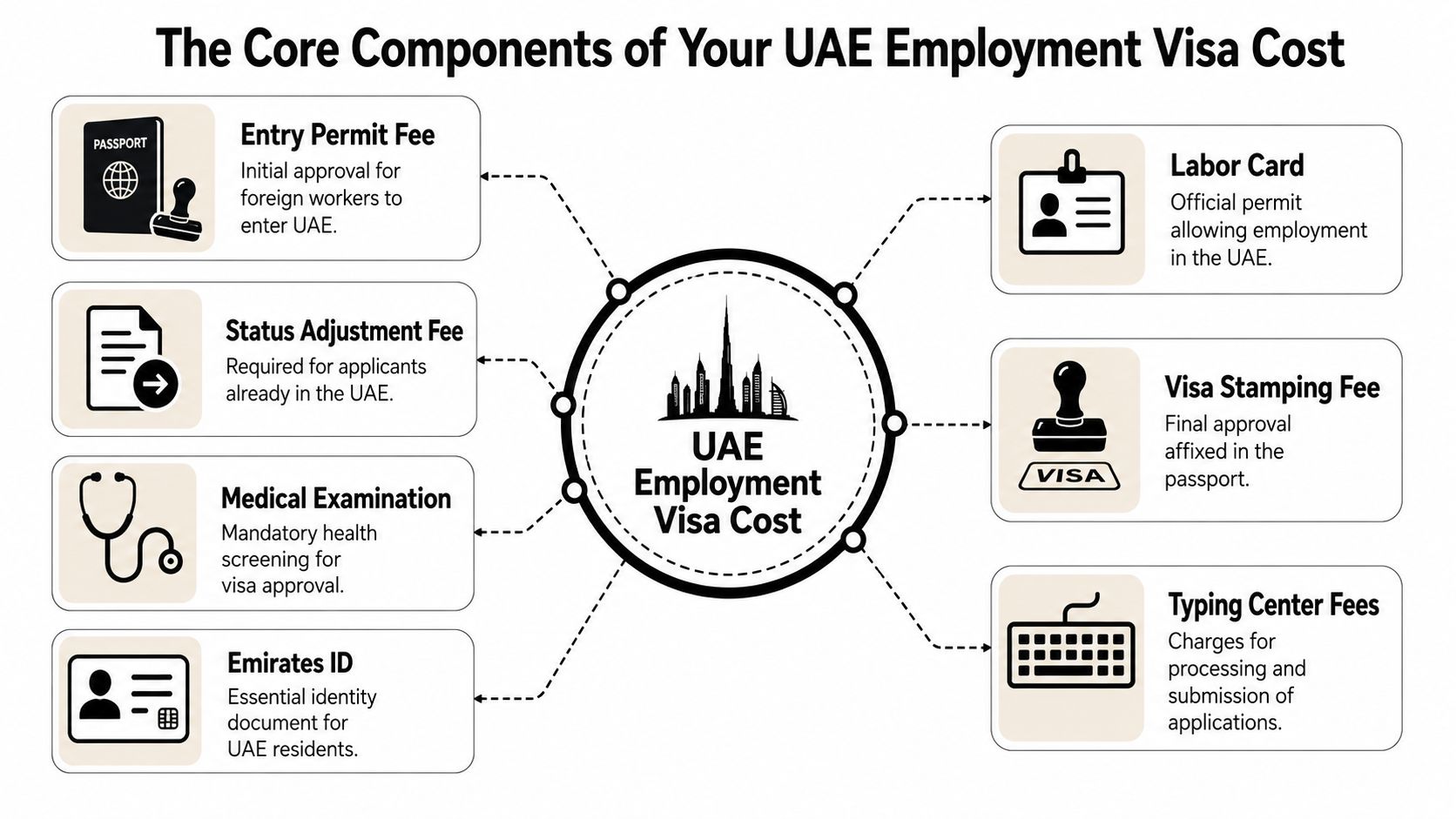
According to Business Link UAE’s 2026-style cost breakdown for a two-year employment visa in Dubai, the total out-of-pocket cost typically falls between AED 3,000 and AED 7,500, with the key components broken down as follows:
| Core component | Typical cost range |
|---|---|
| Work-permit approval | AED 1,000 to AED 2,000 |
| Medical fitness test | AED 500 to AED 800 |
| Emirates ID for 2 years | AED 370 to AED 570 |
| Residency visa stamping | AED 500 to AED 1,500 |
| Administrative processing fees | AED 500 to AED 1,000 |
What each fee actually covers
The work permit approval is the legal permission for the employment relationship to proceed through the relevant authority. For many employers, this is the first major regulated cost in the chain.
The medical fitness test is mandatory for residence processing. The price range exists because service speed and handling can differ.
The Emirates ID is not optional paperwork. It becomes the employee’s core identity document in the UAE and is tied to the residency process.
The visa stamping fee covers the residency approval stage in the passport process. Depending on the case and service handling, this can be one of the more variable line items.
Then there are administrative processing fees. These are often the least understood part of the bill because they may include application handling, typing, and submission support.
What a good quote should look like
A proper visa estimate should separate the components clearly. At minimum, you should be able to see:
- Government approvals: The regulated permit and residency stages.
- Medical and ID costs: These shouldn’t be buried inside a vague service bundle.
- Administrative handling: Processing and submission charges need to be visible.
- Any conditional extras: If the employee is already in the UAE or needs an amendment, that should appear as a separate item.
A visa quote without a line-by-line breakdown isn’t transparent enough for hiring decisions.
Many first-time employers often go wrong. They compare one provider’s “all-in” package against another provider’s partial estimate and assume one is less expensive. Often, the difference is that one quote is complete and the other isn’t.
Key Factors That Influence Your Final Visa Cost
The baseline cost only tells you the rough territory. The final number changes because the UAE system prices employment permissions according to compliance status, hiring profile, and sponsorship route.

Company classification changes the permit fee
For mainland companies, the Ministry’s classification system matters more than most founders realise. According to the UAE government guidance on work permits, firms are classified into categories A, B, and C, with work-permit issuance or renewal fees ranging from AED 250 to AED 3,450 per employee depending on the category. The same guidance notes that Category 1 employers often enjoy zero or minimal work-permit fees, while Category 3 employers may pay up to AED 5,000 per skilled worker.
That creates a direct commercial consequence. A business with stronger compliance can sponsor the same type of employee at a lower cost than a poorly positioned sponsor.
Skill level also affects pricing
Not every employee is priced the same in the labour system. The fee can change based on whether the worker is classified as skilled or unskilled and whether the application starts from inside or outside the UAE.
That means founders shouldn’t assume their first employee and fifth employee will cost the same, especially if the designations are different.
Location changes the process
Mainland and free zone routes don’t just differ in legal structure. They differ in how documents are handled, which authority is involved, and how many supporting steps are needed.
A free zone process can feel cleaner because the authority often centralises more of the workflow. Mainland sponsorship can involve more moving parts, but it may fit the commercial model better if the business needs unrestricted local market access.
A practical way to read the variables
Use this lens when reviewing any cost estimate:
- If your company has stronger compliance standing, your work permit fees may be lower.
- If the employee’s skill classification changes, the permit fee can change as well.
- If the employee is already inside the UAE, the process may include a different handling path than an overseas applicant.
- If you choose mainland over free zone, don’t compare only the visa fee. Compare the broader business value of that setup.
The cheapest visa route isn’t always the most efficient business route. The right question is whether the jurisdiction supports how you sell, hire, and operate.
Practical planning consistently outperforms generic calculators. The calculator gives you a starting figure. The business model determines whether that figure is useful.
Mainland vs Free Zone Visa Cost Comparison
Entrepreneurs often ask one version of the same question: should I keep costs lower in a free zone, or spend more for mainland flexibility? That’s the right question, but it needs to be answered in commercial terms, not just immigration terms.
Existing market coverage already notes that free zones can cost around AED 2,500, versus mainland at AED 7,000 or more, but also points out that most discussions stop short of proper ROI modelling for startups and growth-stage businesses, as discussed by Danburite’s comparison of UAE employment visa costs.
Cost comparison table
| Cost Component | Mainland (Dubai) | Free Zone (Typical) |
|---|---|---|
| Typical visa outlay | Often higher | Often lower |
| Process complexity | Usually more layered | Usually more streamlined |
| Sponsor classification impact | Strong effect on permit cost | Less tied to mainland MoHRE category logic |
| Market access trade-off | Broad local operating flexibility | Depends on free zone rules and business model |
| Best fit | Firms selling directly into the local market | Startups prioritising speed and lower setup friction |
Where free zone often works better
Free zone sponsorship usually suits businesses that want a simpler launch path. If the business is still validating its offer, keeping fixed setup costs lower can be the smarter move.
This is especially true for founders who don’t yet need the broader operating flexibility of a mainland structure. Lower friction can matter more than maximum reach in the early stage.
Where mainland can justify the higher spend
Mainland starts making sense when commercial access matters more than initial savings. If your clients, contracts, or operating model require a mainland presence, focusing only on visa cost can become a false economy.
For that reason, the better comparison is not “Which visa is cheaper?” It’s “Which setup matches how the company will earn revenue?” Founders who are weighing those structural trade-offs usually benefit from a more detailed mainland vs free zone Dubai comparison.
A lower visa fee helps cash flow. It doesn’t automatically help growth if the business ends up in the wrong jurisdiction.
The practical takeaway is simple. If you’re early, lean and testing the market, free zone often wins on simplicity. If local market access is central to the model, mainland can justify the additional visa and compliance burden.
Sample Scenarios Total Employment Visa Costs
Real budgeting gets clearer when you stop thinking in abstract fee lists and start looking at actual hiring situations.
According to Kashmir Overseas’ summary of UAE work visa company categories and fees, the system differentiates by skill level. For skilled employees entering from outside the country, Class 2B companies are charged AED 1,000. For unskilled employees, the fee for a Class 2B company rises to AED 2,200. The same source notes that employees applying from inside the country often benefit from reduced fees.
Scenario one free zone startup hiring from overseas
A Dubai free zone startup hires a skilled software developer from outside the UAE.
In this case, the founder should expect the cost discussion to start with the free zone route rather than mainland labour category logic. The practical budgeting frame is the total free zone visa package, plus the usual medical, ID, residency, and processing elements already covered earlier.
A clean estimate for this type of case should include:
- The free zone visa charge: Here, the free zone route often remains competitive.
- Medical processing and Emirates ID: Standard residency-linked items still apply.
- Residency stamping and admin handling: These complete the file, and founders often forget to leave room in the budget.
This kind of hire is usually easier to estimate because there is no in-country status change and fewer moving parts than a mainland amendment-heavy case.
Scenario two mainland trading company hiring in-country
A mainland trading company classified as Class 2B hires an administrative assistant who is already inside the UAE.
Here, the founder needs to look more carefully at worker classification and in-country handling. If the role falls under the lower-skilled side of the structure, the permit fee can be materially higher than a skilled hire under the same class. If the employee is applying from inside the UAE, reduced fees may apply on the permit side, but the total file may still pick up additional in-country process charges.
What these scenarios teach
| Scenario | Main cost pressure |
|---|---|
| Free zone overseas skilled hire | Simpler route, but still needs all mandatory residency components |
| Mainland in-country hire | More variables, more scope for extra handling fees, greater classification sensitivity |
The lesson is straightforward. Two employers can both say they are paying for an employment visa, but the operational reality behind the invoice can be completely different.
Good budgeting starts with the employee’s exact profile. Job title, skill level, and current location all matter before the first application is even submitted.
That’s why “How much is a UAE employment visa?” is only a useful question when followed by, “For which company, in which jurisdiction, for which employee?”
Beyond the Basics Renewals and Hidden Costs
A lot of businesses treat the stamped visa as the finish line. It isn’t. It’s one event in a continuing compliance cycle.
Renewal deserves attention because the financial commitment doesn’t disappear after the first approval. The cost planning should cover the employee’s full visa life cycle, not only the onboarding month.
Hidden costs that surprise employers
For mainland cases in particular, ancillary items can change the economics of a hire quickly. According to the UAE Labour Law blog’s employment visa cost breakdown, a quota inspection costs AED 553, an offer letter costs AED 243, and an in-country status change costs AED 680, bringing these extras to AED 1,559 before the main work permit is processed. The same source adds that labour contract submission at Tawjeeh costs AED 166.
These aren’t fictional extras invented by service providers. They are the sort of process-linked charges that appear when a case has more administrative steps than the simple “new employee from outside the UAE” model.
The hidden-cost checklist
When reviewing a quote, ask whether it includes:
- Quota-related items: Some mainland files need pre-approval steps before the main permit.
- Offer letter handling: This can be a small line item, but it still belongs in the budget.
- Status change charges: These matter when the employee is already in the UAE.
- Tawjeeh submission: It’s another example of a cost that many basic calculators ignore.
Renewal planning works best when the employer treats the visa as an ongoing compliance cost, not a one-time joining cost.
Renewals need the same discipline as first-time applications
Earlier guidance in the market often notes that renewal costs typically mirror initial costs. That’s exactly why businesses should stop budgeting visas as a launch-only expense.
If your hiring plan extends beyond the first few employees, build a forward-looking schedule for each employee’s renewal window, and review any procedural changes before filing. Businesses tracking upcoming renewals often find it useful to keep an eye on practical updates around UAE residence visa renewal rules.
The practical failure point is almost always the same. The company budgets the visible government fees and forgets the process fees that only show up when the file becomes active.
Simplify Your Visa Process with Expert Guidance
The UAE employment visa cost isn’t hard because the system lacks structure. It’s hard because the structure is layered. Jurisdiction changes the process, company classification changes the permit fee, and employee status changes which extra steps appear.
That’s why broad online estimates only help at the very beginning. Once a hire becomes real, you need a case-specific cost view. Otherwise, the business is making hiring decisions on incomplete numbers.
A disciplined process fixes most of these issues. Good operators standardise documents, check sponsor classification before recruiting, and build costs around actual employee profiles instead of generic assumptions. Teams that want to improve immigration workflow often get better results when they treat visa handling as an operational system rather than a last-minute admin task.
If you’d rather not decode classifications, ancillary charges, and renewal planning on your own, specialised local support is usually the faster route. Business owners who need customized setup and compliance advice can review services such as Dubai business advisory support before committing to a hiring plan.
If you want a clear, case-specific breakdown instead of a generic estimate, Smart Classic Business Hub can help you assess the actual cost of your employment visa based on your jurisdiction, company type, and hiring scenario. That includes practical guidance on setup structure, PRO handling, compliance requirements, and the hidden fees that most basic quotes miss.