
Finding the right office space in Dubai can feel like a real challenge. With sky-high demand and a complex market, it's easy for businesses to get stuck trying to find a space that fits both their needs and their budget. This guide is your clear roadmap to navigating this dynamic environment, from figuring out the different office types to knowing all the costs involved.
Navigating Dubai's Competitive Office Market

There’s a good reason Dubai is a global business hub. Its prime location, investor-friendly policies, and the constant stream of international companies create a commercial real estate market that’s both vibrant and incredibly demanding. Getting an office here isn’t just a simple property transaction; it's one of the first, most critical steps in your company's UAE journey.
Think of this guide as your practical playbook, designed to cut through the confusion. We'll walk through the key decisions and financial realities every business leader has to face when setting up or expanding in this exciting city.
Why the Dubai Office Market Is So Active
The city’s powerful economy and pro-business government initiatives have sparked intense demand for office space. This isn't just a feeling; the numbers tell the story of a market on a steep upward curve.
Dubai's office market has delivered a record-breaking performance, with the total sales value jumping by 84% in the first half of 2025 compared to the same period last year, hitting AED 5.4 billion (that's about $1.47 billion).
This incredible growth was fuelled by nearly 1,900 transactions. Ready-to-move-in offices made up a huge 85% of all sales, as companies scrambled to find immediate solutions to rising rental costs. You can dive into the full report on Dubai's office market growth to see how these trends are shaping the commercial property world. It’s clear that coming prepared is non-negotiable for any business entering this market.
Your Roadmap to Success
Making the right decision means getting your head around several key factors that will shape your choice of office. We’ve structured this guide to walk you through each critical stage, giving you the clarity you need to move forward with confidence.
Here’s what we'll cover:
- Decoding Office Types: From fully serviced offices to buzzing co-working hubs, we’ll break down what works best for different business models.
- Mainland vs. Free Zone: A straightforward explanation of the legal and operational differences that determine where you can set up shop.
- Realistic Budgeting: An honest look at all the costs you need to plan for, far beyond just the annual rent cheque.
- Actionable Checklists: A step-by-step process for securing your ideal workspace, from the initial search right through to signing the lease.
Choosing the Right Type of Office Space
Picking the right office space in Dubai is a lot like choosing a vehicle for a long journey. You wouldn't take a sports car on a desert safari, nor would you use a massive tour bus for a quick trip across town. The best choice always comes down to your team's size, your business goals, and the kind of experience you want to create.
Each workspace option comes with its own unique set of benefits. Getting to grips with these choices is about more than just definitions; it's about matching the way the space operates with your company's culture and growth plans.
Let's break down the main types of office spaces in Dubai to find your perfect match, starting with the most flexible and moving toward the most permanent.
Coworking Spaces: The Professional Gym Membership
Think of a coworking space as a high-end gym membership for your business. You get access to a professional environment, top-notch equipment (like meeting rooms and super-fast internet), and a community of other ambitious people—all without having to buy the whole building.
This model is a fantastic fit for freelancers, startups, and small teams that feed off collaboration and networking. The "pay-as-you-go" or monthly membership approach offers incredible flexibility, letting you scale your presence up or down without any hassle. You can explore the different vibes and benefits in our detailed guide to the best coworking spaces in Dubai.
- Who it's for: Solo entrepreneurs, remote workers, startups, and project teams.
- Pros: Maximum flexibility, great networking opportunities, and low upfront costs.
- Cons: Can get noisy and may lack the privacy needed for sensitive work.
Serviced Offices: The All-Inclusive Resort
A serviced office is the all-inclusive resort of the business world. You show up, and everything is ready to go—from the furniture and IT setup to a receptionist fielding your calls. All your operational needs are neatly bundled into a single monthly fee.
This turnkey solution is perfect for companies that need to be up and running almost overnight. It's a huge draw for international businesses setting up a local office or SMEs that want to dodge the headaches of a traditional lease. You get a prestigious business address and a fully working office without the long-term tie-ins or heavy capital spending.
A serviced office lets your team focus 100% on business operations from day one. All the property management, utility bills, and maintenance are handled by the provider, which is a massive advantage for fast-moving companies.
Private Offices: The Customisable Foundation
Leasing a traditional private office is like building a custom home. You start with an empty shell—a blank canvas that gives you total control over the layout, design, and atmosphere. This is the classic path for established businesses that need privacy, security, and a space that truly reflects their brand.
While this option offers the ultimate in customisation, it also comes with the most responsibility. You'll be signing a long-term lease (usually three to five years) and managing everything yourself, from the fit-out and furnishings to utilities and ongoing maintenance.
- Who it's for: Established SMEs, large corporations, and businesses with specific security or branding needs.
- Pros: Complete control over your environment, enhanced privacy, and a stable, long-term base.
- Cons: High initial investment, a long-term financial commitment, and day-to-day management duties.
Comparing Your Workspace Options
To make the decision a bit clearer, let's put these three main models side-by-side.
| Feature | Coworking Space | Serviced Office | Private Office (Traditional Lease) |
|---|---|---|---|
| Commitment | Low (Monthly) | Medium (3-12 months) | High (3-5+ years) |
| Upfront Cost | Very Low | Low to Moderate | Very High |
| Flexibility | High | Medium | Low |
| Privacy | Low to Medium | High | Very High |
| Ideal For | Startups, Freelancers | SMEs, MNCs | Established Corporations |
Ultimately, choosing the right office is a strategic move that affects your budget, your culture, and how quickly you can adapt. By carefully weighing these factors against your business needs, you can find a workspace that doesn't just house your team but actively helps it thrive in Dubai’s dynamic market.
Understanding Mainland Versus Free Zone Setups
When you decide to set up shop in Dubai, one of the first—and most critical—decisions you'll face is choosing between a Mainland and a Free Zone company. This isn't just about picking a location on a map; it's a strategic move that will define your company's ownership, the markets you can legally operate in, and even the type of office you can lease.
Think of it like this: a Mainland setup is your all-access pass to the entire UAE. You can trade directly with any business or customer across all seven Emirates, no strings attached. A Free Zone, on the other hand, is a specialised economic hub designed to attract international business with some seriously attractive perks.
The Mainland: Your Gateway to the Local UAE Market
Setting up on the Dubai Mainland means you're registering your business directly with the Department of Economy and Tourism (DET). This licence is your golden ticket to operate anywhere in the UAE, allowing you to bid on government contracts and tap into the vibrant local consumer market.
In the past, this path often required partnering with an Emirati national. However, major legal reforms have changed the game, now allowing 100% foreign ownership for a vast number of business activities. If your core business is serving local customers—whether you're opening a retail store, a consultancy, or a service centre—a Mainland licence is almost always the right call. It does come with one key requirement: your office must be physically located within Mainland Dubai.
Free Zones: Specialised Hubs for Global Business
Dubai is home to over 40 Free Zones, and each one is essentially an independent jurisdiction with its own rules and regulator. These zones are cleverly designed to create industry-specific ecosystems. You'll find Dubai Media City buzzing with creative and advertising agencies, while the Dubai International Financial Centre (DIFC) is the go-to for finance and banking powerhouses.
The benefits of setting up in a Free Zone are hard to ignore:
- 100% Foreign Ownership: You maintain complete control over your enterprise.
- Tax Exemptions: Most zones offer exemptions from corporate and personal income taxes.
- Full Repatriation of Profits: You are free to send all capital and profits back to your home country without restrictions.
The trade-off? A Free Zone company is typically limited to doing business within its zone or internationally. To sell directly to the Mainland market, you'll usually need to work with a local distributor. For a more detailed look, our guide on the pros and cons of Mainland versus Free Zone setups can help you weigh your options.
Here's a quick side-by-side comparison to make the choice clearer.
Mainland vs Free Zone Office Setup Comparison
| Feature | Mainland | Free Zone |
|---|---|---|
| Market Access | Unrestricted access to the entire UAE domestic market. | Primarily for international business or trade within the specific Free Zone. Requires a local agent for Mainland trading. |
| Ownership | Up to 100% foreign ownership for most business activities. | 100% foreign ownership is standard. |
| Office Location | Must have a physical office within the geographical boundaries of Mainland Dubai. Registered with Ejari. | Office must be within the designated Free Zone. Options often include flexi-desks, shared spaces, or private offices. |
| Regulatory Body | Department of Economy and Tourism (DET). | Each Free Zone has its own independent authority (e.g., DMCC Authority, JAFZA). |
| Visa Eligibility | Directly linked to the size of your physical office space. | Often more flexible, with visa quotas available even with a flexi-desk package. |
This table lays out the core differences, but the right choice always comes back to your specific business model and long-term goals.
To help you visualise the decision-making process, this flowchart breaks down the best path based on your company's size and focus.
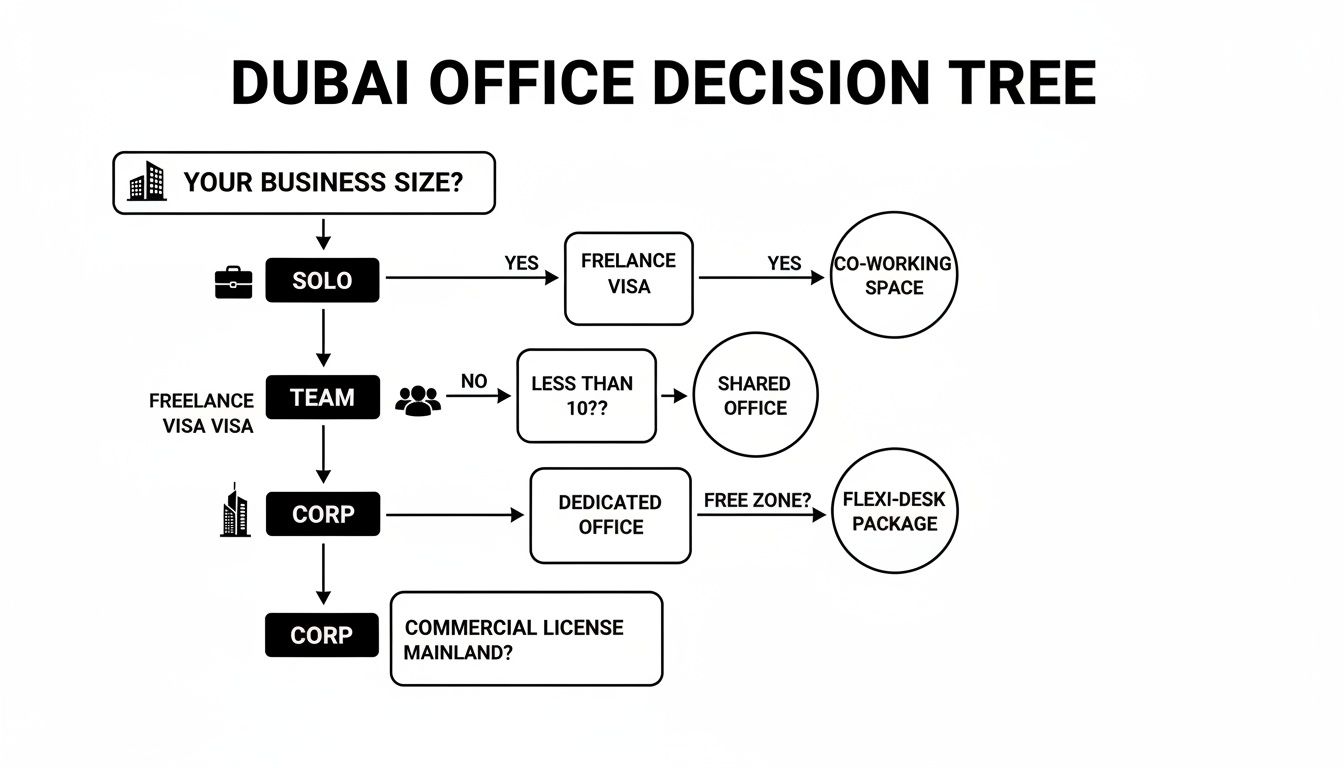
As you can see, your business scale and target market are the key factors that steer you toward either a flexible setup or a more permanent structure in a specific jurisdiction.
Market Trends and What This Means for Your Office Search
Your choice between Mainland and Free Zone directly shapes your hunt for office spaces in Dubai. The market is hot in both jurisdictions. In the first half of the year alone, office sales soared by an incredible 84% year-on-year, hitting AED 5.4 billion. City-wide rents have also jumped by 26.4%, with prime areas like DIFC seeing a jaw-dropping 35% rent increase. This shows just how fierce the demand for quality office space is right now.
Your choice of jurisdiction is directly tied to your physical office. A Mainland licence requires a physical office registered with Ejari, while Free Zone authorities have their own leasing requirements, often including options for flexi-desks or shared facilities to meet visa eligibility.
Ultimately, let your business plan lead the way. If you’re here to serve the local UAE market, the Mainland is your arena. If your sights are set on international trade and you need the support of a specific industry ecosystem, a Free Zone offers the perfect launchpad.
Creating a Realistic Budget for Your Office
When you’re looking at office spaces in Dubai, it’s easy to get fixated on the annual rent. But trust me, that number is just the tip of the iceberg. To avoid any nasty financial surprises down the line, you need to build a budget that covers every single associated cost, both upfront and recurring.
Think of it like buying a house—the asking price is your starting point, but the real cost includes all the fees, deposits, and taxes that come with it. Getting this right from the start is critical. It’s what separates a smooth, sustainable launch in Dubai from one that runs into cash flow problems before it even gets off the ground.
Deconstructing the Total Cost of an Office
Most advertised prices you'll see are for the annual rent alone. The actual cash you'll need for your first year is significantly higher. Let's break down exactly what you should be preparing for.
- Annual Rent: This is your biggest ticket item. Most landlords expect the full year's rent paid upfront with a single cheque. While some might agree to two or four cheques, it’s less common and you might end up paying a premium for the flexibility.
- Security Deposit: This is a standard, refundable deposit, usually 5-10% of your annual rent. It's held to cover any potential damages to the space when you eventually move out.
- Agency Fees: If you’ve worked with a real estate broker to find your office, you'll pay a one-time commission. This is typically 5% of the annual rent.
- DEWA Connection: You'll need to set up your electricity and water with the Dubai Electricity and Water Authority (DEWA). This involves paying a refundable security deposit plus some non-refundable connection fees.
- Ejari Registration: This isn't optional. Ejari is the government's mandatory tenancy contract registration system. The fee is small, but your lease isn't legally valid without it, and you can't connect your utilities.
Getting your head around these initial costs is fundamental to planning your investment. For a wider view of what it takes to get started, take a look at our detailed guide on the cost of starting a business in Dubai.
How Location Dictates Your Budget
It’s no secret that the price of an office in Dubai swings wildly depending on the neighbourhood. A prestigious address in a central hub like Downtown Dubai will cost a great deal more than a similar-sized space in a less central area like JLT. You're paying for prestige, accessibility, and the quality of the building.
The market dynamics here are also a huge factor. Dubai is experiencing a real shortage of top-quality commercial real estate, which has pushed occupancy rates to an all-time high. With city-wide occupancy sitting at 92% and Grade A buildings hitting 94%, the scarcity in prime locations keeps rental prices firm. You can dive deeper into these trends in the Dubai office market performance report from Cavendish Maxwell.
Choosing a location that fits your budget, not just your dream address, is one of the smartest moves you can make. The price difference between a premium spot and a more practical one can free up a huge amount of capital for other parts of your business.
To give you a clearer picture, here’s a look at what you can expect to pay for a standard office in some of Dubai's most popular business districts.
Estimated Annual Office Rental Costs in Key Dubai Areas
This table shows typical annual rental ranges for a standard 1,000 sq. ft. private office across popular business districts in Dubai, highlighting the price variations.
| Business Area | Low-End Estimate (AED/year) | High-End Estimate (AED/year) |
|---|---|---|
| Downtown Dubai | 200,000 | 350,000 |
| Jumeirah Lake Towers (JLT) | 90,000 | 160,000 |
| Business Bay | 120,000 | 250,000 |
| Dubai Marina | 110,000 | 220,000 |
Estimates are for a standard 1,000 sq. ft. private office.
As you can see, your choice of location has a massive impact on your biggest fixed cost.
A Sample Budget for Your First Year
Let's put all this into practice. Here’s a hypothetical first-year budget comparing a small business leasing a traditional office versus one opting for a coworking space. The difference in the initial cash required is striking.
Scenario A: 1,000 sq. ft. Private Office in JLT
- Annual Rent: AED 120,000 (paid upfront)
- Security Deposit (5%): AED 6,000 (refundable)
- Agency Fee (5%): AED 6,000
- DEWA Deposit & Fees: Approx. AED 2,500
- Ejari Registration: Approx. AED 220
- Fit-Out & Furniture: Approx. AED 30,000 (can vary wildly)
Total Estimated First-Year Outlay: AED 164,720
Scenario B: Two-Person Coworking Membership
- Monthly Membership: AED 3,000/month (AED 36,000 per year)
- Security Deposit: Often waived or just one month's fee (AED 3,000)
Total Estimated First-Year Outlay: AED 39,000
The numbers speak for themselves. While a private office gives you ultimate control and privacy, it demands a much, much larger upfront investment. By carefully calculating these costs, you can make an informed choice that sets your business up for financial success from day one.
Your Step-by-Step Plan for Securing an Office
Finding and leasing an office in Dubai might seem like a huge task, but it’s really just a series of logical steps. If you break it down, the whole process becomes much more manageable, helping you cover all the legal and practical bases without any expensive mistakes.
Think of this checklist as your roadmap. It’ll take you from the initial “what do we need?” stage right through to getting the keys in your hand, so you can navigate the rental market with confidence and sidestep the common traps.
Step 1: Figure Out Your Core Needs
Before you even glance at a property listing, you need to be crystal clear on what you’re actually looking for. Getting this right from the start saves you from wasting days looking at unsuitable spaces and gives you a solid brief when you talk to property experts. Don’t just think about square metres; think about how your team will actually live and work in the space.
Your initial checklist should cover:
- Size and Layout: How many people are on your team now? And what’s your headcount likely to be in two years? Do you need a big open-plan area, a few private offices, or a combination of both?
- Location and Jurisdiction: Will you be setting up on the Mainland or in a Free Zone? Think about what area works best for your clients, your employees' commutes, and your wallet.
- Budget: Be realistic. What’s the absolute maximum you can spend in the first year, including rent, deposits, agent fees, and all those other costs we talked about?
- Must-Have Features: Are things like high-speed internet infrastructure, plenty of parking, 24/7 building security, or easy access to the Metro non-negotiable?
Step 2: Bring in a Professional Broker
Once you know exactly what you need, it's time to find a reputable real estate broker who lives and breathes commercial property. A great broker is so much more than a salesperson; they are your guide to the market, your negotiator, and your trusted advisor. In a market as competitive as Dubai's, their insight is priceless.
A good broker will know about properties that aren't even listed publicly and will have a keen sense of what a fair price is, which can save you a lot of time and money. Just make sure they are RERA (Real Estate Regulatory Agency) certified—this is your guarantee that they’re a true professional.
Step 3: Make Your Viewings Count
When you're touring potential office spaces in Dubai, it's about more than just the view from the window. You need to look at each property with a critical eye and think about how it will work for your business in the long run.
As you walk through a space, try to picture your team there on a typical Tuesday. Are there enough power outlets? How’s the air conditioning? What are the common areas like? Is the building well-managed?
Bring your checklist with you and don’t be shy about asking questions. A place can look fantastic at first glance, but a proper inspection might uncover hidden issues that could turn into major headaches down the line.
Step 4: Make an Offer and Scrutinise the Contract
Found the perfect spot? Great. Your broker will help you put together a formal offer for the landlord. Once it’s accepted, you’ll be given the tenancy contract. Do not just sign it. Go through every single clause with a fine-tooth comb, and pay special attention to:
- The lease term and any break clauses.
- The rent payment schedule (how many cheques?).
- Who is responsible for maintenance and repairs.
- Any rules about subletting or making changes to the office.
If any part of it seems unclear, get a legal opinion. This is a legally binding document, and missing a small detail can have big financial implications.
Step 5: Get it Registered with Ejari
Once you've signed the tenancy contract, there's one final, crucial step: registering it with Ejari. This is the government’s mandatory online system that makes your tenancy official and legally binding. You absolutely cannot get your utilities (DEWA) connected or finalise parts of your business licence without an Ejari certificate.
The good news is that the process is simple and can be done quickly at an approved typing centre. Once it's registered, you'll get your official Ejari certificate. That’s the last piece of the puzzle—you're now officially ready to set up your utilities, plan your fit-out, and get ready for moving day.
Partnering for a Seamless Business Setup

Finding and securing the perfect office in Dubai is a journey filled with critical forks in the road. You're not just picking a location; you're deciding between a Mainland or Free Zone setup, creating a budget that holds up in reality, and navigating a detailed legal process. It’s a path that demands real expertise.
Get one of these steps wrong, and you could face costly delays and mountains of paperwork. This is exactly where the value of a professional partner shines. Trying to juggle legal documents, property negotiations, and compliance checks on your own can quickly overwhelm even the sharpest entrepreneur, pulling you away from what really matters: building your business.
Why Expert Guidance Is Essential
Think of a business setup consultancy as the specialist architect for your company's foundation. You wouldn't just build a house on guesswork, and the same goes for your business. Instead of just finding an empty room, a partner like Smart Classic Business Hub makes sure every part of your setup is strong, compliant, and perfectly aligned with your vision.
We go far beyond simply leasing office spaces in Dubai. Our job is to weave your physical workspace into a complete, successful business launch.
This means we handle the heavy lifting:
- Securing Your Trade Licence: We manage the entire application, making sure every document meets the exact standards of the Department of Economy and Tourism or the relevant Free Zone authority.
- Processing Visas: We take the headache out of employee and investor visa applications, handling the process efficiently so you don't have to.
- Ensuring Full Compliance: Our team ensures every legal box is ticked from day one, from Ejari registration to the correct corporate structuring.
Partnering with an expert isn't a cost; it's an investment. It eliminates guesswork and streamlines the entire setup. You get instant access to years of on-the-ground knowledge, saving you priceless time and steering you clear of the common mistakes that can derail a new venture.
Your Next Step to a Dubai Presence
When you trust your business setup to Smart Classic Business Hub, you’re getting more than just an office—you’re getting a solid, compliant, and stress-free start in the UAE. Our all-in-one approach covers every legal, administrative, and logistical detail, freeing you up to focus completely on growth.
We open the door to premium, fully-equipped office solutions while we manage the intricate backend processes that are so crucial for a successful launch. Let us handle the complexities so you can focus on what you do best.
Ready to establish your company in Dubai with total confidence? Contact the experts at Smart Classic Business Hub for a personalised consultation and let's build your foundation for success together.
Frequently Asked Questions
Even with a solid plan, jumping into the Dubai office market can bring up a lot of questions. We get it. Here are some quick, straight-to-the-point answers to the most common queries we hear from business owners.
What Is the Minimum Lease Term for an Office in Dubai?
For a traditional, private office, you’re typically looking at a standard lease of between one and three years. In some newer buildings keen to fill up space, you might be able to negotiate a shorter term, but that’s the general ballpark.
If you’re not ready for that kind of commitment, serviced offices and coworking spaces are your best friend. They offer much more flexibility, with agreements ranging from a single month to a full year. This makes them perfect for startups or companies just dipping their toes in the Dubai market.
Are There Hidden Costs I Should Know About?
Absolutely. The advertised annual rent is just the starting point. To avoid any nasty surprises down the line, you need to factor in several other key expenses.
- Security Deposit: Expect to pay 5-10% of the annual rent upfront. It’s refundable, but it’s still a significant initial cost.
- Agency Fees: If you use a real estate broker, they’ll charge a one-time commission, usually around 5% of the first year's rent.
- DEWA and Ejari Fees: These are standard costs for getting your utilities connected and legally registering your tenancy contract with the authorities.
- Fit-Out Costs: This is where you make the space your own. Budget for furniture, branding, and any customisations needed to match your company's vibe and workflow.
Can I Get a Business Licence with a Virtual Office?
This is a big one. A virtual office gives you a professional address and mail services, which is great for image, but it doesn't give you a physical desk to work at. For this reason, it’s generally not enough to secure a trade licence on the Dubai Mainland.
Mainland business licences almost always require a physical office registered with Ejari. Some Free Zones are a bit more flexible and might allow you to get a licence with a flexi-desk or shared office package, which is a step up from a purely virtual setup.
The golden rule here is to always check directly with your chosen licensing authority. Whether it's the Department of Economy and Tourism for a Mainland company or a specific Free Zone, confirm their exact office requirements before you sign anything. This will ensure you’re fully compliant from day one.
What Happens If I Need to End My Lease Early?
Breaking a commercial lease early in Dubai can be a painful and expensive exercise. Most tenancy contracts have a penalty clause for early termination. This often means you’ll have to pay two to three months' rent to the landlord as compensation.
On top of that, you’ll almost certainly lose your entire security deposit. Always read the break clause and termination conditions in your contract very, very carefully before signing. If you think there’s even a small chance your plans might change, a serviced office or coworking membership is a much safer, more flexible bet.
Finding your way through Dubai's commercial property market is much easier with an expert guide. At Smart Classic Business Hub, we do more than just find you a space; we handle the entire business setup process to ensure your launch is smooth, compliant, and stress-free. Discover how our services can simplify your journey to success in the UAE.