
Of course, you can open a non-resident bank account in Dubai. It's a common question we get, and the answer is a firm "yes." While the banks are definitely more cautious with non-residents compared to locals, it opens the door to a world-class financial system perfect for global investors and entrepreneurs. The whole game is about knowing exactly what the banks are looking for and picking the right one to partner with.
Why a Dubai Bank Account Is a Smart Move for Non-Residents

Dubai isn’t just a hub for business—it's a global benchmark for financial stability. For anyone living outside the UAE, a bank account here is more than a convenience; it's a strategic move. The country's solid economic and political footing creates a safe harbour for your capital, away from the turbulence you might see in other parts of the world.
This reputation for stability is what pulls in so much international money. The numbers speak for themselves. In early 2025, deposits from non-residents in UAE banks climbed to roughly AED 249.1 billion. That's a 5.1% jump in just a few months, which tells you everything you need to know about global confidence in the system. You can dig deeper into these trends in a detailed report from the Khaleej Times.
Practical Benefits for Global Professionals
Beyond being a safe place to keep your funds, a Dubai bank account solves real, everyday problems for people operating internationally.
-
International Investors: If you're buying or already own property in Dubai, a local account is non-negotiable. It makes everything from collecting rent to paying service charges and managing a mortgage incredibly simple. You avoid the punishing international transfer fees and bad exchange rates that eat into your returns.
-
Global Entrepreneurs: Running a business with clients all over the world? A Dubai corporate account gives you a professional edge. You can invoice and get paid in major currencies like AED, USD, and EUR without losing money on constant currency conversions or dealing with cross-border payment delays.
-
Digital Nomads and Frequent Travellers: For those constantly on the move, a Dubai account acts as a solid financial anchor. You get access to slick digital banking apps that let you manage your money from anywhere, pay for things locally with ease, and maintain a financial presence in a key global city.
Advanced Financial Tools and Confidentiality
Dubai's banks are known for being at the forefront of technology and customer service. As a non-resident account holder, you're not getting a watered-down version; you get access to the full suite of powerful tools.
One of the biggest perks is getting access to sophisticated wealth management services and investment products that you might not find back home. It's an excellent way to diversify your portfolio in a stable, pro-business climate.
On top of that, the UAE takes banking privacy very seriously while still playing by the global rules, like the Common Reporting Standard (CRS). This strikes the perfect balance, ensuring your financial affairs are handled with discretion. When you open an account here, you're plugging into a financial ecosystem truly built for global ambition.
Getting Your Paperwork in Order for a Smooth Application
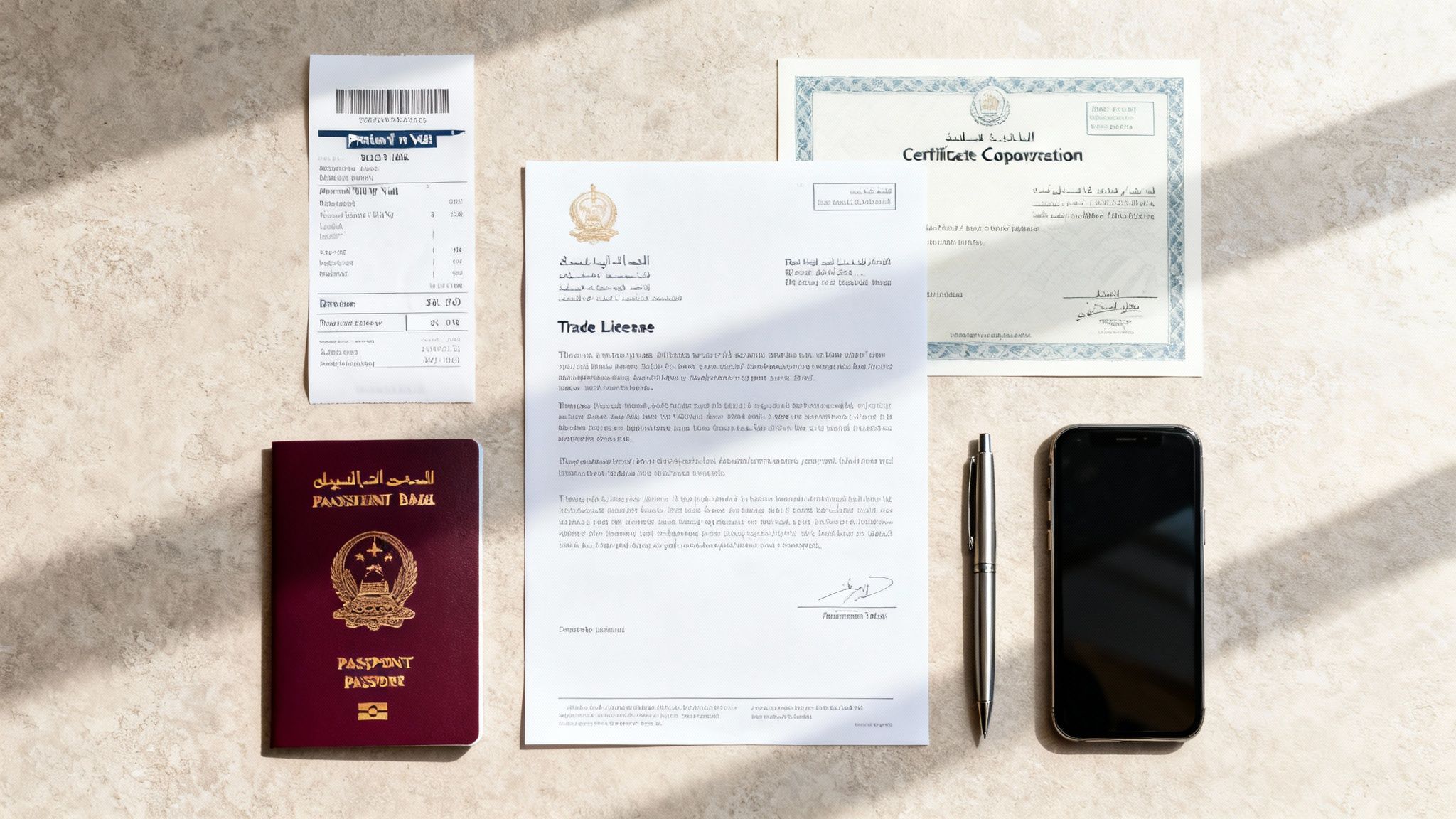
From my experience, the single biggest hurdle that trips up applicants for a non-resident bank account in Dubai is the documentation. Get it wrong, and you're looking at delays or even an outright rejection. Banks here operate under very strict compliance rules, so every single piece of paper is scrutinised.
Think of it this way: you're building a case for yourself. You need to present a clear, verifiable, and professional picture of who you are and why you need a UAE bank account. This is non-negotiable, whether you’re opening a personal account for investments or a corporate one for your international business.
H3: Essential Paperwork for Personal Accounts
For an individual non-resident, the bank’s primary focus is simple: verify your identity, your address outside the UAE, and the source of your funds. It all comes down to satisfying their Know Your Customer (KYC) regulations.
Here’s a breakdown of what you'll almost certainly need to provide:
- Passport and Visa Copies: A sharp, colour copy of your passport's main information page is your starting point. You'll also need a copy of your UAE entry stamp, as many banks require proof you’re physically in the country during the application.
- Proof of Address: This needs to be a recent utility bill or a bank statement from your home country, typically issued within the last three months. It must clearly show your full name and residential address. A mobile phone bill just won't cut it.
- Bank Reference Letter: This is a formal letter from your current bank back home. It should confirm you’ve been a customer in good standing for a decent period (say, more than six months) and that your account has been managed well.
- Source of Funds Documentation: Be ready to show where your money is coming from. This could be a salary certificate, recent payslips, or documents related to business income or investments. The more transparent you are, the smoother the process.
- A Detailed CV: A professional CV helps the bank understand your background and career history, which adds another layer of credibility to your file.
A common mistake I see is people underestimating the bank reference letter. It’s not just a formality; it’s a crucial piece of due diligence for the Dubai bank. Make sure it's on official letterhead, signed, and includes the bank's contact details.
For instance, a freelance consultant from the UK applying for an account would need their passport, a recent council tax bill for proof of address, a reference letter from their British bank, and a few client invoices to show their income. Understanding how these pieces fit together is key, especially if you're exploring options like getting a freelance visa in Dubai, which can make your banking life even simpler down the line.
H3: Navigating Corporate Account Documentation
Opening a corporate non-resident bank account in Dubai is a whole different ball game. The scrutiny is far more intense because the bank is vetting an entire business, not just one person. The document list is long, and everything must be perfectly in order. A single missing attestation can bring the whole process to a screeching halt.
You'll need all the personal documents for every shareholder and signatory, plus a full set of corporate files.
- Trade Licence or Certificate of Incorporation: This is the cornerstone document that proves your company is legally registered.
- Memorandum and Articles of Association (MOA/AOA): These legal documents spell out the company’s purpose, its structure, and internal rules.
- Shareholder and Director Registry: A formal, up-to-date list of all company owners and directors.
- Board Resolution: This is a signed document from the company's board that officially authorises the opening of the bank account and names the people who can sign on its behalf.
- Proof of Business Activity: This is where you prove your business is real and operational. Existing client contracts, invoices, or a very detailed business plan are perfect for this.
Imagine a free zone company looking to open an account. The founders must each provide their personal KYC documents. Alongside that, they'll submit the company's trade licence from the free zone authority, its MOA, and a board resolution signed by all partners. If the company already has clients, including copies of a few invoices will massively strengthen the application by proving the business is active.
H3: Document Checklist for Non-Resident Accounts
To make it easier, I've put together a table comparing the typical document requirements for personal and corporate non-resident accounts. This should give you a clear, at-a-glance view of what you need to prepare.
| Document | Personal Account Requirement | Corporate Account Requirement |
|---|---|---|
| Passport & Entry Stamp | Required for the account holder. | Required for all shareholders & signatories. |
| Proof of Address | Required (Utility bill/bank statement). | Required for all shareholders & signatories. |
| CV / Profile | Required for the account holder. | Required for all shareholders & signatories. |
| Bank Reference Letter | Required from the applicant's home bank. | Required from all shareholders' personal banks. |
| Source of Funds Proof | Required (e.g., payslips, contracts). | Required (Business plan, existing invoices). |
| Trade Licence | Not applicable. | Essential. The company's legal foundation. |
| MOA / AOA | Not applicable. | Essential. Defines company structure. |
| Board Resolution | Not applicable. | Essential. Authorises account opening. |
| Shareholder Register | Not applicable. | Essential. Lists all owners. |
Remember, this checklist is a great starting point, but some banks may have additional or specific requirements. The key takeaway is simple: preparation is your best tool for success. Having every document ready, correctly formatted, and attested where necessary will make all the difference.
How to Choose the Right Bank for Your Needs
Picking the right bank in Dubai isn't about finding the single "best" one. It's about finding the best fit for your unique situation as a non-resident. The city is packed with excellent local and international banks, but their willingness to take on non-resident clients—and the features they offer—can be worlds apart. Your final choice will really come down to your expected account balance, how you plan to move money, and the level of service you'll need.
A common mistake I see is people assuming all banks treat non-resident applications the same way. The reality? Some are far more experienced with the extra paperwork involved and have more flexible internal policies. Others are more conservative, which can make the process drag on and feel much more demanding. You have to look past the glossy ads and dig into the practical details that will actually affect your banking day-to-day.
Understanding the Key Players
Dubai’s banking scene is a mix of powerful local champions and the global financial giants we all know. Each one has its own personality and strengths, especially when it comes to serving international clients trying to open a non-resident bank account in Dubai.
Here are a few of the most prominent options you'll encounter:
-
Emirates NBD: As one of the UAE's largest local banks, Emirates NBD has a huge network and offers a bit of everything. They’re generally open to non-resident accounts but expect a thorough due diligence process. Their digital banking platform is top-notch, which is a massive plus when you're managing your finances from another country.
-
Mashreq Bank: Known for its slick, digital-first approach with Mashreq Neo, this bank is a solid choice for tech-savvy individuals. They often have more modern online application flows, but as a non-resident, you'll almost certainly still need some form of in-person or representative-led verification.
-
HSBC: A global powerhouse, HSBC is a natural go-to if you already bank with them back home. Their international connectivity is the main draw, making cross-border transfers and handling multiple currencies feel pretty seamless. The catch? Their minimum balance requirements for premium accounts can be steep.
-
RAKBANK: Often viewed as a more flexible and SME-friendly bank, RAKBANK can be a great starting point for entrepreneurs and small business owners. They have a reputation for being a bit more approachable for non-resident corporate accounts, as long as you have a strong business case.
It's not just about the name on the building; it's about their internal risk appetite. A bank that is actively courting international investment will often have more experienced relationship managers who understand the nuances of non-resident applications.
Critical Factors to Compare
To make the right call, you need to compare banks based on what truly matters to a non-resident. Don't get sidetracked by perks like local dining discounts that you'll never use.
Zero in on these core areas:
-
Minimum Balance Requirements: This is often the deal-breaker. If you drop below the required minimum, you can get hit with hefty monthly penalties, sometimes over AED 150. The growth of non-resident banking in Dubai is supported by a robust digital infrastructure, and data from leading UAE banks show minimum balance requirements for these accounts typically start around AED 3,000, but can go much higher for premium services. For a broader view of the UAE's investment climate, you can check out this detailed United States Department of State report.
-
Multi-Currency Account Features: If you deal with multiple currencies like USD, EUR, or GBP, you absolutely need an account that lets you hold and transact in them without forcing a conversion to AED every time. Pay close attention to the fees and exchange rate margins for these services.
-
International Transfer Fees: What's it going to cost to send money home or to other international accounts? Compare the fixed fees (like SWIFT charges) and the currency conversion spreads. A small difference here can add up to a significant amount over a year.
-
Quality of Online and Mobile Banking: As a non-resident, you’ll be living on the bank's digital platform. It has to be reliable, secure, and intuitive. Can you do everything you need without having to call someone or visit a branch?
-
Customer Support for Overseas Clients: When you have a problem from a different time zone, you need support that is responsive and actually knows what they're talking about. See if the bank offers dedicated support lines or relationship managers for international clients.
Aligning Your Choice with Your Goals
Ultimately, your reason for opening the account should be your guide. An investor buying property has completely different needs from a business owner who needs to manage trade finance.
A corporate client, for example, will need a bank with strong trade finance services and a clear process for opening corporate accounts. This is especially true if you’re exploring the benefits of a free zone company setup in the UAE, as your choice of bank needs to align with your business structure.
On the other hand, an individual looking to park savings or investments might prioritise a bank with a solid wealth management division and better interest rates on deposits. It’s also worth noting that some banks offer Islamic banking windows, providing Sharia-compliant products that avoid interest-based transactions—a critical factor for many investors.
By carefully weighing these practical elements, you can find a banking partner that not only says "yes" to your application but also effectively serves your financial goals for years to come.
The Account Opening Journey From Start to Finish
Setting up a non-resident bank account in Dubai can seem complex, but once you understand the flow, it becomes much more straightforward. Whether you apply in person or from overseas, the golden rules are the same: prepare everything meticulously and communicate clearly with your chosen bank. The path you take will really hinge on whether or not you can travel to the UAE.
The in-person route is the most traditional and, frankly, the one banks prefer. It allows for face-to-face interaction, instant document checks, and a personal connection that can build trust. On the other hand, applying remotely is possible, but it almost always requires the assistance of a registered corporate service provider to act as your representative on the ground.
The In-Branch Application Experience
Walking into a Dubai bank to open a non-resident account is a formal affair. You'll be introduced to a relationship manager, someone specifically trained to handle these applications. Think of it less like a simple administrative task and more like an interview.
The banker’s job is to satisfy the UAE's strict Know Your Customer (KYC) and Anti-Money Laundering (AML) regulations, so expect direct questions. You need to be ready to discuss:
- The Purpose of the Account: Why exactly do you need an account in Dubai? Generic answers like "for business" are immediate red flags. A solid answer would be, "To receive payments from my UAE-based clients and manage rental income from my property in Dubai Marina."
- Your Source of Funds and Wealth: Where is the money coming from? You must be able to clearly explain and provide proof for your income sources, whether it's from a salary, business profits, investments, or an inheritance.
- Expected Transaction Activity: What kind of transactions do you anticipate? The bank needs to understand the likely volume, value, and geographic location of both incoming and outgoing payments.
A small tip from experience: show up with your documents perfectly organised in a folder, with originals and copies ready to go. It makes a powerful first impression and signals that you're serious, organised, and transparent—qualities that compliance officers absolutely love.
This level of scrutiny reflects Dubai's status as a global financial powerhouse. The banking sector has a long history of supporting international clients—Central Bank of the UAE data shows non-resident bank credit consistently hovering between AED 190 billion and AED 277 billion. This deep engagement underscores the country's commitment to serving the non-resident community.
Navigating the Remote Application Path
If a trip to Dubai isn't on the cards, opening an account remotely is your next best option. However, this isn't a case of filling out an online form and getting approved. This path requires you to work with a professional consultancy licensed to liaise with banks for non-resident clients.
These consultants are experts. They know each bank’s specific risk appetite and documentation quirks inside and out. They will pre-screen your application, make sure every piece of paper is correctly attested, and submit it through their established relationships. While this service has a fee, it dramatically boosts the chances of approval for anyone who can't be here in person. It's especially useful for investors who need a corporate account after setting up a business, a process you can explore in our guide to offshore company formation in Dubai.
Key Milestones and Realistic Timelines
No matter which route you take, the process follows a predictable sequence. The initial decision-making phase, which involves picking the right bank, is a critical first step.
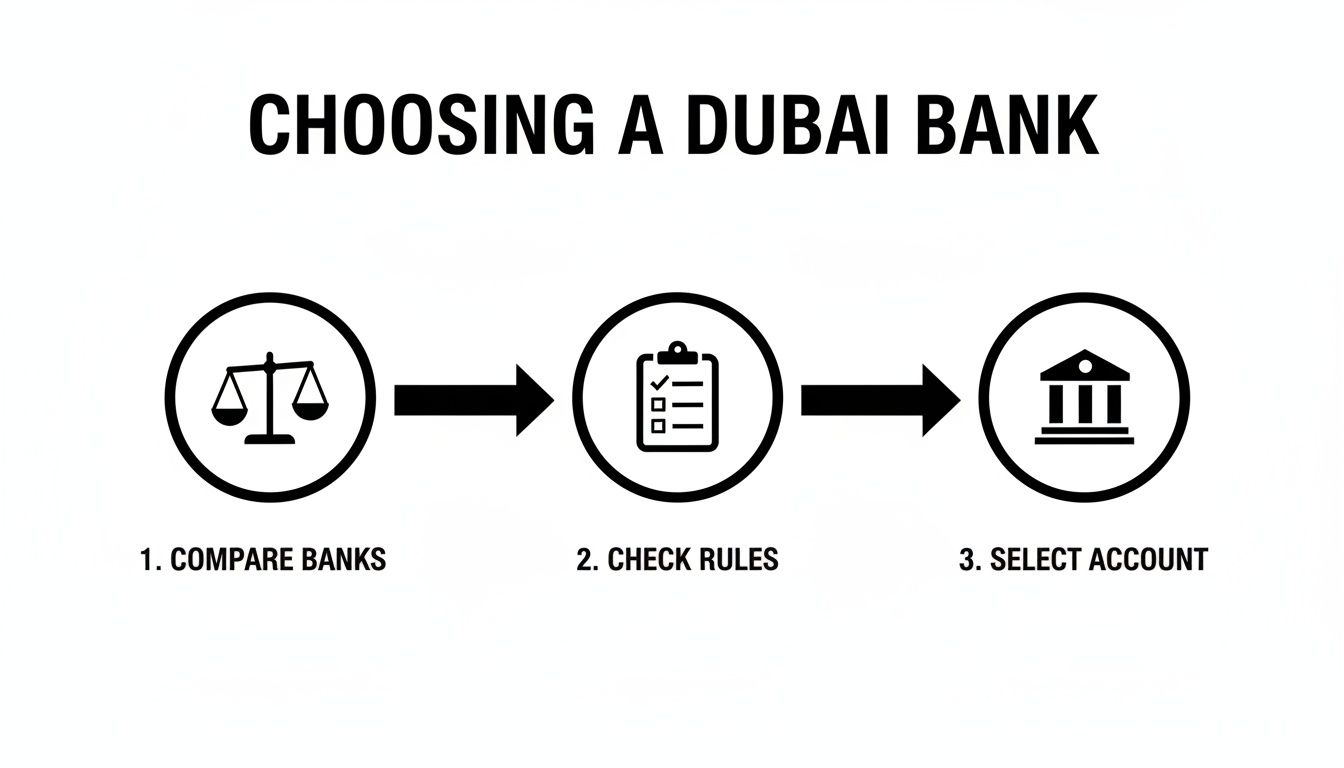
This graphic breaks it down perfectly: you compare what different banks offer, dig into their specific rules for non-residents, and then select the account that truly fits your requirements.
From that point on, the typical milestones look like this:
- Initial Submission: Your application and all the necessary documents are handed over to the bank.
- Compliance Review: This is where you'll need patience. The bank’s compliance team performs enhanced due diligence, double-checking every detail you've provided.
- KYC Verification Call: Don't be surprised if a compliance officer calls you directly to ask a few follow-up questions or clarify some information.
- Final Approval: Once the compliance team gives the green light, you’ll get an official notification that your account has been approved.
- Account Activation: You’ll make your initial deposit to get the account fully up and running. Your debit card, cheque book, and online banking login details will be issued shortly after.
Just be prepared to wait. The entire process for a non-resident can take anywhere from two to four weeks, and sometimes even longer for more complex cases. This isn't the bank being slow; the enhanced scrutiny is a standard part of protecting the integrity of the UAE's financial system. A thorough, deliberate pace is simply part of the journey.
Common Mistakes That Get Bank Applications Rejected
Opening a non-resident bank account in Dubai can feel surprisingly tricky. From what we've seen over the years, most rejections aren't because someone is ineligible. They usually happen because of small, completely avoidable slip-ups that trigger red flags in the compliance department.
Knowing what these common pitfalls are is genuinely the best way to make sure your application gets a green light without any fuss.
UAE banks are incredibly thorough. They have to be, with strict local and global regulations to follow. This means every single detail you provide gets put under a microscope. A tiny oversight might seem harmless to you, but to them, it can look like a lack of transparency, leading to a quick rejection that's often a real headache to reverse.
Incomplete or Poorly Prepared Documents
By far, the most common reason applications fail is simply down to incorrect or incomplete paperwork. And it's more than just forgetting to include a document; it's about providing information that doesn't quite meet the bank's specific standards.
A perfect example is the Proof of Address. People often try to submit a mobile phone bill or a document that’s older than three months. That's an instant no. Banks need something official and recent, like a utility bill or a formal bank statement from your home country, to properly verify where you live.
Another document that trips people up is the CV. Many applicants just hand over a generic, two-page resume they'd use for a job application. This is a mistake. For a non-resident application, your CV is a crucial KYC (Know Your Customer) document. It needs to be a detailed professional profile that clearly lays out your career path, your expertise, and your business background. It helps the bank understand who you are and why your financial activities make sense.
A strong application tells a clear, consistent story. If your CV says you're a software developer but your source of funds documents show large, unexplained cash deposits, you're creating a narrative gap that compliance officers are trained to question.
Vague Source of Funds Justification
Just writing "My funds come from my business" is a guaranteed recipe for rejection. Banks need a clear, documented trail for the money you're looking to bring in. Your "source of funds" and "source of wealth" explanations have to be specific and, most importantly, backed by evidence.
Think about these two approaches:
- Weak Approach: An applicant states their income is from "consulting work" and provides a single, large invoice. This is far too vague and lacks the context a bank needs.
- Strong Approach: The same applicant provides a detailed business profile, a few client contracts, the invoices that go with them, and six months of personal bank statements showing these payments coming in. This paints a complete, verifiable picture of legitimate business.
You have to be ready to prove exactly where your money came from. This might mean providing salary slips, dividend statements, property sale agreements, or audited company financials. The more open and transparent you are, the better your chances of a quick approval.
Misunderstanding Minimum Balance Rules
It's easy to get so focused on just opening the account that you overlook the ongoing requirements, especially the minimum average balance. This isn't just a friendly suggestion; it's a strict contractual rule.
If you fail to maintain it, you'll be hit with significant monthly penalties (often AED 150 or more), and eventually, the bank could just close your account.
Before you even start an application, find out the exact minimum balance required for the specific account you want. And remember, corporate accounts almost always have much higher requirements than personal ones, sometimes starting at AED 25,000 or more. Be honest with yourself about whether you can comfortably meet that threshold every month. It’s much smarter to choose a bank with a lower requirement you know you can maintain than to aim for a premium account you can't sustain. A little foresight here saves you a lot of money and protects your banking relationship down the line.
Your Top Questions Answered
When you're looking into opening a non-resident bank account in Dubai, a few key questions always pop up. These are the practical, make-or-break details that shape your entire approach, so let's get you some straight answers based on what we see every day with our international clients.
Getting these points clear from the start gives you the confidence to move forward without hitting any unexpected roadblocks down the line.
Can I Open a Dubai Bank Account Remotely Without Visiting?
This is the big one, and the short answer is: it's complicated. While it’s nearly impossible to open an account directly with a bank without ever setting foot in the UAE, you’re not out of options.
Most banks are firm on their policy: they need you there, in person, for final signatures and identity checks. It's a fundamental part of their compliance process. But what if a trip to Dubai isn't feasible right now?
This is where a licensed corporate service provider comes in. We can act as your official representative on the ground, handling the paperwork, talking to our contacts at the banks, and managing the whole process for you. It's a professional service, of course, but for many, it’s the only realistic way to get an account opened from overseas.
What Is a Typical Minimum Balance for a Non-Resident Account?
The minimum balance is a critical detail, and it varies wildly between banks and account types. Get this wrong, and you could be facing hefty monthly penalties. It pays to be realistic about what you can comfortably maintain.
Here’s a rough idea of what to expect:
- Personal Savings Accounts: A basic non-resident savings account might require a minimum balance of anywhere from AED 3,000 at some of the more accessible banks. For premium services with a dedicated relationship manager, you could be looking at AED 100,000 or more.
- Corporate Accounts: For businesses, the bar is almost always higher. The starting point is usually around AED 25,000, but it can easily climb to AED 250,000 or higher for more complex corporate structures or at more prestigious banks.
A quick tip from experience: Always double-check the exact average monthly balance required. If you dip below it, you could be hit with penalties, often around AED 150 a month, which adds up fast.
Does a Dubai Bank Account Affect My Tax Residency?
Let’s be clear: opening a bank account in Dubai does not automatically make you a tax resident of the UAE. Your tax residency is determined by the laws in the country where you actually live and have your main economic and personal connections.
However, you absolutely must handle this with care. The UAE is a signatory to the Common Reporting Standard (CRS), which is a global agreement for the automatic exchange of financial information between countries.
What does this mean for you? UAE banks are legally required to share details about your account—like the balance and any income earned—with the tax authorities in your home country. The whole point of the CRS is to prevent global tax evasion. So, it's non-negotiable: you need to speak with a tax advisor in your home jurisdiction to understand your reporting obligations and stay fully compliant.
Trying to piece together all the documentation, choose the right bank, and navigate compliance for a non-resident account can feel overwhelming. At Smart Classic Business Hub, our experts take the guesswork out of it, making sure your application has the best possible chance of success. Let us manage the complexities so you can focus on what matters.