
So, you're thinking about going freelance in Dubai. Smart move. It’s a place that perfectly blends professional ambition with an incredible lifestyle, but getting the initial setup right is absolutely critical. Your first big decision point? Choosing between a simple freelance permit and setting up a full-blown company. This choice will shape everything that follows—your costs, your legal responsibilities, and how much freedom you have to operate.
Charting Your Course in Dubai's Freelance Economy
Dubai has worked hard to become a magnet for independent professionals, and it shows. The city’s infrastructure is second to none, its location is a strategic dream, and the pro-business policies create an environment where freelancers can genuinely flourish. Let’s be honest, the favourable tax regime is a massive draw, letting you keep more of what you earn. It all adds up to make freelancing in Dubai a powerful step forward for your career.
The government is actively pushing this movement, understanding the immense value that skilled, independent talent brings to the economy. You can see this support in the streamlined processes they’ve created for freelance permits and visas. It's never been more straightforward for global talent to make Dubai their home base.
The Market is Booming—Seriously
The freelance scene here isn't just ticking along; it's exploding. We're seeing growth of around 10% every year. And if you need more proof, Outsized's 2025 Talent on Demand report found that freelancer registrations across the MENA region shot up by a staggering 78% in just the last year. This isn't a slow burn; it's a rapid shift towards independent work. You can explore the full report on the rising demand for skilled freelancers.
What does this mean for you? More opportunities. Whether you're in tech, media, consulting, or education, the client pool is deep and dynamic, which means a much better shot at landing high-value projects. The key is to get your legal foundation right from day one.
Your initial legal setup is the foundation of your entire freelance business in Dubai. Choosing between a simple permit and a company structure impacts everything from your liability and ability to hire staff to your long-term scaling potential.
The Two Primary Paths for Freelancers
Alright, so what are your options? It really comes down to two main legal structures. Each has its place, and understanding the core differences is your first practical step.
- Freelance Permit: This is the most direct route. It’s a licence that lets you operate as an individual professional under your own name. It's perfect for solo flyers who don't have plans to hire a team. The setup is generally quicker and lighter on the wallet.
- Company Formation: This means establishing a formal business entity, like a Free Zone Establishment (FZE) or even a Mainland Limited Liability Company (LLC). This path is for freelancers with bigger ambitions—maybe you plan to grow a team, need the protection of limited liability, or simply want to present a more corporate image to clients.
Thinking through this choice isn't just about the initial cost. It's a strategic decision about where you see your business heading in the future.
Freelance Permit vs Company Formation at a Glance
To help you see the differences more clearly, here’s a quick side-by-side comparison. It breaks down the most important factors to consider when you're making this foundational decision for your freelance career in Dubai.
| Feature | Freelance Permit | Company Formation (e.g., FZ-LLC) |
|---|---|---|
| Legal Structure | Individual professional licensed to work | Separate legal entity (e.g., FZ-LLC) |
| Liability | Unlimited personal liability | Limited liability (protects personal assets) |
| Ability to Hire | No, cannot hire employees | Yes, can sponsor employee visas |
| Trade Name | Operates under your personal name | Can register a unique company trade name |
| Corporate Bank Account | Possible, but may face more scrutiny | Straightforward to open |
| Sponsorship | Cannot sponsor dependents (visa is personal) | Can sponsor family visas through the company |
| Scalability | Limited; ideal for solo operators | High; built for growth and expansion |
| Setup Cost | Generally lower (e.g., from AED 7,500) | Higher (e.g., from AED 15,000+) |
Ultimately, the right choice hinges on your personal and professional goals. If you're looking for a simple, low-cost entry into the market to work on your own, a freelance permit is an excellent starting point. However, if your vision includes building a brand, hiring a team, or protecting your personal assets, then forming a company is the more strategic and sustainable path forward.
Choosing Your Visa and Legal Structure
Right out of the gate, this is the most important decision you'll make. Deciding on the right legal structure for your freelance career in Dubai isn’t just about the paperwork; it’s about setting a solid foundation that matches your professional ambitions, your budget, and where you see yourself in a few years.
This choice will directly impact everything from your ability to sponsor your family and your personal liability, to how much room you have to grow. Let’s get practical and break down the real difference between a simple freelance permit and a more formal company structure.
To simplify things, here’s a quick overview of the two main paths you can take.
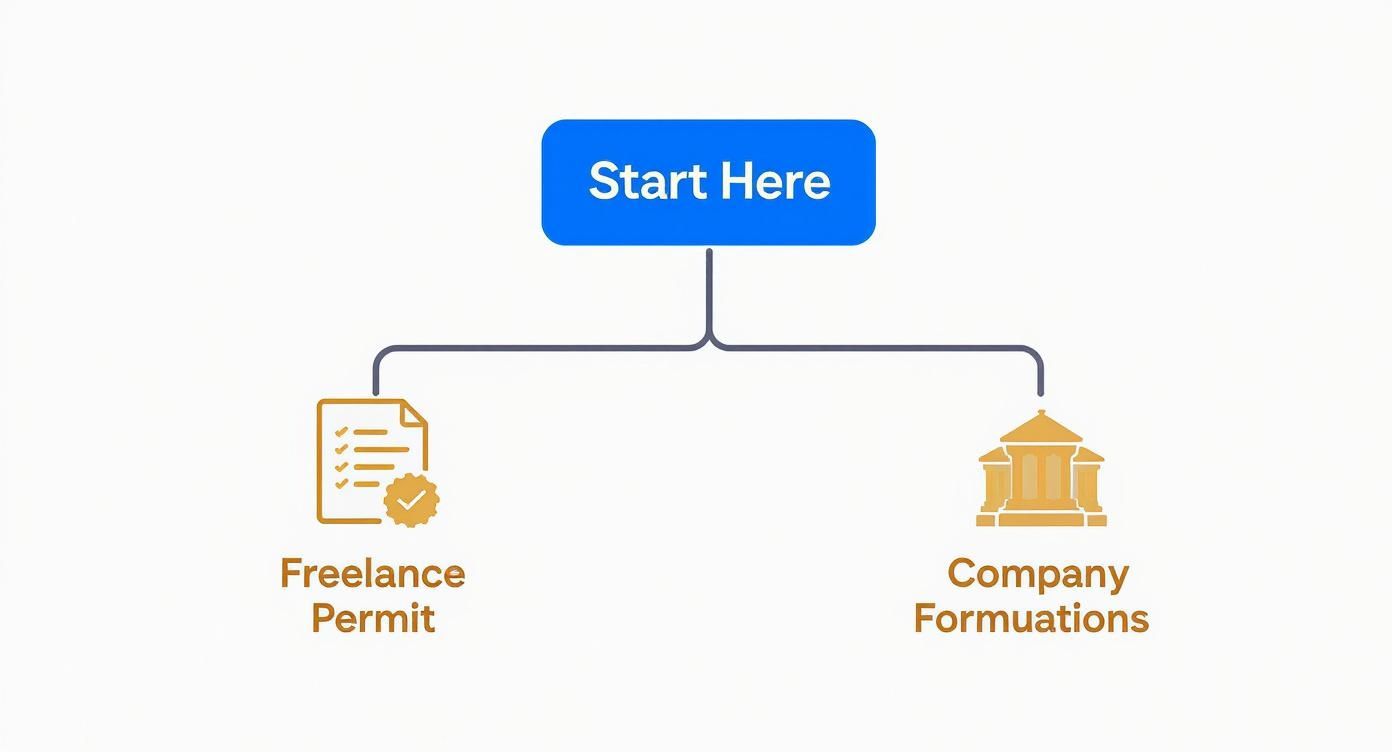
As you can see, it really boils down to one question: Are you a solo operator, or are you planning to build something bigger that involves hiring people?
The Freelance Permit: Your Direct Route to Going Solo
For most individual professionals, the freelance permit is the quickest and most popular way to get started. Think of it as a licence that legally allows you to operate as a sole practitioner, working under your own name. It's the perfect fit for consultants, writers, designers, and tech specialists who plan on working for themselves without bringing on a team.
You’ll find that key free zones like Dubai Media City, Dubai Internet City, and Dubai Knowledge Park are the main hubs for issuing these permits. Each zone is geared towards specific industries, so picking the right one matters. A graphic designer or content creator would feel right at home in Dubai Media City, while a Python developer would probably find Dubai Internet City a better match.
The process itself is refreshingly straightforward. You’ll need to pull together some documents—your passport, a brief business plan, and maybe a few professional references. Once your permit is approved, it paves the way for your residency visa, giving you the full legal right to live and work in the UAE.
A Look at the Green Visa for Freelancers
A recent and very welcome addition to the freelance scene is the Green Visa. This is a game-changer. It’s a long-term residency visa, valid for five years, designed specifically for established independent professionals. The big advantage? Unlike traditional visas that are tied to an employer or a specific permit, the Green Visa lets you sponsor yourself.
To qualify, you’ll generally need a bachelor's degree or a specialised diploma and be able to show proof of a certain level of annual income from your freelance work for the previous two years. It offers a level of stability and flexibility that’s incredibly attractive for seasoned freelancers wanting to really establish themselves in Dubai, as it separates your residency status from your permit issuer.
The Green Visa is a huge step forward, giving skilled freelancers a level of autonomy and security we haven't seen before. It’s built for professionals with a proven track record, cutting out the need for traditional sponsorship entirely.
When a Company Formation Makes More Sense
A freelance permit is perfect for many, but some ambitions just need a bigger vehicle. If your vision includes hiring a team, protecting your personal savings from business debts, or building a brand that's separate from your own name, then forming a proper company is the logical next move.
Setting up a Free Zone Establishment (FZE) or a Free Zone Limited Liability Company (FZ-LLC) creates a distinct legal entity. This gives you limited liability, which is a crucial shield that separates your personal assets from any business risks. It also unlocks the ability to sponsor visas for employees and family, and you can operate under a unique trade name—essential for serious brand building.
This shift usually happens when a freelancer's business starts to scale. Imagine a successful marketing consultant who wants to hire a junior assistant and a social media manager. To do that, they’d need to move from a permit to a company structure to support that growth. For a deeper look at the visa side of things, check out our detailed guide on obtaining a freelance visa in Dubai.
Making the Right Call for Your Situation
The government's forward-thinking approach has created a buzzing ecosystem for freelancers. As of 2025, Dubai is home to over 100,000 licensed freelancers in everything from tech and media to education. This boom is fuelled by flexible options like the five-year Green Visa, which empowers skilled individuals to live and work without a sponsor. Prominent free zones offer permits with licensing costs usually falling between AED 2,000 to AED 12,000, and visa approvals are often turned around in just 7 to 10 days.
To figure out your best path forward, just ask yourself a few honest questions:
- Scope of Work: Am I planning to fly solo, or do I see myself hiring staff in the next year or two?
- Brand Identity: Is working under my own name fine, or do I need a distinct company name for my brand?
- Liability: Am I okay with my personal assets being on the line, or do I need the protection that a limited liability structure offers?
- Budget: Can I comfortably handle the higher setup and renewal costs that come with forming a full company?
Your answers will clearly point you in the right direction, ensuring your freelance business in Dubai is built on a foundation that’s right for you.
Managing Your Finances Like a Pro
Getting your freelance licence and visa sorted is a huge milestone, but honestly, that’s just the start. Now it's time to get serious about the financial engine of your new business. For anyone freelancing in Dubai, mastering your money isn't just a good idea—it's the key to making this venture sustainable for the long haul.

This goes way beyond simply tracking what comes in and what goes out. You need to get your head around the UAE’s tax landscape, open the right kind of bank account, and build a professional invoicing system that ensures you get paid on time, every time.
Navigating UAE Corporate Tax and VAT
The UAE's reputation as a low-tax hub is a massive draw for freelancers, but that doesn't mean no tax. It’s crucial to understand your obligations from day one because ignorance won't be a valid excuse if you fall foul of the rules.
For freelancers, there are really two main taxes to keep on your radar: Value Added Tax (VAT) and Corporate Tax.
- VAT Registration: This is your first major tax hurdle. You are legally required to register for VAT once your taxable supplies and imports cross the AED 375,000 threshold within a 12-month period. My advice? Start tracking your revenue from your very first invoice.
- Corporate Tax: This was introduced in June 2023 and applies to businesses, freelancers included. You’ll be subject to a 9% tax rate, but here’s the important part: it only applies to your annual net profit above AED 375,000. This threshold means many solo freelancers might not have any tax to pay, but you still need to be aware of the law.
Knowing these thresholds is non-negotiable. Getting ahead of your VAT registration as you approach the limit is a critical compliance step. For a detailed walkthrough, our guide on how to register for VAT in the UAE breaks it down clearly.
Staying on top of your tax obligations is one of the clearest signs of a professionally run freelance business. Don't wait until the last minute; track your income meticulously so you know exactly when registration becomes mandatory.
Opening a Corporate Bank Account
I see this all the time—freelancers trying to run their business through their personal bank account. It’s a classic mistake. A dedicated corporate or business bank account is essential for a few simple reasons: it keeps your finances clean, makes you look more professional to clients, and frankly, most free zones require it anyway.
Be prepared, though. Opening a business account in Dubai isn’t always a quick process. Banks here have very strict compliance checks to prevent financial crime.
You’ll almost certainly be asked for these documents:
- Your freelance permit or trade licence
- Copies of your passport and Emirates ID
- A copy of your residency visa
- A short business plan or profile describing what you do
Patience is key, as the whole thing can take a few weeks. Also, some banks require a higher minimum balance for business accounts than for personal ones, so it pays to shop around and find an option that suits your cash flow. Having all your paperwork in perfect order from the start will speed things up considerably.
Pricing Your Services and Invoicing
Once you're set up financially, it’s time to actually get paid. This all starts with pricing your services correctly. The income potential for skilled professionals freelancing in Dubai is significant, thanks to strong demand across almost every sector.
It’s not uncommon for full-time freelancers to earn between AED 30,000 and AED 80,000 per month. Day rates typically fall in the AED 1,000 to AED 3,500 range. For larger projects, like a full brand campaign, fees can easily run into the tens of thousands.
Your invoicing needs to be as polished as your work. A clear, detailed invoice isn't just about getting paid; it's a legal document for your records and a reflection of your professionalism.
Make sure every invoice you send includes:
- Your Details: Your full name and the name on your trade licence.
- Client Details: Their full name and address.
- Unique Invoice Number: Essential for tracking and accounting.
- Dates: The date of issue and the payment due date.
- Service Breakdown: A clear, itemised list of services provided, with rates and hours.
- Total Amount: The subtotal, any VAT you've charged, and the final amount due.
- Payment Information: Your business bank account details and any other payment methods you accept.
Set your payment terms clearly from the outset—whether it's "Net 15" or "Net 30"—to manage client expectations and keep your cash flow healthy. It’s a small detail that makes a big difference.
Setting Up Your Freelance Operations
You’ve made it through the paperwork maze—licence in hand, bank account open. Congratulations! Now it’s time to shift gears from administrative setup to actual operations. This is where you build the day-to-day framework that turns you from a licensed individual into a proper, client-ready business.
It’s all about making smart, practical choices now that will pay off later. Think about where you'll work, how you’ll land those first critical clients, and the legal safety nets you need to put in place.
Getting these fundamentals right from the start is what builds momentum. It establishes a professional foundation that will support your entire freelance career in Dubai.
Choosing Your Workspace
One of the first decisions you'll make is where you’ll actually get the work done. While the idea of working from home is tempting (and cheap), it isn’t always the best move for every freelancer. Thankfully, Dubai has a fantastic range of options.
- Working from Home: This is the most budget-friendly choice, no question. You get maximum flexibility and a commute of zero. The downside? It can get lonely, and the line between your personal and professional life can get very blurry, very fast.
- Co-working Spaces: Places like WeWork or Letswork offer more than just a desk. You get a professional business address, reliable internet, and meeting rooms on demand. More importantly, you're surrounded by other professionals, which opens up networking opportunities that are impossible to find when you're working solo from your sofa.
Ultimately, the choice comes down to your budget and personality. If you thrive on social interaction and need that clear separation to be productive, the monthly fee for a co-working space is a solid investment in your business and your sanity.
Your work environment sends a powerful signal—both to you and your clients. A dedicated workspace, whether it’s a home office or a co-working hub, reinforces that you're running a serious, professional operation.
Finding Clients in the Dubai Market
Landing your first few clients is the single biggest hurdle for anyone starting their freelancing in Dubai journey. This market is built on relationships. A stellar portfolio is a great start, but it's rarely enough on its own. You need to be proactive and get in front of the right people.
A great place to begin is by dialling in your digital presence. Your LinkedIn profile shouldn't just be a digital CV; it needs to act like a sales page. It should shout about the problems you solve for clients. Pack it with keywords relevant to your industry in Dubai, feature testimonials, and actively post content that shows you know your stuff.
But don't hide behind a screen. In-person networking is still king here. Get out to industry-specific events, workshops, and meetups. Groups like the Dubai Business Women Council or local chambers of commerce are goldmines for making genuine connections. Just remember, people in Dubai prefer doing business with people they know, like, and trust.
Crafting Ironclad Client Contracts
Let’s be clear: a verbal agreement is not a contract. A professionally drafted freelance contract is your most important tool for managing expectations, defining the work, and—crucially—making sure you get paid. It protects both you and your client by creating total clarity from day one.
Keep your contract simple and clear. Ditch the complicated legal jargon. Every solid freelance agreement should have a few non-negotiable clauses.
Key Contract Clauses to Include:
- Scope of Work: Be painfully specific about what services you will provide. Just as important, spell out what is not included. This is your best defence against "scope creep," where a project magically grows bigger without the budget following suit.
- Payment Terms: Clearly state your rates, the payment schedule (e.g., 50% upfront, 50% on completion), and how you accept payments. Don't forget to include penalties for late payments.
- Deliverables and Timeline: Outline exactly what you will deliver and when. Clear milestones keep the project on track and everyone on the same page.
- Ownership and Intellectual Property: State who owns the final work after the final invoice is paid. This is absolutely critical for creatives like designers, developers, and writers.
- Termination Clause: Define the conditions under which either you or the client can end the contract. This gives everyone a clear exit strategy if things go south.
Having a solid contract template ready to go makes you look professional and sets the right tone for every new project. And as your operations grow, you might find a simple permit isn't enough. For a deeper look at building a more scalable business, check out our guide to free zone company setup in the UAE. This operational framework—your workspace, client strategy, and legal protections—is the engine that will drive your freelance success.
Staying Compliant and Thinking Long-Term
Getting your freelance licence and that corporate bank account sorted are massive milestones. Celebrate them! But now, the real marathon begins: building a business that lasts. Succeeding as a freelancer in Dubai isn't about that initial setup sprint; it’s about building solid, repeatable habits for compliance and knowing exactly when to call in the experts.
This isn’t just about ticking boxes to avoid fines. Staying on top of your legal duties is a sign of professionalism. It builds trust with your clients and, more importantly, lets you focus on your actual work instead of getting bogged down in administrative quicksand.
Your Annual Licence Renewal Checklist
That freelance permit isn't a "set it and forget it" document. It needs to be renewed every single year, and letting it lapse can cause a world of pain, from hefty fines to serious issues with your residency visa. Think of it as your business's annual check-up.
Usually, your free zone will ping you with a renewal notice about a month before the expiry date. That's your signal to get everything lined up. The process itself is pretty straightforward, provided you’re organised.
Here’s what you’ll generally need to have ready:
- A Signed Renewal Form: The standard application your free zone provides.
- Valid Health Insurance: Your mandatory medical insurance must cover the next 12 months.
- Tenancy Contract (If Applicable): If you lease an office, you'll need to show your current Ejari or lease agreement.
Whatever you do, don't leave this to the last minute. Start gathering your documents the moment that notification lands in your inbox. Any delay could jeopardise your legal status to work and live in the UAE.
Treat your licence renewal date like the most critical deadline in your business calendar. I tell all my clients to set a reminder three months out. It gives you plenty of breathing room to handle any surprises without the stress.
What You Need to Know About Accounting and Audits
Dubai might be famous for its pro-business environment, but financial accountability is taken extremely seriously. As a licensed freelancer, you're not just a person doing gigs; you're operating a formal business, and that means you are legally required to maintain proper financial records under the UAE Commercial Companies Law.
Now, for most solo freelancers with a simple permit, a full-blown third-party audit isn't typically required for licence renewal. However, this isn't a universal rule. It can change based on your free zone's specific regulations or if you've set up a more complex structure like an FZE or FZ-LLC. For those company types, an annual audit is far more likely.
From day one, keeping clean books is non-negotiable. This means:
- Diligently recording every dirham of income and every expense.
- Saving a digital copy of every single invoice you issue and pay.
- Keeping a clear record of all transactions flowing through your business bank account.
This simple habit will be a lifesaver when you're managing VAT or Corporate Tax. Plus, it gives you a crystal-clear view of your financial health, which is vital for making smart decisions about how to grow.
Knowing When to Call for Backup
One of the smartest moves any freelancer can make is admitting they can't—and shouldn't—do it all. Your time is your most valuable asset. It's best spent on the work that actually generates revenue, not on deciphering government forms or wrestling with a spreadsheet.
Outsourcing these administrative and compliance tasks isn't just another cost. It's a strategic investment in your own efficiency and sanity.
The Role of a PRO (Public Relations Officer)
A PRO is your secret weapon for dealing with government departments. They are the specialists who handle the nitty-gritty of visa applications, licence renewals, and sorting out official paperwork. Instead of you spending hours figuring out a complex process, a good PRO gets it done right the first time, and fast. For a freelancer, that means less time standing in queues and more time billing clients.
Why You Need an Accountant
As your income grows, so does the complexity of your finances. An accountant is so much more than a tax filer. They’re a strategic partner. They can help you manage your cash flow, offer advice on financial planning, and ensure you're always fully compliant with VAT and the new Corporate Tax laws. Honestly, the money a good accountant saves you in tax efficiencies and avoided penalties often more than covers their fee.
Engaging a consultant like Smart Classic brings all of this under one roof. We can act as your single point of contact for everything from PRO services to accounting and long-term strategic advice. This integrated approach ensures every part of your business compliance is aligned, freeing you up to focus completely on what you came to Dubai to do: succeed.
Your Top Freelancing Questions, Answered
Starting out as a freelancer in Dubai is an exciting move, but it naturally comes with a lot of questions. We get it. Navigating the rules for the first time can feel a bit overwhelming, so let's clear up some of the most common queries we hear from aspiring freelancers.
Is Health Insurance Really Mandatory?
Yes, 100%. In Dubai, having valid health insurance isn't just a good idea—it's a legal requirement for every single resident, and that includes freelancers. When you go to get your residency visa issued or renewed, you'll have to provide proof that you're covered by a compliant plan.
Don't be tempted to skip this step. The authorities are serious about it. You could face fines of around AED 500 per month for every person you're responsible for who isn't insured. Worse, your visa or permit renewal could be flat-out denied until you get it sorted. Your plan has to meet the minimum standards set by the Dubai Health Authority (DHA), which means an annual coverage limit of at least AED 150,000.
Think of health insurance as a non-negotiable part of your business setup, not an optional extra. It’s a legal must-have that also shields you from the incredibly high cost of medical care here. One unexpected health issue shouldn't be able to sink your entire freelance career.
Can I Bring My Family Over on a Freelance Visa?
Absolutely, and this is a huge draw for many people. Once your own freelance permit and residency visa are officially in place, you gain the right to sponsor your dependents, like your spouse and children.
This feature is what turns a solo career move into a genuine, long-term plan for the whole family. You'll need to meet a few conditions, of course, like proving a minimum monthly income and having an attested tenancy contract (your Ejari), but the process is very clear and well-established.
What if a Client Refuses to Pay Me?
This is the ultimate nightmare for any freelancer, but being properly licensed in Dubai gives you real power and recourse. You’re not just an individual working informally; your freelance licence makes you a legitimate business entity. If a client defaults on what they owe you, you have legal options.
Your first move should always be polite but firm communication, pointing back to your signed contract and the agreed payment terms. If that doesn't work, you can escalate the matter by filing a case with the authorities in your specific free zone or through the Dubai Courts. In these situations, your signed contract and detailed invoices are your best friends—they become the evidence that backs up your claim.
Ready to get started without the guesswork? The team at Smart Classic Business Hub provides complete support for freelancers, from picking the perfect free zone to handling your ongoing compliance needs. Begin your freelance journey with an expert in your corner by visiting https://smartclassic.ae today.