
If you're looking to do business in the UAE, the limited liability company is likely the first structure you'll come across. It’s easily the most popular choice for entrepreneurs, and for good reason: it creates a legal separation between your personal assets and the company's financial obligations. Think of it as a protective financial shield for you, the business owner.
Unpacking the UAE Limited Liability Company

At its heart, a Limited Liability Company (LLC) is a business structure where the owners' liability is limited to whatever they've invested in the company. This means if the business runs into financial trouble or faces legal action, your personal assets—like your home, car, or savings—are generally off-limits. It really does offer the best of both worlds: the solid liability protection you'd get with a corporation, but with the operational flexibility of a simpler partnership.
This setup is perfect for small to medium-sized enterprises (SMEs) and international investors who want to build a real, tangible presence in the local market. An LLC gives you credibility and a formal legal framework, which is crucial for things like securing big contracts, opening corporate bank accounts, and working with government bodies.
The Core Principle of Limited Liability
Imagine your business is a ship sailing on the sea of commerce. As the captain (the owner), you've put your money into building that ship (your company). If the ship unfortunately hits a storm and sinks (incurs debt or fails), your personal lifeboat (your personal assets) remains safe and separate. You might lose the ship, but you won’t get pulled down with it.
A UAE LLC effectively builds a legal wall between your business and personal finances. This separation is the primary reason it is favoured by entrepreneurs who want to pursue growth without exposing their personal wealth to undue risk.
This legal distinction is what it's all about. It allows you to take calculated risks, invest in new ideas, and drive growth, all with the peace of mind that a business downturn won't lead to personal financial ruin.
For a quick overview, here are the standout features of a UAE LLC.
UAE LLC Key Features at a Glance
This table breaks down the essential characteristics and requirements you need to know.
| Feature | Description |
|---|---|
| Legal Structure | A separate legal entity from its owners. |
| Liability | Limited to the capital invested in the company. |
| Ownership | 100% foreign ownership is now permitted for most activities. |
| Number of Shareholders | Can range from a single shareholder up to 50. |
| Local Market Access | Can trade directly within the UAE mainland and internationally. |
| Visas | Eligible for investor and employee residence visas. |
| Corporate Bank Account | Can open a corporate bank account in the UAE. |
| Ideal For | SMEs, foreign investors, trading, and service-oriented businesses. |
Understanding these points is the first step in seeing why the LLC structure is so dominant in the UAE's business scene.
A New Era of Foreign Ownership
The landscape for setting up a limited liability company UAE has changed in a big way. In 2025, LLCs are the most common and straightforward way to do business on the mainland, thanks to some major legal reforms. The real game-changer was a landmark update in 2022 that now allows for 100% foreign ownership of LLCs across most sectors. This completely dismantled the old 51/49 rule, which used to require a UAE national to hold the majority of shares.
This shift has unlocked massive potential, leading to a reported 67% increase in foreign investment approvals and cementing the UAE's reputation as a top-tier global business destination. You can find out more about how these changes have impacted LLC formation in this helpful guide.
Getting to Grips with Ownership Rules and Share Capital
When you’re setting up a limited liability company UAE, two things come up right away: who can own it, and how much money do you need to start? Recent changes in the law have completely rewritten the rulebook for foreign entrepreneurs, making it easier than ever to own your business outright. Let’s break down what this means for you.
The biggest news has been the shift to 100% foreign ownership for mainland LLCs. For years, the rule was that a UAE national—an Emirati sponsor—had to own 51% of any commercial or industrial business. That’s no longer the case for most activities. International investors can now hold all the shares and have complete control over their mainland companies, a perk that used to be almost exclusive to free zones.
But, and this is a big "but," it doesn't apply to everything. Certain strategic industries like banking, insurance, and telecommunications still have their own specific ownership rules. So, your first step is always to check if your business activity is on the official "positive list" that qualifies for full foreign ownership.
Mainland vs. Free Zone Ownership: What’s the Difference?
Even with the new rules, the choice between a mainland and a free zone company is still a crucial one. Both now offer 100% foreign ownership for many business types, but your decision really boils down to your business model.
- Mainland LLC Ownership: This is your best bet if you plan to trade directly within the UAE, bid on government contracts, or set up shop anywhere you like within an emirate. It gives you unrestricted access to the local market.
- Free Zone Company Ownership: This is perfect for businesses focused on international trade, re-exporting goods, or serving clients outside the UAE. If you want to sell to customers on the mainland from a free zone, you’ll usually need to go through a local distributor.
It's also worth noting that even with 100% foreign ownership on the mainland, some professional licences (think consultancies or legal firms) might still need a Local Service Agent (LSA). An LSA is a UAE national who acts as a go-between for government paperwork but has zero shares and no say in how you run your business. Their role is purely administrative.
Think of share capital not as a fee you have to pay, but as a statement of your company's financial credibility. It's the value the owners have committed to the business on paper.
This brings us neatly to the second part of your LLC’s structure.
Demystifying Share Capital Requirements
A lot of entrepreneurs get hung up on the idea of depositing a huge sum of money just to get started. The good news? For most businesses in the UAE, the government has done away with mandatory minimum share capital. You don't have to prove you have a specific amount sitting in a bank account before getting your licence.
That said, share capital is still a core concept. Your company’s Memorandum of Association (MOA)—the foundational legal document for your business—must state a share capital figure. This amount needs to be realistic and "sufficient" for what your business aims to do.
For example, a small IT consultancy might declare a share capital of AED 100,000. A company trading in heavy machinery, on the other hand, might declare AED 1,000,000 to reflect its operational scale. This declared amount is then divided into shares and assigned to the owners based on their stake.
Even though you don't have to deposit it, this figure is important for a few reasons:
- Defines Liability: It caps each shareholder's financial liability to the amount they've invested.
- Boosts Credibility: A respectable share capital figure can make your business look more serious to banks, suppliers, and clients.
- Establishes Ownership: It legally documents who owns what percentage of the company.
Picking the right share capital amount is a strategic move. It should be a number that reflects your business plan and adds credibility, without putting you under any financial strain. Getting this balance right ensures your limited liability company UAE starts on a solid, practical foundation.
Your Step-by-Step Guide to Setting Up a UAE LLC
Setting up a limited liability company in the UAE can feel like trying to solve a complex puzzle, especially with all the bureaucracy involved. But honestly, when you break it down into a clear sequence of steps, it becomes a much more predictable and manageable journey. Let's walk through that roadmap together, from your initial idea right through to holding your new trade licence.
Think of it like building a house. You wouldn't dream of putting up the walls before you've laid a solid foundation. It's the same with an LLC formation; each step builds logically on the one before it, creating a stable legal structure for your business. The entire process is overseen by the Department of Economic Development (DED) in your chosen Emirate, which is the central authority for all mainland business registrations.
This diagram shows the two foundational elements: ownership and capital. They are the absolute cornerstones of your LLC's structure.
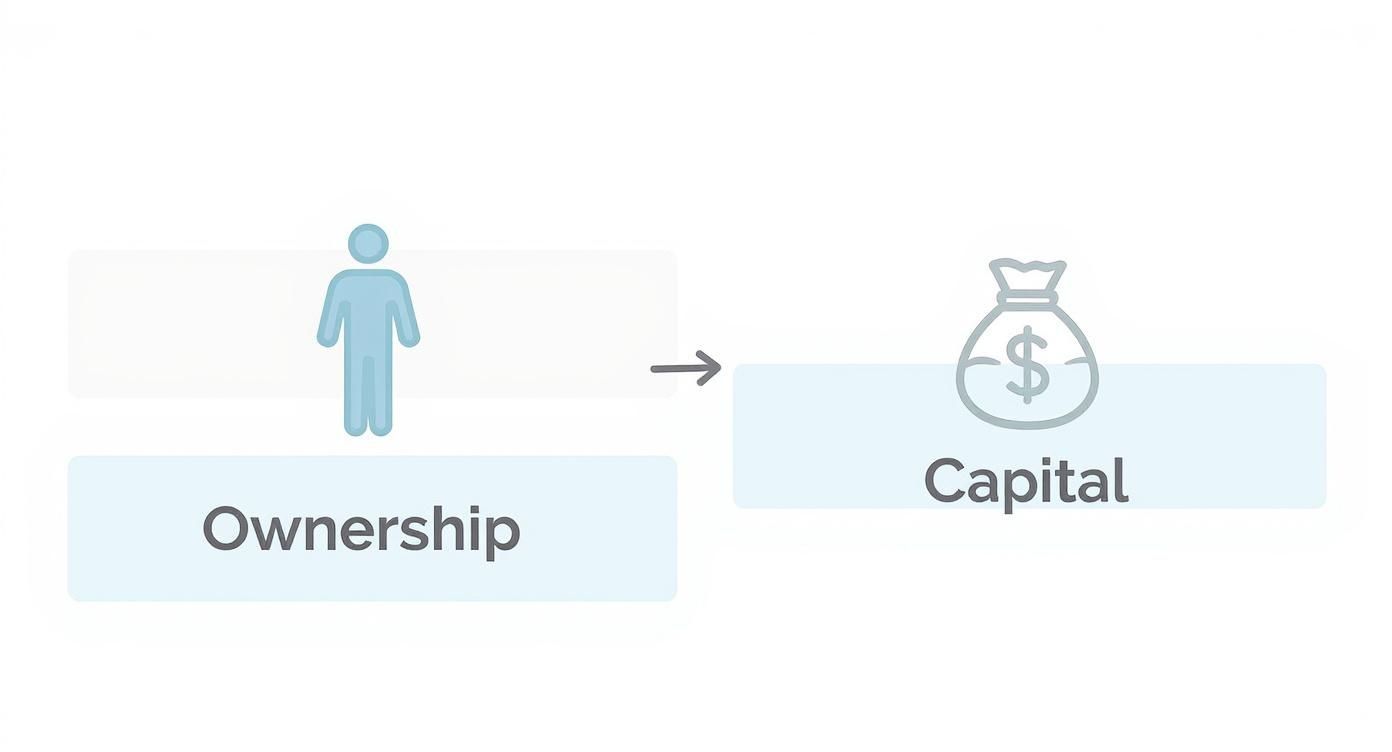
As you can see, the legal ownership structure you decide on directly dictates how the share capital is allocated. This establishes both control and liability right from the get-go.
Stage 1: Initial Approvals and Name Reservation
The very first practical step is to give your business its identity. This means choosing a unique trade name that fits within UAE naming rules and then officially reserving it with the DED. Remember, your name can't be offensive, violate public morals, or already be taken.
At the same time, you'll apply for Initial Approval. This is basically a preliminary green light from the authorities, confirming they have no objection to you starting your proposed business. It’s a crucial document that unlocks the next stages, like drafting your legal contracts.
Here’s what this stage usually involves:
- Submitting a shortlist of proposed trade names (it's best to have three options).
- Filling out the initial application form with details about the shareholders and what your business will do.
- Providing passport copies for every partner in the company.
Once that Initial Approval certificate is in your hands, you have a clear runway to formalise your business.
Stage 2: Legal Documents and Finding an Office
With the initial approval secured, it's time to create the legal backbone of your company: the Memorandum of Association (MOA). Think of this document as your LLC's constitution. It lays out everything from how shares are distributed and profits are shared to management duties and the company's objectives.
The MOA has to be drafted in both Arabic and English and then notarised by a public notary here in the UAE. This is a non-negotiable step, as it legally binds all the partners to the terms you've agreed on, which prevents a lot of headaches and disputes down the line.
You'll also need to secure a physical office space. A mainland LLC can't operate out of a virtual office; you need a real, physical address. This means getting a valid tenancy contract (called an Ejari in Dubai) and registering it with the authorities. This registered commercial address is an absolute must-have to get your trade licence.
Stage 3: Final Submission and Getting Your Licence
This is the final stretch where everything you've prepared comes together. You'll gather all your documents—the initial approval, the notarised MOA, your tenancy contract, and passport copies for all shareholders—and submit them as one comprehensive package to the DED for final approval.
The moment your trade licence is issued is the moment your limited liability company in the UAE officially exists. It is the legal permit that allows you to start conducting your specified business activities anywhere in the country.
Once the DED gives your application the final review and approval, they will issue a payment voucher for the trade licence fees. As soon as you pay it, you'll receive your official Commercial Licence. This is what the whole process has been leading up to.
The entire procedure, from reserving your name to getting the licence, can take anywhere from a few days to a couple of weeks. It really depends on the complexity of your business activity and how organised your documents are. For a more detailed look at what's needed, our guide to mainland company setup in Dubai offers some extra insights.
Finally, with your trade licence in hand, you're ready for the post-formation tasks. This includes registering with the Ministry of Human Resources and Emiratisation (MOHRE) for an Establishment Card so you can hire staff, and registering with the immigration authorities to process visas for yourself and your team.
Decoding the Costs and Required Documents
Before you dive in, it’s worth watching this short video which gives a great overview of what to expect when setting up your company.
Alright, let's talk numbers and paperwork. Getting a handle on the financial and administrative side of things is absolutely essential before forming your limited liability company UAE. The process itself is quite logical, but knowing what you’ll need to pay—and when—will save you from frustrating delays and unexpected bills.
Think of the total cost not as one single invoice, but as a series of fees paid at different milestones. These can fluctuate a bit depending on which emirate you're in, your exact business activity, and even choices like the size of your office. A clear budget from day one is your best friend for a smooth launch.
A Transparent Breakdown of Formation Costs
To give you a realistic idea, let’s lay out the typical one-time and recurring costs for a mainland LLC. Keep in mind these are solid estimates, but the best move is always to get a quote tailored to your specific business. Our team can walk you through a detailed breakdown of the cost of starting a business in Dubai that matches your unique needs.
Here’s a look at what you should plan for:
Estimated Cost Breakdown for a UAE Mainland LLC
This table outlines the common expenses you'll encounter when setting up and running your LLC in the UAE.
| Cost Component | Estimated Cost Range (AED) | Type (One-time/Annual) |
|---|---|---|
| Trade Name Reservation | 600 – 800 | One-time |
| Initial Approval Certificate | 150 – 250 | One-time |
| MOA Notarisation & Typing | 1,500 – 3,000 | One-time |
| Trade Licence Issuance | 8,000 – 15,000+ | Annual |
| Commercial Office Rent (Ejari) | 20,000 – 50,000+ | Annual |
| Establishment Card | 2,000 | Annual |
| Investor Visa Processing | 4,000 – 6,000 | Every 2-3 years |
These figures give you a strong baseline to work with. The Trade Licence fee, for example, is often tied to your business activity; some professional services or industrial operations might be on the higher end of that scale. The biggest variable, however, is almost always the office rent—a mandatory annual cost for any mainland LLC.
The largest recurring expenses for a UAE LLC are typically the annual trade licence renewal and the commercial office rent. Factoring these into your yearly financial plan is essential for long-term operational health.
By getting ahead of these costs, you can sidestep common financial hurdles and make sure your new company is on solid ground from its very first year.
Your Essential Document Checklist
With your budget sorted, the next step is gathering your paperwork. Having everything organised and ready to go will dramatically speed up the approval process with the Department of Economic Development (DED).
Here's exactly what you'll need to have on hand:
- Shareholder Passport Copies: Clear, valid copies for every partner involved.
- Visa or Entry Permit Copies: If any partners are non-residents, they'll need to provide a copy of their visit visa or entry stamp.
- Application Form for Initial Approval: This is the standard DED form where you'll detail your business activity and partners.
- Trade Name Reservation Certificate: The official proof that your chosen business name has been approved and is reserved for you.
- Notarised Memorandum of Association (MOA): Your company's foundational legal document, which must be officially attested.
- Registered Tenancy Contract (Ejari): The official lease agreement for your mandatory physical office space.
- Approvals from Other Authorities (if applicable): Some business activities, like healthcare or education, require a thumbs-up from specific ministries or departments.
Keeping these documents organised isn't just good practice—it's the secret to a fast and efficient setup. A complete, accurate submission is the quickest path to getting your limited liability company UAE licensed and open for business.
Managing Your Tax and Compliance Obligations

Getting your trade licence is a huge milestone, but it's really just the starting line. Once your limited liability company UAE is officially launched, the focus shifts from setup to the day-to-day reality of running a business. This is where ongoing governance and compliance come into play.
Staying on the right side of the UAE's legal and financial regulations isn't just about ticking boxes; it's fundamental to your company's long-term survival. These aren't just administrative hoops to jump through—they're the rules of the game that let you operate legally, avoid hefty penalties, and build a business that lasts.
Understanding UAE Corporate Tax
The single biggest shift in the UAE's business world recently has been the introduction of a federal Corporate Tax. This new system has completely changed the game for almost every company, making sharp financial management more critical than ever.
Rolled out in June 2023, the law brought in a standard 9% rate on any business profits that climb above AED 375,000 (roughly USD 102,000). While this threshold protects many smaller LLCs, the new rules have undeniably added a layer of complexity. In fact, a staggering 94% of UAE businesses reported a heavier regulatory load after it came into effect. You can explore more on these corporate law changes and compliance trends on kayrouzandassociates.com.
For any limited liability company UAE, Corporate Tax is not optional. You must register with the Federal Tax Authority (FTA), even if you don't expect your annual profits to hit the taxable threshold. This applies to all mainland companies.
This non-negotiable requirement highlights just how important it is to have your bookkeeping in order from day one. Your taxable income is based on your company's net profit, with a few adjustments allowed by the law. Good financial records are no longer just a nice-to-have; they're a legal must.
Navigating VAT and Other Duties
On top of Corporate Tax, you also need to get to grips with Value Added Tax (VAT). Introduced back in 2018, VAT is a tax on consumption that applies to most goods and services. Knowing where your LLC stands is absolutely essential.
You are legally required to register for VAT if your taxable supplies and imports total more than AED 375,000 in a 12-month period. There's also an option for voluntary registration if that figure is over AED 187,500. Getting this wrong can lead to serious fines from the FTA. To get a clearer picture, take a look at our guide on how to register for VAT in the UAE.
A few other key compliance tasks for your LLC include:
- Annual Trade Licence Renewal: Your trade licence isn't a one-and-done deal. It needs to be renewed every year with the DED. This involves paying the fees and making sure your office lease (Ejari) is up to date.
- Audited Financial Statements: Not every LLC needs a formal audit. However, it becomes mandatory for certain regulated activities or if it's written into your MOA. Plus, banks or potential investors will almost certainly ask for them.
- Economic Substance Regulations (ESR): If your business performs specific "Relevant Activities," you'll need to prove you have a genuine economic presence in the UAE to meet ESR rules.
Handling these duties properly is what separates a thriving, legally secure business from one that's constantly at risk. Prioritise your compliance, and you'll be building a solid foundation for real, sustainable growth.
Common Questions About UAE LLCs Answered
When you're looking into setting up a limited liability company in the UAE, a few key questions always come up. Let's tackle them head-on, giving you the clear, straightforward answers you need to move forward with confidence.
Can I Get a Residence Visa with a UAE LLC?
Yes, absolutely. In fact, forming an LLC is one of the most reliable routes to securing a UAE residence visa for you and your family. As a shareholder in the company, you're eligible to apply for an investor visa.
It doesn’t stop there. Your company can also sponsor visas for your employees. The number of visas you can get is usually tied to the size of your office and your business activities, so your staffing can grow right alongside your operations. This whole process kicks off as soon as your trade licence is issued.
Mainland LLC vs. Free Zone Company: What's the Difference?
The real difference boils down to where you can do business and who you can do business with. A mainland LLC gives you the freedom to trade directly anywhere in the UAE, without restrictions. Critically, it also allows you to bid for those valuable government contracts.
A free zone company, on the other hand, is generally set up to operate within its specific free zone or to trade internationally. If you want to sell directly to the mainland market from a free zone, you'll typically need to go through a local distributor, which adds another layer of complexity and cost.
The core difference is simple: Mainland gives you unrestricted access to the local UAE economy, while a free zone is structured primarily for international or zone-specific trade.
Getting this distinction right from the start is crucial for choosing the right home for your limited liability company in the UAE.
Is a Physical Office Mandatory for a UAE LLC?
For a mainland LLC, yes – a physical office is a non-negotiable requirement. You can't get around it. You'll need to provide a valid tenancy contract for a commercial space, and in Dubai, this must be registered through the official Ejari system.
This registered lease is a vital piece of the puzzle. The Department of Economic Development (DED) won't issue your final trade licence without it. Things like virtual offices or co-working memberships without a dedicated lease just won't cut it for a mainland setup.
What Are the Penalties for Non-Compliance?
The authorities don't take non-compliance lightly. Falling foul of UAE regulations, especially when it comes to Corporate Tax and VAT, can result in some serious financial penalties from the Federal Tax Authority (FTA). We're talking substantial fines for late registration, missed tax return deadlines, and inaccurate reporting.
The best way to steer clear of trouble is to keep meticulous financial records, hit all your filing deadlines without fail, and make sure your trade licence is renewed on time, every time. Staying compliant isn't just about avoiding penalties; it's about keeping your business in good legal standing so you can focus on growth.
Ready to navigate the setup of your limited liability company in the UAE with an expert team by your side? At Smart Classic Business Hub, we make the entire process straightforward and seamless. Get in touch with us today to start your journey.