
The real heart of the mainland versus free zone debate in Dubai comes down to one simple question: where do you want to do business? A mainland company gives you the keys to the entire UAE kingdom—unrestricted freedom to trade anywhere, with anyone, and even bid for lucrative government contracts. On the flip side, a free zone company is your international trading hub, a tax-efficient basecamp for global operations but with a few more rules when you want to sell directly into the local market.
Choosing Your Business Setup in Dubai
Deciding where to plant your business flag is easily the most critical choice you'll make as an entrepreneur in the UAE. This isn't just about picking an office location; it's a strategic move that defines your operational scope, ownership structure, and potential for growth from day one. Get it right, and you’re set up for success. Get it wrong, and you could face frustrating limitations down the road.
The key is to understand what each jurisdiction was built for. Mainland setups, which fall under the Department of Economic Development (DED), are designed for businesses that want to be deeply integrated into the local economy. Think of a retail shop in a mall, a construction firm building local projects, or a consultancy serving clients across the Emirates. If your target customer is inside the UAE, mainland is your natural home.
In contrast, the UAE's 40+ free zones are specialised economic hubs created to pull in foreign investment. Each one is governed by its own authority and is often laser-focused on specific industries—from tech and media to commodities and logistics. They are the perfect launchpad for businesses centred on export, global e-commerce, or international consulting, where your primary client base is anywhere but the UAE.
The choice isn't just about location; it's a strategic decision that dictates who you can sell to, how you can operate, and the overall trajectory of your business in the region.
Quick Comparison: Mainland vs Free Zone at a Glance
Before we dive deep into the nuts and bolts, this high-level table gives you a quick snapshot of the core differences. It’s a great starting point to frame your thinking and see which column your business naturally falls into.
| Feature | Mainland Company | Free Zone Company |
|---|---|---|
| Market Access | Unrestricted access across the entire UAE | Limited to the specific free zone and international markets |
| Ownership | 100% foreign ownership for most activities | 100% foreign ownership is standard |
| Office Requirement | Mandatory physical office space required | Flexible options, including flexi-desks and virtual offices |
| Visa Eligibility | Scalable, based on office size | Generally limited by office type and zone rules |
| Government Tenders | Eligible to bid on government contracts | Not eligible for direct bidding |
As you can see, the right choice really depends on your business model. Now, let's break down each of these points in more detail.
Why a Dubai Mainland Company Might Be Your Best Move
When your ambition is to tap directly into the vibrant UAE domestic market, setting up on the mainland isn't just an option—it's a strategic imperative. The single biggest reason to choose a mainland company is the complete freedom it gives you to operate across the country. You can trade directly with any customer, business, or government department in all seven emirates, with zero restrictions.
This is about more than just location; it's about total operational liberty. A mainland license, issued by Dubai's Department of Economic Development (DED), means you can set up shop anywhere. Want a high-street retail storefront? A corporate office in a prime business district? A workshop in an industrial area? The mainland structure allows for it. This flexibility is non-negotiable for businesses that thrive on face-to-face client meetings, local logistics, and building a tangible brand presence.
Think of it this way: free zones are built for international trade, but a mainland company is your all-access pass to the local economy. It's the only way you can bid on and win lucrative government contracts, which form a massive part of the UAE's economic activity. For businesses in construction, professional services, or large-scale supply, this alone can be a game-changer.
Unlocking Your Full Market Potential
A mainland setup offers a significantly broader scope of business activities than the often highly specialised free zones. Whether you're in trading, manufacturing, or professional services, the DED provides a huge list of licenses that can accommodate even the most complex or diverse business models.
This structure is the perfect fit for several key business types:
- Retail and F&B: From a boutique in the Dubai Mall to a local karak cafe, a mainland license is essential for selling directly to the public.
- Professional Services: Law firms, accounting practices, and consultancies that serve the local community must operate from the mainland.
- Construction and Real Estate: Any company directly involved in building and managing local infrastructure will need this jurisdiction.
The entire operational framework for mainland companies, governed by the DED, is designed for seamless integration into the UAE's commercial landscape. This includes the requirement for a physical office space registered with Ejari, which anchors your administrative and operational activities.
The real value of a mainland company is its ability to operate without barriers inside the UAE. It’s designed for businesses that want to be a core part of the local economic fabric, not just based near it.
Ownership, Costs, and Visas
Major legal reforms have completely changed the game, now allowing for 100% foreign ownership for most business activities on the mainland. This has levelled the playing field significantly, removing the long-standing requirement for an Emirati sponsor for many entrepreneurs. You can find a complete breakdown of this process in our guide to mainland company setup in Dubai.
On the financial side, mainland companies fall under the UAE's corporate tax regime. This means a 9% tax rate is applied to profits that exceed AED 375,000. While different from the tax exemptions you might see in free zones, it’s a reflection of a company's deep integration with the local economy.
Initial setup costs can range anywhere from AED 15,000 to AED 50,000 and beyond, depending on your business activity and office needs. However, this investment unlocks genuine, scalable growth. For visas, the mainland offers a much more flexible approach—your visa allocation is directly tied to the size of your office space. This provides a clear, scalable path for growing your team, unlike the fixed visa quotas often found in free zones.
Unlocking the Benefits of Dubai Free Zones
While a mainland setup gives you direct access to the entire UAE market, Dubai’s free zones offer a powerful alternative. They were specifically created to attract foreign investment and supercharge international trade. Think of them as specialised economic hubs, each with its own set of rules and a governing authority, making the whole process of setting up and running a business incredibly straightforward.
For any entrepreneur whose main customer base is outside the UAE, a free zone is almost always the default—and smartest—choice.
The biggest draw for most investors is the financial incentives. 100% foreign ownership has long been the standard here, giving you complete control without needing a local Emirati partner. This is a game-changer. Plus, you can repatriate 100% of your capital and profits, meaning every dirham you earn can be sent back home without any restrictions.
On top of that, the tax environment is hard to beat. Many free zones guarantee corporate and personal income tax exemptions for decades, often for 15 to 50 years. This tax efficiency lets you pour more capital back into growing your business. If you want to dive deeper into the specifics, check out our comprehensive guide on free zone company setup in the UAE.
Industry-Specific Hubs and World-Class Infrastructure
Beyond the financial perks, Dubai's free zones are designed as dynamic business clusters. There are more than 40 free zones across the UAE, and Dubai is home to some of the most famous ones. You have Dubai Internet City for tech, Dubai Media City for creative industries, and the massive Jebel Ali Free Zone (JAFZA) for logistics and trade.
This industry focus creates a real synergy. You’re surrounded by peers, potential partners, and a specialised talent pool, all in one place. These hubs offer more than just a license; they provide world-class infrastructure, from blazing-fast internet to advanced logistics facilities, all built for their specific sectors.
A free zone is not just a location; it's a strategic ecosystem. Choosing the right one places your business at the centre of your industry, surrounded by potential partners, clients, and top-tier talent.
The Operational Model and Market Access
The free zone model is built for global commerce. But this international focus comes with one crucial limitation: free zone companies generally can’t trade directly with the UAE mainland market. To sell your goods or services locally, you typically need to partner with a mainland-based distributor or agent. Some businesses get around this by opting for a dual-license setup, giving them a presence in both jurisdictions.
The economic impact of these zones is massive. By 2025, Dubai’s free zones are projected to contribute around AED 250 billion to the city's GDP by 2030, acting as powerful engines for foreign investment. A perfect example is the Dubai Multi Commodities Centre (DMCC), which has been crowned the World's No.1 Free Zone for eight years running. This shows just how significant these hubs are for driving global trade from a strategic base in Dubai.
Comparing Critical Operational Factors
Choosing between a mainland and free zone setup goes far deeper than just where you can sell. This decision sends ripples through every part of your business—from who owns the company and how many people you can hire, to where you can physically set up shop. Getting these details right from day one is absolutely essential for your long-term success.
The fundamental differences in ownership rules, visa eligibility, office requirements, and permitted activities create two very distinct paths. One is built for unrestricted local growth, while the other offers a streamlined, globally-focused launchpad. Let’s break down these factors side-by-side to see which structure truly fits your business model.
Understanding Ownership Structures
For years, the deciding factor in the mainland vs freezone Dubai debate was simple: ownership. Free zones have always offered 100% foreign ownership, a massive draw for international investors. Mainland companies, on the other hand, traditionally required a local Emirati sponsor who held a majority stake.
But that’s all changed. Landmark legal reforms now allow 100% foreign ownership for the vast majority of business activities on the mainland. This has completely levelled the playing field, making a mainland setup far more appealing for foreign entrepreneurs who once hesitated at the idea of a shared ownership model. While a few strategic sectors still have specific rules, most businesses can now enjoy full control, no matter which jurisdiction they choose.
Visa Eligibility and Scalability
Your ability to hire people and grow your team is directly linked to your jurisdiction, and this is where a major operational difference still exists.
-
Mainland Company: Visa eligibility here is incredibly scalable. The number of visas you can get is tied directly to the size of your physical office. A bigger office means more visas, giving you a clear, flexible path to expand your workforce as you grow. This is perfect for businesses that plan to hire a significant local team, like sales reps or service staff.
-
Free Zone Company: Visa allocations tend to be more rigid. They’re usually determined by the specific package you buy, which might include a flexi-desk or a small office. While you can always upgrade, it’s not as fluid as just leasing more space. A typical free zone package might come with one to three visas, which is ideal for freelancers, consultants, or small international teams.
The core difference in visas comes down to flexibility versus predictability. The mainland offers a scalable "pay-as-you-grow" model for your team. Free zones provide a more fixed, package-based approach that works well for leaner operations.
Office Space and Physical Presence
The rules around your physical workspace are another key differentiator. Mainland regulations are designed to ensure you have a tangible presence in the local economy, whereas free zones are built to accommodate modern, flexible work setups.
A mainland company requires a mandatory physical office space registered with Ejari in Dubai. This isn't optional; it's a core part of the licensing process. This rule reinforces the mainland’s purpose: to host businesses that are actively and physically operating within the UAE market.
Free zones, in contrast, offer a whole spectrum of options. You can choose from:
- Flexi-desks or shared workstations for a minimal footprint and cost.
- Virtual office packages that give you a business address without the overhead.
- Fully-serviced physical offices located within the zone's dedicated infrastructure.
This infographic neatly sums up the decision path for entrepreneurs focused on international trade—a key driver for choosing a free zone.
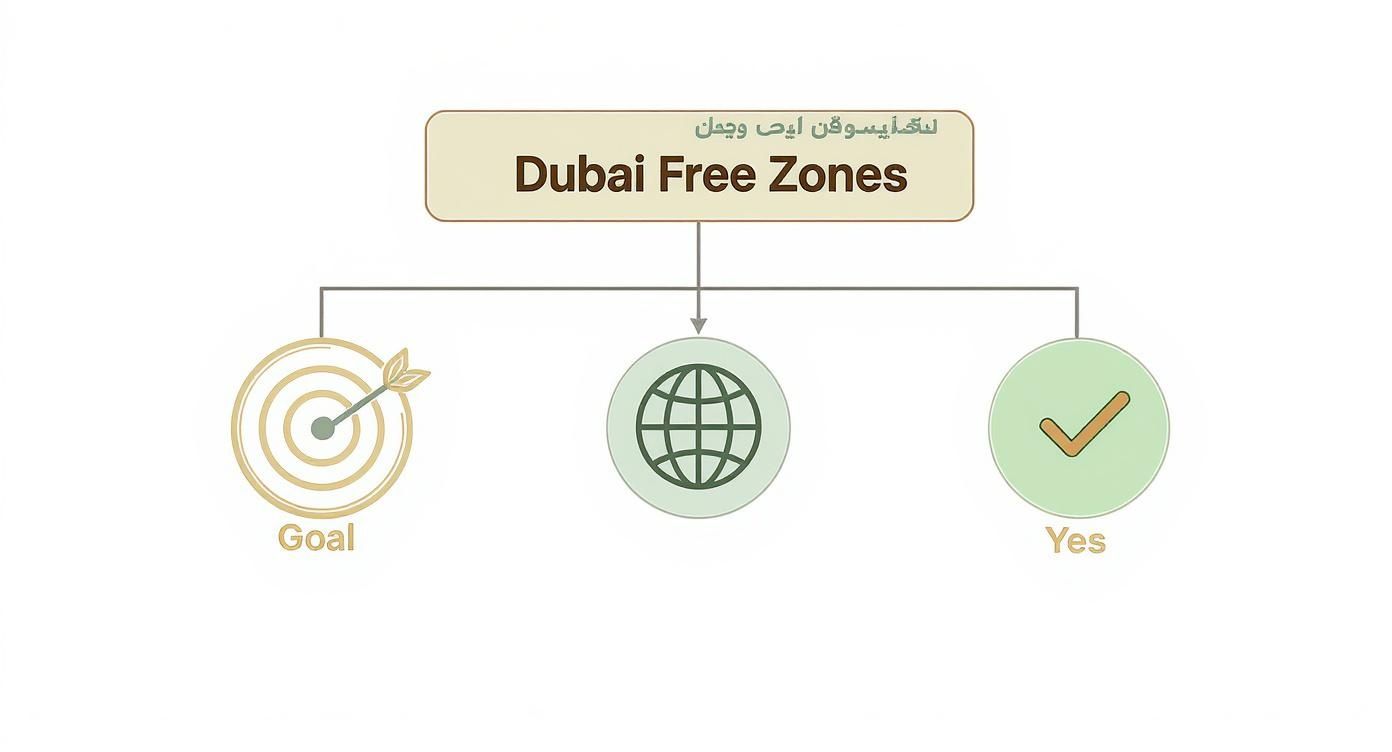
As the diagram shows, if your primary goal is global commerce, the free zone ecosystem is purposefully designed to help you achieve it.
Scope of Permitted Business Activities
Finally, what your business is legally allowed to do is determined by your license. A mainland license, issued by the Department of Economy and Tourism (DET), offers an enormous scope of activities. You have the freedom to combine multiple commercial, professional, or industrial activities under a single license and serve clients anywhere in the UAE without restriction.
Free zones, on the other hand, are often highly specialised. A license from Dubai Media City is for media companies, while one from DMCC is geared towards commodities trading. Trying to operate outside your license's specific scope is a no-go. This specialisation creates powerful industry hubs but offers less operational diversity compared to the broad permissions of a mainland license.
Analyzing Setup Costs and Financial Obligations
When you get down to the brass tacks of setting up in Dubai, the conversation almost always turns to cost. It’s the single biggest factor for most entrepreneurs, and it’s about far more than just the price of a trade licence. You have to look at the total cost of ownership—from the initial setup fees to the recurring annual expenses that keep you operational.
A mainland company, with its unrestricted access to the local market, naturally comes with a higher price tag upfront. The mandatory physical office space is a big part of that. On the other hand, a free zone is often the go-to for startups, freelancers, and international traders precisely because it’s a more budget-friendly entry point. The ability to use flexi-desks and shared workspaces slashes those initial overheads. But remember, the final bill for either option will hinge on your specific business activity, how many visas you need, and your chosen location.
Initial Setup Costs Unpacked
Your initial outlay is a mix of several different fees. It's easy to get fixated on the licence, but you also need to budget for registration, visa processing, office rent (a big one!), and various administrative charges.
-
Mainland Setup: Expect higher initial costs here. The non-negotiable requirement for a physical office lease, which has to be registered with Ejari, is the primary driver. Add in various government approvals and third-party fees, and the initial investment quickly adds up.
-
Free Zone Setup: Free zones are known for their all-in-one packages. These bundles typically include your licence, establishment card, and a set number of visas, which makes budgeting much more predictable. The option to start with a simple flexi-desk keeps those initial costs lean, which is perfect for testing the waters.
The most significant cost variable is almost always the office. A mainland business needs to budget for a real, physical office from day one. A free zone company can start with a flexi-desk and scale up when the time is right.
Comparing Long-Term Financial Obligations
Once you're up and running, you have to think about the recurring annual costs. These aren't one-offs; they include licence renewals, rent, and potential auditing and tax compliance fees that are essential to keep your business in good standing.
The numbers tell a clear story. In 2025, you can find free zone licences starting as low as AED 5,750. A mainland setup, however, will typically start from AED 15,000 and can easily push past AED 50,000. The office cost difference is just as stark: a free zone flexi-desk can be had for as little as AED 5,000 a year, while a basic mainland office will set you back AED 15,000 to AED 50,000 or more. Visa fees are roughly the same, usually between AED 3,000 and AED 7,000 each, but mainland companies can scale their visa quotas more easily by leasing larger offices.
For a clearer picture, let's break down the typical costs you can expect.
Estimated Cost Breakdown Mainland vs Freezone
| Cost Component | Mainland Estimate (AED) | Free Zone Estimate (AED) |
|---|---|---|
| Trade Licence & Registration | 15,000 – 50,000+ | 5,750 – 25,000 |
| Annual Office Rent | 15,000 – 50,000+ | 5,000 – 20,000 (Flexi-desk/Small Office) |
| Visa (per person) | 3,000 – 7,000 | 3,000 – 7,000 |
| Establishment Card | 2,000 | 2,000 |
| MOA Attestation | 1,500 – 3,000 | N/A (Included in package) |
| Local Sponsor/Agent Fee | 5,000 – 15,000 | N/A |
Keep in mind, these are estimates. Your final costs will depend heavily on your business activity and the specific free zone or mainland authority you choose.
Corporate Tax and Auditing Requirements
The arrival of corporate tax in the UAE has added a new layer of financial planning for everyone. If your mainland company's profits exceed AED 375,000, you'll be subject to a 9% corporate tax. This makes meticulous bookkeeping and financial reporting more important than ever. To get a handle on your obligations, our guide on how to register for VAT in the UAE is a great starting point.
Many free zone companies can take advantage of a 0% tax rate, but only if they meet the strict "Qualifying Income" criteria—not all will. What's more, nearly all free zones and every single mainland company must prepare and submit annual audited financial statements. This isn't just a suggestion; it's a requirement. This recurring operational cost needs to be factored into your yearly budget to stay compliant and avoid hefty penalties. Think of professional accounting services not as an expense, but as a necessary investment.
Matching Your Business Scenario to the Right Structure
Knowing the technical differences between mainland and free zone companies is one thing. Applying that knowledge to your actual business model is where the decision really clicks into place. There’s no single "best" choice; it's always situational.
Let's move past the theory and look at how this plays out in the real world. By walking through a few common business scenarios, we can map them to the most logical jurisdiction and see why one path makes more sense than the other for certain ventures. This is the heart of the mainland vs freezone Dubai debate: aligning your operational needs with the right regulatory environment.
Scenario One: The International Retail Brand
An established international fashion brand wants to open physical stores in Dubai's top shopping malls. They also plan to run a local e-commerce site with direct delivery to customers across the UAE. Their entire focus is on residents and tourists within the country.
Recommendation: Dubai Mainland
The logic here is clear-cut. To operate a physical shop, sell directly to the public, and manage local deliveries without hitting any walls, a mainland licence is non-negotiable.
This structure gives the brand the legal freedom to lease commercial space anywhere in Dubai, from the Dubai Mall to a high-street boutique. It allows them to hire a local sales team and engage directly with the UAE consumer market. A free zone setup would completely block this direct-to-consumer model.
Scenario Two: The Tech Startup or Freelance Consultant
A SaaS startup is building a platform to serve clients across the MENA region, with its small development team based in Dubai. In a similar boat, a freelance marketing consultant offers her services remotely to international clients. Neither has an immediate plan to chase contracts with UAE-based companies.
Recommendation: Dubai Free Zone
For businesses like these, a free zone is the perfect launchpad. The key advantages are cost-efficiency and operational simplicity.
The startup can get started with a flexi-desk or small office package, keeping initial overheads low while still getting visas for its team. Critically, they get 100% foreign ownership and all the associated tax benefits. Since their clients are outside the UAE, the mainland's trading restrictions are completely irrelevant. The freelance consultant benefits from the exact same lean setup, securing a UAE residency visa without the cost of a full-blown office.
The most crucial question to ask is, "Who is my primary customer?" If the answer is "anyone outside the UAE," a free zone provides a cost-effective, globally-focused base of operations without the higher costs and complexities of a mainland setup.
Scenario Three: The Logistics and Import-Export Company
A business plans to source goods from Asia, store them in a Dubai warehouse, and then re-export them to markets in Europe and Africa. The entire operation hinges on extensive warehousing, easy access to ports and airports, and super-efficient customs procedures.
Recommendation: Dubai Free Zone (specifically an industry-focused one like JAFZA or Dubai Airport Free Zone)
This is the classic use case for a specialised free zone. Hubs like Jebel Ali Free Zone (JAFZA) are literally built around world-class logistics infrastructure.
They offer direct access to seaports, simplified customs clearance, and zero duties on import and re-export activities. This entire ecosystem is purpose-built for global trade. Trying to run this type of business from a mainland setup would be both impractical and far more expensive.
By aligning your business activities with the jurisdiction designed to support them, you avoid future operational headaches and set your company up for sustainable growth right from the start.
A Few Common Questions Answered
As you get closer to making a decision, a few questions always pop up. It's perfectly normal. Here are some clear, straight-to-the-point answers to the things entrepreneurs usually ask when they're at this final stage of the mainland vs free zone Dubai debate.
Can I Switch from a Free Zone to a Mainland Company Later On?
Yes, you absolutely can, but it’s not as simple as flipping a switch. Think of it less as a "conversion" and more as a "relaunch."
You’ll need to formally liquidate your existing free zone company and then start from scratch with the Department of Economy and Tourism (DET) to form a new mainland entity. This means a fresh application, a new trade licence, and locking down a physical office that meets the mainland's rules. It’s a clean slate, not a direct transfer.
Is a Local Emirati Sponsor Still a Must-Have for a Mainland Company?
For the vast majority of businesses today, the answer is a firm no. Thanks to some game-changing legal updates, 100% foreign ownership is now the standard for most mainland companies.
That said, there are a handful of strategic sectors—think areas related to national security or specific government services—where you might still need an Emirati partner or agent. It's always smart to double-check the specific rules for your exact business activity before you move forward.
What’s the Banking Situation Like for Each Setup?
Good news here: both mainland and free zone companies can open corporate bank accounts in the UAE without much fuss. The paperwork is pretty similar for both—you'll need your trade licence, memorandum of association, and shareholder details.
Here’s a practical tip, though: mainland companies, with their mandatory physical office and direct link to the local economy, sometimes have an easier time with banks. We’ve seen that free zone businesses relying on virtual office packages can occasionally face a few extra questions from compliance departments.
What Exactly Does a Local Service Agent Do?
A Local Service Agent (LSA) is a requirement for certain professional service licences on the mainland when they're owned by a foreigner—think consultancies, design studios, or medical clinics. But don't confuse them with a sponsor. An LSA holds zero shares in your company and has absolutely no control over your operations.
Their job is purely administrative. They act as your official liaison with government departments for things like visa applications and licence renewals, and you pay them an annual fee for this service. This setup is a clever way to allow for 100% foreign ownership of a professional firm while still having a designated local representative for government paperwork.
Navigating the complexities of business setup in Dubai is the first step toward success. At Smart Classic Business Hub, we specialise in guiding entrepreneurs through every stage, from initial jurisdiction selection to ongoing compliance. Let our experts provide the clarity and support you need to make the right choice for your venture. Visit https://smartclassic.ae to schedule your consultation and start your journey with confidence.