
Thinking about setting up shop in the UAE? You're essentially looking at a powerful ecosystem built for growth, with huge perks like 100% foreign ownership and some very attractive tax advantages. For international entrepreneurs, it's the most direct route to establishing a real, operational base in the Emirates.

Why a UAE Free Zone Is Your Best Bet
Deciding where to set up your business in the UAE is one of the biggest calls you'll make. Mainland and offshore setups have their place, of course, but for most international businesses, the free zone model offers a killer combination of autonomy, financial perks, and operational simplicity.
So, what is a free zone? Think of it as a special economic area with its own set of rules, totally separate from the mainland's laws. They're designed specifically to pull in foreign investment by cutting through the usual red tape.
Understanding Your Options: The Three Main Structures
Getting your head around the differences between the three main setup types is vital. Each one is built for different business goals.
- Free Zone Company: This is your go-to for international trade, consulting, or any business that won’t be dealing directly with customers inside the local UAE market. It gives you complete foreign ownership and, crucially, makes you eligible for a 0% corporate tax rate on qualifying income.
- Mainland Company: If your plan is to trade directly within the UAE or bid on government contracts, you need a mainland setup. No getting around it. For professional services, this often means bringing on a Local Service Agent.
- Offshore Company: This isn't for active trading. It’s a tool for holding international assets or property. An offshore company can't do business inside the UAE, and you won't be getting any residency visas with this one.
For most entrepreneurs who are using the UAE as a base to target regional or global markets, the free zone company is the sweet spot. You get a proper operational licence, you and your staff can get visas, and you're plugged into world-class infrastructure, all without the headaches of mainland regulations. In fact, most of the well-known benefits of setting up a business in Dubai are rooted in the advantages found in its free zones.
The key thing to remember is this: your choice of jurisdiction dictates your market access. A free zone is your gateway to the world; a mainland licence unlocks the local UAE economy.
But the appeal of a free zone company setup in the UAE goes beyond just ownership and taxes. These zones are curated ecosystems, often clustered by industry. Think of Dubai Media City for creative agencies or DMCC for commodities trading. This puts you right in the middle of potential clients, partners, and suppliers in your field, sparking collaboration and growth from day one.
How to Choose the Right Free Zone for Your Business
Picking the right free zone is probably the single most important decision you'll make when setting up your company in the UAE. With over 40 different zones, each with its own set of rules, industry focus, and costs, it’s easy to feel overwhelmed. But this isn't about just finding the cheapest option.
Think of it this way: the right zone is a strategic partner for your long-term growth. It puts you in an ecosystem with your peers, potential partners, and even customers, giving you a serious advantage right from the start.
Match Your Business Activity to a Specialised Zone
First things first, look at what your business actually does. Most free zones are built as hubs for specific industries. A marketing agency, for example, would be a natural fit for Dubai Media City (DMC), while an IT consultancy would feel right at home in Dubai Internet City (DIC).
Trying to register a general trading company in a zone built for media professionals is a recipe for frustration. The authorities there simply aren't set up for it, and you'll almost certainly face rejection. Aligning your activity with the zone’s specialisation isn't just a good idea—it's essential.
Let’s look at a few real-world examples:
- E-commerce and Logistics: If you’re importing, storing, and shipping products, you need to be near a major port or airport. It's a no-brainer. This is why Jebel Ali Free Zone (JAFZA) is a global logistics powerhouse; its connectivity is unmatched.
- Cryptocurrency and Tech Startups: For anything in the Web3 or crypto space, you need a modern, forward-thinking zone. The Dubai Multi Commodities Centre (DMCC) has established itself as a leader here, actively welcoming these types of businesses.
- Consulting and Professional Services: If you're a financial or legal consultancy, a prestigious address and a solid regulatory framework are key. Zones like Dubai International Financial Centre (DIFC) or Abu Dhabi Global Market (ADGM) are built for precisely this.
Analyse the Geographical and Logistical Factors
Location, location, location. It’s a cliché for a reason. You need to ask yourself some practical questions. Will you need to be close to specific suppliers? Are clients going to be visiting your office often? Is easy access to an international airport a must-have for your team?
A business that relies on global trade would really struggle if it were based in a remote, inland free zone with poor transport links. On the other hand, a freelance consultant with clients all over the world might not care about location at all and would rather prioritise a zone with cost-effective flexi-desk options.
Your choice of free zone should be a strategic business decision, not an afterthought. Consider its location, industry focus, and scalability to ensure it supports your company’s long-term vision.
It’s also crucial to remember that while a free zone company can operate internationally, it can't trade directly with the UAE mainland market. If your main customer base is local, a mainland setup might be a better fit. Our detailed guide on mainland company setup in Dubai can help you weigh the pros and cons.
Consider Your Budget and Future Scalability
Costs can vary wildly from one free zone to another. Don't get fixated on a low initial setup fee. You have to look at the total cost of ownership over time. This includes:
- Annual Licence Renewal Fees: This is a recurring cost you need to factor into your budget every single year.
- Office Space or Flexi-Desk Costs: Your visa eligibility is often directly tied to the type and size of your office. More visas almost always mean a bigger, more expensive office.
- Visa Allocation: Some packages come with a set number of visas, while others let you apply for more depending on your office size.
Think about where you want to be in five years. That cheap startup package with one visa looks great now, but what happens when you want to hire a team of ten in two years? Will the free zone even allow it? Choosing a zone that can grow with you is vital if you want to avoid the headache and expense of moving your whole business down the line.
The UAE government has strategically built this powerful network of free zones for a reason. There are now 46 free zones across the country, and together they contribute to around 40% of the nation's total exports. This isn't just a collection of business parks; it's a core part of the national economic strategy, designed to offer a stable and supportive platform for businesses like yours to succeed globally. You can learn more about the role of UAE free zones and their impact on international trade.
Comparing Top UAE Free Zones
To give you a clearer picture, we've put together a practical comparison of some of the most popular free zones. This should help you see how they stack up in terms of industry focus, benefits, and typical costs.
| Free Zone Name | Specialisation / Best For | Key Benefits | Estimated Initial Cost Range |
|---|---|---|---|
| JAFZA (Jebel Ali Free Zone) | Trading, Logistics, Manufacturing | Direct access to Jebel Ali Port, excellent infrastructure, vast business network. | AED 45,000 – 80,000+ |
| DMCC (Dubai Multi Commodities Centre) | Commodities Trading, Crypto, Professional Services | Prestigious JLT location, strong regulatory framework, hub for crypto/Web3. | AED 50,000 – 90,000+ |
| IFZA (International Free Zone Authority) | Consulting, Services, General Trading | Cost-effective packages, flexible setup options, no physical office required. | AED 18,000 – 40,000+ |
| Meydan Free Zone | Professional Services, Media, Tech | Prime location near Downtown Dubai, premium address, good for lifestyle businesses. | AED 25,000 – 50,000+ |
| RAKEZ (Ras Al Khaimah Economic Zone) | Manufacturing, Trading, Education | Lower operational costs, access to RAK Port, wide range of business activities. | AED 15,000 – 35,000+ |
Remember, these figures are just estimates to give you a general idea. The final cost will depend on your specific business activity, visa requirements, and office needs. The key is to find the zone that offers the best value and support for your unique business goals.
Getting Your Company Registered: A Practical Walkthrough
Once you’ve picked the perfect free zone, it's time to get down to the actual registration. This part of the journey can feel a bit daunting with all the paperwork and official steps, but it’s much more manageable when you know what’s coming.
Let's break down the core parts of the free zone company setup UAE process, focusing on what you need to have ready and what to expect along the way. Your path from applicant to licensed business owner really boils down to two key decisions: your trade name and your business activities. These aren't just boxes to tick—they form the legal backbone of your company.
Securing Your Trade Name
Choosing a name for your business in the UAE isn't just about creativity; it has to follow the rules. Each free zone authority has specific regulations, so your chosen name must be unique and can't contain anything that might be considered offensive or against public morals.
You'll submit a few name options for approval. The registrar checks them for availability and compliance. Once approved, the name is officially reserved for you, locking in your brand identity from day one.
Defining Your Business Activities
At the same time, you need to be crystal clear about every single activity your company will perform. Free zone authorities maintain detailed, pre-approved lists of business activities, and you have to pick the ones that perfectly match your services. Any vagueness here can get your application kicked back.
For example, a digital marketing agency can't just list "Marketing." You’d need to select specific activities like "Social Media Marketing Services," "Web Design," and "Advertising." This level of detail is vital because it ensures your trade licence accurately reflects what you do—something that's absolutely crucial for staying compliant and, later on, for opening your corporate bank account.
This flowchart maps out the initial thinking process before you get buried in paperwork.
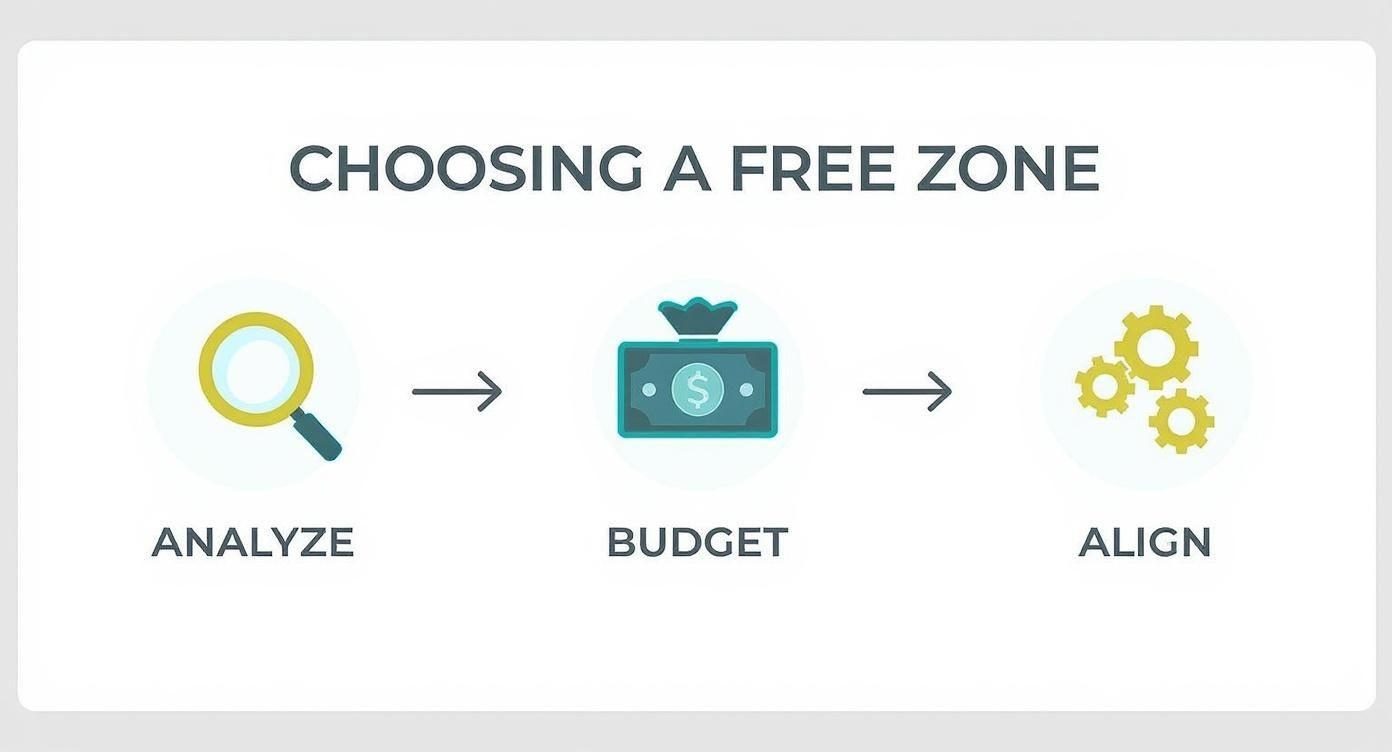
It’s a simple visual reminder of how those early strategic choices—analysis, budgeting, and alignment—set the stage for a smooth registration.
Assembling the Required Documents
With your name and activities sorted, it’s time to gather your documents. Getting this part right is the single most important thing you can do to avoid frustrating delays. The paperwork differs slightly depending on whether the shareholder is a person or another company.
For individual shareholders, the checklist is usually straightforward:
- Passport Copies: Clear, colour copies for every shareholder and manager.
- Visa Status Page: If you're already in the UAE, a copy of your current visa.
- Passport-Sized Photographs: Professional photos with a plain white background.
- Proof of Address: A recent utility bill or similar document for each shareholder.
If a corporate entity is a shareholder, things get a bit more involved. The free zone needs to verify the parent company's legal status, so you'll likely need to provide:
- Certificate of Incorporation: A copy that has been notarised and attested.
- Memorandum of Association (MOA): This also needs to be notarised and attested.
- Board Resolution: A formal document from the parent company authorising the setup of a new branch or subsidiary in the UAE.
- Certificate of Good Standing: Proof that the parent company is active and in compliance in its home country.
Expert Tip: Document attestation can be a real time-sink. If you have a corporate shareholder, start the notarisation and attestation process in your home country as early as possible. We've seen this common bottleneck hold up an entire application for weeks.
Once you submit all the documents and the completed application form, the free zone authority will start its review. This is where having an expert partner like Smart Classic Business Hub really pays off. We make sure every form is filled out perfectly and every document is properly attested, heading off the common mistakes that lead to rejection and re-submission.
Some zones are incredibly efficient. Take the Dubai Multi Commodities Centre (DMCC)—they have their process down to a science to handle the massive volume of applications. DMCC is now home to over 26,000 companies and has already welcomed more than 2,000 new businesses in 2024, with plans for a similar number in 2025. That kind of growth is only possible with a slick, well-managed registration system. You can read more about DMCC's growth as a global business hub.
After a successful review, you'll get your initial approval. This allows you to sign the incorporation documents and pay the necessary fees. The final step is the issuance of your trade licence, which is your official green light to start operating. With that document in hand, along with your Certificate of Incorporation, your UAE business is officially born.
Bringing Your New Company to Life: Visas, Banking, and Compliance
Holding your newly issued trade licence is a huge milestone, and you should definitely celebrate it. But the journey of your free zone company setup in the UAE isn’t quite over. Now, the real work begins: turning your registered entity into a fully operational business.
This next phase is built on three critical pillars that truly bring your company to life. You’ll need to secure residency visas, open a corporate bank account, and get your compliance framework in order. Honestly, getting these right is just as important as choosing the perfect free zone in the first place.
Securing Residency Visas for Shareholders and Employees
Your trade licence is the key that unlocks your legal right to live and work in the UAE. The first thing you'll need is an Establishment Card, sometimes called a Company Immigration Card. This card officially links your company to the immigration and labour departments, giving you the power to sponsor visas.
With that card in hand, you can start the residency visa process for yourself as the owner, and eventually, for your team. The process follows a pretty standard sequence:
- Apply for an Entry Permit: This is the initial green light. It allows you to enter the UAE for residency purposes or, if you're already here, to change your current visa status.
- Complete the Medical Fitness Test: A mandatory health screening that includes a blood test and a chest X-ray. You'll do this at a government-approved medical centre.
- Provide Emirates ID Biometrics: Next, you'll visit a Federal Authority for Identity and Citizenship (ICA) centre. They’ll take your fingerprints and photo for your official Emirates ID card.
- Get the Visa Stamped: Once all the tests and biometrics are approved, your passport is submitted to get the final residency visa sticker placed inside.
It's important to remember your visa eligibility is directly tied to your office setup. A basic flexi-desk package might only get you one or two visas. A physical office, on the other hand, gives you more flexibility, typically allowing for one visa per 80-100 square feet of space. If you're planning to hire, you need to choose an office solution that can grow with you.
Navigating the Corporate Bank Account Opening
Let’s be frank: opening a corporate bank account in the UAE can be one of the trickiest post-setup hurdles. Banks here have very strict Know Your Customer (KYC) and anti-money laundering (AML) regulations. Just showing up with a trade licence isn't going to cut it; you need to build a solid case for your business.
A successful application hinges on thorough preparation. Banks will dig much deeper than your basic company documents. You should be ready to provide:
- A detailed business plan showing your operations, target market, and financial projections.
- The professional profiles (CVs) of all shareholders to show their experience.
- Information on your expected transactions, including who your main suppliers and clients will be.
A common mistake I see entrepreneurs make is assuming all banks are the same. They're not. Each bank has its own risk appetite and prefers certain types of businesses. A bank that welcomes a general trading company might be very hesitant to work with a crypto startup.
Here’s a crucial tip: having a UAE residency visa for at least one shareholder is practically a non-negotiable requirement for most banks. It proves you have a genuine commitment to the UAE, making you a much lower-risk client. Trying to open an account without a resident signatory is almost guaranteed to result in a quick rejection.
Establishing Long-Term Compliance
Your responsibilities don't end once you're set up. Staying compliant with UAE regulations is absolutely essential for keeping your licence active and avoiding hefty penalties. From day one, you need a system for a few key areas.
First up is bookkeeping. Keeping accurate financial records isn't just good business sense; it's a legal requirement. These records are the bedrock for all your tax obligations.
Next, you have to get your head around Value Added Tax (VAT). If you expect your company's annual revenue to cross the AED 375,000 threshold, you are legally required to register for VAT with the Federal Tax Authority (FTA).
Finally, be aware of rules like Economic Substance Regulations (ESR) and Ultimate Beneficial Ownership (UBO) declarations. These regulations require you to prove your company has a real operational presence in the UAE and to declare who ultimately owns and controls it. This is all part of the UAE's commitment to global transparency, and ignoring these rules can lead to significant fines. Tackling these processes early ensures your business is built on a solid, lawful foundation right from the start.
Understanding Setup Costs and Corporate Tax Rules
Before you jump into setting up your free zone company in the UAE, let's talk about the numbers. Getting a clear handle on your budget from day one is crucial. It stops nasty surprises down the line and makes sure you have enough cash to not just launch, but also to keep the lights on for that critical first year.
Your costs essentially fall into two buckets.
First, you've got your one-time setup fees. These are the upfront costs to get your company registered and legally ready to operate. Think of it as the price of admission.
Then, you have the annual recurring costs – the expenses you'll need to plan for every single year to maintain your licence and keep your company in good standing.
Breaking Down One-Time Setup Fees
Your initial investment is made up of a few key components that every new business needs. While the packaging might look a bit different from one free zone to another, the core elements are pretty much the same.
- Trade Licence Fee: This is the big one. The cost here really depends on the business activities you select. For example, a general trading licence that lets you deal in a wide range of goods will almost always cost more than a niche consultancy licence.
- Registration Fee: This is a standard admin charge for processing your application and getting your company name and structure officially on the books.
- Establishment Card: This document is your company's official immigration file. It’s absolutely mandatory and is what allows you to start applying for residency visas for yourself and any staff you hire.
These fees are all paid directly to the free zone authority once they’ve given your application the green light. Any reputable consultant will give you a detailed quotation breaking down each of these costs, so you can see exactly where your money is going.
Planning for Annual Recurring Costs
Beyond getting started, you need to budget for the yearly costs that keep your business compliant and operational. These are just as important as the initial fees and are vital for your long-term financial health.
Your main recurring expense will be the annual trade licence renewal. This is a non-negotiable fee you pay to the free zone authority each year to keep your business legally active. Missing the deadline can lead to serious fines and even a freeze on your company’s bank account and activities.
You'll also have costs tied to your physical setup, like the annual rent for your office or flexi-desk. And don't forget the smaller, but still important, renewals like your company P.O. Box subscription.
Demystifying UAE Corporate Tax for Free Zones
The new UAE Corporate Tax has been a hot topic, but the great news is that free zones still hold a massive advantage. The secret to unlocking this is achieving what’s known as Qualifying Free Zone Person (QFZP) status.
This special designation is what allows your business to benefit from a 0% corporate tax rate on its "qualifying income."
To become a QFZP, your company has to tick a few boxes, like maintaining adequate substance in the UAE (meaning real operations and staff) and preparing audited financial statements. Once you qualify, your income is split into two categories:
- Qualifying Income: This is revenue from deals with other free zone businesses or from exporting goods and services outside the UAE. This income gets taxed at 0%.
- Non-Qualifying Income: This is mainly revenue you make from mainland UAE clients (though there are some exceptions). This income is taxed at the standard 9% rate.
A crucial detail for maintaining your QFZP status is the 'de minimis' rule. Your non-qualifying revenue can't be more than 5% of your total revenue or AED 5 million, whichever is lower. If you go over this limit, you could lose your 0% tax benefit for that year.
This system is smartly designed to boost international trade while ensuring businesses contributing to the mainland economy are taxed fairly. When structured correctly, free zone companies in the UAE can operate in an incredibly tax-efficient environment. On top of that, they also get exemptions on customs duties for goods that are imported and then re-exported, which can be a huge cost saver.
In this new tax era, proper accounting is absolutely essential. It’s the only way you can accurately separate your qualifying and non-qualifying income. If you expect your annual turnover to cross the mandatory threshold, getting your tax affairs sorted out early is a must. Our guide on how to register for VAT in the UAE offers a clear roadmap for this key compliance step.
Got Questions About UAE Free Zone Setup? We've Got Answers.
When you're looking to set up a free zone company in the UAE, a lot of practical questions come up. It's totally normal. Getting clear, honest answers is the only way to move forward with confidence and sidestep those common pitfalls that trip up new entrepreneurs.
We hear the same questions time and again, and they're not just hypotheticals. These are the real-world concerns that can affect everything from where you can bank to how you can operate. Let's tackle them head-on.
Can I Run My UAE Free Zone Company From Overseas?
Yes, you absolutely can. One of the best things about a free zone company is the flexibility it offers. You can own and manage your business without ever needing to become a UAE resident, which is a game-changer for international entrepreneurs who just want a solid corporate base here.
But there's one critical detail to be aware of: banking. Most UAE banks have a strict compliance rule that at least one signatory on the corporate bank account must hold a valid UAE residency visa. It's not something they can bend on. Don't worry, though. We can easily help you get an investor visa to tick that box, and once your account is open, you can manage it from anywhere in the world.
What's the Real Difference Between a Free Zone and a Mainland Company?
It really comes down to three things: who owns it, who you can sell to, and who makes the rules. Nail this down, and you'll know which path is right for you.
- Free Zone Companies are fantastic for international business. You get 100% foreign ownership, and you operate under the regulations of that specific free zone authority. They're built for global trade and services.
- Mainland Companies are your ticket to the entire UAE market. Registered with the Department of Economy and Tourism (DET), they let you trade directly with any customer or business in the UAE, no strings attached. For certain professional activities, you might need a local service agent, but the market access is unparalleled.
Think about your customers. Are they global? Go for a free zone. Are they right here in Dubai? A mainland licence is what you need.
This isn't just a legal choice; it's a strategic one that defines your entire commercial playground. A free zone company is your gateway to the world, while a mainland licence unlocks the full potential of the local UAE economy.
How Long Does the Whole Setup Process Actually Take?
While it can vary a bit from one free zone to another, getting the initial company licence is surprisingly fast. You're usually looking at a timeframe of just a few days to two weeks. That's your first big win.
But the job isn't done yet. After your licence is issued, there are a few more steps like getting your establishment card, processing residency visas, and, of course, opening that corporate bank account. These post-setup tasks typically add another four to six weeks to the timeline. Working with an expert here is key—we make sure all your paperwork is flawless from day one, which can shave a significant amount of time off the whole process.
Are There Any Hidden Costs I Should Watch Out For?
Nobody likes financial surprises, especially when launching a business. A good consultant will give you a detailed quotation that lists out every single potential cost, not just the big package fee. Transparency is everything.
Beyond the main licence fees, you should always factor in these associated costs:
- Fees for visa medical tests and Emirates ID processing.
- Security deposits for your office or flexi-desk.
- Costs for document attestation, which is especially important if you have corporate shareholders.
Budgeting for these smaller but essential expenses from the start makes for a much smoother and more predictable launch.
Getting answers is the first step, but flawless execution is what guarantees your success. At Smart Classic Business Hub, we bring clarity and hands-on support to every part of your free zone company setup in the UAE. Let us handle the complexities so you can get back to what you do best—building your business. Contact us today for a free consultation.