
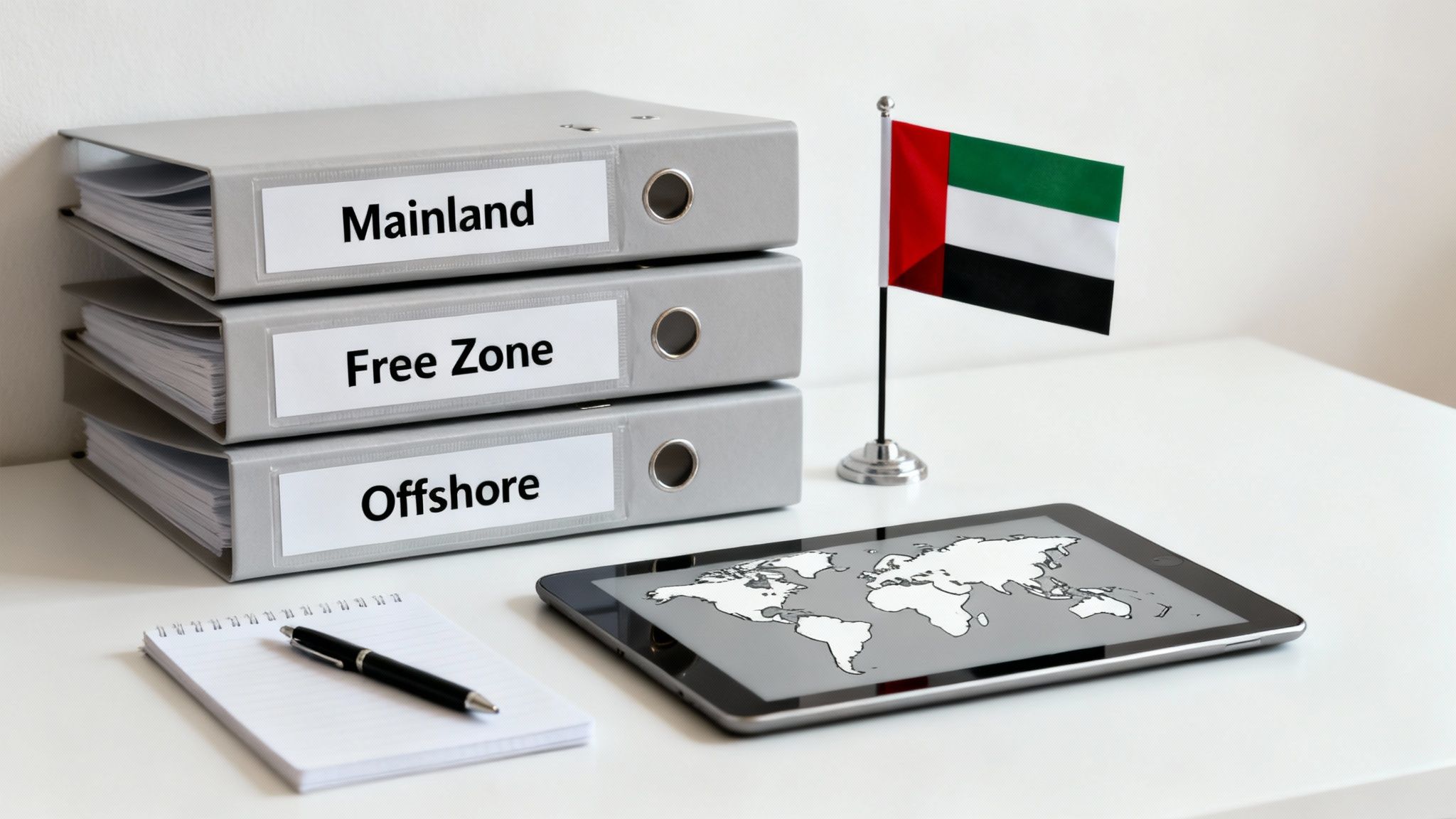
When you decide to start a business in the UAE, your very first move is also your most critical: choosing where to set it up. Will it be a Mainland, Free Zone, or Offshore company? This isn't just a box to tick; this decision shapes everything that follows—who you can sell to, how your company is owned, and the ultimate potential of your business. Getting this right from day one is the single most important step you'll take.
Your Blueprint for a UAE Business Launch
Stepping into the UAE's business world means planting your flag in a global commercial hub. The country is built for business, with supportive policies, incredible infrastructure, and a location that connects East and West. But to truly succeed here, you have to understand the foundational legal structures.
This choice is far more than a legal formality. It’s a strategic decision that ripples through your entire operation, affecting your customer base, tax liabilities, and day-to-day activities. Aligning your business model with the right jurisdiction from the start helps you sidestep costly errors and frustrating roadblocks later on.
Understanding the Core Jurisdictions
Each of the three jurisdictions—Mainland, Free Zone, and Offshore—is designed for a specific purpose. They cater to different business models and ambitions.
Let's break them down:
- Mainland Company: This is your ticket to the entire UAE market. A mainland setup allows you to trade without restriction, work directly with other local businesses, and even bid on lucrative government contracts.
- Free Zone Company: Ideal for international businesses, free zones offer compelling perks like 100% foreign ownership, tax exemptions, and the ability to repatriate all your profits. They're perfect if your focus is on global trade or a specific industry like tech or media.
- Offshore Company: Think of this as a specialised tool for asset protection and international investment. An offshore entity can hold assets or property but isn't designed for active trading within the UAE.
This initial decision is the bedrock of your business. For example, if you dream of opening a retail shop in a Dubai mall, you'll need a Mainland licence. But if you're a tech consultant with clients scattered across the globe, a Free Zone setup would be a much better fit. Digging into the key benefits of a Dubai business setup can offer more perspective on why so many entrepreneurs flock here.
UAE Business Jurisdiction At a Glance
To make this crucial decision a bit easier, here’s a quick comparison of the three main business jurisdictions in the UAE. This table will help you see at a glance which option might be the best fit for your business goals.
| Feature | Mainland Company | Free Zone Company | Offshore Company |
|---|---|---|---|
| Ownership | 100% foreign ownership for most activities | 100% foreign ownership | 100% foreign ownership |
| Business Scope | Unrestricted trade within the UAE and globally | Trade within the free zone and internationally | Primarily for holding assets; no local trade |
| Office Space | Physical office space required | Flexi-desk or physical office options | Registered agent address only; no physical office |
| Visas | Yes, investor and employee visas available | Yes, investor and employee visas available | No visas issued |
| Corporate Tax | 9% on taxable income above AED 375,000 | Often 0% tax for qualifying income | 0% corporate tax |
| Best For | Local retail, services, government contracts | International trade, consulting, specific industries | Asset protection, international investments, holding company |
This table provides a high-level overview, but the nuances of each jurisdiction are important. Your specific business activity and long-term vision will ultimately guide your final choice.
A Supportive Ecosystem for Growth
The UAE's dedication to entrepreneurship isn't just talk. According to the Global Entrepreneurship Monitor (GEM) report, the UAE has been ranked first globally for its entrepreneurial ecosystem for four years running.
This top-tier environment is backed by serious government investment, like the $8.7 billion "Projects of the 50" initiative, which is designed to fuel innovation and support SMEs. It’s clear the country is invested in seeing businesses thrive.
Choosing the right jurisdiction is like picking the right soil for a plant. Your selection will determine whether your business has the right conditions to grow, access its target market, and ultimately flourish in the competitive UAE landscape.
This guide will demystify these choices, giving you a practical blueprint to follow. We’ll dive into the specifics of each setup, helping you navigate licensing, visas, and banking to make sure your venture is built on solid ground from day one.
Choosing Your Path: Mainland vs. Free Zone
Right out of the gate, you’ll face a major decision when setting up your business in the UAE: choosing your jurisdiction. This isn’t just a box to tick on a form; it's a strategic choice that will shape your market access, ownership structure, and how your company can grow. The two main paths for entrepreneurs are setting up on the Mainland or within one of the UAE's many Free Zones.
Think of it this way: this choice dictates exactly where and how you can do business. A Mainland company, licensed by the Department of Economic Development (DED) in an emirate like Dubai, gives you the keys to the entire country. You can trade anywhere, with anyone. A Free Zone company, on the other hand, is licensed by its own governing authority and is built for international trade, offering some incredible benefits like tax exemptions and full foreign ownership.
Understanding the Mainland Advantage
If your goal is to tap into the local UAE market, a Mainland business is your ticket. Simple as that. Whether you’re planning to sell products directly to consumers in a mall, offer services to local businesses in Abu Dhabi, or open a café in Jumeirah, this is the path for you. It provides unrestricted access to the domestic economy.
So, what are the real perks of a Mainland setup?
- Unrestricted Market Access: You can trade, provide services, and set up your office or shop anywhere you like across the UAE. No barriers.
- Government Contracts: Only Mainland companies can bid on lucrative government tenders, which is a massive revenue stream for countless industries here.
- Location Flexibility: You’re free to rent commercial space in any non-free zone area, putting your business right in front of your target customers.
This structure is a natural fit for businesses like retail stores, restaurants, local consulting agencies, and construction firms that need to operate seamlessly within the country. And while 100% foreign ownership is now the norm for over a thousand commercial and industrial activities on the Mainland, keep in mind that a few strategic sectors might still require an Emirati partner.
Exploring the Free Zone Ecosystem
The UAE is home to over 40 Free Zones, and each one is essentially its own independent economic area with its own rulebook. These zones are specifically designed to pull in foreign investment by rolling out the red carpet with compelling financial incentives.
The big draw for a Free Zone is a powerful trio of benefits: 100% foreign ownership, 0% corporate tax on qualifying income, and the freedom to repatriate 100% of your profits and capital. It’s an environment engineered for global business.
What makes the Free Zone ecosystem so effective is that they are often industry-specific, creating dynamic hubs where like-minded businesses cluster. For instance:
- Dubai International Financial Centre (DIFC): The undisputed hub for fintech, banking, and financial services firms.
- Dubai Media City (DMC): The go-to spot for anyone in media, advertising, or marketing.
- Jebel Ali Free Zone (JAFZA): A world-class logistics and trading powerhouse built around one of the globe's busiest ports.
Choosing a Free Zone means your business can operate from within that zone and trade internationally without issue. However, direct trade with the UAE Mainland market is generally restricted. If you want to sell your products locally, you’ll typically need to team up with a Mainland distributor.
A Real-World Scenario: A Digital Marketing Agency
Let's make this tangible. Imagine you're launching a new digital marketing agency. How does this decision play out in the real world?
Scenario 1: Mainland Setup
As a Mainland agency, you can hit the ground running. You can directly approach and sign contracts with any business in the UAE, from a small local coffee shop to a huge corporation in Abu Dhabi. You could rent an office in a bustling commercial district like Business Bay and easily bid on marketing contracts from government bodies. Your focus is broad, with the entire local market as your playground.
Scenario 2: Free Zone Setup
Now, let’s say you set up in Dubai Media City. You’re immediately surrounded by potential clients and partners in the creative and media industries. Your primary focus might be serving international clients who want to market their products across the Middle East. You get to enjoy the full ownership and tax benefits, but if you want to work directly with a local UAE retailer, you'd likely need to engage a third-party agent to bridge the gap.
Ultimately, the right choice boils down to your business plan. Are you targeting the local UAE economy, or is your vision global from day one? Answering that one question is the critical first step to building a successful company here.
Getting Your Paperwork in Order: The UAE Company Registration Path
Once you’ve locked in the perfect jurisdiction for your new venture, it's time to tackle the paperwork. This part of setting up a business in the UAE can feel like a mountain of forms, but if you break it down, it's just a series of logical steps that bring your company to life. It all starts with one critical move: securing a unique trade name.
This isn’t just about branding; it’s a strict regulatory requirement, and honestly, it’s where many entrepreneurs hit their first speed bump. The name you pick must be completely unique and follow the UAE’s naming rules. For example, you can't use names of religions, government bodies, or anything that could be considered offensive. A bit of research here can save you weeks of back-and-forth with the authorities.
The image below lays out the two main routes you'll take—Mainland or Free Zone—which will shape all the registration steps that follow.
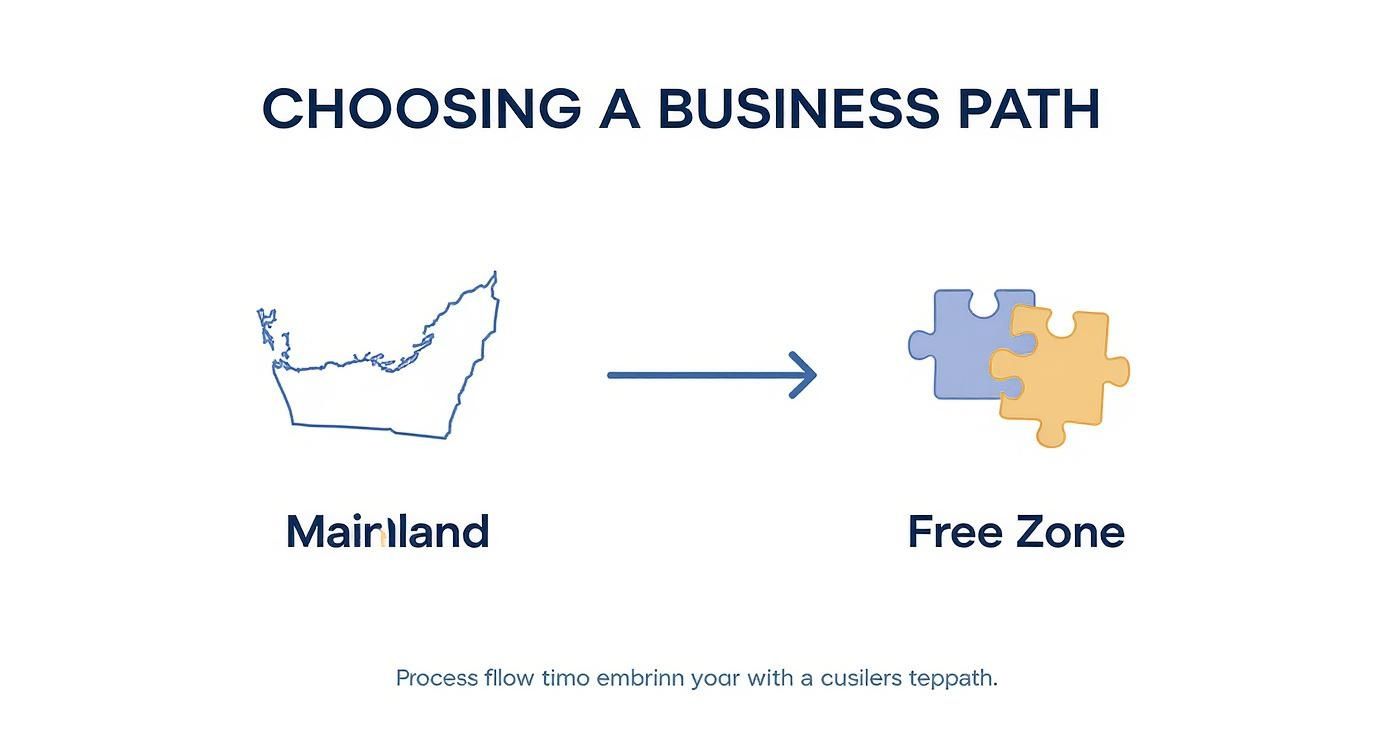
As you can see, that initial decision really does define your entire journey, from how you access the market to the specific approvals you'll need.
Securing Initial Approval and Legal Documents
With your trade name successfully reserved, the next big milestone is getting an Initial Approval Certificate (IAC). Think of this as the government’s green light—an official nod confirming they have no objection to your business being established. You can't move forward with anything else until this certificate is in your hands.
Next up, you’ll draft your company’s core legal documents. For most businesses, this means preparing a Memorandum of Association (MOA). In some mainland setups, you might need a Local Service Agent (LSA) agreement instead. The MOA is the blueprint of your company; it spells out your business activities, who owns what (the shareholding structure), and the duties of each partner. It absolutely must be drafted correctly and notarised to be legally valid.
Getting the MOA right is non-negotiable. An improperly drafted document can lead to messy disputes down the road. I always advise working with a legal expert to ensure it’s airtight and fully compliant from day one.
The UAE's tech sector is a massive engine for its startup scene, making it a hotspot for tech founders. In fact, industry revenues are projected to climb by $3.8 billion, with an expected compound annual growth rate of about 6.3% over the next four years. Major investments, like Microsoft’s partnership with AI firm G42, show just how supportive the environment is for high-tech businesses. You can learn more about the UAE's expanding tech market to see where your idea could fit.
Finalising Your Business Location
Every single business in the UAE, whether on the Mainland or in a Free Zone, needs a registered physical address. This isn't just for mail; it’s a non-negotiable legal requirement for your trade license. You’ll have to provide proof of this address with a valid tenancy contract, which is known as an Ejari in Dubai.
Here’s what’s involved in nailing this down:
- Lease Agreement: You must have a signed commercial lease for an office, warehouse, or retail space.
- Ejari Registration: In Dubai, this tenancy contract has to be registered with the Real Estate Regulatory Agency (RERA). This process generates your unique Ejari certificate.
- Flexi-Desk Options: For startups and service-based companies looking for a more budget-friendly option, many Free Zones offer "flexi-desk" or shared workspace solutions that fulfil the physical address requirement.
This tenancy contract is one of the last major pieces of the puzzle. Once you have it, you'll submit it along with your notarised MOA and other documents to the relevant authority—either the Department of Economic Development (DED) for mainland or a specific Free Zone authority. After a final review and payment of all the fees, you'll be issued your official trade license. And just like that, your UAE company is legally born.
Securing Your Visa and Corporate Bank Account
Getting that trade licence in your hands feels like crossing the finish line, and it's a huge milestone. But think of it less as the end of the race and more as the key to the front door. To actually open that door and start running your business, you need two more things: a residency visa and a corporate bank account.
Without them, your business is just a name on a piece of paper. This next phase is where everything gets real, turning your legal entity into a fully operational company. It’s about getting your own residency sorted, which you’ll need for practically everything, and then tackling the notoriously tricky process of opening a business bank account. A lot of entrepreneurs get tripped up here, but with a solid game plan, you'll get through it just fine.
The UAE Residency Visa Process
Your company's trade licence is the ticket that makes you eligible to apply for residency visas—for yourself, your family, and any staff you hire. This isn't a single step but a sequence of formalities that officially changes your status from a visitor to a legal resident of the UAE.
It all kicks off with an Entry Permit. This document allows you to enter the country specifically to complete your visa process. Once you’re in the UAE, you’ll head for a mandatory medical screening, which is pretty standard stuff: a blood test and a chest X-ray to check for certain communicable diseases.
After you get the all-clear from the medical test, your next stop is the Emirates ID biometrics appointment. This is where they take your photo and fingerprints for your national identity card. Don't underestimate the importance of this card; your Emirates ID is your go-to identification for renting an apartment, getting a mobile phone plan, and almost everything else in your day-to-day life.
Your Emirates ID is more than just a card; it’s your key to daily life in the UAE. The entire visa process, from entry permit to having the ID in hand, can take around 2-3 weeks, so it’s vital to factor this timeline into your setup plans.
Choosing the Right Visa for You
As a business owner, you've got a few visa options, each with different perks and requirements. The most common route is the Investor Visa, which is tied directly to your company ownership. It solidifies your status as a business investor in the country and is usually valid for two years.
But there are other long-term options if you meet the criteria:
- Golden Visa: This is the premium 10-year residency visa for investors, entrepreneurs, and highly skilled professionals who meet specific investment thresholds, whether in a business or real estate.
- Freelance Permit: A great, cost-effective option for solopreneurs and independent professionals. It gives you a trade licence and residency without the expense of a physical office.
Figuring out the best path for your specific situation is crucial. For a detailed breakdown of what's involved, looking into an investor visa package in the UAE can give you real clarity on the requirements and benefits. This decision doesn't just affect you; it also determines your ability to sponsor your family.
Opening Your Corporate Bank Account
Be prepared: this is often the biggest hurdle for new entrepreneurs in the UAE. Banks here have incredibly strict due diligence processes to combat money laundering and verify the legitimacy of new companies. Just showing up with a trade licence isn't enough to get an account approved.
Bankers want to see a real, credible business. They need to understand what you do, who your customers are, where your money is coming from, and why you need a bank account here. Every part of your application will be closely examined, so being well-prepared is non-negotiable.
You'll need a full set of documents, including your trade licence, Memorandum of Association (MOA), office tenancy contract (Ejari), and passports and visas for every shareholder. Most importantly, you need a detailed company profile that clearly explains your business model.
To give yourself the best shot at a quick approval, keep these tips in mind:
- Be Physically Present: Nearly all banks will require the business owner to be in the UAE to sign the final paperwork.
- Maintain a Minimum Balance: Be ready for minimum balance requirements. These can be anywhere from AED 25,000 to over AED 200,000, depending on the bank and the type of account.
- Show Substance: Banks favour businesses that look and feel real. Having a physical office and a resident owner makes you a much lower risk than a company with a virtual address and a non-resident owner.
The whole process of opening a bank account can take anywhere from two weeks to over a month. Patience and meticulous preparation are your best friends during this final, crucial step.
Breaking Down Your Startup Costs and Financials
A brilliant business idea is one thing, but a clear, realistic budget is what actually gets it off the ground. When you're figuring out how to start a business in the UAE, getting a firm grip on the financials isn't just important—it's everything. You need to move past vague estimates and map out both the initial setup fees and the recurring costs that will define your first year.
This kind of financial planning is what separates a smooth launch from a stressful one. It helps you avoid the classic cash flow problems that can sink even the most promising ventures before they have a chance to succeed. Think of your budget as a practical roadmap, not just a hopeful guess.
Mapping Out Your One-Time Setup Costs
Your initial investment is a mix of government fees and professional services needed to get your company legally on the books. These are the upfront costs you'll have to cover before you can even think about making your first dirham.
While the exact numbers will shift depending on your chosen jurisdiction and business activity, here’s what you should generally be budgeting for:
- Trade Name Reservation: A small but essential fee to secure your business name.
- Initial Approval: This is the fee for getting the government's first nod on your business concept.
- Trade Licence Issuance: This is the big one—the main government fee and the largest slice of your registration cost.
- Memorandum of Association (MOA) Notarisation: Fees for legally drafting and attesting your company’s foundational document.
- Establishment Card: A critical document that registers your company with the immigration authorities, paving the way for visas.
- PRO Services: The fee you pay a professional firm to handle all the paperwork, queues, and government legwork for you. It's an investment in saving time and avoiding headaches.
For a typical service-based company setting up in a Dubai free zone, a good ballpark figure for these one-time costs is anywhere from AED 15,000 to AED 25,000. This gets your company legally established and ready for what comes next.
Here’s a sample breakdown of what those costs might look like for a typical service-based company.
Estimated Startup Costs for a Dubai Free Zone Company
| Cost Item | Estimated Cost (AED) | Frequency |
|---|---|---|
| Trade Licence & Registration | 12,000 – 18,000 | Annual |
| Establishment Card | 2,000 | One-Time |
| PRO Services | 2,500 – 5,000 | One-Time |
| Flexi-Desk / Virtual Office | 3,000 – 7,000 | Annual |
| Investor Visa (per person) | 4,500 – 6,000 | Per 2 Years |
| Emirates ID & Medical | 1,500 | Per 2 Years |
| Total Estimated Initial Outlay | ~AED 25,500 – 39,500 | – |
Remember, these are estimates. Your actual costs could be higher or lower depending on the free zone, the number of visas you need, and any additional government approvals your specific business activity might require.
Understanding Recurring Annual Expenses
Once you're up and running, your focus shifts from one-time setup fees to the recurring costs you'll face every year. These are the expenses you need to plan for to keep your business compliant and fully operational.
Without a doubt, the most significant recurring cost is your annual trade licence renewal. This is the government fee that keeps your business licence active for another year. If you've opted for a flexi-desk or virtual office to satisfy the physical address requirement, that rental fee will also be due annually.
Think of your annual renewal fees as your business's subscription to operate legally in the UAE. Missing these payments can lead to hefty fines and even the freezing of your company’s activities, so it's absolutely critical to budget for them well in advance.
Ongoing Financial Compliance: VAT and Corporate Tax
Beyond setup and renewals, you’ve got to stay on top of the UAE's tax system. For most new businesses, the two main taxes to get familiar with are Value Added Tax (VAT) and the more recent Corporate Tax.
Value Added Tax (VAT) is a 5% tax applied to most goods and services. You are legally required to register for VAT once your company's taxable supplies and imports cross the AED 375,000 threshold within a 12-month period. Getting this right from the start is crucial, and you can get the full picture by checking out our guide on how to register for VAT in the UAE.
Corporate Tax is now a key part of the UAE's financial landscape. A 9% tax is applied to the net profits of businesses that exceed AED 375,000. The good news for many is that Free Zone companies might qualify for a 0% tax rate if they meet specific "qualifying income" criteria.
The UAE's dynamic startup scene continues to pull in serious investment, underscoring the country's economic muscle. In just one recent month, UAE startups secured an incredible $704.3 million across 26 deals, with proptech and AI proving to be especially hot sectors. This flood of capital shows just how much confidence investors have in the local market.
Having a solid grasp of these financial pillars—startup costs, annual renewals, and tax obligations—is fundamental. It's what transforms your business plan from a mere idea into a viable, financially sound enterprise that’s ready to thrive.
Your Top Questions About Starting a Business in the UAE, Answered
Even with the best roadmap, you’re bound to have questions. It’s only natural. Every entrepreneur’s journey is different, and getting clear answers to those specific sticking points can save you a world of time, money, and headaches. We hear a lot of the same queries from founders, so we’ve put together this straightforward guide to tackle them head-on.
Think of this as your go-to for those nagging "what if" scenarios. We'll cut through the noise and give you practical, no-fluff answers to help you sidestep common hurdles and move forward with confidence.
Can I Start a Business in the UAE Without Living There?
Yes, technically you can. It's entirely possible to own a UAE company—be it in a free zone or offshore—without being a resident yourself. You can register the business and simply appoint a general manager to handle things on the ground.
But here’s the real-world challenge: banking. Opening a corporate bank account without a residency visa and an Emirates ID is a massive hurdle. UAE banks have incredibly strict due diligence protocols, making them extremely hesitant to onboard companies owned by non-residents.
The Bottom Line: While you can legally own the company from abroad, its ability to actually operate and transact within the UAE banking system will be severely limited. You'll struggle without a resident shareholder or manager.
An offshore company is another route, but it serves a completely different purpose. It’s a vehicle for holding international assets or investments, and it doesn't grant you any rights to trade within the UAE market or obtain residency visas.
What Is the Cheapest Way to Start a Business in the UAE?
For freelancers, consultants, and solo service professionals, the most budget-friendly options are almost always a freelance permit or a basic licence package in one of the northern emirates' free zones. These are designed to get you off the ground without a huge upfront investment.
- Freelance Permits: Many free zones offer these permits, which are perfect for creatives, developers, and consultants. They give you a trade licence and one visa, allowing you to operate legally as an independent professional.
- Northern Emirates Free Zones: Look into zones like Ras Al Khaimah Economic Zone (RAKEZ), Sharjah Media City (SHAMS), or Ajman Free Zone (AFZA). They're well-known for their competitive pricing on no-frills business packages.
The big cost-saver here is the office space. These packages eliminate the need for an expensive physical office lease. Instead, they typically include "flexi-desk" access, which satisfies the legal requirement for a physical address at a tiny fraction of the cost.
How Long Does the Entire Business Setup Process Take?
Be realistic and budget for 4 to 8 weeks from start to finish. You’ll see ads promising a "three-day setup," but that almost always just refers to the initial issuance of your trade licence, which is only one piece of the puzzle.
Here's a timeline that reflects reality:
- Trade Licence Issuance: This part is quick. Once your documents are approved, it can take just a few working days.
- Visa Processing: This is the next major step and usually takes about 2-3 weeks. It involves getting your entry permit, going for a medical screening, and completing your Emirates ID biometrics.
- Corporate Bank Account Opening: This is often the longest and most unpredictable stage. Depending on the bank, your business profile, and their compliance checks, this can take anywhere from 2 weeks to over a month.
Patience is a virtue here. Each step is dependent on the one before it, so building a realistic timeline into your launch plan is absolutely essential.
Do I Need a Local Partner for a Business in Dubai?
For most businesses today, the answer is a firm no. The UAE has made massive reforms to attract foreign investment, and 100% foreign ownership is now the norm, not the exception.
Free Zone companies have always offered this benefit—it’s one of their main attractions. More importantly, for Mainland companies, the government now allows 100% foreign ownership for over 1,000 different commercial and industrial activities. This has been a complete game-changer for entrepreneurs who want direct access to the local UAE market.
There are, of course, a few exceptions. Certain strategic sectors or professional service licences (like a law firm or an auditing firm) might still require a Local Service Agent (LSA). It’s critical to verify the specific rules for your chosen business activity with the Department of Economic Development (DED).
Ready to turn your UAE business plan into reality? The expert team at Smart Classic Business Hub can guide you through every step, from choosing the right jurisdiction to securing your visa and bank account, ensuring a seamless and compliant setup. Start your journey with a trusted partner today by visiting https://smartclassic.ae.